


Related

PRISM Wealth-Building Process
With most early adopters already established as clients, robo-advice platforms compete on scale, pricing, planning depth and customization.
by Ken Schapiro | June 2026

Condor Capital Wealth Management publishes The Robo Report, a free quarterly newsletter covering the digital advice industry. The current edition tracks 34 live accounts across 24 robo-advice providers. Our mission at Condor Capital Wealth Management is to bring transparency to automated investment services so investors can see how the major players stack up.
The portfolios we track skew moderately aggressive, targeting roughly 60% equities and 40% fixed income. All portfolio performance commentary in this article is for the period ended March 31, 2026.
The 2026 update finds the robo-advice industry with over $1.2 trillion in assets and in a continued period of consolidation. With most early adopters already established as clients, surviving platforms compete on scale, pricing, planning depth and customization. Low-cost advice remains difficult to scale; profit increasingly sits with wealthier clients, while the smaller accounts that originally defined the robo-advice category are harder to serve. Another wave of exits over the past 12 months underscores the pressure.
The difficulty achieving profitability showed up in two ways over the past year. On the exit side, several firms discontinued their robo-advice platforms. UBS wound down Advice Advantage in June 2025; U.S. Bank shut down Automated Investor in October 2025; and, in December 2025, Charles Schwab announced the retirement of Schwab Intelligent Portfolios Premium [its hybrid tier offering access to a certified financial planner (CFP)] and Schwab Intelligent Income. (The stand-alone Schwab Intelligent Portfolios service remains in place.) These closures followed the 2024 sale of Marcus Invest to Betterment, JPMorgan Chase & Co.’s  (JPM) retirement of Automated Investing, Ellevest’s retail digital exit and BlackRock Inc.’s (BLK) closure of FutureAdvisor.
On the pricing side, Betterment raised its monthly subscription price on accounts under $24,000 from $4 to $5 on January 5, 2026. At the same time, the Premium tier’s 0.40% fee was waived on balances above $1 million, leaving only the 0.25% base advisory fee. Smaller accounts are being seen as too costly for their potential profit, while wealthier clients receive the kind of fee accommodation typical of traditional asset management.
Wealthfront Corp.’s (WLTH) December 2025 initial public offering (IPO) opened the books on one of the industry’s largest pure-play robo-advisers. For its most recent quarter ended January 31, 2026, it reported record revenue of $96.1 million (up 16% year over year), $94.1 billion in platform assets and 1.42 million funded clients. Cash management produced 73% of that revenue ($69.7 million), tying the business to short-term interest rates that the Federal Reserve has been cutting. The firm is shifting away from that dependence, with investment advisory revenue up 31% year over year against 12% for cash management. Whether advisory growth offsets slower cash revenue, and how public investors price the shift, will set the trajectory from here.
Tax management drove product changes in 2025. In December 2025, Fidelity Go added tax-loss harvesting for taxable accounts of $25,000 or more, a feature that Wealthfront and Betterment have offered for years. Betterment’s Goldman Sachs Tax-Smart Bonds portfolio and Wealthfront’s Automated Bond Ladder, both from 2024, remain the more differentiated aftertax fixed-income products we track.
The next leg of growth is less obvious. Wealthfront’s stock-level tax-loss harvesting already operates as direct indexing for accounts above $500,000, and the next step beyond that might be long/short tax-advantaged strategies, which are starting to reach retail through specialized firms. Adjacent financial services are the other open lane: Wealthfront Home Lending was launched in Colorado and Texas in late 2025, with California and jumbo adjustable-rate mortgages (ARMs) scheduled for 2026.
Artificial intelligence (AI) is still positioned as the next major area of competition, but client-facing rollouts remain limited. One year after Robinhood Strategies launched in March 2025, following its acquisition of AI planner Pluto, it is still the only major robo-adviser built around an AI recommendation engine. Betterment, Wealthfront, SoFi and Fidelity Go have not introduced comparable AI-led advice products. Fiduciary requirements, costs and concerns are likely slowing client-facing AI adoption in financial advice products.
Our top pick this year for best overall robo-adviser is Fidelity Go, replacing Vanguard Personal Advisor from last year. The base tier has no management fee and no account minimum. At $25,000, Fidelity Go adds access to live licensed advisers and charges a 0.35% fee. Planning capabilities include single- and multi-goal financial plans, “what-if” scenario modeling, and retirement spending projections that incorporate Social Security and pension income. Fidelity Go also introduced tax-loss harvesting, as mentioned above. The platform earns high marks for customer experience, with educational materials, a mobile app, chat support and account aggregation.
Portfolio construction has supported performance, with roughly 70% of the equity sleeve allocated to U.S. large caps. Over the five years ending March 31, 2026, Fidelity Go outperformed its normalized benchmark by 0.78 percentage points, the strongest benchmark-adjusted return in our tracked universe. Together, these factors establish Fidelity Go as the best overall robo-adviser this year.
SoFi Automated Investing is our top pick for new investors. Many first-time investors are paying down debt before building a portfolio, and SoFi addresses that directly through debt consolidation, career coaching, live planning sessions for SoFi Plus members and the SoFi Relay budgeting tool that aggregates outside accounts.
SoFi’s $50 minimum investment, 0.25% advisory fee and fractional-share trading offering make it one of the most accessible options on the market. Its strong long-term performance, driven by a heavy U.S. large-cap growth tilt and a municipal bond core, completes the picture.
Wealthfront and Empower share our best digital planner pick this year.
Wealthfront’s planning tool reflects its digital-first design. Goals span retirement, education, home buying (using Redfin data for property estimates) and travel. The planner also supports detailed inputs for Social Security, windfalls and real estate. Its Self-Driving Money feature ties cash management to long-term goals by automatically directing excess balances from linked bank accounts into the appropriate savings or investment targets.
Empower once again leads on breadth and depth. Its planning suite spans retirement, home purchase, education and general saving, with specialty modules such as a retirement fee analyzer that estimates how much of a portfolio’s return will be consumed by fund expense ratios. Users can model concurrent spending goals alongside debt paydown and view consolidated cash flow, net worth and aggregated positions from linked accounts in a single dashboard.
Vanguard Personal Advisor remains the top choice for complex planning, offering a blend of digital management and human guidance. With a minimum investment of $50,000, clients are paired with a licensed adviser for a 0.30% management fee. Investors with $500,000 or more receive a dedicated adviser at the same rate—a fraction of the 1% management fee typically charged by traditional full-service human advisers.
Table 1 and Figure 1 show returns for the major robo-advisers over the trailing one-year, three-year, five-year and eight-year periods ended March 31, 2026, as tracked by The Robo Report.
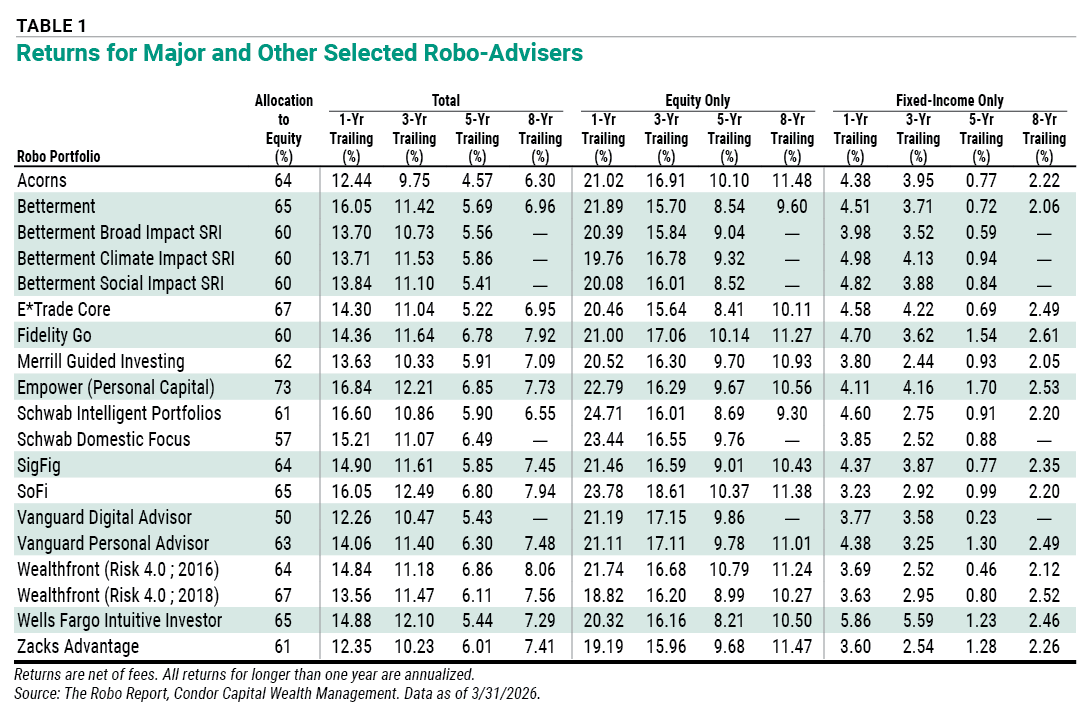
Over the three years ending March 31, 2026, SoFi, Fidelity Go and Vanguard Digital Advisor delivered the strongest benchmark-adjusted returns, largely due to their substantial allocations to U.S. equities. The S&P 500 index returned an annualized 18.27% over this period, outpacing the MSCI EAFE index’s 14.31% annualized return and the MSCI Emerging Markets index’s 15.36% annualized return. Notably, SoFi allocated 73% to domestic equities, Fidelity Go allocated 70% and Vanguard Digital Advisor allocated roughly 68%—all above the typical robo-adviser allocation of around 67%.
The interplay between growth and value continued to influence returns, with growth retaining a clear advantage. The Russell 3000 Growth index returned an annualized 20.61% over three years, compared to 14.21% for the Russell 3000 Value index. SoFi, with a 30% allocation to large-cap growth (above the peer average of 20%), benefited most directly from this tilt. Fidelity Go and Vanguard Digital Advisor also captured upside through their concentrated exposure to U.S. mega-cap leaders.
Municipal bonds were not the standout fixed-income performer over the three-year window on a pretax basis. The Bloomberg Municipal Bond index returned an annualized 2.87%, behind the Bloomberg US Corporate Bond index’s 4.70% annualized return and the Bloomberg US Aggregate Bond index’s 3.63% annualized return.
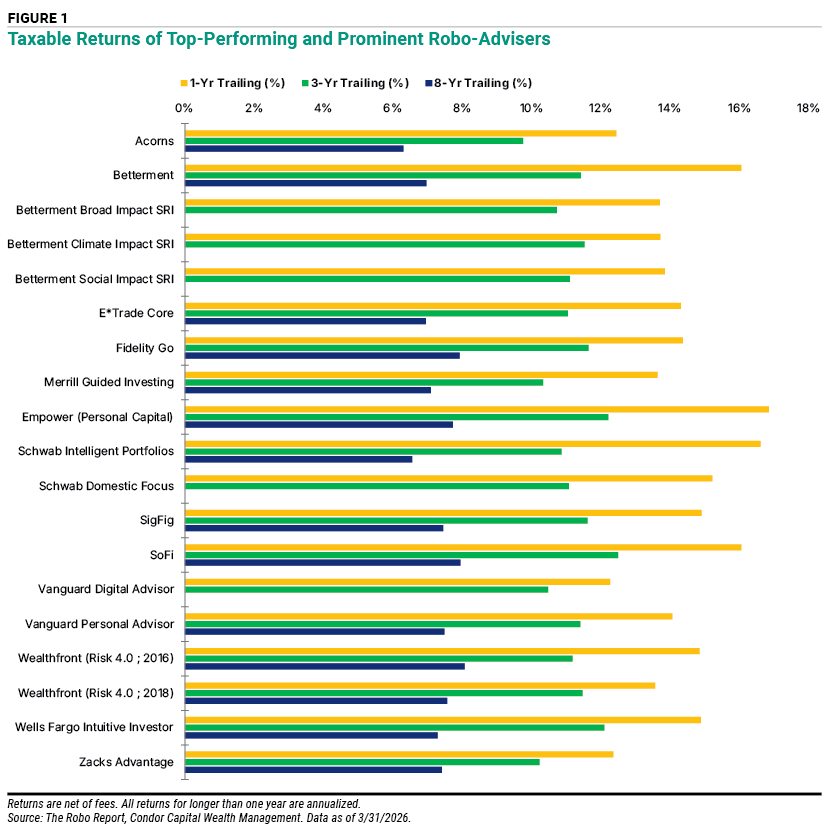
Over the past eight years, Fidelity Go, SoFi and Wealthfront were the standout performers. They concentrated on large-cap U.S. stocks and anchored their bond sleeves with municipal securities. This U.S.-centric approach proved highly advantageous, as the S&P 500 generated a 13.77% annualized return, well ahead of the MSCI EAFE’s 7.89% annualized return. Each leader maintained an above-average domestic weight: Fidelity Go held 70% in U.S. equities, SoFi held 73% and Wealthfront held roughly 72%.
The dominance of large-cap equities over small caps over the longer term remained a persistent theme, with the Russell 1000 index delivering a 13.50% annualized return over the most recent eight-year window. This was well above the small-cap Russell 2000 index’s 7.73% annualized return. Growth stocks also continued to outpace value, with the Russell 3000 Growth returning 15.79% against 9.82% for the Russell 3000 Value on an annualized basis. Interestingly, Wealthfront’s moderate value tilt still outperformed, thanks to its U.S. mega-cap holdings. Meanwhile, SoFi’s growth lean and Fidelity Go’s broad large-cap exposure reinforced that disciplined U.S. large-cap allocation was the key driver.
In fixed income, high-yield corporates led, with a 5.19% annualized return for the Bloomberg US Corporate High Yield. This was ahead of the Bloomberg US Corporate’s 2.76% annualized return and the Bloomberg Municipal Bond’s 2.34% annualized return. Even so, the muni-heavy allocations of the leading portfolios produced respectable returns: Fidelity Go’s fixed-income sleeve, dedicated to municipal bonds, returned 2.61% over the period.
PRISM Wealth-Building Process

Portfolio Strategies

Investor Professor

ROBERT A from NC posted 4 months ago:
BARRY J from TX posted 3 months ago:
YISHAI K from ISR posted 3 months ago:
BARRY J from TX posted 3 months ago:
You need to log in as a registered AAII user before commenting.
Log InCreate an account