

Related

Portfolio Strategies
Retiring early requires careful planning, but a simplified one-page approach can help you stay focused on what matters most.

Charles Rotblut leads a class in AAII's new Essential Investing Video Course. Go to https://www.aaii.com/ves for more information and to subscribe.
Voluntary early retirement brings the advantage of free time while a person or couple is often still energetic and in good health. Early retirement allows a person to end, or at least greatly reduce, work-related stress, pursue new opportunities and/or spend more time on activities of personal interest.
The downside of early retirement is that savings must last longer. Contributions to retirement savings may cease and withdrawals may start. There are also many other considerations, including health care costs and how you will keep yourself occupied given the very large increase in free time.
There is no specific age separating early retirement from traditional retirement. The average retirement age for workers in the U.S. varies between 62 and 65, depending on the study and survey. Even the Financial Independence, Retire Early (FIRE) movement does not have a specific age. The Social Security Administration (SSA) defines early retirement as any age before full Social Security retirement benefits can be claimed. The full retirement age (FRA) for adults born in or after 1960 is 67.
Regardless of the age at which you choose to retire early, having a plan—preferably set up in advance of leaving full-time work—will enable you to enjoy a more successful early retirement. In this article, I present a one-page PRISM Wealth-Building Plan designed to help a couple—Jason and Michelle—retire at age 50.
In broad terms, FIRE involves saving enough to retire from a full-time career early. It has traditionally been associated with frugal lifestyles and passive sources of income (e.g., home rentals).
The FIRE movement has broadened in scope from what is now referred to as Lean FIRE to include several variations.
There is also traditional early retirement. This involves leaving a full-time career early and is not always voluntarily.
While the PRISM Wealth-Building Plan presented here focuses on Barista FIRE, adjustments for other types of early retirement are included.
The first step, and the cornerstone, of the PRISM Wealth-Building Process is prioritizing goals. Jason and Michelle’s primary objective is retiring from full-time work by age 50 using Barista FIRE.
The couple expect to reach their savings target of $2 million in two years. (Both work in high-paying fields.) After discussing their intended lifestyle and creating a budget for it, the couple determine that they will need $90,000 per year to cover expenses.
Fidelity Investments suggests that those following the FIRE approach have the equivalent of 33 times first-year expenses in savings. This multiple equates to a 3% first-year withdrawal rate, which would be $60,000 of the couple’s planned savings. Jason and Michelle calculate that they can retire with $2 million saved provided they earn at least $30,000 per year from part-time or gig work.
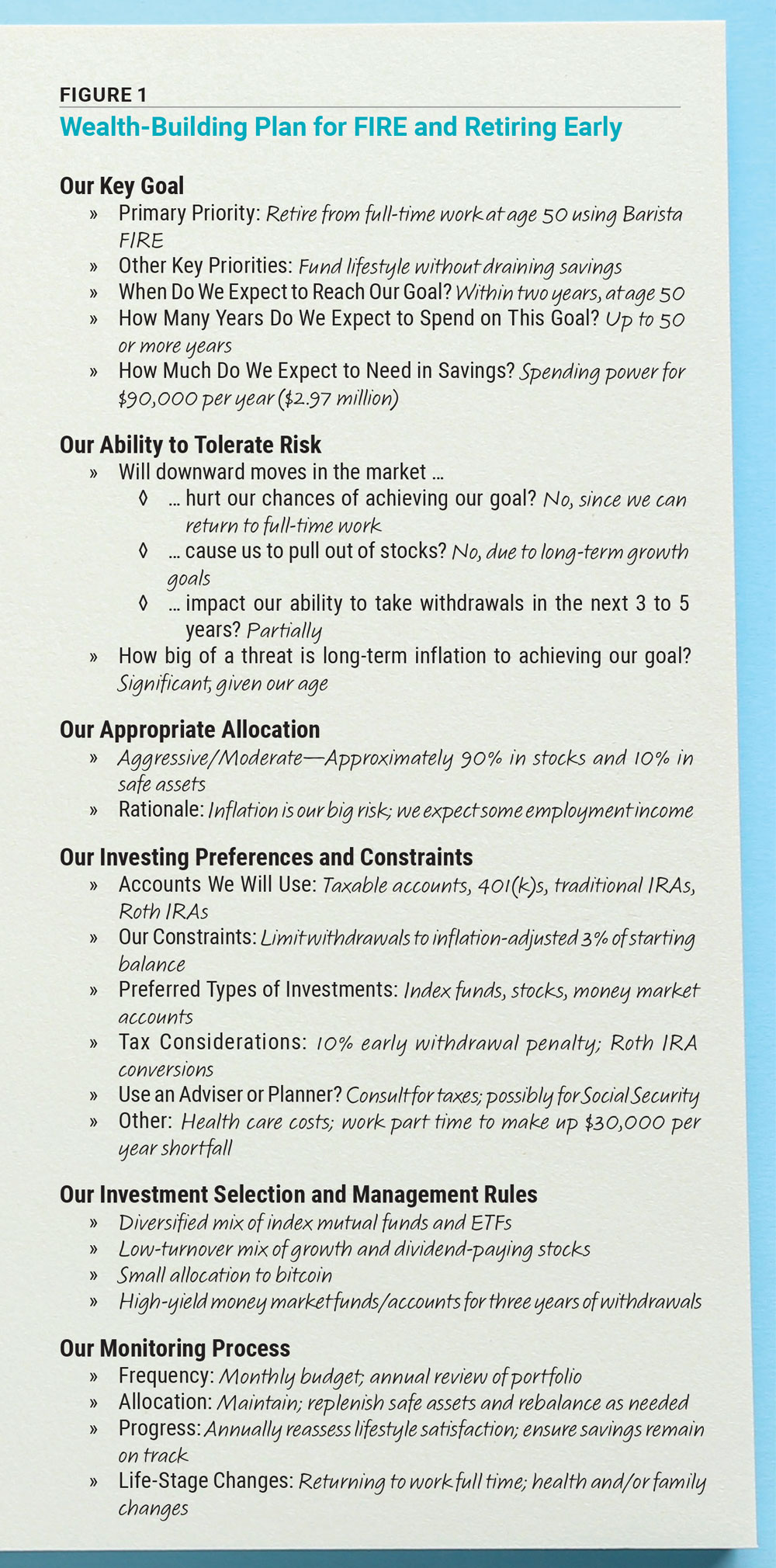
The couple include a note on their PRISM plan about the income shortfall they expect to have and how they intend to make up for it.
The longer the retirement period is, the lower the starting withdrawal rate should be. Jason and Michelle realize the possibility of living for another 50 years and take this into account when deciding on a withdrawal rate.
Others pursuing Barista FIRE (or those who entered into retirement earlier than expected) may find the income from a safe portfolio withdrawal rate to be insufficient to cover their expenses. They should include a note in their goals about how much they will need to earn to cover any shortfalls, and they should continue saving for retirement. Those opting for Coast FIRE should determine a savings total at which they may have to restart contributions should their portfolios perform worse than expected.
An envisioned lifestyle can also be included in the goals section, if desired. Anyone contemplating early retirement should take the time in advance to consider what they will do with their free time. Not only will this help you assess how much money will be needed, but it will also help you determine skills or resources needed to fulfill such activities.
Voluntary early retirement can come with an important backstop: the ability to return to full-time work if needed. Jason and Michelle acknowledge this in determining their ability to tolerate downward moves in the financial market.
Keeping the option to return to full-time work requires maintaining professional contacts and keeping their skills reasonably up to date—especially if their part-time jobs are in a different field. These nonfinancial assets can prove to be invaluable should they need to resume the careers they intend to leave.
Jason and Michelle further make note of sequence of returns risk (aka sequence risk) when considering the impact of an ill-timed drop in the financial market on their ability to take portfolio withdrawals over the next three to five years. The couple would rather return to full-time employment than put their portfolio under too much stress early in retirement given their long time horizons.
Maintaining at least two years of expenses in cash can help those following Barista FIRE offset sequence risk.
Jason and Michelle have long been disciplined investors who were not fazed by past bear markets. Those who have found themselves unnerved by past bear markets may want to consider delaying the start of their early retirement, opt for a lower withdrawal rate and/or consider having a larger source of non-portfolio income (employment or otherwise) once retired.
Asset allocation in the PRISM Wealth-Building Process is based on both goals and the ability to tolerate risk.
Jason and Michelle will have an investment time horizon spanning several decades once they enter early retirement. Shorter-term portfolio withdrawals will need to be funded, but the initial amount will be small compared to the size of their portfolio. They’ve never panicked during past bear markets. Plus, even though they intend to follow Barista FIRE, they are open to the possibility of returning to full-time work if needed, as previously noted.
This combination calls for an aggressive allocation approach. The couple need their portfolio to grow faster than the rate of inflation. Jason and Michelle will allocate 90% of their portfolio to a diversified set of stocks and stock funds. The remaining 10% will be invested in safe assets.
Following other types of FIRE strategies or involuntarily entering into early retirement does not necessarily change this allocation. As long as larger withdrawals are not needed from the portfolio and there is a psychological tolerance to withstand downside volatility, an aggressive allocation can be maintained. Having another non-portfolio source of income (including pension income) also supports an aggressive portfolio allocation.
Longevity risk is the biggest financial threat facing any retiree, regardless of when retirement occurs. Longevity risk is the chance of outliving your savings.
Lower withdrawal rates are necessary for those who retire early. Dollars saved must last for a longer period relative to those retiring at full retirement age. Unless wealth is substantial enough that a spendthrift lifestyle would be required to drain it, prudence must be used when taking withdrawals and making spending decisions.
As noted above, a metric suggested for FIRE and other types of early retirement is withdrawing 3% of savings each year. This equates to having savings totaling 33 times planned first-year expenditures. To account for the increased longevity risk of retiring early, this is lower than the 4% to 5% withdrawal rates suggested for those who retire later.
Jason and Michelle opt for this 3% withdrawal rate with the realization that it is easier to take larger withdrawals in the future if their wealth enables it than it is to be forced to cut spending.
The couple note that both health care costs and working part time are constraints to being fully retired. Health insurance is a consideration for anyone who retires prior to being eligible for Medicare. Jason and Michelle take this into account when seeking part-time jobs.
Withdrawals from retirement accounts made prior to the account earner turning age 59½ are generally penalized by the Internal Revenue Service (IRS). Withdrawals from traditional retirement accounts—such as 401(k) plans and individual retirement accounts (IRAs)—are subject to an additional 10% tax on top of the marginal tax rate. Withdrawals of earnings from Roth accounts (e.g., Roth IRAs) are also hit by the 10% surcharge for those under age 59½.
The treatment of the basis, meaning aftertax dollars contributed directly to or converted into a Roth IRA, is more complicated. The basis can be withdrawn at any time tax-free. Dollars converted from a traditional IRA, 401(k) or other kind of retirement account to a Roth account and withdrawn within a five-year period by a person below age 59½ are assessed the 10% penalty. According to Ed Slott and Co. LLC, “the five-year period applies separately to each Roth conversion made in a separate year.”
The 10% penalty is waived for hardships and other special situations. See IRS Topic 557 for more information.
An alternative is a 72(t) distribution schedule, which is also known as a series of substantially equal periodic payments (called SEPP or SoSEPP). This provides a stream of distributions that are not subject to the 10% penalty. Once distributions start, no other distributions can be taken from the account and no additional contributions can be made. The SEPP also cannot be modified until after payments have been made for five years and the account owner is at least 59½ years old unless specific exceptions are met.
Roth IRA conversions become more attractive in early retirement. Income is lower than in working years and neither Medicare premiums nor the taxation of Social Security benefits are considerations. Care must still be taken not to be bumped into higher federal, and potentially state, income brackets. Plus, the five-year restriction of withdrawing Roth IRA conversions must be considered, especially before age 59½.
Given these complexities, Jason and Michelle write down their intent to meet with a tax professional to review their options. The couple also choose to limit their 401(k) contributions to the minimums required to receive the employer match prior to retiring early. Doing so will allow them to increase their taxable savings as they approach early retirement.
Those who opt to follow Coast FIRE should also consider contributing the minimum necessary to get the full employer match while working since it will provide them with added wealth in the retirement plan.
Withdrawals from retirement accounts are generally not allowed until the account owner turns age 59½. A 10% tax penalty will be levied on most early withdrawals.
These accounts include 401(k) and 403(b) plan accounts as well as traditional individual retirement accounts (IRAs), Simplified Employee Pension (SEP) IRAs and Savings Incentive Match Plan for Employees (SIMPLE) IRAs. Early withdrawals from such accounts are taxable as ordinary income and are subject to the 10% penalty.
Withdrawals from governmental 457(b) plans are penalty-free, except for any amounts that were directly transferred or rolled over from a 401(k), 403(b) or similar type of account into the 457(b) account.
Direct contributions to a Roth IRA can be withdrawn without penalty. Earnings are taxable at marginal tax rates and subject to the 10% penalty if the account owner is under age 59½.
Roth IRA conversions are subject to slightly different rules. If the account owner is under 59½ and conversion occurred less than five years ago, all dollar amounts that were taxable at the time of the conversion are subject to the 10% penalty. This penalty stops being assessed at age 59½, even if the five-year rule has not been met.
Roth 401(k) plans and similar accounts follow different rules. Early withdrawals are allocated to both the basis and earnings. The earnings portion of the withdrawal is taxed as ordinary income and is subject to the 10% penalty.
The tax code includes several exemptions to the 10% penalty on early withdrawals. One is the 72(t) distribution schedule, also known as a series of substantially equal periodic payments (called SEPP or SoSEPP). The 72(t) payments must continue for at least five years AND until age 59½ to fulfill the SEPP rules.
There are several other exemptions, including the first-time purchase of a home, disability, excess medical expenses and federally declared disasters. The full list is in Internal Revenue Service (IRS) Topic No. 558.
Jason and Michelle hold mutual funds in their 401(k) accounts. They intend to continue doing so for as long as they maintain those accounts. [The couple will need to determine their employers’ rules for participating in the 401(k) plans after entering early retirement.] Both Jason and Michelle prefer low-cost index funds.
The couple hold low-cost exchange-traded funds (ETFs) in their IRAs and Roth IRAs. These ETFs track well-known indexes.
Additionally, Jason and Michelle own a mix of growth and dividend stocks. They view themselves as buy-and-hold investors. The growth stocks provide them with more potential for price appreciation, while the dividend-paying stocks are more stable companies with greater levels of fundamental strength. Their long-term approach enables them to take advantage of reduced tax rates on capital gains and dividends.
There is no reason for the couple to change their investing strategy once in early retirement. Any change to their strategy would be simply for personal preference.
Jason and Michelle maintain a small allocation to bitcoin. They view this as a speculative investment and have limited their exposure to avoid derailing their goals, given the cryptocurrency’s high level of volatility. This is also a personal decision.
The couple’s three-year cash allocation in high-yield money market accounts serves multiple purposes. It provides immediate liquidity for withdrawal needs, reduces the necessity of selling investments during market downturns and offers psychological comfort during volatile periods. The couple intend to replenish the cash account when the stock market is trading at or near record highs and take withdrawals during down years.
A key to Barista FIRE and other early retirement approaches is monitoring spending. Jason and Michelle will start by practicing living off their planned budget while working full time. This will help them determine if the budget is feasible from both a financial and personal satisfaction standpoint.
This is an important step. One reason people can fail at FIRE, including Lean FIRE, is because they have unrealistic expectations about their ability to stick to a certain budget. Barista FIRE and Coast FIRE allow for greater flexibility by accounting for a higher level of spending and incorporating an employment element to offset any shortfalls.
Jason and Michelle further agree to annually reassess their lifestyle satisfaction. Though the idea of retiring early may seem enticing, it is not for everyone. Some find that they are happier working full time. Incorporating flexibility into the plan at the onset gives the couple more room to pivot as necessary.
Portfolio reviews will be conducted annually. Jason and Michelle will assess if their withdrawals are in line with expectations and if any rebalancing is needed. The couple will also replenish their safe assets as needed.
Finally, the couple note that their plan should be updated if there is a change in their life stage. This can include returning to full-time work, a deterioration in health or a change in their family. The PRISM Wealth-Building Plan is designed to be updated over time. As goals, tolerances for risk and life stages change, so should one’s PRISM plan.
Early retirement can be successful if it is planned for. Whether pursuing Barista FIRE, Coast FIRE or Lean FIRE, the key lies in having a structure set up in advance. Ideally, you will have both a wealth-building plan and a plan for how you will occupy your time. (If you enter into early retirement involuntarily, update or establish your PRISM Wealth-Building Plan as soon as is reasonably possible.)
Those contemplating early retirement should take note of the potential tax issues facing Jason and Michelle. Though withdrawals can be taken before age 59½, the rules are complex. Be sure you understand them.
There is no single version of early retirement that works for every person. PRISM provides a framework for creating a wealth-building plan. It is designed to be customized to each person’s and each couple’s goals and needs. The one-page plan provided here offers a potential template for following Barista FIRE.
Portfolio Strategies

Portfolio Strategies

Financial Planning

BARRY J from TX posted about 1 year ago:
MICHAEL B from WI posted about 1 year ago:
You need to log in as a registered AAII user before commenting.
Log InCreate an account