


Charles Rotblut leads a class in AAII's new Essential Investing Video Course. Go to https://www.aaii.com/ves for more information and to subscribe.
The prospect of retiring early is appealing to some. It frees up time and allows people to pursue their desired lifestyle while still being young enough to enjoy it. The financial independence/retire early (FIRE) movement is, in part, based on this concept. Others may find themselves facing the prospect of an earlier-than-planned retirement due to a change in their job status.
In this article, we focus on five major considerations for early retirees and those contemplating it: staying occupied, health insurance, Social Security, the rules for taking withdrawals from retirement accounts and sustainable withdrawal rates for long periods of retirement.

The article assumes retirement was not started early for health reasons, such as a disability. There is no specific age, though much of the article discusses topics relevant to those who are in their late 50s or younger (including the FIRE community). Readers who are in their early 60s and are considering when to start retirement may find topics covered here to be useful as well.
What Are You Going to Do With Your Time?
Though it may sound like a simple question, it is one of the most important questions to answer. Stopping work frees up a lot of time. The younger the age you retire at, the more time you will have to fill. While the concept of leaving a stressful career or a job you are unhappy with may have appeal, there is the very real challenge of what to do next.
 The data on early retirement and health is mixed. Some studies have linked early retirement to reductions in longevity (“Early Retirement, Early Death?,” June 2012 AAII Journal). A 2018 study of Dutch workers found a difference in longevity of just three months for men. The data was inconclusive for women (“Delaying Retirement Has a Small Impact on Men’s Longevity,” December 2018 AAII Journal).
FIRE expert Doug Nordman told us in an email that “too many people see FIRE as an escape from an unhappy career. They’re running away from work instead of running toward new goals, and they haven’t figured out their new lifestyle. This is especially problematic for those who identified closely with their careers, or who were abruptly laid off, or who had to leave due to stress/health issues.” He added, “You have to be responsible for your own entertainment.”
One of the factors playing a role in a successful retirement is what people do after retiring. Staying socially, physically and cognitively active has been shown to have positive medical and emotional benefits. Budgetary factors also come into play as desired activities may turn out to be too costly given sustainable withdrawal rates.

If retirement is voluntary, consider transitioning into it rather than jumping in with both feet. Try out hobbies or other activities you think might be enjoyable. If your plans include moving to another city or state, trying vacationing there first to begin building a social network and ensure you like the area. Companies like Airbnb can allow you to stay in an actual residence instead of a hotel.
Alternatively, you can seek out evening or weekend work in a field you would like to transition to. It may be a position in a different industry, a hobby or some type of charitable work. Doing so will help you gauge your actual interest before leaving your current career.
If retirement is involuntary (e.g., you were laid off), address your monetary situation first. Determine what your budget is and how much income you need to earn. If you don’t need to begin looking for new employment immediately, the advice doesn’t change much. Take the time to explore your options before making a decision that is difficult and/or costly to reverse. It is better to take small steps to ensure you are happy with the path chosen than to make an abrupt change that you may later regret.
Maintaining Health Insurance
One of the big challenges for early retirees is health insurance. Not having adequate coverage can lead to substantial medical bills should something happen.
Assuming no qualifying disability, the earliest a person will be eligible for Medicare is when they reach age 65. It is prudent to have a well-thought-out plan for which option you want before applying. (See “Health Insurance in Retirement: Medicare and Beyond” by Steve Vernon in the April 2019 AAII Journal for a comparison of the options.) Early retirees should set up a reminder to review Medicare options once they turn 64 and a second reminder to sign up for at least Medicare Part A three months before turning 65.
Since what most people consider early retirement is before age 65, health insurance options should be thought through before starting retirement if possible.
If a spouse is still working, coverage may be available through their plan. Alternatively, coverage could be obtained through part-time employment or through a full-time but less stressful (e.g., hobby-like) job.
 Employer coverage through the Consolidated Omnibus Budget Reconciliation Act (COBRA) can be maintained for up to 18 months. COBRA coverage can be maintained for 36 months for a person’s spouse and dependents after the date that the primary insured (the employee leaving the company with coverage) becomes entitled to Medicare. Check with human resources to find out the specifics and the costs.
If COBRA is not an option or the cost is too high, shop for an insurance plan. The Affordable Health Care Act (ACA) exchanges are a good place to start. Subsidized pricing on these plans may be available. An alternative is to work with a health insurance agent to see what options are available on the open market.
 Nordman has observed that shopping for plans on ACA exchanges comes with its own challenges: “An issue with the ACA exchanges is that the networks and coverages (and fees) are constantly changing, so every open season is a new research project. The uncertainty puts a lot of stress on the decision about when to give up employer coverage. There’s no easy answer, especially for families with chronic health issues.”
Another potential risk is health care reform. Current proposals range from repealing/replacing the ACA to some type of Medicare for All plan. It is uncertain how health care coverage will evolve during the next decade, which adds to the complexity.
Health care savings accounts (HSAs) can be used to cover medical bills tax-free. Since HSAs are funded with pretax dollars and withdrawals are not taxed when used for qualified medical expenses, they also have tax advantages.
Being Eligible for and Claiming Social Security Benefits
The minimum age for being eligible to claim Social Security retirement benefits is 62. The age to receive full benefits gradually increases from 66 for those born in 1954 or earlier to 67 for those who were born on January 1, 1960, or later. Table 1 shows the cumulative lifetime benefits received based on the age you start taking Social Security.
In addition, those intending to claim retirement benefits will have had to work and pay Social Security taxes long enough to earn at least 40 credits (equivalent to 10 years of work). A longer period of qualifying employment increases your benefit since it is based on average index monthly earnings (AIME). AIME is a worker’s average monthly earnings for the 35 years of highest earnings, where earnings for years before age 60 are indexed to reflect increases in U.S. workers’ average wage level. Years with no credits earned are treated as zero income years.
Getting larger Social Security benefits is an incentive to seek some type of employment after early retirement is taken. Even if a lower-salaried position is taken, the earnings will contribute to future benefits and could potentially offset years when wages were even lower.
While there can be a temptation to claim benefits right at age 62, the decision should be thought out. Claiming before full retirement age leads to a reduction in benefits for the remainder of a retiree’s life. It also reduces their spouse’s lifetime benefits if spousal benefits are claimed and/or the survivor’s benefit will be claimed. When considering when to claim, it can be helpful to think of Social Security as an inflation-adjusted annuity. It is guaranteed income whose lifetime value increases the longer that claiming benefits is delayed (up to age 70), especially if either the primary beneficiary or their spouse lives at least into their 80s.
 Social Security benefits taken before full retirement age can also be reduced or eliminated depending on how much is earned relative to the earnings test. For 2019, benefits are reduced for earnings above $17,640 and eliminated for earnings above $46,920. Once full retirement age is reached, benefits are adjusted to account for months when benefits were withheld. (See “Social Security Basics” by William Reichenstein and William Meyer in the October 2013 AAII Journal for more information about Social Security and claiming strategies.)
The Rules for Taking Early Withdrawals From Retirement Accounts
In general, withdrawals taken from an individual retirement account (IRA), a Roth IRA, a 401(k) plan, a Roth 401(k) or similar type of account are allowed without penalty after age 59½. Taking a withdrawal before reaching age 59½ may trigger an additional 10% tax.
There are several exemptions to the 10% penalty.
Rolling over your accounts, say from a 401(k) to a traditional IRA, or doing a conversion, say from a traditional IRA to a Roth IRA, does not trigger the 10% surcharge. If you choose to take a check instead of doing a direct rollover or a trustee-to-trustee transfer (e.g., broker-to-broker), you have 60 days to complete the transaction, otherwise you will be subject to the 10% surcharge. You are only allowed one rollover per year from an IRA to another (or the same) IRA.
Total and permanent disability, an IRS levy and unreimbursed medical expenses exceeding 10% of adjusted gross income (AGI) are exceptions applying to both IRAs and qualified workplace retirement plans such as 401(k)s. Distributions from qualified workplace plans can also be exempt from the 10% penalty if used as part of a qualified domestic relations order, if they are dividends passed through from an employee stock ownership plan (ESOP) or if you leave your job during the year or after the year you reach 55 (50 for certain state employees). Funds held in an IRA, or similar type of account, can be withdrawn—penalty-free—to pay for higher qualified education expenses and to purchase a first-time home (up to $10,000). Table 2 is from the IRS and shows the exemptions to the IRS rules.
Substantially equal period payments are also exempt from the surcharge. These payments can be either required minimum distributions (RMDs) based on the IRS’ life expectancy tables, a fixed amortization method based on life expectancy and an interest rate of no more than 120% of the federal midterm rate, or a fixed annuitization determined by an annuity factor (based on a mortality table) and an interest rate of not more than 120% of the federal midterm rate. For both the second and third method, the dollar amount withdrawn does not change in subsequent years after it is first calculated.
There are two caveats with equal payments to be aware of. If you are taking these withdrawals from a qualified workplace retirement plan, you must first leave your job. The payments cannot be modified (except for death or disability) within five years of the first payment or, if later, age 59½. We encourage those of you who are interested in learning more to read “Retirement Plans FAQs regarding Substantially Equal Periodic Payments,” which can be found in the IRS’ website.
Roth IRA and Roth 401(k) distributions are subject to the five-year rule. The IRS defines qualified distributions from these types of accounts, in part, as being “made after the five-year period beginning with the first taxable year for which a contribution was made to a Roth IRA.” Contributed amounts can be withdrawn before five years, but any earnings (capital gains, dividends, bond interest, etc.) can be taxable and subject to the 10% early withdrawal levy. The clock for the five-year rule starts on January 1 of the calendar year in which a contribution was made to a Roth IRA.
 For amounts converted from a traditional IRA or rolled over from a qualified retirement plan [e.g., a 401(k)] to a Roth IRA, the 10% penalty generally applies to distributions made within five years. The penalty applies to the distributions of the amounts converted or rolled over. A separate five-year period applies to each conversion and rollover.
The five-year rule also applies to rollovers made from a Roth 401(k) or a Roth IRA. Withdrawals of earnings are taxable if the Roth IRA has been open for less than five years, regardless of how long the Roth 401(k) had been open. If the Roth 401(k) is not rolled over, then the five-year rule starts on January 1 of the year in which the first contribution was made to the employer-sponsored account. The Roth IRA starting date only applies to the Roth 401(k) assets after those assets have been rolled over into a Roth IRA. [Since Roth 401(k) accounts are subject to required minimum withdrawals but not Roth IRAs, there is an advantage to doing the rollover if the five-year rule is not an issue.]
Inherited IRAs, if not converted into your own IRA (which can only be done if the deceased is a spouse), have different withdrawal rules. We covered them in the July 2017 AAII Journal article “Inherited IRA Rules for Spouses, Heirs and Trusts.”
IRS Publication 590-B explains the rules regarding distributions from retirement accounts, including early withdrawals. Given the complexity of the rules for early withdrawals, it can be helpful to meet with a tax professional who is versed in the rules to avoid unintentionally triggering the 10% penalty.
Sustainable Inflation-Adjusted Withdrawal Rates
Most studies on withdrawal rates assume a normal retirement. Those who are looking toward an extended period of retirement face an increased level of longevity risk, meaning the risk of outliving their savings.
A simple, off-the-cuff solution would be to withdraw less in retirement. The problem with such advice is that it doesn’t give any guidance into what withdrawal rates have worked historically for longer-than-average retirement periods. To find out, we added to the analysis we conducted last year and discussed in the November 2018 AAII Journal (“Revisiting the Risks of Retirement Spending Rules.”) Specifically, the additional analysis looked at various historical inflation-adjusted withdrawal rates for retirement periods ranging from 35 years to 60 years.
Under the approach used, portfolios are constructed for various asset allocations based on historical year-to-year rates of return for the asset classes. Then, various withdrawal rates are applied to these historical portfolios for various payout periods to determine if they are sustainable. For example, an inflation-adjusted 4% withdrawal rate is applied to a portfolio for 40 years, first for the time period covering the beginning of 1927 to the end of 1966, then for the next time period covering 1928 to 1967 and so on. The success rate is the percentage of all past payout periods in which savings were not exhausted despite the annual withdrawals taken, based on the sequence of actual historical returns over the period.
As was the case in last November’s article, we used a success rate table originally published in the February 1998 AAII Journal (“Retirement Savings: Choosing a Withdrawal Rate That Is Sustainable,” by Philip L. Cooley, Carl M. Hubbard and Daniel T. Walz) as our basis. The authors calculated how frequently portfolios constructed of various allocation weightings of stocks and bonds lasted over varying periods of time when inflation-adjusted withdrawals were taken. A specific percentage withdrawal rate was used to calculate how much of the portfolio’s value was to be distributed to the retiree during the first year. In the following years, the dollar amount of the withdrawal was increased by the rate of inflation. The original table covered all historical periods from 1926 to 1995.
Table 3 is an updated and revised version. It covers the period of 1927 through 2018. Like the table published in November 2018, we use intermediate-term government bonds, which are less sensitive to interest rate fluctuations than long-term bonds, as the original version did. Large-cap U.S. stocks as represented by the S&P 500 index continue to be used for the stock allocation to provide consistency with the shorter withdrawal periods. Similarly, 60% stocks/40% bonds and 40% stocks/60% bonds allocations are included, which the original 1998 version lacked. These allocations provide more granularity, and the 60% stocks/40% bonds allocation is a commonly accepted allocation strategy. We omitted the 11% and 12% withdrawal rates in the table published here because they are simply too high and are guaranteed to cause an early retiree to run out of money.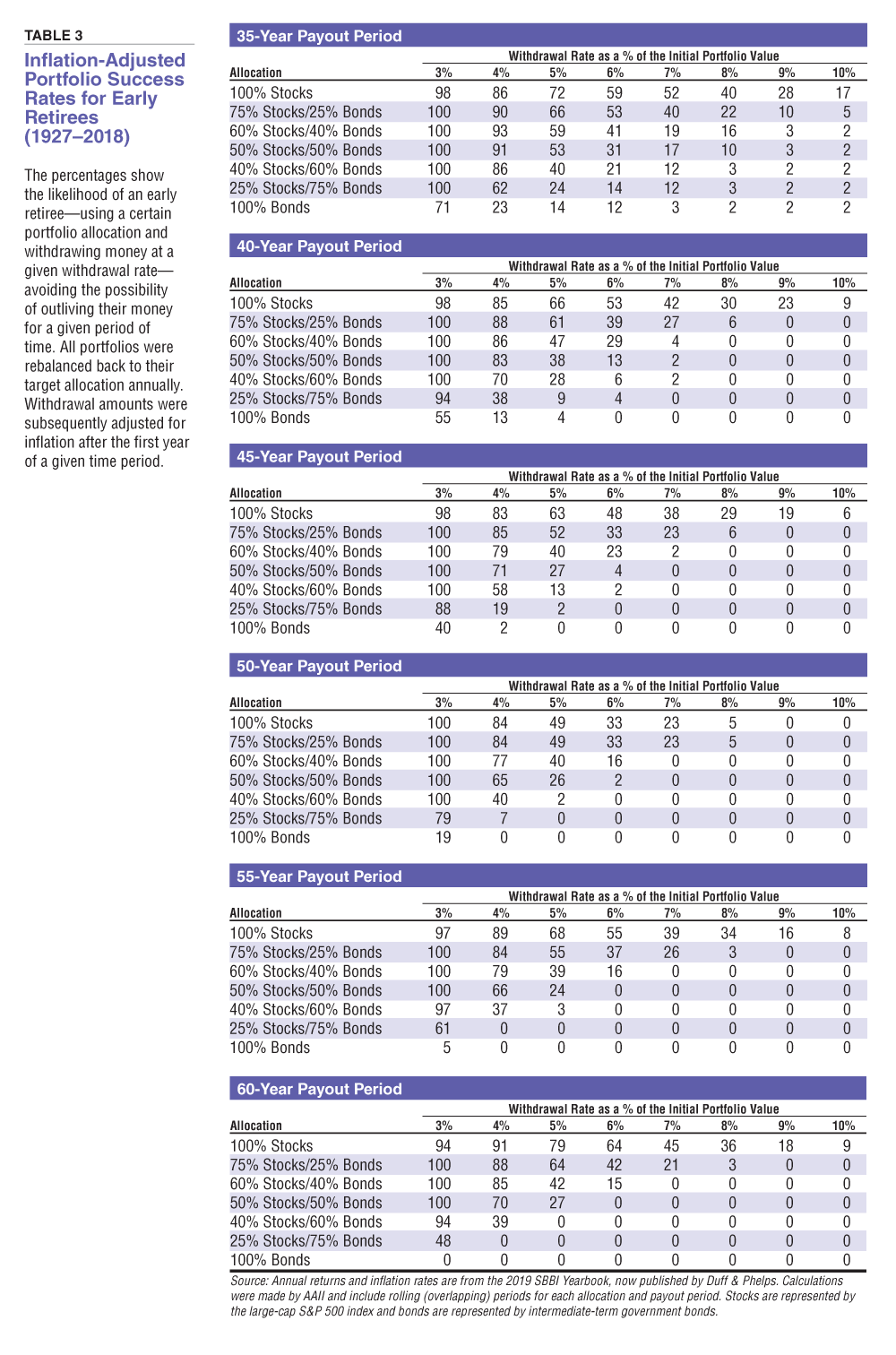
The biggest change is the length of the withdrawal periods analyzed. The original version covered withdrawal periods spanning from 15 years to 30 years in length. The 2018 version added 35-year withdrawal periods. The table in this article starts with a 35-year time period and goes out to 60 years. A retirement period of 60 years would be applicable to someone who retired at age 50 and expects to live past 100 or someone who retires in their 40s (e.g., a person in the FIRE community) and assumes they will live to 100 or longer. Those intending to bequeath assets could also use a longer-than-anticipated retirement period to increase the odds of ensuring that wealth will be left for their heirs.
All of the tables use historical annual returns and inflation rates in the sequence in which they occurred. A challenge to this type of analysis is the inverse relationship between the assumed length of retirement and the number of periods to analyze. For a 35-year retirement, we were able to use 58 rolling periods. For a 60-year retirement, we were only able to look at 33 rolling periods. Put another way, there were fewer actual outcomes to consider when looking at lengthier withdrawal periods. This implies that a greater margin of error should be built into planning for those who are considering or are in the midst of a lengthy retirement.
At any point on the table, you can see the odds of a portfolio with a given percentage withdrawal rate not running out of money. As an example, consider an early retiree splitting their allocation between 60% in stocks and 40% in bonds. This retiree believes they will need their savings to last 35 years. The first set of numbers in Table 3 indicates that if they withdrew 4% initially (e.g., $40,000 from a $1 million portfolio) and increased the initial withdrawal amount ($40,000) by the rate of inflation for each subsequent year (years two through 35), their portfolio would have supported them for the full payout period for 93% of the rolling 35-year periods between 1927 and 2018. Some of the successful payout periods would have left a retiree with a sizeable amount of wealth remaining after the 35 years of withdrawals. However, if you had withdrawn at that rate during one of the unsuccessful 35-year time periods, you would have prematurely exhausted your assets. There were four such periods, including 1965–1999 when large-cap stocks fell by 10% in the second year of retirement, by 9% in the fifth year and then by 15% and 26% in years nine and 10. A more conservative 3% withdrawal rate using the same allocation worked during every single period.
The 3% withdrawal rate has historically worked better for early retirees. For allocation mixes of 75% stocks/25% bonds, 60% stocks/40% bonds and 50% stocks/50% bonds, it never failed during any of the time periods tested. An all large-cap stock allocation had a few failures, but the odds of success never fell below 94%. A 40% bond/60% stock allocation also had high levels of success, with the failure rates similar to those of an all-stock portfolio.
 For those concerned about the current low yields, annual bond returns only exceeded 3% twice between 1936 and 1956 and were factored into the analysis. The median return for intermediate-term bonds over this 21-year period was 2%.
Those wanting or needing a higher withdrawal rate should not go over 4%, according to our data. Even then, a high allocation to stocks is required to grow the portfolio. A full bond or mostly bond portfolio would lead to failure for a person who is unable to live solely off of the interest paid from the bonds. Withdrawal rates of 5% or higher have either a high or complete rate of failure for lengthy retirement periods. The big takeaway from the tables should be to maintain a significant allocation to stocks and withdraw conservatively.
None of these calculations assume the impact of taxes. An early retiree withdrawing from a taxable account would have to be cognizant of their returns being reduced by the impacts of capital gain, dividend and ordinary income taxes regardless of the allocation used.
This is also the case for people retiring at more traditional ages; there is the risk of misjudging your payout period, presumably based on your life expectancy. If you assume a payout period that is too short, you run the risk of prematurely using up all of your resources. Offsetting this risk is the possibility of working in retirement, which would allow you to withdraw less than planned, particularly in your earlier years of retirement. Data from Vanguard suggests that the more flexibility you have in reducing the size of the withdrawals, the greater the odds will be of not outliving your savings. (See “Vanguard’s Dynamic Spending Strategy for Retirees” in the January 2017 AAII Journal for more information.)
 Err on the side of projecting a longer-than-expected life expectancy. Life expectancy tables include both those who will die earlier and later for many ages. While there is an upper limit to how long humans can live, it is possible that a retiree could live longer than they think. Plus, not only could medical expenses rise late in life, but living expenses could rise as well should assistance with daily activities (e.g., dressing, toileting, etc.) and/or memory care be required. Former AAII Journal editor Maria Crawford Scott suggested adding on 10 years or so, based on current health and family history, to provide a margin of safety (“Retirement Spending Rules: What Can Go Wrong?,” July 1998). Those who are married must consider the life expectancy of their spouse as well.
Planning Is Critical to Successfully Retiring Early
Regardless of whether retiring early is planned or involuntary, taking the time to create a comprehensive plan is critical. Think about how you will spend your time, where you will live, how you will afford your lifestyle, where you will get health insurance from and when you will begin claiming Social Security. In doing so, allow for a healthy margin of error. Portfolio returns may be less than expected, unplanned expenses can occur and you may find your desired lifestyle choices are not feasible (or even what you want).
If possible, ease into early retirement by practicing what it will be like before making the decision to move forward with it. Also, consider building up a cash balance of up to four years to protect your finances against a bear market occurring during your early years of retirement. Most importantly, allow for the flexibility to adjust should early retirement not be what you expected it to be.

Related

Portfolio Strategies
Vanguard's Dynamic Spending Strategy for Retirees
Related

Financial Planning
Delaying Retirement, But Not Your Retirement Dreams
Discussion
FREE REPORT

Get your free copy of our special
report analyzing the tech stocks
most likely to outperform the
market.
Ken Ness from WA posted over 7 years ago:
James from Tennessee posted over 7 years ago:
Mary Alice from CO posted over 7 years ago:
HLVernon from VA posted over 7 years ago:
Grafton from NC posted over 7 years ago:
Gilbert from TN posted over 7 years ago:
DR & MRS ROBERT S from MO posted over 5 years ago:
You need to log in as a registered AAII user before commenting.
Log InCreate an account