


Wade Pfau is a widely followed retirement researcher and a professor and program director at The American College of Financial Services in King of Prussia, Pennsylvania. He is also principal and director for McLean Asset Management and RISA LLC. In this first of a two-part interview, we discuss both retirement portfolio withdrawal rates and allocation strategies for retirees.
—Charles Rotblut, CFA
There is much debate about whether the traditional rule of taking 4% of a retirement portfolio’s starting value and adjusting it annually for inflation still makes sense. What are your thoughts?
There’s a lot of assumptions that go into calculations for the 4% rule, and some of them are not very realistic. One in particular is the notion that you never adjust your spending in response to market performance, which actually creates more sequence risk. But if you’re trying to stay as close as possible to the core assumptions, I think a 4% withdrawal rate is too high at the present, primarily because of the low-interest-rate environment.
The 4% rule is based on U.S. historical data, and we’ve never had interest rates this low. Four percent is supposed to be a safe withdrawal rate. I don’t think in this kind of interest rate environment it can be considered a safe withdrawal rate if you’re otherwise trying to maintain all of the rule’s basic assumptions: a 30-year retirement, no investment fees, no taxes and a fairly aggressive asset allocation of 50% to 75% stocks. It’s just going to be under more strain than the U.S. historical data would suggest.
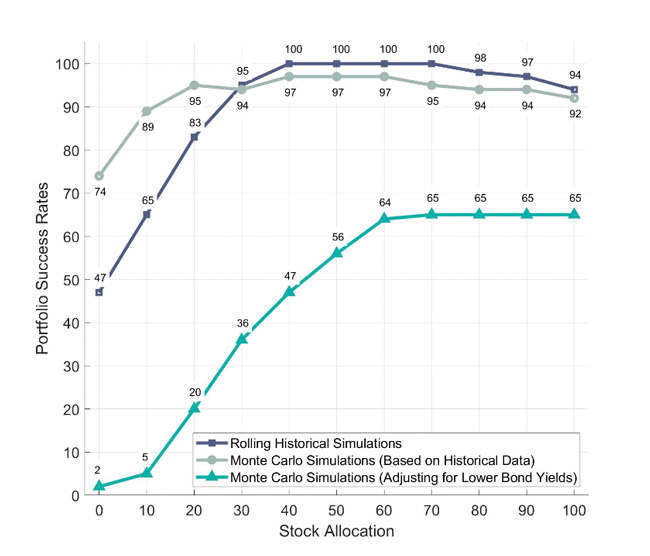
[See Figure 1 for portfolio success rates using the 4% rule.]
Figure 1. Portfolio Success Rates for the 4% Rule
This chart shows the likelihood of a retiree not outliving their portfolio over a 30-year period when following the William Bengen 4% withdrawal rule and using a portfolio allocation of 50% stocks and 50% bonds. The historical simulations use average returns for rolling periods. The Monte Carlo simulations randomize the sequence of returns. The adjusted returns scenario assumes a real (inflation-adjusted) return of –1% for intermediate-term bonds.
Source: “Retirement Planning Guidebook,” by Wade Pfau (Retirement Researcher Media, 2021).
Is there a safe number now that you would give out?
There was a Morningstar study that was recently updated. I was a co-author on the previous iteration, and I think we had a number in the ballpark of 2.8%. The updated study came out with a 3.3% withdrawal rate. Anything in the area around 3% is more realistic in this interest rate environment.
In my analysis of worst-case scenarios, it seemed that a retiree was most likely to outlive their savings when a sequence of bad returns occurred early in retirement. Have you noticed something similar or different?
The worst-case scenario is some sort of prolonged downturn in the early retirement years. If inflation is high, that does seem to require lower withdrawal rates as well.
The worst case in the U.S. historical data was retiring in the 1960s when there were big downturns in the stock market, like in 1966. In 1973 and 1974 the S&P 500 index fell by 47%. Combined with the inflation rate at that time, it set up a scenario where these early market downturns disrupted retirement.
In the data that William Bengen (the creator of the 4% rule) used, 1966 was the retirement year that led to the worst-case scenario. The year 1982 was a big turning point. After 1982, the markets did great and accounted for almost half of a 30-year retirement for the 1966 retiree. If you’d retired in 1982, you could have used almost a 10% withdrawal rate.
It was the best-case scenario in history, but it was too late for those earlier retirees to benefit from what happened in the second half of their retirement. It was really what happened in those early retirement years that led to these worst-case scenario outcomes. The early retirement years matter much more than the later retirement years in determining retirement sustainability.
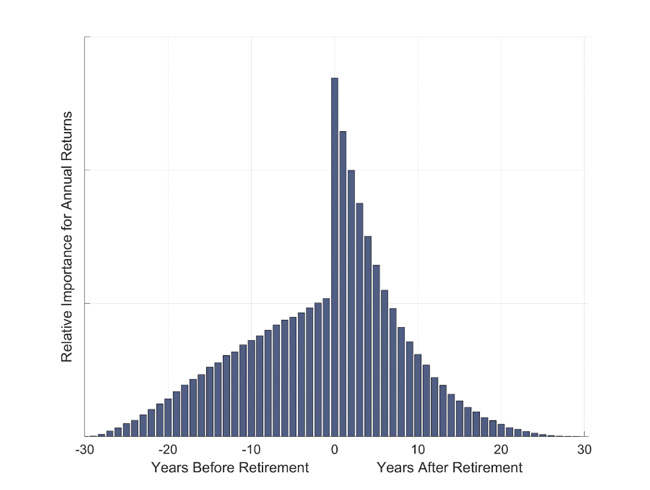
[See Figure 2 for an illustration of sequence of returns risk.]
Figure 2. Lifetime Sequence of Return Risk
Returns in the early part of an investor’s career have very little impact on the absolute level of wealth accumulated at the end of the savings period. As retirement nears and a large amount of wealth has been accumulated, a given percentage return (be it positive or negative) has an increasing impact. Investors are most at risk around the date of retirement as they have a large amount of wealth saved, leading to proportionately large changes in wealth for a given return.
Source: “Retirement Planning Guidebook,” by Wade Pfau (Retirement Researcher Media, 2021).
Is there a benchmark retirees can use to determine when their portfolio is on safe ground if they reach it?
The thing about the 4% rule method is that the initial withdrawal rate only applies in the first year of retirement. Afterward, you’re always just adjusting your spending with inflation, but you’re not worried about what the current withdrawal rate is.
You could simply divide current spending by your remaining portfolio balance to get a new withdrawal rate. If things are going well in retirement and you’re spending conservatively, your actual current withdrawal rate could decline throughout retirement.
If your portfolio balance ever falls below where it started just in nominal terms, without even making inflation adjustments, that’s kind of a signal that you may be getting into trouble. So, you might want to start cutting back on spending and prepare for the possibility that you are in one of those scenarios where you may deplete your investment portfolio, or at least have an uncomfortable time later in retirement.
Some investors prefer using time-oriented buckets. Could you share some of the weaknesses and advantages of doing a bucket strategy versus a traditional allocation?
With bucketing, the advantages are going to be behavioral. And in some recent research I’ve done with Alex Murguia, we talk about retirement income styles and identify bucketing or time segmentation as one of four viable retirement income styles for people who do want some sort of contractual protection, but also want a lot of optionality. They use bonds to cover upcoming expenses, and then that creates a window for not having to sell their stock market investments during a market downturn.
Retirees can just continue to spend down their fixed-income buckets. If that helps them to stay the course with their strategy, then that’s a sort of behavioral advantage toward having a better retirement outcome.
Now, in terms of disadvantages, this is a strategy where it’s often discussed at a basic level but without details about when you should refill your buckets. So, if you have, just for example, five years’ worth of projected expenses in bonds and everything else in stocks, you need some sort of rule. As I spend my bonds, when am I going to sell stocks to replenish my bonds so that I still have five years of bonds to cover my upcoming expenses?
If you have a rule in place to automatically refill the bucket every year, that can increase sequence of returns risk, because you’re having to effectively take a full year of spending out of a smaller stock portfolio to replenish the bond portfolio. It can cause you to run out of money sooner than if you just use a basic total-return strategy for retirement. The only way bucketing can actually help get a better outcome is the logic of not selling stocks during a downturn.
The way bucketing is sold as an idea is to let my bond ladder get smaller and smaller until at some point it could even be gone. But if a stock market downturn occurs once my bond ladder is depleted, I’ve already shifted toward 100% stocks.
A bucket strategy requires people to have a dynamic asset allocation. It requires investors to effectively increase their stock allocation during the market downturn. It’s not that they’re buying more stocks, it’s just that they’re spending bonds and not touching their stocks. This pushes them more toward a higher stock allocation. So, if they’re comfortable doing that, then it’s good. If they’re not comfortable doing that, if they use some other strategy for refilling their short-term buckets, it could actually be worse in absolute terms than just using a basic total-return investing strategy.
Interesting. You wrote about bond ladders in your book, “Retirement Planning Guidebook.” Can investors use bond funds if they don’t want to ladder individual bonds? How important is it to have bonds maturing on certain dates as opposed to just having a source of cash flow available in the shorter-term bucket?
There are debates about this. I think it’s much easier to explain bucket strategies with a bond ladder tied to when you’re planning to spend the money. You could do it as bond funds, but I think it’s harder than is commonly appreciated. The idea is if you have a constant duration—bond funds with a duration that matches your expenses—then it shouldn’t matter.
But when you’re spending from the portfolio, the math to have the right duration on your remaining bonds is incredibly complicated. There are a few commercial providers who’ve created solutions for that, where they use bond funds in lieu of having a bond ladder. But for a household trying to do that on their own, good luck. You really need to be an advanced engineer to handle getting the right duration on your bonds so that you’re not exposed to that interest rate risk.
If you just hold the individual bonds to maturity, you’ve got the right duration for your expenses, because as the bond matures, it covers your spending. You could have paper losses if interest rates go up, but if you hold your bonds to maturity, you know what you’re getting.
If you’re trying to replicate this with bond funds, yes, it’s mathematically possible but it’s just a lot more complicated to do in practice.
You also found that the total-return strategies had a better outcome than bond ladders, particularly if you’re increasing your allocation to equities once you’re retired. Is that correct?
When I looked at comparing the time-segmentation strategies to total-return strategies, I usually just look at a simple kind of 60% stock/40% bond allocation for the total returns, where you have a fixed asset allocation throughout retirement. But using time segmentation actually leads to a rising equity glide path in many cases. So, a kind of U-shaped lifetime stock allocation.
The reason time segmentation can work is because it can give you a rising equity glide path during troubled market environments. You’ve got to be comfortable with that. If you’re not, then it’s not necessarily going to work for you.
If you automatically refill your bond bucket every year, you can have a declining equity glide path in retirement because as the portfolio gets into trouble, your stock piece is getting smaller, but you keep selling from it to replenish your bonds until at some point you don’t have stocks anymore. This could leave you in a scenario where you may run out of money.
You get to the end where your stocks are gone, and now all you have left is a five-year bond bucket. If you spend that down over the following five years, you’ll be out of money. That’s where it doesn’t work as well.
Where bucketing does work is if you use a rising equity glide path. When Michael Kitces and I first wrote about the rising equity glide path (“Reduce Stock Exposure in Retirement, or Gradually Increase It?,” April 2014 AAII Journal), we were thinking in terms of a total-return strategy, but it shows up as well in a version of time segmentation that works. It’s a rising equity glide path.
That leads to my next question about glide paths. Could you explain to our members what a glide path is and why a U-shaped path makes sense?
With a target-date fund, you have a higher stock allocation when you are young. As you get to retirement, you have a lower stock allocation. Target-date fund allocations vary quite a bit, but they usually have between 20% and 40% in stocks at the retirement target date. That’s countered by all of the financial planning style research that Bengen did showing that retirees should hold 75% stocks and in no circumstances hold less than 50% stocks.
A recurring theme calls for higher stock allocations, but that’s different from what target-date funds call for. So, we’ve got this disconnect. The 4% rule style research says to hold a high stock allocation throughout retirement. Target-date funds, in contrast, are saying no, have a lower stock allocation at retirement. Then post-retirement, if it’s a “to” target-date fund, it just keeps you at that same low stock allocation afterward. If it’s a “through” target-date fund, it might continue to decrease your stock allocation as you go throughout retirement.
What we said was that you can go ahead and follow the target-date fund approach, where you have a lower stock allocation at retirement. But then what you do is you increase your stock allocation again as you go throughout retirement. It’s a risk-management technique because it helps manage the worst-case scenario, which is having a market downturn in the early retirement years.
So, a rising equity glide path—having a lower stock allocation at retirement and then increasing that later—is going to work best for you when a bad market environment occurs early in retirement followed by a better market environment later on. Now, if you had a bad market environment for your entire retirement, nothing’s going to work. But a more probable worst-case scenario is getting a downturn early on, and then markets recover. And that’s where the strategy is designed to give you risk management to help you get through the sequence of returns risk.
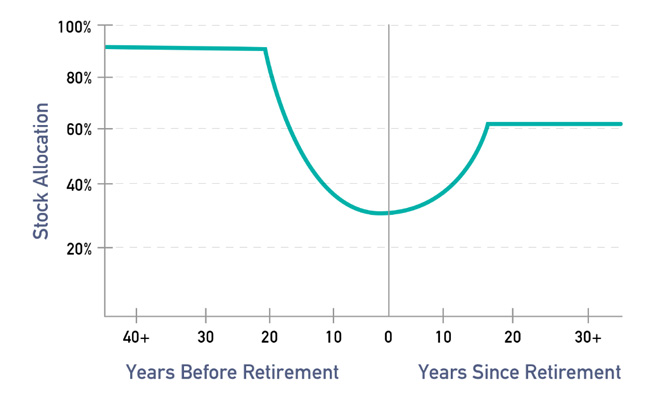
[See Figure 3 for an illustration of the U-shaped glide path.]
Figure 3. U-Shaped Glide Path for Portfolio Allocation
When an investor is young, most of their portfolio is allocated to stocks. Then as the investor begins to near retirement, exposure to stocks is reduced to protect the portfolio against a bad sequence of returns. Once in retirement, the investor then increases their allocation to stocks to support spending.
Source: “Retirement Planning Guidebook,” by Wade Pfau (Retirement Researcher Media, 2021).
How early before retirement should people start decreasing their equities?
We never tried to optimize that side because we were looking more at post-retirement, but I don’t necessarily have any issues with how target-date funds approach that, gradually over time. As you get to be maybe within 10 years of retirement, that’s when you’re starting to get exposed more to market returns. There is sequence of returns risk prior to retirement as well for savers because those pre-retirement returns are impacting their lifetime of savings. So, that’s where you can start to take some of that risk off the table.
I haven’t taken that analysis much further other than to just start taking some of that risk off the table say five, 10 or 15 years before retirement.
Okay. What do we say to someone who reduced their equity exposure heading into retirement and is nervous about then raising their allocation? Perhaps a bear market just ended. Any suggestions you’d give?
If you’re used to a lower stock allocation, and there was some market volatility, it can be hard to increase your stock allocation later. I suppose a time-segmentation strategy like bucketing could be a behavioral way to implement that, because you may not even realize you’re implementing it. You may not realize bucketing gives you a rising equity glide path.
If you’re coming at it from the total-return perspective, like the case study we looked at in the original article, you’re at 30% stocks at the start of retirement and then you work your way back up to 60% stocks.
Beyond that, just look at the historical data and see that whenever these market volatility periods happen, things do recover. So, just feel comfortable with that. It’s not going to resonate with everyone. There are annuities. You don’t have to have a total-return investment strategy for retirement or a bucketing variation on it.
One of our AAII asset allocation models uses a diversified version of the traditional 60% stock/40% bond allocation. For investors who are concerned about rising interest rates, any suggestions on what to do on the bond side of the allocation?
Everyone reading this understands the idea that if interest rates go up, you can have losses on your bond funds. And the longer the maturity or duration on your bonds, the bigger the potential losses you experience.
If you are worried about a rising interest rate environment, that speaks more toward having lower-duration bonds as part of your strategy. Such bonds are not going to get as big of hit with the rising interest rates. The only problem, of course, is that lower-duration bonds are not yielding much at all. So, you’ve got that drag on potential returns while you’re waiting for interest rates to rise.
Investors are in a tough spot going into retirement or being retired in a low-interest-rate world. Even more so in a low-interest-rate world where the expectation is that interest rates will rise in the future. If these bonds are meant to be the source of funds for funding their expenses and they have to sell bonds after an interest rate increase, then they will lock in capital losses. In this scenario, the bonds aren’t really helping them. They’re doing the same thing stocks do, which is creating the risk of having to sell them at a loss.
That’s what creates the sequence of returns risk for retirement. So, just keeping the same sort of high bond allocation with a longer duration and so forth can create risks if you’re worried about rising interest rates.
Previous articles by Wade Pfau and Michael Kitces on Retirement Withdrawals:
Increasing Retirement Withdrawal Rates Through Asset Allocation
Reduce Stock Exposure in Retirement, or Gradually Increase It?
A New Perspective on Withdrawal and Allocation Strategies for Retirees Video
We think you’d like this related webinar! Individual Investor Show: What to Do After the Retirement Party Ends

Related

Portfolio Strategies
How to Score a Retirement Home Run
Related

Portfolio Strategies
Insights on Using the 4% Withdrawal Rule From Its Creator
Discussion
FREE REPORT

Get your free copy of our special
report analyzing the tech stocks
most likely to outperform the
market.
ROBERT A from NC posted over 4 years ago:
HAROLD S from ME posted over 4 years ago:
STEVE O from FL posted over 4 years ago:
JOSEPH B from GA posted over 4 years ago:
ROBERT A from NC posted over 4 years ago:
JEAN H from IL posted over 4 years ago:
JEAN H from IL posted over 4 years ago:
ROBERT A from NC posted over 4 years ago:
JOHN W from NC posted over 4 years ago:
RICHARD S from AZ posted over 4 years ago:
WARREN S from CA posted over 4 years ago:
MATTHEW C from CO posted over 4 years ago:
J M from NJ posted over 4 years ago:
DENNIS T from IL posted over 4 years ago:
JIM L from MI posted over 4 years ago:
BARRY J from TX posted over 3 years ago:
VICTOR S from NC posted 11 months ago:
You need to log in as a registered AAII user before commenting.
Log InCreate an account