


- Two growth strategies that combine quantitative metrics and qualitative factors to identify sustainable companies
- BetterInvesting’s GARP approach balances growth and valuation, targets doubling potential, and emphasizes margins, return on equity (ROE), debt and historical price-earnings (P/E) ranges.
- AAII’s strategy uses the Growth Grade and G-Score as well as rules-based portfolio management to ensure disciplined long-term growth investing
AAII and BetterInvesting held a webinar on May 26, 2026, that explored two growth investing approaches that look past “glamour” stocks to find sustainable growth opportunities. AAII’s John Bajkowski moderated the discussion between BetterInvesting’s Dan Boyle and AAII’s Cynthia McLaughin. This excerpt gives a taste of their guidance. For the full recording, please see the box at the end of this article.
John Bajkowski: What criteria do growth investors typically look for when selecting stocks?
Cynthia McLaughlin (CM): AAII members use both quantitative and qualitative criteria to select stocks attached to businesses with attractive characteristics that are lacked by their rivals. Quantitative criteria include measurable factors such as growth rates, sales or earnings. Qualitative criteria include customer loyalty, a valuable brand or a competitive moat. Growth stocks tend to hold promising positions in emerging industries or niches, and they feature long runways for expansion.
Successful growth strategies go beyond high price-earnings (P/E) and price-to-book-value (P/B) ratios. Stocks that are moving up but only have those characteristics are called glamour growth stocks.
Dan Boyle (DB): According to the BetterInvesting methodology, a growth company is one with diligent management, strong and consistent historical results, and consistent earnings growth over a five-to-10-year period. Past sales and earnings guide future projections, so history is very important. But, as a growth investor, it’s still important to make money in a reasonable, risk-adjusted way. So, I invest in stocks that I feel can at least double in value over a five-year period.
The BetterInvesting philosophy is a variant of growth at a reasonable price (GARP) investing, which balances the growth and valuation aspects of stock picking. You really want to try to buy stocks at the right price. BetterInvesting’s Stock Selection Guide (SSG) helps investors get a sense of the growth they’re paying for and how it relates to the stock’s trading history.
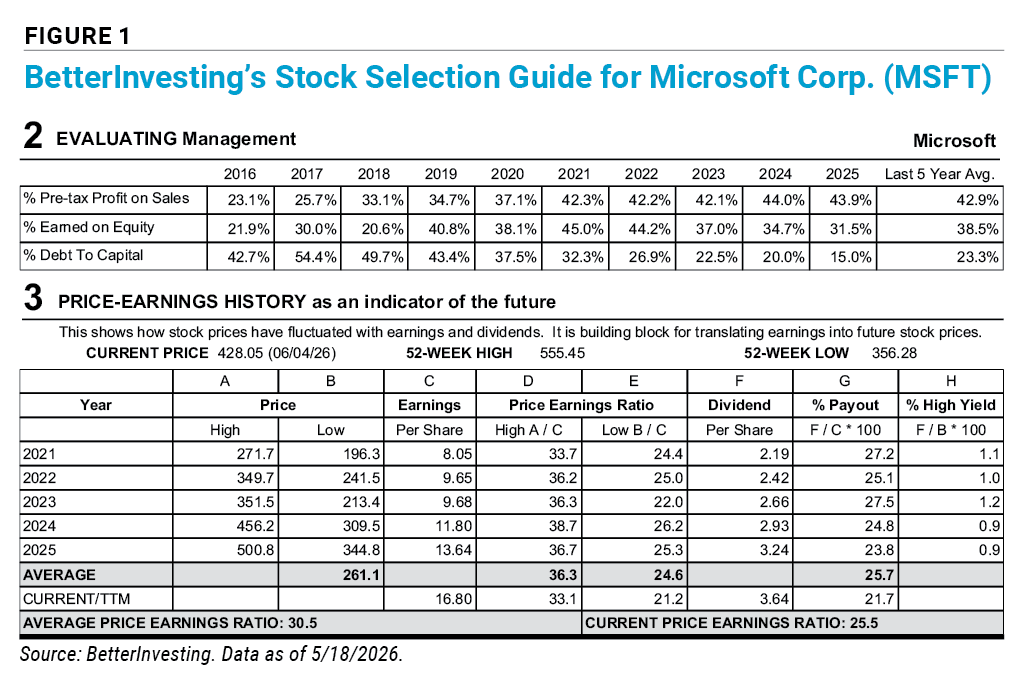
BetterInvesting’s methodology looks for stable or expanding pretax profit margins, a consistently high return on equity (ROE) and manageable debt levels. Increasing pretax profits are a good way to determine whether management is investing properly or just defending its existing position from competitors. Strong growth companies have other avenues to expand into.
The methodology also uses the historical range of the price-earnings ratio combined with estimated earnings growth to provide an expected high and low price-earnings ratio.
Microsoft Corp.  (MSFT) is a strong example of a BetterInvesting stock. [Figure 1 shows two sections of the SSG for Microsoft.]
How does the BetterInvesting approach handle the aura associated with some glamour stocks?
DB: By examining valuation in a historical context independent of market or story, the BetterInvesting approach does not treat price momentum as validation. It requires stocks to have a 3-to-1 upside-downside ratio—that is, potential appreciation that is roughly triple the potential downside—encouraging investors to ask, “Is this stock’s price adequate for the risk I’m taking?” Traditional glamour and momentum stocks don’t really meet that criterion.
It’s not that we ignore momentum; we like to see it, especially if a stock is going up. It is particularly useful for helping investors decide when they want to take some portfolio management actions. That said, it’s not at the core of how we invest at Provident Investment Management.
How does the AAII Growth Investing approach separate companies with sustainable growth from those that are strictly glamour stocks in the eyes of the media?
CM: The AAII Growth Investing strategy uses two metrics. First, the A+ Growth Grade prioritizes companies with strong and sustainable growth rather than just chasing the highest growth rate. It also rewards companies with consistent positive cash flow from operations and steady year-over-year sales growth. It looks at stocks’ five-year sales growth and the consistency of their annual sales growth.
The other metric is Partha Mohanram’s G-Score, an eight-factor model for evaluating growth companies using their financial statements. The score analyzes the quality of stocks’ growth relative to the industry median, looking for stability, profitability and conservative accounting practices. Spending on research and development (R&D) and advertising may temporarily impact companies’ earnings, but it is worthwhile and competitive in the long run.
A good A+ Momentum Grade is preferable when analyzing candidates for the model portfolio, but momentum is not a requirement of the strategy. The approach also does not focus on value. Rather, it looks for “Goldilocks” growth that is neither too low nor too high.
Dan, how does valuation GARP investing work versus a pure growth methodology when it comes to selecting stocks, and how does it apply within the BetterInvesting framework?
DB: Traditional GARP investing asks the question, “Is this stock’s price reasonable enough that I’m not destroying my returns by overpaying for it?” The strategy is ultimately worried about paying too much for an incorrect investment thesis, leading to downside risk. The GARP strategy often uses a price-earnings-to-earnings-growth (PEG) ratio—a quick and dirty discounted cash flow analysis calculated by dividing a stock’s price-earnings ratio by the earnings growth you expect for it. Traditionally, good growth stocks hold PEG ratios between 1.5 and 2.0.
BetterInvesting’s methodology differs from a traditional GARP approach by using the historical price-earnings range as a substitute for the PEG ratio and adding an element of forecasting where earnings are expected to be. It asks, “Is the stock’s growth fast enough for its price to be able to double in five years and provide a 3-to-1 upside-downside ratio?” In contrast, pure growth investors don’t care about valuation.
Cynthia, what criteria does AAII’s Growth Investing model portfolio use to help identify stocks with a sustainable growth rate?
CM: The Growth Investing strategy calculates a Growth Composite Score, which considers a company’s success in growing sales on a year-over-year and longer-term annualized basis. The score also considers the generation of positive cash flow from core operations. An A+ Growth Grade from A–F is assigned based on the Growth Composite Score.
For a stock to be included in the portfolio, it has to have an A+ Growth Grade of A or B, a G-Score of 7 or 8 out of the eight possible points and an A+ Quality Grade of A or B. The strategy is market-capitalization agnostic, with a minimum market cap of $400 million. It does not look for the biggest stocks.
Stocks are removed from the model portfolio when they meet any of the strategy’s deletion rules and may be trimmed if the position becomes 2.5 times larger than the average position.
How does a stock get a Growth Grade of A?
CM: The Growth Score assigns individual scores to each of its specific criteria, and those scores are combined to form the Growth Composite Score. A stock must have a Growth Composite Score of 81 or higher to be considered for addition to the Growth Investing model portfolio. When ranking stocks for inclusion in the portfolio, most of the candidates tend to have a score of 100.
The Growth Investing approach doesn’t give a Growth Grade of A to the stocks that have the highest historical or expected growth. Though that may surprise some investors, stocks with a Growth Grade of A have been shown to outperform, as their growth is more sustainable.
The strategy also looks at confirming factors that go beyond simply high levels of earnings growth, such as cash flow growth and sales growth.
Growth stocks are known for becoming expensive. How do growth investing strategies typically address valuation risk when it comes to staying true to a growth-focused market?
DB: To address valuation risk, I have found that nothing substitutes for industry research and following a company over time. It is paramount to try to understand as much as you can about the company’s industry and business quality. By quality, I mean organic growth versus growth through acquisitions or share buybacks.
You should also go into every investment with a thesis as to the catalysts that will lead to share price expansion. Following a company over time allows you to continually challenge your investment thesis.
Portfolio management is important. If a stock is expensive but you’ve done your qualitative homework properly and concluded that the price is just fine, you might hedge your downside risk by buying a smaller position in the event that you’re wrong. Or, if a company is facing a temporary setback that you believe it will get past—and if the company is not in a particularly competitive industry or offers a product that is difficult to substitute—you might add the stock to your portfolio while other investors are beating it down.
How does one’s time horizon contribute to the significance of growth versus the current valuation?
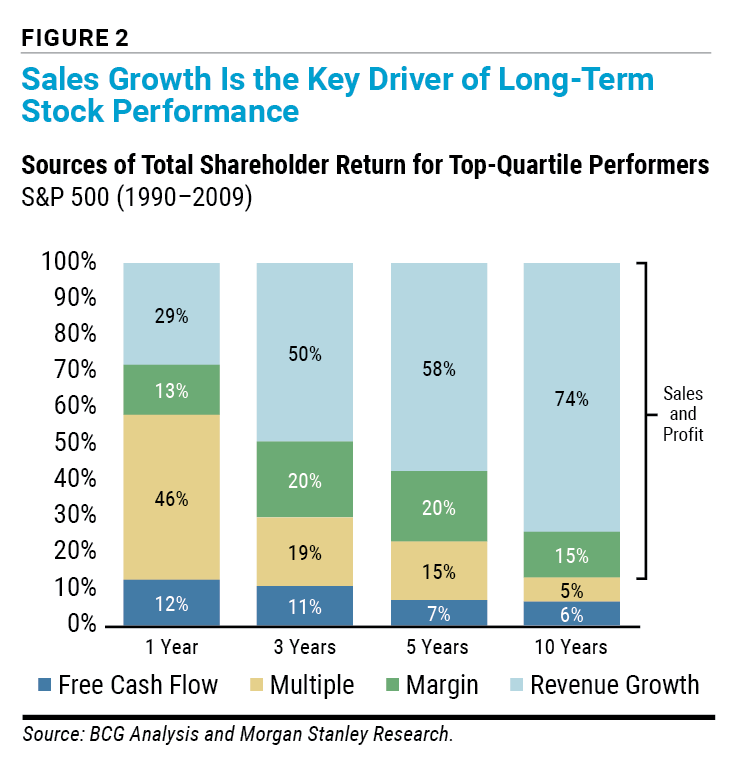
CM: When considering high valuation in terms of price multiples like the price-to-book ratio, some interesting studies have found that the impact on individual stocks drops significantly over longer holding periods.
The critical takeaway is that sales growth is the primary driver of long-term performance. Looking back at the top-performing S&P 500 index companies from 1990–2009 broken down into one-, three-, five- and 10-year time frames, valuation plays the most significant role in performance over a one-year period. In the three-year period, the sales growth contribution rises to 50%. In the five-year period, it rises even more to 58%, and in the 10-year period, sales growth dominates at 74%. The longer you hold an investment, the more that revenue growth will drive its performance, focusing on a long-term investing perspective (Figure 2).
What signals do growth investors look for to determine when it’s time to add a stock to or remove a stock from their portfolio?
DB: As a growth investor, you must be very focused on sales growth. A good management team that leverages its strengths will end up generating good earnings growth.
You really want to be mindful of position sizes and diversification. The S&P 500 is quite concentrated. As of late May, 47% of the S&P 500 is information technology and communication services stocks. Even though growth is currently being driven by technology companies, particularly those related to artificial intelligence (AI), there are non-technology growth stocks out there that might be of interest.
Additionally, if you write down your thesis for each holding and continually monitor it, you will get opportunities to add to and subtract from your portfolio. Finally, pay attention to management changes. So much of your long-term performance is tied to sales and earnings growth produced by excellent managers.
In growth investing, it is critical to have discipline and decide in advance which factors you’re going to consider when buying and selling stocks. Cynthia, what are some of the AAII Growth Investing strategy’s portfolio deletion criteria?
CM: The AAII Growth Investing portfolio uses a rules-based methodology to determine when to delete holdings, which helps to avoid emotional decisions. When a stock’s Growth Grade falls to D or F or its Growth Score falls to 40 or lower, the portfolio’s rules call for it to be removed. The same is true if the G-Score falls to 4 or lower or if the Quality Grade falls to F.
The portfolio has deletion rules regarding year-over-year sales growth, five-year annualized sales growth, cash flow from operations and three-year performance since being added to the portfolio. Additionally, a stock is removed if it has underperformed the portfolio’s benchmark, iShares Core S&P 500 ETF (IVV), by more than 50 percentage points from the stock’s closing high price since being added to the model portfolio.
These rules also guide whether a deletion is necessary versus just a portfolio rebalance.
Cynthia, how do you find growth stock ideas?
CM: The Growth Investing Ideas list serves as a feeder list. New additions to the model portfolio are pulled from this list, as all the stocks on the list meet the portfolio addition criteria.
As of May 26, 42 stocks are on this list, ranging from Apple Inc. (AAPL) to a small communication services company called Ooma Inc. (OOMA). Stocks from the Growth Investing Ideas list are largely falling in the consumer discretionary and information technology sectors.
Dan, how do you find growth stocks early?
DB: To paraphrase Warren Buffett, my advice is to invest in what you know. Think about the products and services you use all the time. There is probably an interesting company behind them, or maybe there’s an interesting company in the supply chain that feeds into those products or services. Follow an industry you’re interested in to develop expertise. Look for customer contacts, trade publications and anything else you can get your hands on to get a deeper understanding of that particular industry and its competitive factors.
Additionally, stock screens are really valuable. They can help you uncover underfollowed stocks, particularly small caps and micro-caps. Spin-offs are interesting too because they can unlock hidden growth businesses. You can also apply the BetterInvesting methodology to look for growth opportunities.
How does one evaluate a growth company?
DB: It comes down to three questions.
First, what is the firm’s competitive advantage? This includes networking effects, switching costs, scale advantages, intangible assets, management quality and capital allocation decisions. Consider how the company keeps its customers and what part of the whole value chain they are getting.
Second, is it getting stronger or weaker? Look at how the company is doing relative to the industry. If it is expanding its gross margin, that means it’s finding adjacent opportunities to expand its products and services at higher margins while not having to spend as much to defend its own existing customers.
Finally, how long is it going to persist? Technology changes over time. For example, it briefly looked like OpenAI’s ChatGPT was going to disaggregate Alphabet Inc.’s (GOOGL) Google search engine. But Alphabet responded with its own AI platform Gemini and reasserted itself. You have to watch for those signs of technology disruption. Additionally, look out for secular versus cyclical growth.
How is a company’s potential evaluated within the AAII Growth Investing framework?
CM: We use AAII’s Growth Analyzer. It not only shows you a company’s Growth Score and G-Score but also tells you what criteria the stock passes, offers comparisons to the industry median and provides grade history. It includes information such as trading metrics as well.
What role, if any, do dividends play when it comes to putting together a growth portfolio?
CM: The AAII Growth Investing portfolio does not specifically look for stocks that pay a dividend. As of May 26, the portfolio held 11 dividend-paying stocks. Match Group Inc. (MTCH) had the highest dividend yield in the portfolio, and Alphabet had the lowest yield.
DB: BetterInvesting’s dividend portfolio doesn’t demand rapid top-line sales growth. It’s more concerned with making sure that the company has a wide moat in its industry, even if it’s mature, and that sales and earnings can grow by mid-to-upper single digits. It doesn’t go after poor-quality companies with high yield. It’s more focused on whether a company can grow its dividend and what it’s doing with its excess cash. Oftentimes, dividend companies don’t have opportunities to deploy their cash flow into high return on investment activities.
The BetterInvesting dividend portfolio likes to see companies paying excess cash flow out as dividends or buying back shares. It focuses on three components: What is the company’s yield? What is the dividend payment, and can that increase through rising earnings? How are they handling their excess cash?
AAII members can join BetterInvesting for just $99 for the first year (regularly $145). Visit BetterInvesting’s site and use the promo code AAII. New BetterInvesting membership includes: the BetterInvesting Magazine, full access to the SSGPlus online tools suite, First Cut stock studies and a learning library.
Discovering Growth Beyond the Headlines Video
We think you’d like this related webinar! Finding Growth Beyond the Headlines.

Related

Stock Strategies
Cash Is King and Free Cash Flow Wears the Crown
Related

Discussion
FREE REPORT

Get your free copy of our special
report analyzing the tech stocks
most likely to outperform the
market.
JOHN L from NJ posted 3 months ago:
ROBERT A from NC posted 3 months ago:
BARRY J from TX posted 2 months ago:
Vinod N from MA posted 2 months ago:
BARRY J from TX posted 2 months ago:
You need to log in as a registered AAII user before commenting.
Log InCreate an account