

Choosing Between a Traditional and a Roth IRA
by Charles Rotblut | November 16, 2017
Yesterday’s commentary contained an incorrectly drawn doodle and incorrect information about when to favor a traditional IRA over a Roth IRA. It is preferable to pay taxes at lower rates. So, in the case of choosing an IRA to contribute to, you should choose a Roth IRA if you anticipate higher future taxes and a traditional IRA if you expect your marginal tax rate to be lower in the future—all else being equal. A corrected image and corrected text is below. I apologize for any confusion this may have caused. —Charles
I spent yesterday at Schwab’s IMPACT Conference. The annual conference is oriented toward independent financial advisers. Nearly 5,000 people attended this year’s conference. I’ll share some of my notes at the end of this week’s commentary, but first I want to focus on a specific session that addressed the topic of choosing between a traditional and a Roth IRA.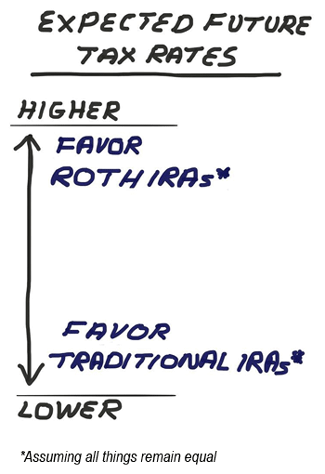
The subject is timely because of the Tax Cuts and Jobs Act (TCJA). Should the proposed tax reform legislation make it through Congress, the tax brackets will be condensed. The bill, which passed the House of Representatives today, would also end the ability to recharacterize (meaning undo) a Roth IRA conversion.
One of the points financial planner Michael Kitces made during the session was the tax equivalency of both types of IRAs. Assuming all things remain equal—the tax-adjusted dollars allocated for contributions, planned withdrawals and taxes—it should not matter which type of IRA is chosen. If anything changes, so does the decision. Lower future tax rates favor traditional IRAs; higher future tax rates favor Roth IRAs. Not wanting or needing required minimum distributions (RMDs) favors Roth IRAs. Desiring to put away more now in terms of absolute dollars favors traditional IRAs.
The challenge in the current environment is determining what your future tax rate will be. While the tax brackets could be condensed and standard deduction doubled, various deductions and exemptions could go away. Anyone who is considering making a contribution to a retirement savings account may want to consider doing a rough estimate of what their taxes would be under both current law and the proposed law. (The contribution limit for most people is $5,500—plus a $1,000 catch-up for those age 50 or older—for both 2017 and 2018. The TCJA currently does not alter this amount.)
It gets trickier if a Roth IRA conversion is being considered. Since such conversions are taxable, it is more advantageous to do them during years when your other tax obligations will be lower. To determine whether or not doing a conversion makes more sense this year or waiting until next year, you need to consider not only how it will affect your taxes this year, but also how the conversion will affect your taxes next year. For 2018, you need to run the numbers assuming the current law stays in effect and assuming the TCJA is passed, along with your best estimate of 2018 income and expenses. An additional wrinkle to consider is the inability to recharacterize (undo) your Roth IRA conversion should the markets perform poorly. The House version of the TCJA repeals the ability to do recharacterizations.
Kitces also addressed backdoor Roth IRA contributions. These allow those with incomes above the income limits for making Roth IRA contributions to move money into such accounts. The process involves making a contribution to a traditional IRA and then shifting the funds into a Roth IRA. A big caveat is whether the IRS would invoke the step transaction doctrine: If the conversion is done too quickly after the contribution is allowed, the IRS could require the conversion to be undone. Kitces says there is not a standard for how much time should pass between the traditional IRA contribution being made and the Roth IRA conversion occurring. His firm suggests clients wait a year. Some other firms use shorter periods. Kitces says author and columnist Ed Slott believes waiting one month is sufficient. The key is the intent implied by the actions. Kitces believes investing the money while it is in the traditional IRA helps to show the original intent was to have the money held in such an account. The later conversion then implies a change of mind as opposed to a deliberate plan to do a backdoor Roth IRA contribution.
A few other notes about the conference: Schwab’s CEO Walt Bettinger described cybersecurity as one of his company’s biggest challenges. He said that password theft creates the potential for someone other than the actual client to be logging in and communicating. When asked about the revenue impact of commissions potentially falling to $0, Bettinger pointed to other sources of fee income such as cash management accounts, retirement planning services and exchange-traded funds.
During a later session with the media, Schwab’s strategists were asked what keeps them up at night. Chief investment strategist Liz Ann Sonders said geopolitical risks. Chief global strategist Jeffrey Kleintop said, in addition to those risks, repeated natural disasters. While a small number would provide an economic boost from rebuilding, a series of natural disasters would create an economic drag beyond the obvious human costs. Chief fixed-income strategist Kathy Jones frets about the ongoing complacency in the bond markets.
Author Michael Lewis spoke late in the day. He personally became a Schwab client after his then-broker put half of his portfolio into Lehman Brothers preferred stock. This was in 2006. Lewis joked that the broker probably hadn’t read his book, “Liar’s Poker” (W.W. Norton & Company, 2010), which was about Lewis’ experience working in the brokerage industry.

- New Rules for Converting to a Roth IRA – Though this article was written in 2010 in response to the elimination of income limitations for Roth IRA conversions at the time, it can help you to determine when it makes sense to do a conversion and when it does not.
- IRA Rollover Chart: Rules Regarding Rollovers and Conversions – This helpful chart shows what types of retirement accounts can be rolled over into other ones.
Pessimism among individual investors jumped to a two-month high in the latest AAII Sentiment Survey. Neutral sentiment also rose, while optimism fell.
Bullish sentiment, expectations that stock prices will rise over the next six months, plunged 15.8 percentage points to 29.3%. Optimism was last at this level on September 6, 2017. This is the first time in four weeks that bullish sentiment is below its historical average of 38.5%.
Neutral sentiment, expectations that stock prices will stay essentially unchanged over the next six months, rose 3.6 percentage points to 35.4%. The historical average is 31.0%.
Bearish sentiment, expectations that stock prices will fall over the next six months, rebounded by 12.1 percentage points to 35.2%. Pessimism was last higher on September 6, 2017 (35.7%). The historical average is 30.5%.
At current levels, all three sentiment indicators are within their historical ranges. Bullish sentiment, however, is near the low end of its typical range.
The big rise in pessimism follows recent declines in the major large-cap and small-cap indexes. Many AAII members have previously expressed concerns about the possibility of a pullback or a more severe drop occurring. Tax reform could also be playing a role. While some of our members are optimistic about the prospects of tax reform being passed, about 40% of members polled in a different weekly AAII survey said the proposed legislation could hurt them.
Also having an effect on investor sentiment are earnings growth, economic growth and/or the market’s overall upward momentum (all cited as reasons for optimism). Other individual investors view stocks as being a bit too overpriced or are concerned about the lack of volatility. Political drama in Washington also continues to be at the forefront of many individual investors’ minds.
This week’s special question asked AAII members for their opinion of bitcoin and related digital currencies and blockchain technologies. More than half of all respondents (55%) have a negative view. Many say they avoid crypto-currencies, while others used the words tulips, mania, speculative, foolish and losses in their responses. Approximately 20% said they don’t have an opinion, with a lack of knowledge or understanding about bitcoin and blockchain as the primary reason why. Slightly more than 12% believe blockchain technologies have a future, but are either uncertain or downright skeptical about bitcoin itself.
Here is a sampling of the responses:
- “Bitcoin is based on thin air. There is nothing backing it but euphoric sentiment.”
- “Bitcoin is completely beyond my understanding. I would rather buy tulips.”
- “A very speculative investment. I would not touch it.
- “Bitcoin is a bubble, but the technology could be valuable.”
- “No opinion. I still don’t understand it.”

Bullish: 29.3%, down 15.8 points
Neutral: 35.4%, up 3.6 points
Bearish: 35.2%, up 12.1 points
Bullish: 38.5%
Neutral: 31.0%
Bearish: 30.5%
November 9, 2017 Tax Planning In an Uncertain World
November 2, 2017 My Decision to Stick With an Intermediate-Term Corporate Bond Fund
October 26, 2017 Portfolio Optimization Isn’t Necessarily Worth the Effort
October 19, 2017 Lessons From Black Monday

Discussion
No comments have been added yet. Add your thoughts to the discussion!
You need to log in as a registered AAII user before commenting.
Create an account