

Tax Planning In an Uncertain World
by Charles Rotblut | November 09, 2017
It is admittedly difficult to write a tax guide when tax rates are uncertain. It is even harder to make tax planning decisions when future tax rates are uncertain. Yet with just a little over seven weeks left in 2017, this is the world we live in.
As the horse trading is occurring in Washington, D.C., I am moving forward with publishing our annual Individual Investor’s Guide to Personal Tax Planning in the next month’s AAII Journal (the link goes to our 2016 guide which contains 2017 information). I do this while being fully cognizant of the possibility of a massive update being required. Postponing the guide risks waiting on legislation that may or may not pass and getting year-end 2017 information out after it’s too late to act upon the numbers. So, as an editor, I’m damned if I do and damned if I don’t.
Taxpayers—both individual and business entities—face the same conundrum: make plans based on current tax law, or wait to see what happens? The correct decision won’t be known until after the fact. We do have an idea of the possible outcomes, however. If no significant changes are made to the tax code, inflation-adjusted deductions, exemptions and credits subject to inflation adjustments will increase by an approximate average of 2% next year. If significant legislation is passed, it will likely reduce the headline tax rates and alter or eliminate many credits, exemptions and deductions. Based on this, there are some steps individuals can take now, without trying to place odds on what will or will not be the eventual outcome for tax legislation.
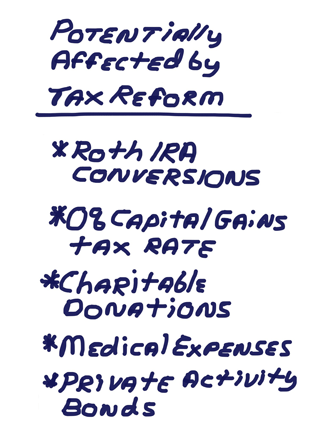
Capital gains distributions from a sizeable minority of mutual funds are skewing to the high side for this calendar year. According to CapGainsValet, 222 mutual funds so far have announced distributions exceeding 10% of their underlying net asset value. If you have losses you were planning to realize and you have capital gains that are either already realized or will be realized (from funds or other investments), it may make sense to use those losses to offset your gains in the current calendar year. (As of right now, the tax rates on long-term capital gains do not look like they will change, though the income bracket at which the 0% rate applies would be raised to $77,200 for married couples filing joint returns by the House bill.)
If you were intending to do or undo a Roth IRA conversion, you will want to watch how the current tax legislation progresses. Section 1501 of the November 6, 2017, version of the Tax Cuts and Jobs Act (TCJA) contains a section entitled, “Repeal of special rule permitting recharacterization of Roth IRA contributions as traditional IRA contributions.” Wolters Kluwer’s tax and accounting division (CCH) interprets the House bill as not only repealing the ability to undo a Roth IRA conversion, but also “the rule allowing conversion of a traditional IRA to a Roth IRA.” If you are considering making a Roth IRA conversion this year, make sure you run the numbers on whether or not doing so will unintentionally bump you into a higher tax bracket. If, on the other hand, you are considering undoing a Roth IRA conversion, the clock is ticking. Even if the current tax law remains in effect, you must make the recharacterization no later than the due date (including extensions) of when you must file the tax return for the year of the conversion.
It may make sense to accelerate charitable donations and medical expenses into this calendar year if possible. The increased standard deduction included in the House of Representatives’ proposed tax legislation may limit your ability to deduct charitable donations. The deduction for qualified medical deductions is also among the deductions eliminated by the pending House legislation. Right now, medical expenses in excess of 10% of your adjusted gross income are deductible.
Be aware of the possible change in the tax treatment of private activity bonds. The pending legislation repeals the tax-exempt treatment of the interest paid by these bonds. Under current law, the interest is tax-free except in cases where the taxpayer is subject to the alternative minimum taxes (AMT). (The AMT itself would be repealed by the pending House bill.)
Keep in mind the possibility of significant changes being made to tax legislation between now and whenever a “final” version comes up for a vote. (I wrote this week’s commentary before the Senate’s version of the tax bill was released.) Nothing attracts special interest groups, lobbyists and donors like comprehensive tax legislation. As such, avoid making big changes you would not otherwise make based on what you think may or may not happen in Washington. The reality is that we simply do not know what the actual outcome of tax reform legislation will be.

- Converting to a Roth IRA Can Minimize RMDs – A Roth IRA conversion reduces the amount of future retirement income subject to taxation, potentially increasing your lifetime wealth.
- Minimizing Taxes With Asset Allocation – Regardless of what does or does not happen with tax legislation, the tax-treatment of the account where you hold a given investment will continue to matter.
Pessimism about the short-term direction of the stock market among individual investors is at its lowest level since mid-September. The latest AAII Sentiment Survey also shows a rebound in neutral sentiment.
Bullish sentiment, expectations that stock prices will rise over the next six months, is unchanged at 45.1%. Optimism is above its historical average of 38.5% for the sixth time in nine weeks.
Neutral sentiment, expectations that stock prices will stay essentially unchanged over the next six months, rebounded by 5.4 percentage points to 31.8%. The rise follows what had been an eight-month low. The historical average is 31.0%.
Bearish sentiment, expectations that stock prices will fall over the next six months, fell 5.5 percentage points to 23.1%. Pessimism was last lower on September 13, 2017 (22.0%). Bearish sentiment is below its long-term historical average of 30.5% for the seventh week out of the past nine weeks.
Pessimism has fallen by a cumulative 10.0 percentage points over the past two weeks. The drop in bearish sentiment has occurred as the major large-cap indexes have continued to set new record highs. At their current levels, all three sentiment indicators are well within their typical historical ranges.
Some individual investors are encouraged by the growth in earnings, economic growth, progress on tax reform and/or the market’s upward momentum. Other individual investors view stocks as being a bit or too overpriced. The lack of volatility and the possibility of a forthcoming correction are also dampening sentiment. In addition, political drama in Washington continues to be at the forefront of many individual investors’ minds.
This week’s special question asked AAII members how confident they are in their expectations for the direction of stock prices over the next six months. We received a wide range of answers.
Slightly more than one out of five respondents (21%) to the special question described themselves as having little confidence in their ability to forecast stock prices. Many of these respondents said it is too difficult to predict where stock prices are headed. About 10% of all respondents said they had some confidence in their expectations, but there are too many variables to be firmly confident. Approximately 26% reiterated their expectations for stock prices to rise. Prospects for earnings growth, economic expansion and/or tax reform were given as reasons for the optimism. Conversely, close to 24% of respondents to the special question expressed pessimism. Several of these respondents expressed concerns about Washington politics, valuations and/or the likelihood of tax reform being passed. (Not all AAII members who took the Sentiment Survey answered the special question.)
Here is a sampling of the responses:
- “Pretty confident. Earnings are pretty good and the world economy is getting better.”
- “I have no confidence that the market will stay at current levels or increase over the next six months.”
- “A seven on a scale of one to 10 because of expectations for a favorable impact from tax reform, market gains outside the U.S. and general investor euphoria.”
- “There is so much volatility in current events, that it is not possible to accurately predict the future.”
- “If business growth is the dominant factor, I am very confident. If international intrigue gets into the mix, well, my confidence will diminish.”

Bullish: 45.1%, up 0.1 points
Neutral: 31.8%, up 5.4 points
Bearish: 23.1%, down 5.5 points
Bullish: 38.5%
Neutral: 31.0%
Bearish: 30.5%
November 2, 2017 My Decision to Stick With an Intermediate-Term Corporate Bond Fund
October 26, 2017 Portfolio Optimization Isn’t Necessarily Worth the Effort
October 19, 2017 Lessons From Black Monday
October 12, 2017 Bill Bengen Discusses His Retirement Withdrawal Strategy

Discussion
No comments have been added yet. Add your thoughts to the discussion!
You need to log in as a registered AAII user before commenting.
Create an account