

Bill Bengen Discusses His Retirement Withdrawal Strategy
by Charles Rotblut | October 12, 2017
William “Bill” Bengen, whose 1994 study introduced the concept of the 4% withdrawal rate for retirees, recently participated in a question and answer session on social media website Reddit. The conversation focused on retirement withdrawal strategies and portfolio allocation. I’ll provide some highlights here. The full exchange is interesting, though you will want to set aside some free time as it encompasses nearly 450 questions and comments in total. Keep your eyes open for an interview with Bengen to appear in the AAII Journal early next year.
Not surprisingly, there were several questions about Bengen’s withdrawal strategy. 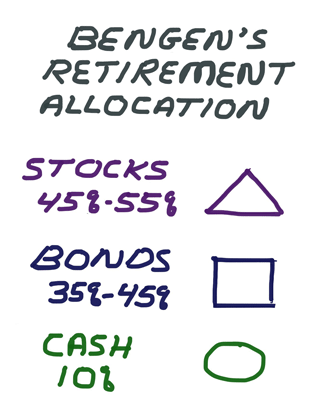 The 4.5% rule is a guideline for how much can be safely withdrawn each year without causing the retiree to run out of money over a period of 30 years. As such, it is referred to as a safe withdrawal rate (SWR). The strategy starts by withdrawing 4.5% of portfolio assets (Bengen has increased the percentage since his original research was published). The dollar amount is then increased by inflation each year thereafter. [Bengen uses the consumer price index (CPI) for determining by how much the withdrawals should be increased.]
There were several questions about whether or not the 4.5% rule is still applicable in the current environment. Bengen believes the state of the economy has had “little bearing on safe withdrawal rates.” Rather, he thinks the big dangers are encountering a “major bear market early in retirement” and/or experiencing high inflation during retirement. (Bengen called inflation “the retiree’s worst enemy.”) Though the average safe withdrawal rate has historically been 7%, a bear market similar to what occurred in 1937 or 2000 drops the SWR to 5.25%. Adding in the heavy inflation of the 1970s lowers the SWR to 4.5%. Bengen then added, “So far, I have not seen any indication that the 4.5% rule will be violated.”
Longevity also plays a role. A 35-year retirement would require a safe withdrawal rate of 4.3%. For 40 years, the SWD is 4.2%. It’s 4.1% for someone expecting to spend 45 years in retirement.
He thinks it’s too early to tell how a prolonged period of low interest rates will affect the 4.5% rule. It may be another 10 years before an assessment can be made. If, on the other hand, inflation rises significantly, it would be a problem. As far as prevailing valuations, Bengen—citing research from financial adviser Michael Kitces—said “it is best to stick with the appropriate safe withdrawal rate, and not try for something higher.”
Bengen’s original research used a 50% stock/50% bond allocation. He continues to believe in this mix. Bengen found that safe withdrawal rates peaked at 4.5% at equity allocations of 45% to 55%. He described an allocation mix of 50% to 55% in stocks, 35% to 40% in bonds and 10% in cash as appearing to be “optimum.” When asked about his own allocation, Bengen simply responded, “I have a lot of cash!”
Bengen says he advised his clients to always have a significant amount of cash on hand. This cash allocation reduced the bond allocation “dollar-for-dollar.” The 10% allocation was intended to be the equivalent of two years of withdrawals. Bengen believed this gave his clients comfort in knowing that they would not have to touch their investments during periods of down markets.

- Will Your Savings Last? What the Withdrawal Rate Strategies Show – William Reichenstein explained what the withdrawal studies found and discussed some of their shortcomings.
- A Key to a Lasting Retirement Portfolio – Analysis by Fidelity found that staying within or below a 4% to 5% withdrawal rate decreases a retiree’s risk of outliving their retirement savings.
Bullish sentiment, expectations that stock prices will rise over the next six months, rose 4.2 percentage points to 39.8%. The increase puts optimism above its historical average of 38.5% for just the sixth time this year.
Neutral sentiment, expectations that stock prices will stay essentially unchanged over the next six months, rebounded by 1.7 percentage points to 33.3%. This is the 24th consecutive week that neutral sentiment is above its historical average of 31.0%.
Bearish sentiment, expectations that stock prices will fall over the next six months, plunged 5.9 percentage points to 26.9%. This is a four-week low. The drop puts pessimism back below its long-term historical average of 30.5% for the fourth time in five weeks.
The improvement in optimism and pullback in pessimism occurred as the large-cap indexes continued to set new record highs. At current levels, all three sentiment readings are well within their typical historical ranges.
Political drama in Washington remains at the forefront of many individual investors’ minds. (Many are skeptical about the prospects of tax reform being passed. Valuations are also playing a role, creating concern among some about stocks being overpriced and potentially leading to a correction. Others, however, are encouraged by the continuing economic and earnings growth as well as the market’s upward momentum.
This week’s special question asked AAII members for their opinion on the current yields that stocks are trading at. Slightly more than two out of five respondents (42%) view prevailing yields as being too low or believe companies should do more to raise their payouts. Nearly 34% are either content with dividends or think they are at fair/average levels. About 18% described dividends as attractive, particularly when compared to bond yields and the interest rates offered by banks.
Here is a sampling of the responses:
- “Current yields are low reflecting (too) high prices of equities.”
- “Dividend yields are barely adequate, but they’re better than bonds.”
- “Dividends yields are reasonable versus other types of interest earning vehicles such as bonds and savings accounts.”
- “Okay so long as interest rates remain low.”
- “Could be better if companies would do fewer stock buybacks and use their cash for dividends.”
- “Hard to give a complete answer as some stocks pay high dividends and others pay very low dividends.”

Bullish: 39.8%, up 4.2 points
Neutral: 33.3%, up 1.7 points
Bearish: 26.9%, down 5.9 points
Bullish: 38.5%
Neutral: 31.0%
Bearish: 30.5%
October 5, 2017 What Investments Do You Need?
September 28, 2017 A Big Argument for Buying and Then Monitoring
September 21, 2017 It’s Not Just the Fed’s Balance Sheet That’s Changing
September 14, 2017 Equifax, Plus Observations From the Morningstar ETF Conference

Discussion
No comments have been added yet. Add your thoughts to the discussion!
You need to log in as a registered AAII user before commenting.
Create an account