

Coming Out Ahead by Doing Less
by Charles Rotblut | May 03, 2018
It’s easy to adhere to an investment strategy when you don’t have to do very much. Such is the case with the approach I use to manage my 403(b) account, which is similar to a 401(k) account.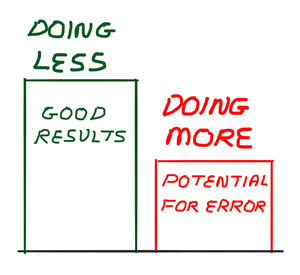
When I recently looked at my account, there was nothing for me to do. No changes were required. The automatic contributions from my paycheck are continuing to be added to the account, the funds are adhering to their strategies and the allocation is staying within the boundaries I set for it. So, I’ll just sit back and let things continue. Easy breezy.
The reason I didn’t have to do anything is because I use a rebalancing strategy. As long-time readers of this column are aware, I have my 403(b) account allocated to just five funds: Vanguard S&P 500 (VFIAX), Vanguard FTSE All-World ex-US Small-Cap (VFSVX), Vanguard Intermediate-Term Investment-Grade (VFIDX), Vanguard REIT (VGSLX) and Vanguard Small-Cap Value (VSIAX). The target allocation for each fund is 20%. As long as the weighting for each fund does not go below or above a 10-percentage-point band (under 15% or above 25% of total account value), I don’t do anything. Such was the case when I looked at the account this week for the first time in six months.
[A quick aside: The ticker symbols for all but the foreign small-cap fund are for the Admiral Share class of shares, which have higher minimum requirements but lower fees than their Investor Share class counterparts. Exchange-traded funds (ETFs) are available for all of the funds except for the bond fund.
The real estate investment trust (REIT) fund and the bond fund are both below the target with 17.5% and 17.6% weightings, respectively. The bond fund has realized single-digit returns for four consecutive years. Such returns are not unexpected for a bond fund. For someone years away from retirement—like me—a bond fund’s role is not to drive the portfolio’s returns, but to provide a cushion against the volatility of equity funds. (Bond funds will have down years, but higher credit quality bond funds should experience less severe downside risk than stock funds.)
The REIT fund has incurred single-digit returns for three consecutive years. I’m not bothered by this, given the long-term outperformance of REITs relative to large-cap stocks and because REITs are not highly correlated to stocks over the long term. Put another way, I expect the REIT fund to experience different return patterns than stocks while rewarding me for taking a long-term view.
(Vanguard is in the process of transitioning to a new index for this REIT fund. The new index is the MSCI U.S. Investable Market Real Estate 25/50 Index. The change will expand VGSLX’s investable universe to include specialty REITs and real estate management firms. Higher returns are expected as a result.)
The Vanguard FTSE All-World ex-US Small-Cap fund currently has the largest weighting in my account, at 21.9%. As the name implies, this fund invests in foreign small-cap funds. It lost ground in 2014 and 2015 (annual returns of –4.9% and –0.4%, respectively) and realized a modest 4.1% gain in 2016 before soaring by 30.1% last year. Since I use dollar cost averaging, I was able to purchase more shares of the fund than I would have if the price were higher. As a result, when shares of the fund jumped in price last year, I was in a good position to take advantage of the big gains without having to make any change to my portfolio.
It’s worth noting that anyone else following my allocation strategy will have different weightings. Any time money flows into or out of a portfolio, the returns and the allocation weightings will be altered. The timing of the cash inflows and outflows, as well as the proportionate amount of those flows influence the allocation. (I have the account set up to automatically invest my contributions when they are sent to Vanguard near the end of each calendar month.)
One could argue that a trend-following approach or some other tactical strategy would have yielded higher results. It may quite possibly be so on paper, but what matters is the execution. By doing less, I’ve come out far ahead than if I did more and incurred the error of wrongly guessing which fund will have the best returns over a certain period of time.
To do less now, I had to initially determine the allocation and set up the rules for following the strategy. This required upfront effort, but now I’m reaping the rewards of that effort. The key to being successful at doing less investing-wise is having a process set up with clear rules about when not to act, when to act and the discipline to routinely follow the process.

- Best Practices for Portfolio Rebalancing – My decision to rebalance when my allocations are off target by five percentage points or more is based on this Vanguard study.
- When Less Is More: How to Increase Aftertax Returns by Doing Less – Returns for taxable accounts can be boosted by trading less often, as this 1996 AAII Journal article from our archives explains.
The percentage of individual investors who described their short-term outlook for stocks as “neutral” is above 40% for the first time in almost two months. The latest AAII Sentiment Survey also shows a big drop in optimism and a rise in pessimism.
Bullish sentiment, expectations that stock prices will rise over the next six months, plunged 8.5 percentage points to 28.4%. The drop keeps optimism below its historical average of 38.5% for the 10th consecutive week and the 11th time in 13 weeks.
Neutral sentiment, expectations that stock prices will stay essentially unchanged over the next six months, rose 3.8 percentage points to 41.4%. Neutral sentiment was last higher on March 14, 2018 (41.8%). This is the 11th consecutive week with a neutral sentiment reading above the historical average of 31.0%.
Bearish sentiment, expectations that stock prices will fall over the next six months, rebounded by 4.7 percentage points to 30.2%. The rise puts pessimism close to, but still below, its historical average of 30.5%.
Since falling to a two-month low of 31.2% on April 11, neutral sentiment has jumped by a cumulative 10.2 percentage points. At its current level, neutral sentiment is at an unusually high level. Meanwhile, bullish sentiment is near the bottom of its typical range.
Many individual investors, but not all, anticipate continued volatility and/or think that the current political backdrop could have a further impact on the stock market. Trade policy is influencing some individual investors’ sentiment. While many individual investors either approve of the Federal Reserve’s plan to gradually raise interest rates or don’t expect it to affect the stock market, some are concerned about the impact that rising rates will have. Also influencing sentiment are valuations, tax cuts, earnings and economic growth.
This week’s special question asked AAII members what factors would most likely be responsible should stock prices rise between now and the end of the year. Responses varied, with the largest group (29%) crediting earnings, particularly earnings growth. A distant second was taxes, picked by 10% of respondents. Almost 9% of respondents say the economy. A nearly equal number say the interest rates, especially stable or slowly increasing rates. About 6% think an easing of trade tensions would help stocks. Other factors listed include, but are not limited to, the midterm elections, Iran and North Korea, investor sentiment and President Donald Trump.
Here is a sampling of the responses:
- “Evidence for higher sustained earnings.”
- “Elimination of concern over possible trade wars.”
- “Continued improvement in the economy coupled with reduced pressure on interest rates.”
- “Improved economy, better-than-predicted corporate results and a cooling of political issues.”
- “Reversal of White House position on trade deals and successful resolution of Korean issues.”

Bullish: 28.4%, down 8.5 points
Neutral: 41.4%, up 3.8 points
Bearish: 30.2%, up 4.7 points
Bullish: 38.5%
Neutral: 31.0%
Bearish: 30.5%
April 26, 2018 A Checklist Can Make You a Better Investor
April 19, 2018 Guidelines for Projecting Retirement Savings
April 12, 2018 How Much Is a Lottery Ticket Worth?
April 5, 2018 Keep Calm and Ignore the Market’s Volatility

Discussion
No comments have been added yet. Add your thoughts to the discussion!
You need to log in as a registered AAII user before commenting.
Create an account