

How Much Can You Withdraw From a Portfolio and Not Outlive It?
by Charles Rotblut | November 08, 2018
The biggest risk any investor faces is running out of money. From the standpoint of retirement savings, this is known as longevity risk. It is the risk of living longer than your savings can support you. Longevity risk is why millennials are encouraged to put most of their savings into stocks and why retired investors should keep withdrawals to a reasonable level.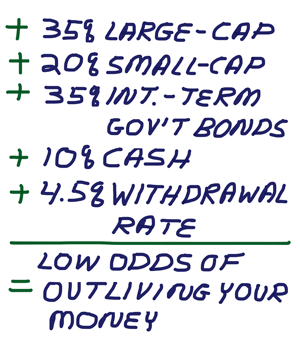
What defines a reasonable level is the subject of an article I wrote for this month’s AAII Journal. I’ll share one of the conclusions here: If you are using a systematic approach like the 4% rule, don’t plan on using a withdrawal rate greater than 5% as your base. This is a handy rule of thumb even for those who aren’t retired. For any amount saved, a person can quickly estimate how much income their portfolio will provide in the first year of retirement. No fancy calculator needed; simply multiply what you have saved by 5%. The total will be the base amount of dollars you can withdraw. (Those of you with many years until retirement should keep in mind the boost that additional savings and market returns will have on the actual future amount of dollars you will be able to withdraw.)
The longer one’s expected life-span in retirement is, the smaller the withdrawal rate should be. While a 5% inflation-adjusted withdrawal rate holds up fairly well over periods of up to 25 years (an 82% success rate of not outliving your money with a 60% large-cap stock/40% intermediate-term government bond allocation), its odds of success fall at 30-year and 35-year periods (71% and 58% success rates, respectively). Going down to 4% is better (98% and 93% success rates at 30 years and 35 years). A middle ground not covered in the article is to diversify slightly more and use a 4.5% withdrawal rate.
The idea comes from retired financial planner William (“Bill”) Bengen. Bengen created the original 4% withdrawal rule. In subsequent research, he found an initial 4.5% of retirement savings could be withdrawn and subsequently increased by the rate of inflation if small-cap stocks were included.
I took Bengen’s suggested allocation of 35% large-cap stock, 20% small-cap stock, 35% intermediate-term bond and 10% cash and tested it over 30-year and 35-year periods using a 4.5% withdrawal rate. The success rates (meaning the odds of not outliving one’s money) were good. For retirements lasting 30 years, the portfolio only ran out of money three times out of all actual 30-year rolling periods (1928–1957, 1967–1996 and 1968–1997)—a 95% success rate. At 35 years, the portfolio failed just four times (1928–1962, 1936–1970, 1967–2001 and 1968–2002)—a 93% success rate. Not perfect, but quite high.
When the portfolios did fail, a down year for stocks occurred early in retirement. Examples include the years of 1931, 1937 and 1969. The value of the equity holdings fell at the same time withdrawals were being taken. To the extent that a retiree could have avoided withdrawing from their equity holdings and/or cut back on withdrawals, the greater the likelihood of success would have been.
Those who are years away from retirement should realize that without withdrawals taken, the portfolios would have never run out of money. It is the size of the withdrawals combined with the sequence in which returns occur that matters. As such, it makes sense to take risks when younger and to incorporate a cash bucket and/or sources of guaranteed income (pensions, Social Security, annuities, etc.) when older.

-
Insights on Using the 4% Withdrawal Rule From Its Creator – William Bengen explained why he now suggests a 4.5% withdrawal rate and what the biggest threat to his withdrawal strategy is.
-
The Sequence in Which Returns Occur Affects Your Wealth – The timing of positive and negative returns significantly impacts wealth, particularly if withdrawals are taken or other changes are made.
Optimism among individual investors about the short-term direction of stock prices is above average for just the second time in nine weeks. The latest AAII Sentiment Survey also shows slightly lower neutral sentiment and pessimism holding above its historical average despite a decline.
Bullish sentiment, expectations that stock prices will rise over the next six months, rose 3.4 percentage points to 41.3%. This is a five-week high. The historical is average 38.5%.
Neutral sentiment, expectations that stock prices will stay essentially unchanged over the next six months, declined by a marginal 0.1 percentage points to 27.5%. The decrease keeps neutral sentiment below its historical average of 31.0% for the second consecutive week.
Bearish sentiment, expectations that stock prices will fall over the next six months, fell 3.3 percentage points to 31.2%. The drop was not steep enough to prevent pessimism from remaining above its historical average of 30.5% for the eighth time in nine weeks.
This is the first time that neutral sentiment has stayed below average on consecutive weeks since mid-February. Over the same 38-week stretch, bullish sentiment has been above average just 11 times and bearish sentiment has been above average just 15 times.
At current levels, all three indicators are within their typical ranges.
Due to the timing of when our survey period runs (Thursday through Wednesday), the majority of this week’s results were recorded before Tuesday’s election results were known.
The recent rebound in the major indexes may have given some individual investors encouragement that a short-term bottom in the stock market has been set. Tariffs and the possibility of an escalating trade war remain front and center in the minds of many individual investors. Also influencing sentiment is Washington politics (including President Donald Trump), midterm elections, economic growth, valuations and corporate profits.

Bullish: 41.3%, up 3.4 points
Neutral: 27.5%, down 0.1 points
Bearish: 31.2%, down 3.3 points
Bullish: 38.5%
Neutral: 31.0%
Bearish: 30.5%
November 1, 2018 How We Define Risk
October 27, 2018
October 25, 2018 Credit Spreads Aren’t a Reason to Alter Bond Allocations
October 18, 2018 Actionable Steps for the Current Market

Discussion
No comments have been added yet. Add your thoughts to the discussion!
You need to log in as a registered AAII user before commenting.
Create an account