

Successful Investing Requires Coping With Some Discomfort
by Charles Rotblut | August 03, 2017
“Super investors take pain better than everybody else.”
Wesley Gray, CEO and CIO of Alpha Architect, made this observation at last week’s Financial Analysts Seminar, an annual CFA Institute event hosted with CFA Society Chicago. He was referencing the ability of successful investors to stick with a strategy.
Gray raised the point as part of a discussion about factor investing. Factor investing is selecting investments based on certain quantitative characteristics such as a low valuation (value), higher relative returns (momentum) or a smaller market capitalization (size). He could have easily made a comment about any other investment strategy.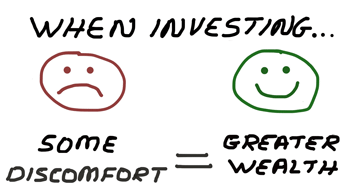
Pain in the world of investing is incurring a loss. It can be a drawdown, a drop in the value of your portfolio. It can also be the loss of upside returns. Even if your investment is appreciating in price, the perceived loss of not being in a better-performing investment can be discomforting. Either way, loss is a powerful driver of human emotions and decision-making. Psychologist Daniel Kahneman says the pain of a loss exceeds the pleasure of a gain by a measure of 2:1.
Pain is also very personal. A strategy one person finds easy to follow can be extremely difficult for another person to adhere to. Similarly, the pain threshold at which one investor panics or otherwise abandons a strategy can be different for another investor. Gray said he knows of one person who has been able to withstand “multiple” drawdowns of up to 75%. (This energy investor has accumulated significant wealth by sticking to a disciplined strategy over the long term. You can ask Gray about it at our forthcoming Investor Conference.) Other investors begin to get very worried when the stock market falls by 10%—not an uncommon occurrence. (In their defense, I have yet to experience a market correction without strategists and pundits warning about it being the start of the next recession and/or bear market. Whenever Mr. Market’s mood turns sour, Chicken Little warms up his voice.)
As much as nobody likes discomfort (including myself), investors are rewarded for enduring it. If there was no discomfort, there wouldn’t be as much of a reward for investing.
There are things you can do to better cope with the discomfort of down or otherwise unfavorable market conditions. One is to simply look less often at the market and your portfolio. The longer you ignore the stock market, the less volatile it will seem. Another is to realize the advantage of being a long-term investor. Gray believes “patience” is very much an investor’s “alpha.” (Alpha is outperformance attributable to an investor or money manager.) A third thing is to be very focused on your process. Michael Falk, a partner with Focus Consulting Group, told attendees at a different session that process is six times more important than analysis in terms of realizing higher returns. (Good analysis is still required, though.) Part of a good process is having pre-established sell rules—not just for when things go right, but also for when things go wrong. He also advocates for creating a personal behavioral checklist. If you can determine what influenced your decision at the time you made a buy or sell decision, you can start to create safeguards and systems to help prevent repeating the same behavioral mistakes in the future.

-
The Case for Systematic Decision-Making – Wesley Gray explained how relying on models can help make you a better investor in this 2014 AAII Journal article.
-
Oakmark Funds’ Long-Term Approach to Stock Investing – William Nygren discussed his firm’s disciplined, low turnover approach, which includes a five- to seven-year time horizon.
Pessimism in the latest AAII Sentiment Survey surged to its highest level since mid-May, as neutral sentiment plunged to nearly a four-month low. Optimism rebounded modestly.
Bullish sentiment, expectations that stock prices will rise over the next six months, rebounded by 1.7 percentage points to 36.1%. Optimism was last higher on May 3, 2017 (38.1%). This is the 23rd consecutive week and the 28th time out of the last 29 weeks that bullish sentiment is below its historical average of 38.5%.
Neutral sentiment, expectations that stock prices will stay essentially unchanged over the next six months, plunged 9.4 percentage points to 31.8%. Neutral sentiment was last lower on April 26, 2017 (30.2%). Even with this week’s drop, neutral sentiment is above its historical average of 31.0% for the 14th consecutive week and the 19th time out of the last 20 weeks.
Bearish sentiment, expectations that stock prices will fall over the next six months, rose 7.8 percentage points to 32.1%. Pessimism was last higher on May 17, 2017 (34.3%). This is the also the first time in nine weeks that bearish sentiment is above its historical average of 30.5%.
Though the Dow Jones industrial average continued to set record highs over the survey period (Thursday through Wednesday), other major indexes declined. The changes in this week’s readings also follow both unusually high levels of neutral sentiment and an eight-month low for pessimism.
While some individual investors are encouraged by this year’s record highs for the major indexes (even given the modest declines in several of the major indexes over the past seven days), many others have expressed concern about the possibility of a pullback and/or the prevailing level of valuations. The Trump administration remains at the forefront of many investors’ minds and is having a significant impact on sentiment. Other factors playing roles are earnings and interest rates/monetary policy.
This week’s special question asked AAII members how their sentiment toward the stock market is being influenced by the prospects for tax reform. The majority of respondents (56%) said it’s not influencing their sentiment. Many of these respondents clarified their response by saying they do not anticipate that tax reform will actually occur. Slightly more than 26% say the passing of tax reform, particularly significant tax reform, would boost stock prices. Approximately 5% believe that if meaningful tax reform is not passed, stock prices will fall.
Here is a sampling of the responses:
- “The probability of meaningful tax reform is vanishingly small, so it’s not factored into my thinking about investments.”
- “I don’t put much weight on anything getting done. There is so much divisiveness in politics.”
- “I am assuming no tax reform. A significant tax cut would make me more bullish.”
- “Any tax reform will be around the edges, nothing major.”
- “If tax reform should fail or continues to be delayed, a major correction will ensue.”
Historical averages:
- Bullish: 38.5%
- Neutral: 31.0%
- Bearish: 30.5%

Bullish: 36.1%, up 1.7 points
Neutral: 31.8%, down 9.4 points
Bearish: 32.1%, up 7.8 points
Bullish: 38.5%
Neutral: 31.0%
Bearish: 30.5%
July 27, 2017 Volatility Is Extraordinarily Low
July 20, 2017 Suggestions for Conducting a Quick Analysis of a Stock
July 13, 2017 Value Works, But You May Want to Add Additional Criteria
July 6, 2017 Two Concepts That Can Affect Your Returns

Discussion
No comments have been added yet. Add your thoughts to the discussion!
You need to log in as a registered AAII user before commenting.
Create an account