

The New 1040 Is Shorter, But Not Simpler
by Charles Rotblut | June 28, 2018
The familiar 1040 tax form is getting a big makeover. Treasury secretary Steven Mnuchin said that the Internal Revenue Service (IRS) will release a new Form 1040 this week: “It will be a postcard as we’ve promised.” As of early this afternoon, nothing about it had been posted yet on the IRS website, but The New York Times published images of the draft versions yesterday.
The new form is shortened considerably. The Wall Street Journal counts 56 lines as being removed. Form 1040 will now be one page instead of two pages. There is also a blank space in the middle, which I presume exists so that you could fold the form in half to mail it. 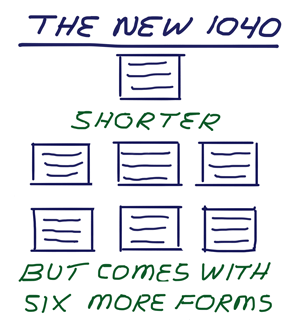 Doing so would make Form 1040 close enough for Mnuchin to claim his postcard description is true, even though a folded 8” x 11” sheet of paper is still bigger than a postcard. As a reference point, the U.S. Postal Service says that in order to qualify for the postcard price, a mailpiece must be “no more than 4-1/4 inches high x 6 inches long x 0.016 inches thick.”
Describing the form as “postcard-sized” makes for good symbolism from a tax reform standpoint, but for most taxpayers the physical size doesn’t matter much. IRS statistics show that close to 90% of individual taxpayers filed electronically in 2016 and a similar percentage is projected to have done so in 2017.
What matters for most taxpayers—beyond what they’re paying to the government—is how simple or hard it is to figure out how much they owe or are due. The revised Form 1040 will force many taxpayers to complete more forms. Capital gains, penalties on early withdrawals of retirement savings, IRA deductions and student loan deductions go on a different form. If you’re subject to the alternative minimum tax (AMT), that’s another form. Qualify for the retirement savings credit? Yup, fill out another form. The six new forms are in addition to Schedule D (capital gains and losses), Form 6251 (AMT), Form 8880 (credit for qualified retirement savings) and other forms you may already be filling out.
The extent to which you will notice the complexity depends on how you are completing your taxes. Those of you who file by hand will definitely notice the difference. Users of TurboTax and similar software-based programs may not notice the change as long as they stay within the programs’ primary interface. I can’t comment on how noticeable the change will be with the various online offerings because I’m a long-time TurboTax user, but I suspect that the experience will be similar. The change will be very noticeable by those of you who, like me, go through their tax return by hand to ensure there aren’t any mistakes or unintended errors, or need to use the view forms’ functionality in tax software or web-based platforms.
Speaking of taxes, now is a good time to review your tax situation and begin to take any actions you were planning to take. Since we’re halfway through the year, you should have an idea of how your income and expenses are trending relative to expectations. For instance, if you’ve already incurred larger-than-expected medical expenses, you might want to make sure you incur other related expenses (e.g., new glasses, dental work, etc.) this year instead of next. Alternatively, those of you who are still working may want to review your retirement savings contributions. If the tax cuts have increased the amount of aftertax income you receive, consider shifting some of the savings into your retirement savings accounts [e.g., 401(k), traditional IRA, Roth IRA, etc.] and/or health savings account.
You may also want to start acting on any planned account-related activity. For instance, if you were intending to use the lower tax rates to do a Roth IRA conversion this calendar year, start the paperwork. You can always open the account now and gradually make the conversions over the second half of the year by converting the same dollar amount each month. Alternatively, if you think that the stock market will incur more downside volatility before the end of the year (and there’s no guarantee that it will), setting up the account now will give you the chance to act quickly should the opportunity arise to take advantage of the reduced prices. (Lower prices reduce the tax cost of the conversion or allow you to convert more shares for the same dollar amount.) If you do opt for attempting the more tactical approach, just be sure to set up a reminder to complete the intended Roth conversion before the end of the calendar year.

- An In-Depth Look at the Tax Consequences of Asset Location – The type of account used to hold a specific type of investment impacts the return you will actually realize.
- Health Savings Accounts – These accounts allow money to be both contributed and withdrawn tax-free (with some restrictions), making them a great retirement savings vehicle.
Pessimism among individual investors about the short-term direction of stock prices is above 40% for just the second time this year. The latest AAII Sentiment Survey also shows a large drop in optimism and a decrease in the percentage of investors describing their outlook as neutral.
Bullish sentiment, expectations that stock prices will rise over the next six months, plunged 10.3 percentage points to 28.4%. Optimism was last at this level on May 2, 2018 (also 28.4%). The drop puts bullish sentiment below its historical average of 38.5% for just the second time in the past six weeks.
Neutral sentiment, expectations that stock prices will stay essentially unchanged over the next six months, fell by 4.4 percentage points to 30.7%. This is the lowest reading since February 14, 2018 (30.1%). Nonetheless, neutral sentiment remains above its historical average of 31.0% for the 19th consecutive week.
Bearish sentiment, expectations that stock prices will fall over the next six months, surged 14.6 percentage points to 40.8%. Pessimism was last higher on April 11, 2018 (42.8%). The rise ends a streak of 10 consecutive weekly readings below the historical average of 30.5%.
Year-to-date, pessimism has only been above its historical average five times (including this week’s reading). Optimism has been above its respective historical average just 11 times. Neutral sentiment has been the one comparative constant, registering above its historical average 19 times (and above 30% during 21 out of the first 26 weeks of this year).
At its current level, pessimism is unusually high (more than one standard deviation above its historical average). Historically, the six-month returns for the S&P 500 index have only been slightly above their historical average following such readings. Optimism is still within its typical historical range, albeit not by much. The breakpoint between typical and unusually low bullish sentiment is 28.1%.
This week’s shift in sentiment follows declines in both the Nasdaq composite and the Russell 2000 index from their recent highs. Many—but not all—individual investors anticipate continued volatility and/or think that the current political backdrop could have a further impact on the stock market. Trade policy is influencing some individual investors’ sentiment as well. While many approve of the Federal Reserve’s plan to continue gradually raising interest rates, some AAII members are concerned about the impact that rising rates will have. Also influencing sentiment are valuations, tax cuts, earnings growth and economic growth.
This week’s special question asked AAII members if oil prices are affecting their outlook for the stock market. Nearly two-thirds of respondents (66%) say no, oil prices are not affecting their outlook. Many of these respondents add (without any prompting by us) that tariffs and the possibility of a trade war do, however, while a smaller number say oil prices would have to be higher to have an impact. Just under 18% of respondents say rising oil prices adversely affect the economy, particularly consumer spending. A small group of respondents say the rise in oil prices are helping their investments in energy stocks.
Here is a sampling of the responses:
- “I’m not worried about oil prices. I am worried about the beginning of a trade war.”
- “Little impact unless there is a large movement in prices.”
- “More money to fill the gas tank means the consumer will have less money for other uses.”
- “I own oil stocks and hope there is some appreciation in price going forward.”
- “Oil prices are not of major concern in my outlook for the market.”

Bullish: 28.4%, down 10.3 points
Neutral: 30.7%, down 4.4 points
Bearish: 40.8%, up 14.6 points
Bullish: 38.5%
Neutral: 31.0%
Bearish: 30.5%
June 21, 2018 A Few Observations About the Dow’s Latest Change
June 14, 2018 Kahneman on Decision-Making, and Other Morningstar Conference Notes
June 7, 2018 The Number of Investments to Hold in Your Portfolio
May 31, 2018 Paying a Premium to Take on More Risk

Discussion
No comments have been added yet. Add your thoughts to the discussion!
You need to log in as a registered AAII user before commenting.
Create an account