

Too Much Complexity Isn’t a Good Thing
by Charles Rotblut | April 20, 2017
A year ago, I began including doodles with my weekly commentary. The first one was a sketch discussing the impact of changes in earnings forecasts on stock prices. The purpose was to visually highlight and graphically explain one of the points I was making. Being a writer who thinks in terms of communicating by text instead of graphics, coming up with doodles has been challenging at times.
Part of the challenge has been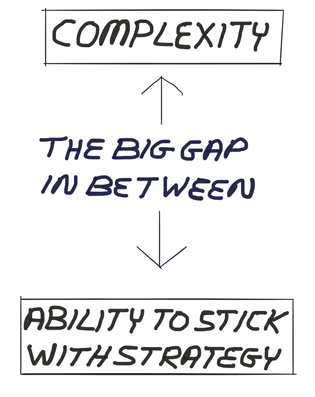 converting the inherent complexity of investing and personal finance into a graphic that I could actually draw. Both investing and personal finance are based on accounting rules, advanced mathematical equations, economic theories, psychology, regulations and law. Our job at AAII is to convey all of this in a manner that those of you without financial degrees or high levels of expertise can understand. In doing so, we regularly give thought to how we present information both in terms of text and through graphics.
Making use of graphics is more than just about including doodles in a weekly email. We want to ensure that concepts and strategies are explained in a manner someone else can understand. For some people, this means a well-written article. Others prefer a good infographic. Still others prefer presentations—either in-person or via the Web. Regardless of the outlet, properly explaining key and potentially complex concepts is the goal.
In the world of investing, this is no small thing. There are so-called financial advisers who pitch strategies and investment products they themselves do not fully understand. There are also investors who follow strategies and buy securities, funds, annuities or even life insurance policies that they don’t fully understand. Both scenarios increase the risks of something going wrong.
If you don’t understand the characteristics of an investment or how a strategy works, you’re likely not going to be able to differentiate between when your timing is simply off (e.g., small-cap value is simply out of favor) and when things are actually going horribly wrong. You will also expose yourself to unexpected volatility, costs and/or an inability to get your money out when you want to. A very large gap exists between too much complexity and a person’s ability to stick with a strategy.
At the same time, if an adviser doesn’t fully understand the investment or strategy, his or her clients will be put at risk. This is why the best thing you can do when working with an adviser is to ask questions, and keep asking questions until you fully understand what’s being pitched. If you don’t get satisfactory answers, grip your wallet tightly and walk out the door.
It can also be a good exercise to try and explain your investing strategy to someone else. See if you can do it in a short period of time. If this proves to be a difficult task, it may be that your strategy is too complicated. Alternatively, it may be that your spouse, adult child or whoever you are counting on to step in and manage your finances on your behalf cannot replicate what you are doing. In either case, a simpler strategy is needed or at least a simpler plan B that can be reverted to.
Complexity itself is not inherently bad. Some complexity can help you invest better. Examples would be concepts such as portfolio allocation, financial statement analysis, screening and retirement withdrawals. The common ground between seeking simplicity and accepting some complexity is the point at which you understand the concepts well enough to apply in them in an ongoing manner and are able to explain those concepts to others. This is where self-awareness really has big benefits. Knowing the limits of your knowledge, your willingness to deal with complexity and the amount of effort you want to put into investing can very much help you select a strategy you’ll be able to follow no matter how the market performs.

-
Five Steps for Gaining Control of Your Investments and Avoiding Mistakes – The idea of using sketches to convey investment ideas came from Carl Richards, whose drawings appeared in this AAII Journal article.
-
The Advantages of Simple Allocation Strategies – Simpler strategies often deliver the same level of performance as their more complex brethren do, as Wesley Gray explained.
Optimism among individual investors about the short-term direction of stock prices is at a new post-election low, according to the latest AAII Sentiment Survey. At the same time, neutral sentiment is at a two-month high and pessimism remains above its historical average.
Bullish sentiment, expectations that stock prices will rise over the next six months, fell 3.3 percentage points to 25.7%. Optimism was last lower on November 2, 2016 (23.6%). The drop keeps bullish sentiment below its historical average of 38.5% for the 13th out of the last 14 weeks.
Neutral sentiment, expectations that stock prices will stay essentially unchanged over the next six months, rose 1.9 percentage points to 35.6%. Neutral sentiment was last higher on February 8, 2017 (36.5%). The rise keeps neutral sentiment above its historical average of 31% for the fifth consecutive week.
Bearish sentiment, expectations that stock prices will fall over the next six months, rebounded by 1.3 percentage points to 38.7%. The rise keeps pessimism at or above its historical average of 30.5% for the 10th consecutive week and the 13th out of the last 14 weeks.
This is the third consecutive week with a bullish sentiment reading below 30%. This week’s reading is unusually low, meaning more than one standard deviation below the historical average. (The breakpoint is 28.1%.) Historically, unusually low levels of optimism have been followed by above-average gains in the stock market. The S&P 500 has realized a median six-month gain of 6.3% over the following six-month periods. Furthermore, the large-cap index has risen nearly 85% of the time following unusually low bullish sentiment readings versus nearly 72% for all six-month periods between September 1987 and November 2016.
The potential impact that President Trump could have on the domestic and global economy continues to cause uncertainty and/or concern among some individual investors, while encouraging others. At the same time, prevailing valuations and the lack of downside volatility have increased concern about the potential for a forthcoming drop in stock prices.
This week’s special question asked AAII members what influence the performance of small-cap stocks has on their outlook for stock prices. More than four out of 10 (43%) respondents said that small-cap stocks either have no influence or have only a small/minimal impact. Some of these respondents said that they do not invest in small-cap stocks, while others say that they only invest in small-cap stocks for diversification purposes. Conversely, nearly 32% of respondents said that small-cap stocks have a big influence on their market outlook. Some of these respondents noted that small-cap stocks have outperformed large-cap stocks. Others described small-cap stocks as a leading sign for the direction of large-cap stocks. About 9% say that small-cap stocks have a modest impact on their outlook.
Here is a sampling of the responses:
- "They indicate the trajectory of larger stocks. They are the “first responders” to forces affecting the stock market.”
- "I do not currently track small-cap stocks.”
- "Small cap has no effect on my outlook. Trump has a large impact.”
- "Best performers over the long term.”
- "Small-cap stocks make up a small amount of my stocks.”

Bullish: 25.7%, down 3.3 points
Neutral: 35.6%, up 1.9 points
Bearish: 38.7%, up 1.3 points
Bullish: 38.5%
Neutral: 31.0%
Bearish: 30.5%
April 13, 2017 The Influence of Perception on the Urge to Trade
April 6, 2017 A Rules-Based Approach to Managing a Portfolio
March 30, 2017 The Small-Cap Premium Still Lives on the Value Side
March 23, 2017 Helpful Steps My Late Father-in-Law Took

Discussion
No comments have been added yet. Add your thoughts to the discussion!
You need to log in as a registered AAII user before commenting.
Create an account