

Two Ways to Build and Preserve Wealth
by Charles Rotblut | January 11, 2018
For all of the chatter coming out of the financial industry about building wealth, I continue to believe that two of the best methods for individual investors are process and automation. The likelihood of success is enhanced when a good process is put in place and automation is used when it is both reasonable and realistically possible to do so.
Process is how you go about managing your finances, or accomplishing any other task for that matter. 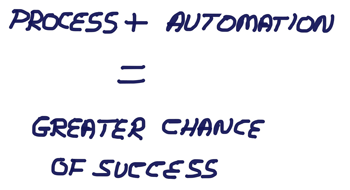 The more clear, defined and easy to follow your process is, the more likely you will be to achieve the desired outcome. Checklists can really help: Have a list of procedures you follow when making decisions or taking certain actions and then refer back to this list regularly.
Let’s say you’re analyzing a stock. What do you look at? Chances are there are some characteristics you favor. Maybe it’s a certain valuation; perhaps it’s a certain level of growth. You could require a certain yield or a particular level of momentum in the price. I make a point of scanning through the 10-K report (an annual filing required by the U.S. Securities and Exchange Commission) to see if there is anything odd or alarming. Having a checklist of what specifically to look for can help you avoid skipping an important step. As much as we might think we do the same things every single time, we all get distracted and, at times, forgetful.
The process doesn’t just have to be a checklist. I maintain a spreadsheet for my savings accounts. It shows how much I should be/am setting aside each pay period for retirement and short-term savings. Every year, I adjust the numbers on the spreadsheet to boost the dollar amount I save for the forthcoming year. Part of this adjustment is reviewing what I’m saving on a percentage basis relative to my salary so that both my savings and savings rate increase over time. The spreadsheet is a simple, but highly effective way of keeping me on track to save regularly.
Those of you who have been long-term readers or have seen me speak over the years know that I’m a big a fan of notebooks. I currently maintain several notebooks between my personal and work life. They’re inexpensive, need no instruction on how to use and are great for tracking what you are doing. They’re also good for writing down the rules you should be following. A reporter for The New York Times even made the case for choosing paper over digital apps last week.
As effective as notebooks and checklists are, they still rely on human interaction. This is where automation comes in. Automating regular tasks increases the odds that what you want done actually gets done. The contributions made to my and my wife’s retirement accounts are all automatic, as are the contributions to my “rainy day” savings account. (They all either come directly out of my paycheck or from my bank account every payday.) My mother-in-law’s required minimum distributions (RMDs) are set up to be distributed monthly to her bank account. Dividends paid by the funds and stocks my wife and I own are automatically reinvested. (Most online brokerage firms will facilitate this, not to mention all mutual fund families.) Some companies will automatically increase retirement plan [e.g., 401(k) plan] contributions for their workers (auto-escalation). You can even have your portfolio automatically rebalanced, if you choose to, via certain firms (e.g., robo-advisers). Some funds are also designed to be periodically rebalanced. Even many of your bills can be paid automatically; just be sure to look over them to ensure there are no suspicious charges.
Good processes combined with proper automation can build wealth because they put a barrier between the steps you should be taking and the emotions and distractions that may deter you from doing so. Plus, once they are set up, inertia and habit will kick in. Inertia and habit can help you stay on the right path by making it mentally tougher to shift away from what has now become your status quo.

- The Case for Systematic Decision-Making – Wesley Gray made the argument for systematic decision-making in this 2014 AAII Journal article.
- What the Evolving Robo Advisory Industry Offers – For those who prefer an automated advisory service, so-called robo-advisers could be an option. My colleague Jaclyn McClellan did a comprehensive overview of them.
Optimism among individual investors about the short-term direction of stock prices pulled back, but remains at an unusually high level, according to the latest AAII Sentiment Survey. At the same time, pessimism and neutral sentiment rebounded.
Bullish sentiment, expectations that stock prices will rise over the next six months, fell 11.1 percentage points to 48.7%. The large drop follows what had been the highest reading in more than seven years. The historical average is 38.5%.
Neutral sentiment, expectations that stock prices will stay essentially unchanged over the next six months, rose 1.6 percentage points to 26.3%. Neutral sentiment is below its historical average of 31.0% for a sixth consecutive week.
Bearish sentiment, expectations that stock prices will fall over the next six months, rebounded by 9.5 percentage points to 25.1%. The large rise follows what had been the lowest reading in more than three years. The historical average is 30.5%.
In looking at this week’s results, it’s important to keep the context of last week’s readings in mind. Last week’s bullish sentiment reading of 59.8% was only matched or exceeded on 46 weeks during the more than 30-year history of our survey. At the same time, bearish sentiment was at an unusually low level last week.
This week, pessimism is back within its typical historical range. Optimism, however, remains unusually high, as noted above. Bullish sentiment is, however, just over the border between what we consider to be a typical and an unusually high reading (48.7%).
Some individual investors are encouraged by the record highs for the major indexes, the tax cuts and/or the Federal Reserve’s decision to continue raising interest rates at a gradual pace. Other individual investors are concerned about the possibility of a pullback or a more severe drop occurring. Even many investors who are optimistic about the overall direction of stocks expect a return of volatility this year. Also affecting investor sentiment are earnings growth, economic growth, valuations and the lack of volatility. Washington politics remain at the forefront of many individual investors’ minds.
This week’s special question asked AAII members to share their thoughts about the Dow Jones industrial average reaching 25,000 for the first time. Two out of five respondents (40%) had a cautious view of the milestone, with many saying the market has gotten ahead of itself or is otherwise due for a drop. Nearly 31% view the Dow’s crossing of 25,000 as not being a significant event. About 26% are encouraged by the milestone or say it’s a reflection of President Donald Trump’s policies and/or the tax cut.
Here is a sampling of the responses:
- “As it keeps going farther up, the greater the correction is going to be.”
- “Even though I am somewhat bullish, I am afraid there is a bubble that could burst sometime this year.”
- “The new tax reform bill should continue to drive this market up.”
- “Scary! But I am sure we will see some more potential upside over the near term.”
- “The overall trend has been that of a rising market. I do not believe the number 25,000 means anything specific.”
- “This is what good economic and business policy will do!”

Bullish: 48.7%, down 11.1 points
Neutral: 26.3%, up 1.6 points
Bearish: 25.1%, up 9.5 points
Bullish: 38.5%
Neutral: 31.0%
Bearish: 30.5%
January 4, 2018 Quality Can Help Put the Odds in Your Favor
December 28, 2017 19 Investing Resolutions for 2018
December 21, 2017 Value and Momentum Work Well Together
December 14, 2017 Optimism Has Been Low This Year, but Not Unusually So

Discussion
No comments have been added yet. Add your thoughts to the discussion!
You need to log in as a registered AAII user before commenting.
Create an account