

Valuing Stocks Based on Their Dividend
by Charles Rotblut | June 02, 2016
The subject of valuing stocks by their dividend is discussed in the June AAII Journal, which was posted to our website yesterday. Specifically, Computerized Investing editor Jaclyn McClellan takes an in-depth look at Geraldine Weiss’ approach. I’m going to extend the conversation by discussing Weiss’ and other dividend valuation strategies.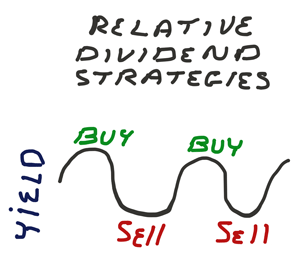
Weiss used a relative valuation approach. Using 10 years of dividend data—20 years when possible—she plotted a stock’s yields to identify its dividend cycle. Doing so alerted her to when yields were high on a historical basis (implying a low valuation) and when yields were low on a historical basis (implying a high valuation). She determined when to buy and sell based on this information. Specifically, she targeted stocks trading within 10% of their historical high yields and sold stocks trading within 10% of their historical low yields.
Those of you who incorporate technical analysis will be familiar with this type of strategy. It is akin to using a stock’s price range or channel. For both relative yield and technical analysis strategies, decisions about the attractiveness of the stock are based on how investors have historically reacted to the stock’s price and valuation movement.
An alternative method is to compare the stock’s yield relative to the universe of exchange-listed stocks. If a stock’s yield is above the market average, it is cheap on a relative basis. If the yield is below the market average, it is expensive. (Yields and valuations are inversely related, with a low yield implying a high valuation and vice versa.) We consider relative yield as part of our approach to managing the AAII Dividend Investing portfolio. Our reason for doing so is because a stock’s yield can be at the high end of its historical range and still be way below the market’s average.
Consider a stock yielding 1.0%. If this stock has historically traded within a high/low range of 1.0% to 0.5%, it looks cheap relative to what investors have been willing to pay in the past. Comparing the stock to the broader market results in a less favorable valuation. The market—as measured by the Dow Jones U.S. ETF (IYY)—currently yields 2.0%. This means an investor can get twice the yield by simply owning a broad market index. Granted, there may be other reasons to own the stock, such as strong earnings growth, but for a dividend-oriented investor, the stock is not very attractive. Hence, when using any valuation strategy, it’s always helpful to take a step back and consider the broader picture.
There is a limit to looking for higher-than-average yields, however. Data from both James O’Shaughnessy and Dartmouth professor Kenneth French show higher yields only lead to higher returns up to a certain point. Why would this be the case? Stocks with the highest yields are those most likely to be perceived as risky by investors. Often, but not always, the perception is justified, with such companies encountering financial problems and hence incurring lower returns.
It’s also possible to value a stock based on the present value of its future dividend payments. To do this, you will need to be reasonably accurate in forecasting what the future dividend stream will be and correctly determine the minimum rate of return you would require to part with your money today in exchange for a future stream of income. Both steps require making assumptions about the company’s growth rate and future interest rates. The likelihood of getting these assumptions wrong is high.
No single approach is perfect. Caveats exist with all valuation methods. Market valuations rise and fall. Business risks change. And while an investor’s short-term perceptions may be very wrong, other times they are justified. Attempts to forecast future returns and growth rates come with their own risks.
One advantage to using a relative valuation approach is its simplicity. Complexity may give an aura of confidence, but it also creates more room for assumptions to be incorrect.

-
Calculating Intrinsic Value with the Dividend Growth Model – Specific instructions to how to use the dividend discount model to calculate a stock’s value.
-
Weiss Blue Chip Dividend Yield Screen – This AAII stock screen identifies stocks based on Geraldine Weiss’ approach.
Optimism among individual investors about the short-term direction of stocks rebounded strongly in the latest AAII Sentiment Survey. The rise followed two consecutive weeks of extraordinarily low levels of bullish sentiment. At the same time, neutral sentiment plunged after having reached a 26-year high last week.
Bullish sentiment, expectations that stock prices will rise over the next six months, jumped 12.4 percentage points to 30.2%. Though a six-week high, optimism is only at the lower end of its typical historical range. Furthermore, bullish sentiment remains below its historical average of 38.5% for the 30th consecutive week and the 63rd out of the past 65 weeks.
Neutral sentiment, expectations that stock prices will stay essentially unchanged over the next six months, fell 12.1 percentage points to 40.8%. Even with the significant drop, neutral sentiment remains at an unusually high level. This is the 13th consecutive weekly reading above 40% and the 18th consecutive week that neutral sentiment has been above its historical average of 31.0%.
Bearish sentiment, expectations that stock prices will fall over the next six months, declined 0.3 percentage points to 29.1%. Pessimism is below its historical average of 30.5% for the 12th time in the past 14 weeks.
As noted above, this week’s big change in bullish and neutral sentiment follow what had been extraordinarily low and high, respectively, readings for both measures. Even with the big changes, optimism remains low and neutral sentiment remains high. Pessimism is close to, though technically below, its average.
Giving individual investors cause for concern is the slow pace of U.S. economic growth and uncertain pace of global economic growth, terrorism and global unrest, lackluster corporate earnings, the prevailing level of valuations, the forthcoming election and monetary policy. Some AAII members, however, are encouraged by sustained domestic economic growth, corporate earnings and still comparatively low energy prices.
This week’s special question asked AAII members how big of an impact news and data about Europe, including Great Britain, is having on their outlook for the U.S. stock market. Nearly three out of five respondents (58%) said it was either not affecting their outlook or only having a small impact. Many of these individual investors added that domestic events (including the Federal Reserve, the economy and the November elections) are having a bigger impact on their U.S. market outlook. Slightly more than 19% said that events in Europe are having some impact. Just under 12% said Europe is or could have a significant impact due to Great Britain’s referendum on the European Union membership (“Brexit”) and/or its economy’s influence on U.S. multinational corporate profits.
Here is a sampling of the responses:
- “No impact from Europe and Great Britain. I feel that the U.S. political arena is the significant factor.”
- “None. What the Fed does and whether the U.S. economy can break out of continuing weakness are dominating my decisions.”
- “Not much. I don’t think Great Britain will withdraw from the European Union.”
- “I think the Brexit and general European outlook will affect the U.S. market somewhat, but not critically.”
- “Small impact, but I am watching closely.”

Bullish: 30.2%, up 12.4 points
Neutral: 40.8%, down 12.1 points
Bearish: 29.1%, down 0.3 points
Bullish: 38.5%
Neutral: 31.0%
Bearish: 30.5%
May 26, 2016 The Most Tax-Efficient Investment
May 19, 2016 Crowdfunding Is Here; What You Need to Know
May 12, 2016 My Notes From the CFA Conference
May 5, 2016 Don't Be Quick to Sell (or Rotate) in May

Discussion
No comments have been added yet. Add your thoughts to the discussion!
You need to log in as a registered AAII user before commenting.
Create an account