

What Type of Individual Investor Are You?
by Charles Rotblut | July 16, 2020
Special note: Come to AAII.com and check out the redesigned home page, which launched today. The new design highlights useful content and directs you to areas of the site that should help you become a better investor.
During the past few weeks, we’ve been discussing stocks, bonds and asset allocation strategies. This week, we’re going to focus on something more tactical: who is responsible for implementing the allocation strategy and managing your portfolio? Are you going to do it? Are you going to hire an adviser to help you? Are you going to use mutual funds instead?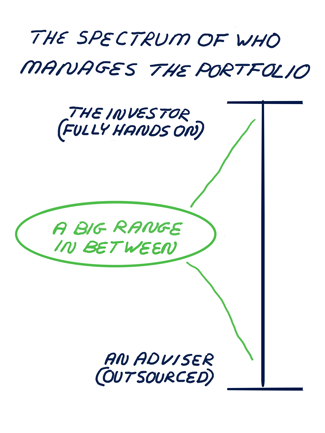
For dyed-in-the-wool do-it-yourself (DIY) investors, the answer is obvious: They want to make all of the decisions. Others take comfort in having a professional manage their portfolio. In between, there is a wide spectrum. I’m going to discuss this spectrum while we create a framework to help you determine where you are on the spectrum.
I’ll start with a fully hands-on investor. This type of investor likes to handpick the stocks and bonds matching their allocation strategy. An investor who follows this approach has the time and interest to research individual securities. Successful ones have the discipline to adhere to a systematic approach for carrying out such a strategy and adjusting their portfolios as necessary. This type of approach requires enough wealth to hold a diversified portfolio of securities.
A partially hands-on investor combines holding individual securities with mutual funds, exchange-traded funds (ETFs) or closed-end funds. This investor owns both individual securities (most commonly individual stocks) and funds. An example would be an individual investor who picks their own stocks but uses mutual funds or ETFs for the bond portion of their portfolio. The approach requires less wealth and less time relative to the fully hands-on approach. It also offers greater diversification among individual securities.
Those of you participating in 401(k) plans or similar defined-contribution plans offered by your employer may be following this type of approach without thinking about it. You could hold individual stocks in your IRAs and traditional brokerage accounts, while holding mutual funds in your 401(k) account. Even though your workplace retirement plan choices are limited to a specific set of funds, you are still making the active decision of which funds to hold.
The index investor prefers index mutual funds and ETFs over individual securities. They view passive strategies as advantageous. The wealth requirement to follow this is very low. The amount of time required to follow such a strategy after an allocation strategy is decided upon is limited to selecting the appropriate funds, periodically monitoring them for any changes (e.g., a switch in the benchmark index followed) and reviewing the portfolio on a set schedule to ensure the allocation targets are being maintained. This approach has among the lowest costs but cedes control over the securities chosen.
The fund investor is similar to the index investor with the exception that they consider owning actively managed funds. This type of investor is either hoping to outperform the market and/or takes comfort in knowing a professional portfolio manager is choosing the investments and (potentially the allocation). It can also be unintentionally followed, such as when an actively managed target-date fund is the default investment option in a workplace retirement plan. The strategy requires less time and wealth than the fully hands-on or partially hands-on approaches but can require closer monitoring than the index investor approach and has a higher ongoing cost.
The combo hands-on/works with an adviser investor combines using an adviser with personal control of investments. This type of investor hires a financial professional—such as a financial planner or a financial adviser—to provide assistance with carrying out their investment strategy. A fee-only planner might be used on a periodic basis to assist with the portfolio review process to ensure the allocation strategy chosen matches current goals, or to simply provide objective feedback and consultation. A financial adviser might be hired to select investments. Alternatively, a portion of the portfolio might be given to a robo-adviser to be managed, while part of the portfolio is self-managed. This type of approach works best for those who want some personalized assistance while still making their own investing decisions. The level of wealth required depends on the amount of assistance sought and the type of professional hired (e.g., a fee-only financial planner could work well for those seeking consultation and feedback, but not specific investment recommendations). This type of approach can save time but comes with potentially higher costs—especially if a traditional (non-robo) financial adviser is hired.
A twist on this combo approach is a bolt-on approach. This involves working with specialists to address specific tasks. For instance, a life insurance agent could be contacted for the purchase and management of policies. Alternatively, a tax professional or estate attorney may be warranted. A good fee-only financial planner or financial adviser may be able to serve as a hub for providing recommendations to these types of specialists and, for those with complex financial and estate-planning needs, coordinating their recommendations.
The adviser investor hires a professional to carry out their allocation strategy. This investor outsources the process of implementing and managing their allocation and investment strategy. It can make sense for those who lack confidence, knowledge and/or the time to make their own investing decisions. As one ages, turning over management of investment decisions can a prudent decision though the selection of an adviser (or a trusted family member instead) should be done well before cognitive issues evolve. Robo-advisers would be a consideration for those with moderate levels of wealth and who don’t require much one-on-one communication. A traditional adviser makes sense if you have complex financial and/or estate-planning needs.
We’re planning on using these categorizations to create a worksheet to help you determine where you fit on the spectrum. So, tell us in the comments section below whether we’ve appropriately covered the spectrum.

-
Active Management Stinks, But It Doesn’t Have To – Daniel Crosby thinks incorporating some characteristics of passive investing, including low turnover and low fees, can improve active investing approaches.
-
Advice on Evaluating an Adviser From an Industry Veteran – There are five questions investors should ask when evaluating an adviser.
The percentage of individual investors describing their six-month outlook for stocks as “neutral” is at a 10-week low. The latest AAII Sentiment Survey also shows increases in both optimism and pessimism.
Bullish sentiment, expectations that stock prices will rise over the next six months, rose 3.7 percentage points to 30.8%. This is a five-week high. Nonetheless, optimism remains below its historical average of 38.0% for the 19th consecutive week and the 24th week this year.
Neutral sentiment, expectations that stock prices will stay essentially unchanged over the next six months, fell 6.4 percentage points to 23.8%. Neutral sentiment was last lower on May 6, 2020 (23.7%). Neutral sentiment is below its historical average of 31.5% for the 25th week this year.
Bearish sentiment, expectations that stock prices will fall over the next six months, rebounded by 2.7 percentage points to 45.4%. Pessimism remains above its historical average of 30.5% for the 21st consecutive week and the 23rd time this year.
Optimism is back within its typical historical range, while pessimism continues to be at an unusually high level. Neutral sentiment is now near the lowest end of its typical range.
The current level of pessimism reflects concerns about the coronavirus pandemic and the economy. However, some AAII members have been encouraged by the rebound in the stock market from its March lows. Other factors influencing AAII members’ sentiment include the economy, corporate earnings, the November U.S. presidential election and interest rates.
In this week’s special question, we asked AAII members which industries or sectors they think are attractive buying opportunities in the current market environment. Some of the respondents gave more than one answer.
More than one out of four respondents (27%) name the technology sector, while 17% favor the health care sector. This compares to 7% of respondents who say that they think the energy sector is an attractive buy opportunity and 7% of respondents who say that they are looking at precious metals.
Other sectors and industries include consumer staples (named by 5% of respondents); utilities (named by 3% of respondents); financials (named by 3% of respondents); consumer cyclicals (named by 3% of respondents); and pharmaceuticals (named by 3% of respondents).
Here is a sampling of the responses:
- “Things are fairly or overpriced in the current market environment, but health care, consumer staples and utilities look the best right now.”
- “Individual security selection is more important in this market environment. That being said, I like technology, health care and consumer discretionary the best.”
- “I think the market is way ahead of itself and I am not a buyer at the moment, but I may buy a little more gold and/or silver.”

Bullish: 30.8%, up 3.7 points
Neutral: 23.8%, down 6.4 points
Bearish: 45.4%, up 2.7 points
Bullish: 38.5%
Neutral: 31.0%
Bearish: 30.5%
July 9, 2020 Revising Our Asset Allocation Models
July 2, 2020 Bonds Have a Role Even With Current Interest Rates
June 25, 2020 Comparing the Five Major Categories of Stocks
June 18, 2020 How Much Could You Gain or Lose in One Year?

Discussion
John Quigley from TX posted over 6 years ago:
I manage our portfolio's IRA and Jt-Ten accounts. I worked for Bache & Co., in NYC for almost 10 years and then was with a mutual fund management company in San Antonio TX for a few years and held a 63 while there. I have been managing our accounts for the past 20 years, and have managed to keep us going well. We did get burned in the Pandemic, as did many others both professional and amateur. We are coming back nicely though and almost back to where we were before the mess hit.
DEM from AZ posted over 6 years ago:
I don't think we exactly fit in any of the categories. We used Ameriprise a long time ago but got burned on fees and poor advice. I am a DIY using mutual funds (no ETFs or stocks). We have some Index funds but mostly not, it isn't because I expect to "beat the market". I do very little buying/selling. We had paper losses thia spring but did not sell so have mostly recovered already.
Dan L. Smith from VA posted over 6 years ago:
I like your categories. I have been in the Index/Fund Categories ever since I got my Life Subscription to AAII in 1988. Last month I bought both my sons, who are in their low 30’s and saving 15% of their earnings for retirement, a Life Subscription each. I have always felt that the volatility was not as much of an issue as the advisors say, and have been fully invested in the market for 36 years. That has worked well, and now as I’m retiring I’ve made a detailed budget for all the “Basic Expenses”, with things like health increasing as a percent each year as we get older. This year, with the pandemic and no travel or restaurants, the spending is even less than our budgeted Basic. All values are in constant, inflation adjusted dollars. Since we are waiting to start Social Security until I’m 70, the SS will more than cover all the Basic Expenses and then some. I also estimated how much we would spend for “Fun Money”, and made a graph showing SS, Basic Needs, and the Total of Basic and Fun Money. I therefore know how much I will need from savings each year, and have 3 years in an Ally Savings account. The rest is in the Market, as in Level3. I also have a graph of what the savings will be if we make 1, 3, and 5 percent after inflation over the next 30 years. Our savings are in Roth accounts, so there should be no tax. I also graph: • if we spend $10K more and less than the budget. • if the Market does the top range and we spend $10K more than budgeted, or • the market is at the bottom range for 30 years and we spend $10K less than budgeted. That works for me, and gives me a good idea of where we are and also the future. I can also do what-ifs, such as if the market plunges by a third in 2 years, or we spend $100 for a more expensive house. Thoughts?
c Bartel from IL posted over 6 years ago:
I think your categories are good.
RetiredInvestor from TN posted over 6 years ago:
I guess I am a Hybrid investor. I make the decisions as to allocation and then fit various vehicles to the allocation. I use individual stocks and bonds as well as mutual funds and ETFs as I deem appropriate. I believe in diversification that spans not only the category of the investment but also the type. My wife an I have multiple accounts including tax deferred, tax free and taxable accounts. I combine these in amounts to determine the overall allocation levels of our total portfolio. The portfolio is updated monthly and allocations are adjusted semi-annually if needed. My allocation choice as well as my asset selections are reviewed by an outside advisor at least annually to determine if I am missing anything or just not thinking logically. I am 69 years old and have been retired for 10 years. Our net worth has more than tripled in that time frame so something is working.
DB from Nevada posted over 6 years ago:
I've recently moved from full hands on to combo hands on investor. I'm late 70's so it's time for help in managing investments. I'm really interested in how to manage the manager. We agreed upon a written investment plan that includes measuring overall results to a benchmark.
Plumb from CA posted over 6 years ago:
I think your categories cover the options well. As someone in the partially hands-on category, I'll be interested to see what you come up with.
You need to log in as a registered AAII user before commenting.
Create an account