


Charles Rotblut leads a class in AAII's new Essential Investing Video Course. Go to https://www.aaii.com/ves for more information and to subscribe.
The Tax Cuts and Jobs Act (TCJA) led to a sharp increase in the usage of the standard deduction. Slightly more than two-thirds (68.0%) of all returns filed for 2017—the last year prior to the TCJA taking effect—claimed the standard deduction. In comparison, 87.3% of all individual tax returns filed in 2020 claimed the standard deduction, according to the Internal Revenue Services (IRS).
The reason for the change was the large increase in the deduction instituted by the TCJA. The law raised it from an originally inflation-adjusted amount of $13,000 to $24,000 in 2018.
The TCJA also altered how inflation adjustments are determined. The consumer price index (CPI) was replaced with the chained CPI. The chained CPI factors in potential differences in consumer choices if one item or service rises faster in price than another. This results in the chained CPI calculating a slower rate of price increases.
Figure 1 shows how the standard deduction has changed since the TCJA went into effect. Between 2018 and 2021, the deduction rose by a cumulative $1,100. The cumulative increase between 2021 and 2024 is $4,100. The 2024 inflation adjustment of 5.4% will raise the standard deduction for married joint filers to $29,200. (It will be $14,600 for single filers.)
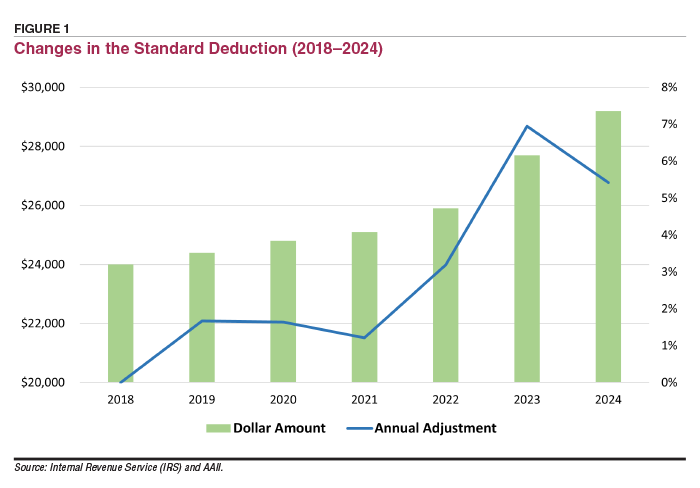
Larger standard deductions make it harder to itemize deductions. This is a double-edged sword. Taking the standard deduction eliminates the need to fill out IRS Schedule A (Form 1040). This simplification comes with the trade-off of having a higher hurdle to claim various deductions, including charitable donations. Taxpayers still benefit from the larger standard deduction if it is higher than the deductions they would otherwise claim.
Keep in mind that the standard deduction along with many income tax brackets, exemptions and other deductions are set to return to their pre-TCJA levels (though still adjusted for inflation) after 2025 without congressional action.

Discussion
FREE REPORT

Get your free copy of our special
report analyzing the tech stocks
most likely to outperform the
market.
ROBERT A from NC posted over 2 years ago:
DAVE G from TX posted over 2 years ago:
CAROL B from CO posted over 2 years ago:
RICHARD E from TX posted over 2 years ago:
You need to log in as a registered AAII user before commenting.
Log InCreate an account