

Related

Tax Strategies
In addition to large inflation adjustments being made for a second consecutive year, several changes related to the SECURE 2.0 Act will go into effect.
by AAII Staff | December 2023

Inflation may have slowed from last year, but its impact is still noticeable in adjustments made for 2024 taxes. The Wall Street Journal describes the 5.4% increase in the standard deduction and tax bracket thresholds as “the second largest adjustment in the last three decades after last year’s 7.1% hike.” Our calculations show inflation-related adjustments ranging from 2.2% for 401(k) and 403(b) contributions to 7.7% for individual retirement account (IRA) contributions. The percentage differences reflect the various dollar thresholds for making adjustments.
The Tax Cuts and Jobs Act (TCJA) mandated the use of the chained consumer price index (CPI) for determining inflation adjustments. The TCJA also instituted many other changes to the tax code. They included lower marginal tax rates, higher standard deductions, larger alternative minimum tax exemptions and capping the deduction of state and local taxes (“SALT”). These changes are set to sunset in two years unless new legislation is passed.
No matter how the tax laws (and tax forms) evolve in the future, one thing is constant: You will still have to pay taxes. The tax code is complex, hence the need for tax guides. As has been the case in years past, our tax guide provides an overview of the tax rates and deductions likely to impact the majority of AAII members. Since there are many details, loopholes and pitfalls within the tax code, it is impossible for this guide to provide enough details to cover specific tax situations. If you have questions, consult a tax professional. It is your tax return, and the Internal Revenue Service (IRS) will hold you responsible for any errors made on it.
A special note of thanks goes out to Ed Slott of Ed Slott and Company LLC for answering questions about the rule changes for inherited IRAs and A special note of thanks goes out to Ed Slott of Ed Slott and Company LLC for answering questions about the rule change for inherited IRAs and to Mark Luscombe, a principal analyst at Wolters Kluwer Tax & Accounting, for previous assistance in answering detailed questions about the tax code. Sources of information used for this year’s guide also include the Internal Revenue Service, Healthcare.gov, Medicare.gov, the Social Security Administration, The Kiplinger Tax Letter and The Wall Street Journal.
We’ve added a new section devoted to the SECURE 2.0 Act and related changes to this year’s guide. It covers the changes that went into effect this year or will go into effect next year that will impact the majority of individual investors. The updated inherited IRA rules are also covered given the guidance issued by the IRS earlier this year.
Unlike 2023, most taxpayers will face the traditional April 15 deadline for filing their tax returns. Those living in Maine or Massachusetts may file by April 17. Even though you can wait until the deadline, we continue to advise filing your taxes as early as possible to make it more difficult for a fraudster to file a false return under your name.
Other tax deadlines have been extended for victims of natural disasters. See www.irs.gov/newsroom/tax-relief-in-disaster-situations if you were affected by a hurricane, flooding, wildfire or other disaster for more information and the available tax relief options.
The IRS will conduct a limited pilot of its new Direct File option. Direct File will allow taxpayers to file their returns directly with the IRS at no cost via their computer, tablet or phone. Requirements to participate are likely to include W-2 wage income and/or Social Security and railroad benefits, interest income of $1,500 or less and claiming the standard deduction. Arizona, California, Massachusetts and New York will work with the IRS to integrate their state taxes. Taxpayers in Alaska, Florida, New Hampshire, Nevada, South Dakota, Tennessee, Texas, Washington and Wyoming—all of which do not have state income taxes—may also be able to participate in the pilot program. See www.irs.gov/directfile for more information.
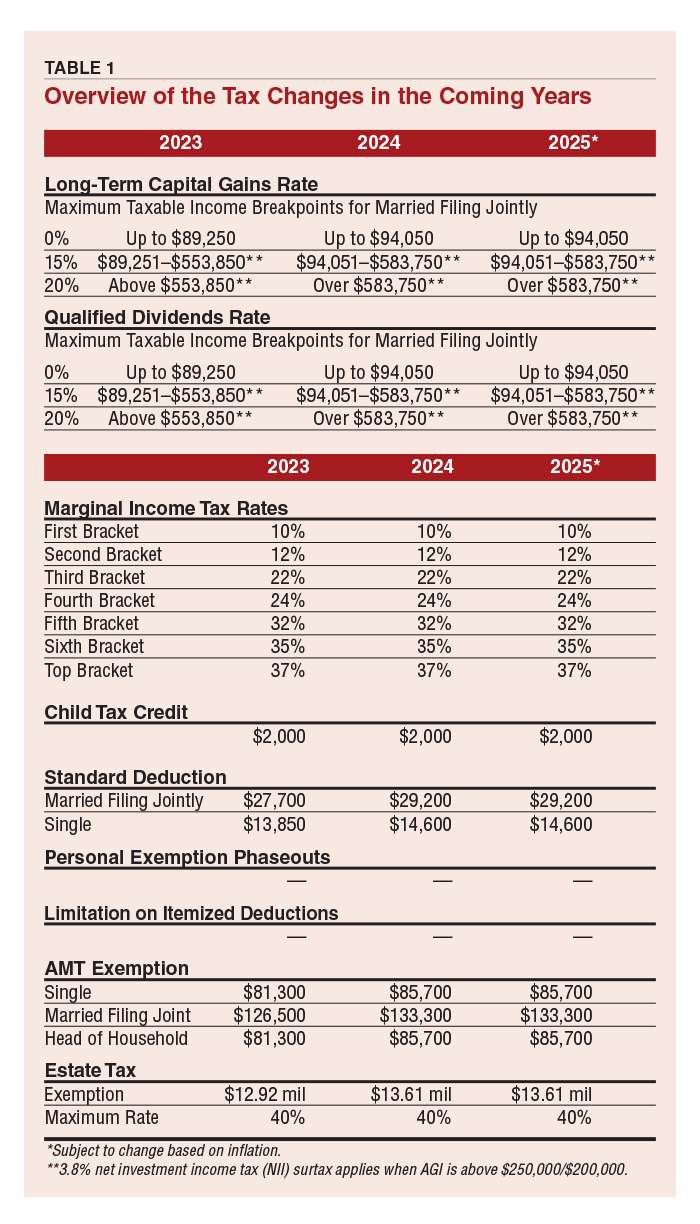
The TCJA revised marginal tax brackets remain in effect. They are 10%, 12%, 22%, 24%, 32%, 35% and 37%. As previously noted, these reduced rates are presently set to expire after 2025.
The U.S. Supreme Court will hear a case this session that could have major ramifications for the tax code. At issue is a provision in the TCJA mandating that companies make a one-time inclusion of deferred foreign earnings in their taxable U.S. income for the past 30 years. The plaintiffs in the case allege this deemed repatriation is unconstitutional. A broad ruling, as opposed to a narrow one, by the court could have big implications for what a follow-up to the 2017 TCJA looks like.
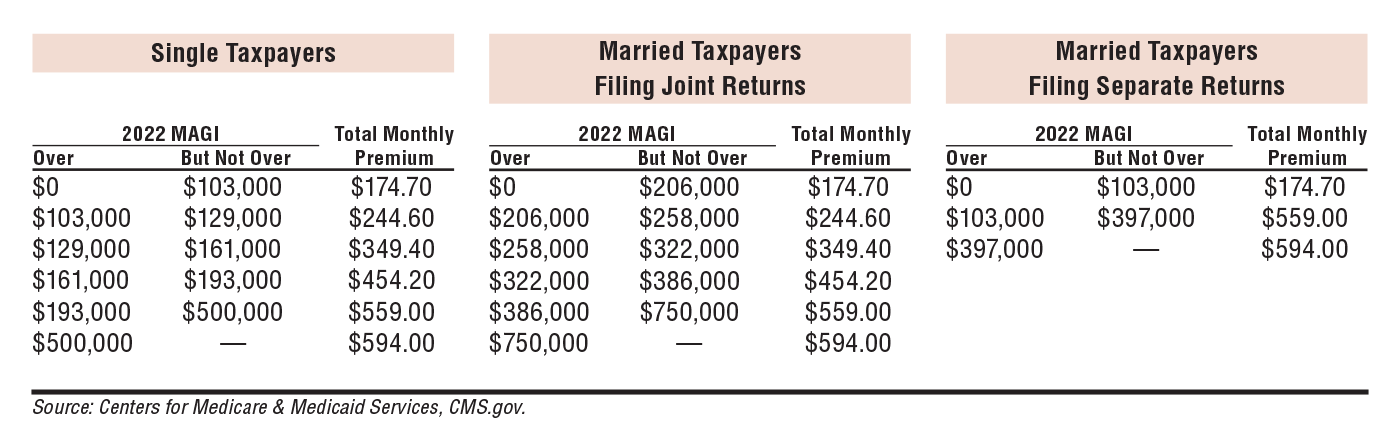
After declining last year, Medicare Part B premiums will rise in 2024. Married joint and single filers with modified adjusted income (MAGI) below $206,000 and $103,000, respectively, will see their monthly premiums rise 5.9% to $174.70. Medicare participants will continue to see future increases in their Part D premiums capped at 6% per year through 2029 as a result of the Inflation Reduction Act. For Part D, joint filers with MAGI between $206,000 and $258,000 ($103,000 and $129,000 for single filers) will pay an additional $12.90 per month in 2024.
Mark Wilson, who runs the CapGains Valet website, thinks this year could be below average in terms of mutual fund capital gains distributions. Last year’s tough market conditions, the lack of a big increase in withdrawals from mutual funds and a low number of companies reporting capital gains distributions so far are reasons why. Only 49 funds declared distributions in excess of 10% as of early November (versus 233 at approximately the same time last year). The annual average number of funds making distributions exceeding 10% since 2014 is 384.
Be aware that mutual funds, as well as exchange-traded funds (ETFs), can make capital gains distributions even during years when their returns are flat or negative. This occurs when the gains that funds realize from selling profitable positions exceed the amount of realized losses they can use to offset the gains. Even if the price of a security held by a fund declines, it is possible for the fund’s sell price of a security to exceed the price the security was purchased at.
Student loans canceled under federal debt relief are not taxable for federal income tax purposes.
The draft versions of the 2023 Form 1040 and Form 1040-SR—which is for taxpayers age 65 or older—are very similar to last year’s versions. The only change we noticed was a new and bigger spot for designating your claiming status.
Taxpayers will continue to be asked if they received, sold, exchanged or gifted a digital asset. These assets include both cryptocurrency and non-fungible tokens (NFTs). Check the final version of the 1040 instructions if in doubt. The draft version of the instructions says you “generally” aren’t required to check “yes” if you purchased “digital assets using U.S. or other real currency, including through the use of electronic platforms such as PayPal and Venmo.”
Unlike 2022, there was no midyear change in the mileage rates for 2023.
The SECURE 2.0 Act was enacted at the end of 2022. Here is a list of the changes that were either effective in 2023 or will go into effect in 2024 and will impact many individual investors.
Catch-up contributions to traditional and Roth IRAs will be indexed to inflation starting in 2024. No inflation adjustment was announced for 2024, but any future adjustments will be made in increments of $100.
High earners will have two additional years before their catch-up contributions to a 401(k) and similar plans must be made on a Roth (aftertax) basis. The new rule will go into effect in 2026 and not 2024. The IRS made the change to allow plan sponsors more time to facilitate the new rule.
The IRS also clarified that catch-up contributions could continue to be made by all eligible participants. The wording in the SECURE 2.0 Act had been interpreted by some observers as eliminating all catch-up contributions to defined-contribution plans like 401(k) plans. Congress had yet to pass legislation correcting the error, and other errors, in the law as of press time.
The required beginning date (RBD) to start taking a required minimum distribution (RMD) was raised from age 72 to 73. The change is effective for tax year 2023. Retirement account owners who attain age 72 this year had until September 30, 2023, to roll back distributions taken this year under the old RMD rules into their accounts. (The RBD will rise to age 75 in 2033.)
RMDs do not apply to Roth 401(k) and Roth 403(b) plans starting in 2024. The RMD rules were in effect in 2023 and those who are 73 or older this year must take their RMDs. Individuals who turned 72 in 2023 will not have to take any RMDs from these types of accounts in 2023 or beyond. RMDs will still apply for traditional 401(k) and 403(b) plan accounts once the applicable RBD is reached.
Starting in 2024, up to $35,000 from 529 college savings plans can be rolled over to a beneficiary’s Roth IRA on a tax-free basis. To qualify, the 529 plan must have been funded for at least 15 years ending on the date of distribution, the amount cannot “exceed the aggregate amount contributed to the program (and earnings attributable thereto) before the five-year ending on the date of the distribution” and the rollover must be made via a “direct trustee-to-trustee transfer to a Roth IRA maintained for the benefit of such designated beneficiary. In addition, Roth IRA contribution limits apply. This means the total of IRA/Roth IRA contributions and any 529-to-Roth rollovers cannot exceed the contribution limit for the calendar year.
Qualified charitable distributions (QCDs) will be indexed to inflation starting in 2024. QCDs will rise to $105,000 in 2024 from $100,000 in 2023.
Effective this year (2023), up to $50,000 from an IRA can be used by retirees age 70½ or older to fund a gift annuity. The amount can be used to offset RMDs for the year the gift annuity was funded dollar for dollar. The gift can only be made in one year, according to The Wall Street Journal, and counts toward the QCD annual limit.
The IRS further clarified the rules regarding RMDs from inherited IRAs. As background, the agency proposed a rule change in February 2022 requiring certain designated beneficiaries subject to the 10-year rule to take RMDs. Specifically, if the deceased IRA owner died both in or after 2020 and on or after their RBD, beneficiaries must continue to take RMDs each year until all assets are withdrawn from the inherited IRA. Beneficiaries subject to this rule can just take the RMDs each year and then withdraw the remaining account balance by the end of the 10th year after the original owner’s death or withdraw the full amount prior to the 10th year.
This past July, the IRS extended the relief for delaying RMDs from inherited IRAs through 2023. The grace period includes nonspouse beneficiaries (technically, non-eligible designated beneficiaries, or NEDBs) who inherited an IRA from someone who died in 2022. No penalty will be applied to these beneficiaries who did not take the RMD in 2021, 2022 or 2023. Penalties are expected to apply to RMDs not taken in 2024.
The rule clarifications do not change the new surviving spouse designation. The spouse of an employee who dies will be able to elect to be treated as a “surviving spouse” beginning in 2024. By doing so, the surviving spouse will be treated as if they are the employee and will not need to take distributions from the deceased spouse’s plan account until the employee would have reached their RBD for taking withdrawals. Furthermore, if the surviving spouse dies before plan distributions start, they would be treated as if they were the employee.
The penalty for missing an RMD (outside of the aforementioned grace period for inherited IRAs) has been reduced from 50% to 25% effective in 2023. If the missed RMD is taken and the penalty is paid within two years, the penalty is reduced to 10%.
You can estimate your 2023 and 2024 tax liabilities on our Tax Forecasting Worksheet. This downloadable Excel spreadsheet will calculate the results based on the data you enter and can be saved for your records.
It’s painful enough to pay taxes. Paying additional amounts to file your taxes can add to the pain. Taxpayers with adjusted gross income (AGI) of $73,000 or less may be able to file their taxes for free through certain providers. See https://apps.irs.gov/app/freeFile for more information. (Free File has been around since 2003 and is different than the previously mentioned Direct File pilot.)
You may also be able to file your state taxes for free. Check with your state’s revenue department. Illinois, for instance, allows taxpayers to file through its website at no charge.
Here is a list of the tax rates, deductions, exemptions, credits and other related items that may apply to your 2023 and 2024 taxes. These numbers reflect the changes made by the American Taxpayer Relief Act of 2012 (ATRA), the 2017 TCJA, the American Rescue Plan Act of 2021, the Consolidated Appropriations Act of 2021, the 2022 SECURE 2.0 Act and the 2024 adjustments released by the IRS as of November 9, 2023.
The alternative minimum tax (AMT) exemption is $126,500 for married couples filing jointly and $81,300 for single filers in 2023. In 2024, the exemption will rise to $133,300 and $85,700, respectively. The phaseout levels for 2023 are $1,156,300 for married filing jointly and $578,150 for singles. They will increase to $1,218,700 and $609,350, respectively, in 2024. The TCJA’s higher levels are in effect through 2025 and are indexed to inflation.
The rate at which your long-term capital gains and dividends will be taxed depends on your taxable income and not your marginal tax bracket. Under the TCJA, married couples filing joint returns with taxable income up to $89,250 ($44,625 if single) in 2023 will not owe taxes on capital gains or qualified dividends. Couples with incomes of $89,251 to $553,850 ($44,626 to $492,300 for singles) will pay a 15% tax rate. Filers with income above those levels will pay a 20% tax on long-term capital gains and dividends. These levels are indexed to inflation and will rise in 2024: No taxes up to $94,050/$47,025 for married and single filers, respectively; 15% tax rate up to $583,750/$518,900 for married/single; and 20% for those with taxable income above those levels.
To be eligible for the long-term capital gains rate, you must have owned the eligible asset for at least 12 months. The discounted qualified dividend tax rate applies to stock dividends and requires a holding period of at least 61 consecutive days during a 120-day period beginning 60 days before the ex-dividend date. (There is no capital gains tax or dividend taxes for securities held within a retirement account, such as an IRA. See Robert Carlson’s article, “Do’s and Don’ts of IRA Investing,” in the March 2010 AAII Journal for investments that can cause an unexpected tax problem.)
For a complete tax guide to the buying and selling of your personal investments, go to our Personal Investments 2023 Tax Guide.
Collectibles, which include gold coins and bars, are taxed at a maximum 28% rate. Mutual funds and ETFs investing in precious metals may also be subject to the collectibles tax rate. Check with the fund company if you have questions about the tax status.
Short-term capital gains are taxed as ordinary income.
Municipal bond interest is exempt from federal tax, as well as state and local taxes if you live in the same state as the issuer. Treasury bond interest is taxable at the federal level, but not the state level. Corporate bond interest is taxable at both the federal and state level. (Bond interest is not taxed in states with no income tax.)
Married couples filing joint returns with net investment income (NII) and modified adjusted gross incomes (MAGI) above $250,000 and single filers with NII and MAGI above $200,000 also must pay the additional 3.8% NII surtax on capital gains and dividends. Collectibles are also eligible for the 3.8% surcharge. The $250,000/$200,000 thresholds are not indexed to inflation and will remain the same in 2025.
Cryptocurrency is treated as property for tax purposes. According to the IRS, “A taxpayer generally realizes capital gain or loss on the sale or exchange of virtual currency.”
The tax impact of the Affordable Care Act includes surcharges, higher limits on medical expense deductions and changes to health flexible spending account (FSA) contributions and carryovers. All of these will remain in effect unless repealed by new legislation.
A 0.9% additional Medicare tax applies to wages, compensation and self-employment income above $250,000 for married persons filing jointly and qualifying widow(er)s, $200,000 for single persons and heads of household and $125,000 for those who are married but filing separately. The tax applies to wages that are subject to the Medicare tax and does not depend on adjusted gross income (AGI). Should the additional tax not be withheld from wages (a situation that could occur for dual-income couples or individuals working more than one job), the tax could be subject to a penalty if not paid with estimated taxes or through additional withholdings (you can request that your employer increase the income tax withholding on your W-4). More information about the additional Medicare tax can be found on the IRS website at www.irs.gov/businesses/small-businesses-self-employed/questions-and-answers-for-the-additional-medicare-tax.
A 3.8% surtax on net investment income (NII) applies to the lesser of NII or modified adjusted gross income (MAGI) exceeding $250,000 for married persons filing jointly and qualifying widow(er)s, $200,000 for single persons and heads of household and $125,000 for those who are married but filing separately. (These thresholds are not indexed to inflation.) Investment income subject to the tax includes, but is not limited to, taxable interest, dividends, non-qualified annuities, rents and royalties, capital gains and passive income from partnerships. Capital gains from the sale of one’s primary residence are subject to the tax to the extent that the income exceeds the applicable home sale exclusion ($500,000 for joint filers and $250,000 for single filers). Excluded are tax-exempt interest (e.g., municipal bond interest payments), distributions from individual retirement accounts (IRAs) and distributions from qualified retirement plans [e.g., 401(k) plans]. The IRS has answers to common NII surtax questions at www.irs.gov/uac/Newsroom/Net-Investment-Income-Tax-FAQs.
The 2021 Appropriations Act made permanent the 7.5% of AGI floor for deducting medical expenses. The floor applies to all individuals regardless of age. Health FSA contributions for 2023 are limited to $3,050 annually. This limit is indexed to inflation and will increase to $3,200 in 2024. At the election of their plan sponsors, employees can either carry over unused balances into the next plan year or take a grace period of up to two and a half months. The carryover amount is indexed to inflation and will increase from $610 in 2023 to $640 in 2024.
Brokers are required to report the cost basis for stocks purchased after January 1, 2011; mutual fund, ETF and dividend reinvestment program (DRP) shares purchased after January 1, 2012; and options and traditional bonds bought and sold by their clients on or after January 1, 2014. If you bought a stock, fund, option or bond before the aforementioned dates, your broker is not required to report the cost basis.
Certain debt instruments, particularly those that are more complex than traditional bonds, purchased after January 1, 2016, fall under the cost basis reporting rules. These include variable-rate bonds (including inflation-adjusted bonds), stripped bonds and convertible bonds. Excluded from this rule are debt instruments where the principal is subject to acceleration (e.g., mortgage-backed securities) and debt instruments with a fixed maturity date not more than one year from their issue date.
If you sold a capital asset in 2023, you will need to fill out Form 8949. See the online version of this guide for details on the reporting rules.
Brokers are required to report cost basis for stocks purchased on or after January 1, 2011; mutual fund, exchange-traded fund (ETF) and dividend reinvestment plan (DRP) shares purchased on or after January 1, 2012; and options and traditional bonds purchased on or after January 1, 2014. Brokers are also required to state whether any gain or loss on a sale is short-term or long-term. The rules do not apply to securities and funds purchased before the aforementioned dates.
Traditional bonds and debt instruments purchased on or after January 1, 2014, are subject to the reporting rules. The cost basis of and the proceeds for variable-rate bonds, inflation-indexed bonds, convertible bonds, stripped bonds and other complex debt instruments purchased on or after January 1, 2016, fall under the same reporting rules. Excluded are debt instruments where the principal is subject to acceleration (e.g., mortgage-backed securities) and debt instruments with a fixed-maturity date not more than one year from their date of issue.
Investors have the option of notifying their broker as to how market discounts or interest are treated. Brokers will follow a default method of amortizing bond premiums if not otherwise notified. The rules are complex and we suggest speaking with your brokerage firm about the application of the rules, as well as with a tax professional about the best tax treatment to use.
The type of option owned alters how cost basis is reported. Index options may be subject to different cost basis reporting rules. Again, we suggest speaking with your broker if you have questions about how the cost basis is reported.
A default accounting methodology known as first-in, first-out (FIFO) is used when the purchase of securities (other than a mutual fund or DRP shares) involves more than one transaction. The FIFO method treats the first shares purchased (“first in”) as also being the first shares sold (“first out”). Depending on how the stock has performed, this treatment can result in a larger tax bill (the shares appreciated in value) or a bigger capital loss (the shares fell in value).
For mutual funds and DRP stocks, the adjusted basis must be reported in accordance with the broker’s default method—average cost basis—unless you specify otherwise. As the name implies, the average purchase price for your shares, regardless of when they are acquired, is used to determine the cost basis. You can specify FIFO instead of average cost basis. Another option is specific identification. The specific identification method allows you to choose the specific shares that are sold. This treatment can also result in a larger or a smaller tax bill, depending on how the fund has performed relative to the purchase price of the selected shares. You may be able to use other methods such as highest-in, first-out (HIFO) or last-in, first-out (LIFO). Contact your broker, fund family or DRP program to determine what their default methodology is and what choices you have for selecting methodologies.
If you want your broker or fund family to use a specific methodology other than their default methodology (e.g., FIFO for stocks or average cost for mutual funds), you must notify them. In order to do this, you must provide written instructions to your broker or fund administrator detailing your intentions before the order is executed, not afterward.
Dustin Stamper at Grant Thorton’s National Tax Office emphasized the importance of providing these instructions in writing. If you give your broker or fund family specific instructions and they report a different methodology to the IRS, the only way you can dispute what is on Form 1099-B is to provide a dated copy of your instructions. Stamper said that investors will not be able to retroactively determine which shares were sold; they must provide written instructions at or before the time the shares are sold.
Donations of clothing and other personal items must be in “good condition” or better in order to be deducted. Form 8283 must be filled out if your total deduction for all noncash contributions exceeds $500.
In addition, charitable contributions of cash (regardless of the amount) to any qualified charity must be supported by a dated bank record (such as a canceled check) or a dated receipt from the charity that includes the name of the charity, date and amount of contribution.
Those age 70½ or older can distribute up to $100,000 from their traditional IRA to qualified charities in 2023. SECURE 2.0 Act indexes the cap on qualified charitable distributions to inflation starting in 2024. The 2024 limit will be $105,000. QCDs reduce RMDs. See “The Tax Advantages of Qualified Charitable Distributions From IRAs” in the October 2016 AAII Journal for more information.
The child tax credit reverted back to the maximum of $2,000 in 2023. This credit was set by the TCJA, will remain in effect through 2025 without new legislation being passed and is not indexed to inflation. The refundable portion of the credit is indexed to inflation and was $1,600 in 2023. In 2024, the refundable portion will be $1,700.
The maximum Hope Scholarship Credit (the American Opportunity education credit) of $2,500 per year for the first four years of post-secondary education for tuition and related expenses (including books) was made permanent by the Consolidated Appropriations Act of 2016. As such, this credit can be claimed in both 2023 and 2024.
The Lifetime Learning Credit can be claimed for education expenses beyond the fourth year of post-secondary education and for nondegree courses intended to improve job skills. The maximum credit is $2,000 annually and is subject to income phaseouts.
You can make nondeductible contributions to qualified tuition plans, also known as section 529 plans. (However, the contributions may be deductible from your state income tax, depending on where you live.) These accounts, offered by states or their designees, are maintained solely for the qualified higher education expenses of a beneficiary. Distributions are tax-free, provided that the distributions are used to pay qualified expenses.
The ATRA made the $2,000 per beneficiary contribution limit to a Coverdell Education Savings Account permanent. The contributions are not deductible, but they grow tax-free in the IRA.
Coverdell accounts may be used to fund qualified elementary, secondary and higher education expenses. However, the amount that can be contributed is limited for higher-income taxpayers and the phaseouts are not adjusted for inflation.
The estate tax exemption is both portable and indexed to inflation. The exemption is $12.92 million in 2023. The exemption will rise in 2024 to $13.61 million. The basic exclusion amount will remain at the higher level through 2025. This is a per-spouse exclusion and it is portable, meaning that if one spouse dies, the surviving spouse can claim the deceased’s exclusion, resulting in a total effective exclusion of $25.84 million in 2023 and $27.22 million in 2024.
The large figures will prevent most families from having to pay estate taxes.
The maximum estate tax rate is 40%. The step-up basis rule applies when an inherited asset is sold: The capital gain resulting from the sale is calculated as the difference between the proceeds at the time of the sale transaction and the value of the assets at the time of the inheritance.
Executors have to report the fair value of the property included in the gross estate to both the IRS and the heirs. Beneficiaries claiming a basis for inherited property above the reported value may be subject to a 20% penalty.
The annual gift tax exclusion in 2023 is $17,000 and $34,000 for consenting couples. (The IRS says “you probably must file Form 709” for gifts exceeding these respective limits. Spouses may not file a joint gift tax return; each must file their own Form 709.) These limits are indexed to inflation and will rise to $18,000 and $36,000, respectively, in 2024.
Workers participating in flexible spending accounts (FSAs) can carry over up to $610 ($640 beginning in 2024) of unused amounts into the next plan year if their plan sponsor allows them to. Plan sponsors have the choice of either offering employees the ability to carry the amount over or allowing employees a grace period of up to two and a half months to spend it. Dependent care is also eligible for the grace period option, but not the carryover option.
The 2023 minimum annual deductible for self-only coverage is $1,500; it is $3,000 for family coverage. These amounts are indexed to inflation and will increase to $1,600 and $3,200, respectively, in 2024. The 2023 maximum limits for annual deductible and other out-of-pocket expenses are $7,500 for self and $15,000 for family. The maximum limits will rise to $8,050 and $16,100, respectively, in 2024.
HSA contributions cannot exceed $3,850 for individual coverage and $7,750 for family high-deductible health care plan (HDHP) coverage in 2023. In 2024, the maximum contributions will be $4,150 and $8,300 for individual and family coverage, respectively.
You may be able to deduct contributions to a health savings account (HSA). These tax-free savings accounts can be used to pay for medical expenses incurred by you, your spouse or your dependents. They are used in conjunction with high-deductible health plans, where your basic health insurance does not cover first-dollar medical expenses.
HSAs may be established by anyone who is covered by an HSA-qualified “high-deductible health plan,” is not covered by any other health insurance and is not enrolled in Medicare. Qualified high-deductible health plans must have an annual deductible of at least $1,400 for self-coverage and $2,800 for family coverage in 2022. These amounts are indexed to inflation and will rise to $1,500 and $3,000, respectively, in 2023.
Tax-deductible contributions can be made to the HSA up to a maximum of $3,650 for self-coverage and $7,300 for families in 2022. In 2023, the maximum will increase to $3,850 for individual coverage and $7,750 for family coverage. If you are over age 55, you can also make a “catch-up” contribution to your account of up to $1,000 and still enjoy the same tax advantages.
Individuals can also make a one-time transfer from their IRA to an HSA, subject to the contribution limits applicable for the year of the transfer.
Contributions to HSAs can be made by you, your employer or both. You can fully deduct your own contributions to an HSA, even if you do not itemize, and contributions made by your employer are not included in your taxable income. The interest and investment earnings generated by the account are also not taxable while in the HSA.
Amounts distributed from the HSA are not taxable as long as they are used to pay for qualified medical expenses. They can be used to:
Amounts distributed that are not used to pay for qualified medical expenses will be taxable, plus a 20% penalty will be applied.
HSAs are similar to IRAs in that they are owned by individuals—you are not dependent on a particular employer to enjoy the advantages of an HSA. And if you change jobs, the HSA goes with you.
What if you already have an existing medical savings account (MSA)? In that case, you can either retain it or roll the amount over into a new HSA.
See “Health Savings Accounts” in the July 2016 AAII Journal for more about HSAs.
The maximum allowed IRA contribution for 2023 is $6,500 ($7,500 for individuals age 50 or older). The contribution limit will increase in 2024 to $7,000 ($8,000 for individuals age 50 or older). The additional catch-up
contribution limit of $1,000 will be indexed to inflation starting in 2024. The contributions can be fully deducted for modified adjusted gross income (MAGI) below $116,000 and $73,000 for married filing joint and single household returns, respectively, for the 2023 tax year. The 2023 exemption is $218,000 for a person filing a married joint return who is not covered by a workplace retirement plan but whose spouse is. In 2024, the phaseout levels for deducting contributions will increase to $123,000 for married filing jointly and $77,000 for singles. It will be $230,000 for those married filing a joint return not covered by a workplace retirement plan but whose spouse is.
In 2023, the maximum annual contribution limit to a 401(k) plan or similar type of defined-contribution plan is $22,500 ($30,000 if you are age 50 or over). The maximum contribution limit will rise to $23,000 and the catch-up contribution will remain at $7,500 in 2024.
In 2023, the maximum annual contribution for Savings Incentive Match Plan for Employees (SIMPLE) plans is $15,500 (those age 50 or over can make a maximum catch-up contribution of $3,500). The contribution limit will rise to $16,000 (plus a $3,500 catch-up contribution) in 2024.
Married couples with AGI below $73,000 and singles with AGI below $36,500 in 2023 can qualify for the Saver’s Credit. Those limits are indexed to inflation and will rise to $76,500 and $38,250 in 2024. The credit is equivalent to 50%, 20% or 10% of retirement plan, IRA or Achieving a Better Life Experience (ABLE) account contributions totaling no more than $4,000 for married filing jointly, $2,000 for single filers. While the income thresholds are indexed to inflation, the credit itself is not.
The phaseout of itemized deductions (the Pease Limitation) was suspended for the years 2018 through 2025 by the TCJA.
The “kiddie tax” applies to children up to age 18 and could apply to children up to age 23—depending on how much earned income they have and whether or not they are full-time students.
Under the kiddie tax rules, children with 2023 or 2024 investment income above a certain amount may have part or all of their investment income taxed at their or their parent’s tax rates, whichever is higher. (The SECURE Act repealed the provision in the TCJA pegging the kiddie tax to the trust and estate tax rates. The change was retroactive to 2018.)
The kiddie tax applies if the child is age 17 or younger by the end of the year. In 2023, the kiddie tax will apply if the child’s total investment income exceeds $2,500. The exemption is indexed to inflation and will increase to $2,600 in 2024.
In addition, the kiddie tax can apply to older children, depending on how much earned income they have and whether or not they are full-time students.
The 2021 Appropriations Act made the 7.5% of adjusted gross income floor for deducting medical expenses permanent.
Medical insurance premiums for the self-employed are deductible and can be used to reduce AGI on Form 1040.
Premiums for qualified long-term care insurance can be deducted along with other qualifying medical expenses up to certain amounts. In 2023, those limitations were $480 for those age 40 or less, $890 for those 41–50, $1,790 for those 51–60, $4,770 for those 61–70 and $5,960 for those older than 70. In 2024, those limitations will decrease to $470 for those 40 or less, $880 for those 41–50, $1,760 for those 51–60, $4,710 for those 61–70 and $5,880 for those older than 70.
Taxpayers who itemize deductions can deduct (as a medical expense) the premiums they pay for Medicare Part B supplemental insurance and Medicare Part D prescription drug insurance. Those who voluntarily enrolled in Medicare and are not covered under Social Security or weren’t a government employee who paid Medicare tax can include Medicare Part A premiums in their deductible medical expenses.
Medicare Part B premiums are based on MAGI as reported on returns from two years ago. As such, the Medicare Part B premium will be $174.70 in 2024 for taxpayers who file married joint returns with 2022 MAGI of $206,000 or less and single filers with 2022 MAGI of $103,000 or less. If your MAGI is higher, see the box below for the income-related monthly adjustments.
The floor for deducting medical expenses is 7.5% of adjusted gross income for 2023 and 2024. It will stay at this level until changed by legislation.
The premiums for Medicare Part B are determined by the amount of modified adjusted gross income (MAGI) reported two years ago. MAGI is adjusted gross income (AGI) plus tax-exempt interest (e.g., interest from municipal bonds). AGI can be found on IRS Form 1040. AGI includes the taxable portion of Social Security benefits plus taxable distributions from retirement accounts such as required minimum distributions (RMDs).
Roth IRA conversions can lead to higher Medicare premiums two years into the future. While it’s impossible to predict what the MAGI threshold breakpoints will be, you can use the thresholds for the upcoming year as a guideline.
Here are the Medicare Part B MAGI thresholds and premiums for 2024.
The TCJA suspended the personal exemption for the years of 2018 through 2025.
In 2023, the maximum annual contribution for qualified plans, including SEP and Keogh plans, is $66,000 or 25% of your compensation, whichever is less; in 2024, the maximum contribution will rise to $69,000 or 25% of your compensation, whichever is less.
Distributions are mandatory from traditional (meaning non-Roth) retirement accounts by December 31 once certain age limits are reached. The original SECURE Act raised the required beginning date for taking RMDs from retirement accounts from age 70½ to age 72. The SECURE 2.0 Act raised the starting age to 73 effective in 2023. (The required beginning date will rise further in 2033, to age 75.) Those falling under the older rules using ages 70½ or 72—meaning you were at least 72 in 2022—will continue to take their RMDs as is. Those who turned 72 in 2023 will not need to start taking their RMDs until either 2024 or by April 1, 2025, at the latest. (Those who opt to delay until April 1, 2025, will still have to take their second RMD by December 31, 2025.)
Accounts subject to RMDs in 2023 include 401(k) plans, 403(b) plans, 457(b) plans, traditional IRAs, SEP IRAs, SARSEP IRAs, SIMPLE IRAs, Roth 401(k) plans and Roth 403(b) plans. RMDs will no longer be required from Roth 401(k) and Roth 403(b) plans starting in 2024 thanks to the SECURE 2.0 Act. Roth IRA accounts were previously exempt and will continue to remain exempt from the RMD rules while the owner is alive.
RMDs from defined-contribution plans, such as 401(k) plans, can be postponed beyond the RBD (now 73) for those who are still working, contributing to a defined-contribution
plan and own less than 5% of the company. Roth IRA accounts are exempt from the RMD rules while the owner is alive.
According to the IRS, “Generally, an RMD is calculated for each account by dividing the prior December 31st balance of that IRA or retirement plan account by a life expectancy factor that the IRS publishes in tables in Publication 590-B, Distributions From Individual Retirement Arrangements (IRAs).”
The Social Security tax is 6.2% for employees and 12.4% for those working in self-employed positions on the first $160,200 of wages. The cap will rise to $168,600 in 2024.
Retirees younger than full retirement age who have claimed Social Security benefits can earn up to $21,240 without benefits being withheld in 2023. This limit will rise to $22,320 in 2024.

For 2023, the standard deduction is $27,700 for married couples filing a joint return, $13,850 for those who are single or married filing separate returns and $20,800 for heads of household.
For 2024, the standard deduction will increase to $29,200 for married couples filing a joint return, $14,600 for those who are single or married filing separate returns and $21,900 for heads of household. The now higher standard deduction is adjusted for inflation (in $50 increments) but will revert back to pre-TCJA levels at the end of 2025 if the legislation is not renewed.
The additional standard deduction for the elderly and the blind who are married will increase from $1,500 in 2023 to $1,550 in 2024. For single taxpayers who are elderly or blind and not a surviving spouse, the additional standard deduction will increase from $1,850 in 2023 to $1,950 in 2024.
Taxpayers who itemize deductions have the option of choosing between a deduction of sales taxes or income taxes when claiming a state and local tax deduction. Taxpayers cannot deduct both. A $10,000 limit ($5,000 for married filing separate returns) on state and local tax deductions is in effect through 2025. This cap is not indexed to inflation.
State and local governments are required to report interest paid on tax-exempt state and local bonds on Form 1099-INT, Interest Income. This amount must be shown on your tax return. While this income is generally exempt from federal income tax under the current tax law, it is used for determining how much of Social Security income is taxable. Income from private-activity bond interest is included in alternative minimum tax calculations.
If you use a software program (e.g., TurboTax), a book (e.g., “J.K. Lasser’s Your Income Tax 2024”) or a related aid, check for updates before filing. Doing so will help to ensure that you are using the most up-to-date forms and information.
Part of the complexity of the tax code is determining how taxes will be affected by certain situations. This section gives information on scenarios that potentially may be experienced by many individual investors.The Affordable Care Act’s Impact
The net investment income tax (NIIT) levies a 3.8% tax to interest, dividends, capital gains, rental and royalty income, and non-qualified annuities among other investment-related income. It applies to married persons filing jointly with MAGI above $250,000—$200,000 for single persons—for both 2023 and 2024 tax years. (Trusts may be subject to the NIIT too.) The 0.9% additional Medicare tax applies to wages, compensation and self-employment income above the same thresholds. More information about these taxes can be found the Health Care Reform’s Impact on Taxes box.
Cryptocurrency is treated as property for tax purposes. According to the IRS, “A taxpayer generally realizes capital gain or loss on the sale or exchange of virtual currency.” A gain or a loss from cryptocurrency can be realized even if it is not sold. Using a cryptocurrency you hold as a capital asset to pay for a good or service will result in a capital gain or loss being realized.
The property designation means losses on cryptocurrencies are not subject to the wash-sale rule. A loss can be realized for tax purposes even if the same cryptocurrency is repurchased within 30 days of it being disposed of.
IRA rollovers are restricted to one per person per year. The limitation does not apply to trustee-to-trustee transfers, meaning you can move funds from broker to broker as many times as you would like. The key is that the funds are transferred directly from one broker to another without the assets being distributed to you. (The transfer of retirement accounts from TD Ameritrade to Schwab that occurred as part of the merger integration of the two firms did not trigger the 12-month rule.)
A check payable to you instead of the receiving custodian would trigger the 12-month rule.
Rollovers to or from a qualified plan [e.g., a 401(k) plan] are excluded from the rule. Roth IRA conversions are not subject to the one-year limitation and the IRS will disregard them in terms of applying the one-rollover-per-year limitation to other rollovers. Moving funds between Roth IRAs would, however, trigger the one-year waiting period if a check is made payable to you.
There is a 60-day deadline for completing a rollover. Waivers to the deadline will be allowed if certain conditions are met, including, but not limited to, an error by the financial institution making or receiving the contribution, a misplaced distribution check, severe damage to the taxpayer’s principal residence and serious illness. Written certification to a plan administrator or IRA trustee must be submitted by the taxpayer within 30 days after being able to make the contribution to take advantage of the waiver. See IRS Revenue Procedure 2016-47 for more information.
Pretax and aftertax contributions from defined-contribution plans [e.g., 401(k), 403(b) and 457(b) plans] can be assigned to different accounts as long as directions are given to the plan administrator in advance of the distribution. See IRS Notice 2014-54 for more information and examples of various scenarios.
The IRS’ Rollover Chart shows the types of retirement savings accounts that funds can be rolled over from and into a different type of retirement savings account. The chart was recreated in the May 2023 AAII Journal (“The Rules Regarding Retirement Account Rollovers”).
Under the tax code, a couple is considered married for the whole year if, on the last day of the tax year, both people are married and living together, living together in a recognized common law marriage, married and living apart without being legally separated under a decree of divorce or separate maintenance or separated under an interlocutory (not final) decree of divorce.
Widow(er)s are considered married for the whole year in which their spouse died and can file a joint return with their deceased spouse. For widow(er)s who remarry before the end of the same tax year, a joint return can be filed with the new spouse. The deceased spouse’s filing status would be married filing separately in this case.
Qualifying widows and widowers (called “qualifying surviving spouses” as of 2022) can claim joint filing status for up to two years after their spouse’s death if they do not remarry during that time frame, have paid more than half of the home costs for the year and have a child or stepchild who both qualifies as a dependent and lives with them. Afterward, the surviving spouse may be able to claim head of household filing status.
A person’s filing status may be single if they were widowed before the start of the calendar year and did not remarry before the end of the calendar year.
A person who becomes divorced under a final decree by the last day of the year is considered to be unmarried for the whole year.
Same-sex couples are treated as being married for federal tax purposes if they were married in a U.S. or a foreign jurisdiction whose laws authorize the marriage of individuals of the same sex. As such, same-sex spouses must file using either married filing separately or married filing jointly status (certain exceptions apply).
Those in common-law marriages are treated as being married for federal tax purposes if they are living together in a common law marriage recognized in the state where they now live or in the state where the common law marriage began.
Couples in domestic partnerships, civil unions or other similar formal relationships recognized but not denominated as marriage under state law are not considered to be married for federal tax purposes.
Alimony and separate maintenance payments made by divorced spouses are not deductible, and the payee spouse does not need to report these payments as income. This rule applies to divorces and legal separations executed after December 31, 2018, and to previously executed agreements modified after December 31, 2018, that expressly state that the tax law change applies to the modification.
The rule of thumb for how taxable income determines Medicare Part B premiums is that your modified adjusted gross income from two years prior will determine your premiums for the current tax year (e.g., 2024 premiums will be determined by 2022 income). See the Medicare Part B Premiums for 2025 box for information about premiums and the income-related monthly adjustment amounts (IRMAAs).
Married home sellers filing joint returns can exclude the first $500,000 of capital gains on the sale of a house, provided eligibility requirements are met. The exclusion is $250,000 for single filers. These exclusions are not indexed to inflation and will stay the same in 2024 as they were in 2023.
The capital gains from the sale of a home are determined not only by the difference between what you paid for the house and then sold it for, but also by any adjustments to your cost basis. These adjustments include both certain fees and closing costs as well as many improvements made to your property. Keep receipts for improvements made, such as the replacement of a roof or all of your windows. More information can be found in IRS Publication 523.
The IRS continues to warn about tax scams. Among the common current scams are fake charities. These bogus charities are designed to “take advantage of the public’s generosity during international crises or natural disasters. Typically, they seek money and personal information, which can be used to further exploit victims through identity theft.” A common red flag is pressuring you to make an immediate donation and/or asking the donation be made via a gift card or by wiring money. A list of qualified, legitimate charities can be found at www.irs.gov/charities-non-profits/tax-exempt-organization-search.
Over the summer, a new scam involving refunds emerged. Scamsters send out a cardboard envelope with a notice saying it is “in relation to your unclaimed refund.” These letters include a phone number and other contact information not related to the IRS. Typically, they ask for a photo of your driver’s license.
Appearing near the top of the agency’s “Dirty Dozen” list are employee retention credit claims, offers to “help” create an online account on the IRS’ website, false fuel tax credit claims and “unscrupulous” tax return preparers. The latter group includes tax return preparers who charge a fee based on the size of the refund and/or are unwilling to sign the return.
Always restrict access to your Social Security number, regularly monitor your credit reports, consider freezing your credit report and use antivirus and firewall software on your computer. Never give personal or financial information to an unsolicited caller. Don’t click on a link in emails or text messages without verifying where it is going. Better yet, type in the URL of the legitimate website you want to visit. When in doubt, end a phone call or otherwise cease communication immediately and contact the financial institution, service provider or retailer directly to see if they actually contacted you.
Filing your tax return as early as is reasonably possible can also help protect you against scamsters. For additional protection, consider signing up for an Identity Protection PIN at www.irs.gov/ippin. Those in their retirement years should be especially on guard, as fraudsters are targeting this demographic group.
The Internal Revenue Service (IRS) continues to warn about con artists posing as IRS agents. Often initiating contact through a telephone call, the fraudsters claim back taxes and/or penalties are owed. Payment is usually immediately demanded either in the form of prepaid cards or a money wire. Hesitancy to cooperate leads to threats of lawsuits, a call to the police or the involvement of federal law enforcement. Despite what your caller ID may show and how convincing the fraudster sounds, these calls are scams.
Another scam involves identify theft. Criminals obtain Social Security numbers and then file false returns under the victims’ identities in order to receive refunds. When the victim later tries to file a legitimate return, it can be rejected by the IRS.
Many other scams are also occurring, but there are steps you can take to protect yourself:
If you suspect you are a victim of identity theft or financial fraud, act immediately. Call your banks, brokerage firms, credit card companies, the major credit bureaus and, in the case of tax fraud, the IRS. If your Social Security number is compromised, fill out IRS Form 14039 and continue to file your taxes as you normally would.
Though the ATRA and the Consolidated Appropriations Act of 2016 provided clarity in terms of legislation and both SECURE Acts made some refinements, the TCJA had a much bigger and broader impact on the tax code. Not only did the tax brackets for individuals change, but so did many deductions and exemptions.
The following are traditional tax planning strategies that can help keep your tax bill down. It is important, however, to keep in mind that your goals and risk tolerance, not just the income tax impact of an investment, should drive your investment decisions.
If you owed more than expected or received a larger-than-expected refund for the 2022 tax year, consider adjusting your withholding amount. The IRS’ Tax Withholding Estimator can help you run the numbers. Make note of any changes in your income for this year that may not be repeated in future years.
The same logic applies to estimated taxes. If you found yourself underpaying or receiving a large refund, use the aforementioned calculator to determine what adjustments you should make to your estimated tax payments.
In order to qualify for the reduced 0% or 15% (20% for higher earners) tax rate on qualified dividends for common and preferred stocks, a holding period must be satisfied. Specifically, common stocks must be owned for more than 60 days during the 121-day period that begins 60 days before the ex-dividend date. (The holding period is more than 90 days out of a 181-day period for preferred stocks with dividends attributable to periods aggregating more than 366 days.) The ex-dividend date is generally one trading day prior to the record date.
Not all dividends are qualified. Qualified dividends are paid by common and preferred stocks. Distributions from a real estate investment trust (REIT) or master limited partnership (MLP) do not qualify for the discounted taxed rate. Contact the investor relations department of the specific company if you have questions about the tax treatment.
Increasing retirement savings makes sense from a financial planning standpoint and, depending on your adjusted income, may reduce your tax bill. You have until April 15, 2024, to make an IRA contribution for the 2023 tax year. See the box on page 25 for annual contribution limits to various types of retirement plans.
Various parts of the tax code govern how much can be saved for retirement, when withdrawals can be made and how much has to be withdrawn.
There are three big birthdays you should be aware of. At age 50, the maximum amount allowed to be contributed to retirement savings accounts increases (“catch-up contributions”). At age 59½, you can take withdrawals from all retirement accounts without incurring the 10% early withdrawal penalty. Finally, once you reach age 73, you must begin taking required minimum distributions (RMDs). There is no age limit on making contributions to an IRA, but you must have earned income to contribute.
The tax code incentivizes savings for retirement. Workers can contribute up to $22,500 in 2023 and $23,000 in 2024 in a defined-contribution plan [e.g., a 401(k) plan]. A higher limit of $30,000 in 2023 and $30,500 in 2024 exists for workers age 50 or older. Taxpayers and spouses covered by an employer retirement plan can contribute up to $6,500 ($7,500 for those 50 or older) to a traditional IRA in 2023 and $7,000 ($8,000 for those 50 or older) in 2024. The limitations for deducting for these traditional IRA contributions are subject to income phaseouts. Contributions to a tax-deferred retirement savings account reduce adjusted gross income (and thereby your tax liability) as long as they are within the designated limits.
Contributions to Roth IRAs and Roth 401(k) plans are not tax-deductible. Like traditional IRAs, up to $6,500 ($7,500 for those 50 or older) in 2023 and 7,000 ($8,000 for those 50 or older) in 2024 can be contributed to a Roth IRA. The maximum contribution to a Roth IRA is subject to AGI limits of $218,000 for married couples filing jointly and $138,000 for singles in 2023. (The limits will increase to $230,000 and $146,000, respectively, in 2024.)
Contributions to IRAs and Roth IRAs for the 2023 tax year can be made as late as April 15, 2024. When making a contribution for the previous calendar year, ensure your broker registers the deposit correctly.
Withdrawals from retirement accounts are considered to be taxable income unless taken from a Roth IRA, a Roth 401(k) or similar types of accounts.
RMDs are required from most retirement accounts in 2023. The required beginning date (RBD) was raised by the SECURE 2.0 Act. Those who attained age 72 after December 31, 2022, must start taking withdrawals the year they turn 73. (The RBD will rise to 75 for those who attain age 74 after December 31, 2032.)
The first RMD can be taken as late as April 1 of the calendar year following the year you turned age 73 (75), though the second RMD must be taken by December 31 of that same year. The percentage of retirement savings subject to the RMD increases every year. Roth IRAs are exempt from RMDs. RMDs must be taken from Roth 401(k) and Roth 403(b) plan accounts in 2023. Starting in 2024, distributions will no longer be required from these accounts. Those who are still working, contributing to an employer-sponsored retirement plan and own less than 5% of the company they work for can delay the first RMD from a defined-contribution plan until April after the year they retire.
A discussion of all the tax aspects of investing for and in retirement is beyond the scope of this guide. Those seeking greater detail should read IRS Publications 590-A and -B on Individual Retirement Arrangements.
You have the option of converting all or part of your traditional IRA into a Roth IRA, regardless of your adjusted gross income. Roth IRAs can provide certain advantages: The converted assets can be withdrawn tax-free at any time and future earnings are also tax-free (with some limitations) to both you and your heirs. Withdrawals do not impact how much of Social Security benefits are taxed nor do they count as income for determining Medicare premiums. Additionally, Roth IRA owners are not required to take any minimum distributions in retirement. The downsides, however, are that the conversion amount is taxable in the year it occurs, it can increase the amount of Social Security benefits taxed in the year of conversion and can increase Medicare premiums two years out.
While the benefits of a Roth IRA conversion could be considerable, taxpayers must carefully weigh the up-front tax costs against the long-term tax advantages. For more on this, see “The Importance of Considering Marginal Taxes When Taking Withdrawals” by William Reichenstein and William Meyer in the September 2023 AAII Journal, as well as “Roth Versus Traditional IRA” in the December 2019 AAII Journal. You may also want to consult a tax professional.
Once a Roth IRA conversion is completed, it cannot be undone (a “recharacterization”).
You cannot convert RMDs from your traditional IRA for a particular year (including the calendar year in which you reach age 73) to a Roth IRA. IRS Publication 590-A explains the rules for Roth IRA conversions and Publication 590-B covers the rules for RMDs.
Selecting tax-aware managers of mutual funds may be important to maximizing your aftertax rate of return in your taxable investment portfolio.
You may choose when to sell specific shares of the fund and may, therefore, create long-term versus short-term capital gains, as long as you notify the fund family or your broker in writing with specific instructions. But you don’t control the investments within the fund.
Should an equity manager fail to extend the holding period on a stock, it could cost you as much as 17.0% of your gain (37.0% ordinary rate for short-term capital gains versus the 20% long-term capital gains rate) between now and the end of 2025.
Some mutual fund distributions can be treated as qualified dividends and are therefore eligible for the reduced tax rate, while others will not qualify. Dividends paid by stocks held by the fund and passed through to the shareholder are eligible for the qualified dividend tax treatment. However, capital gains distributions and interest from bonds are not. These payments are reported on Form 1099, which specifies the type of distribution.
You can read more on mutual fund distributions in the online Personal Investments Tax Guide 2023.
If you are receiving Social Security benefits, you may have to pay taxes on them if your combined income (primarily your AGI plus any tax-exempt interest income plus half of your Social Security benefits) exceeds certain levels (see the Social Security Earnings Thresholds box).
To protect your benefits, watch the amount of interest you receive from municipal bonds, since this amount is included in your MAGI when determining the Social Security benefit taxability. In addition, you may want to delay discretionary taxable distributions from a retirement plan or IRA.
Interest from tax-free municipal bonds is generally exempt from federal income taxes, unlike the interest from taxable bonds, which is taxed as income. Like any bond, credit quality matters, as you want to ensure that the issuer will not default. Changing yields can also alter the aftertax yield advantage, making municipal bonds more or less attractive compared to taxable bonds.
Additionally, private-activity bonds (a type of tax-free bond) could increase your exposure to the alternative minimum tax since their interest income is taxable for purposes of the AMT. Check with the bond issuer to find out the bond’s tax status.
You should review your bond and money market accounts to make sure that you are earning the highest aftertax return. But don’t forget to consider the state tax implications of switching from tax-free to taxable bonds before making any final portfolio decisions.
The spread between capital gains and ordinary income rates has important implications with respect to your asset allocation between taxable and tax-deferred (retirement) accounts.
For example, from a tax perspective, holding individual stocks in tax-deferred accounts and bonds in taxable accounts could be expensive because the long-term gains resulting from stocks held in tax-deferred plans such as IRAs or 401(k) plans will be taxed at ordinary rates when taken as a distribution. By reversing that structure, taxable bonds and other tax-inefficient assets will be shielded from taxation in the deferred accounts, while equities will enjoy the reduced rates for capital gains in personal accounts.
Tax-free municipal bonds should remain outside of retirement accounts. Individuals should also consider the cost of commissions and taxes, current cash flow needs and the 0.9% additional Medicare tax and 3.8% NII surtax before making any investment moves between taxable and tax-deferred accounts.
Deferring income that is taxed at higher ordinary tax rates makes sense. Most taxpayers will pay long-term capital gains tax rates of 0% or 15%. For married couples filing jointly with income above $553,850 and single filers with income above $492,300 in 2023, the long-term capital gains rate is 20%. In 2024, the 20% long-term capital gains tax rate will apply to married couples filing jointly and single filers with incomes above $583,750 and $518,900, respectively.
Short-term capital gains, in contrast, are taxed at ordinary income tax rates of up to 37% in 2023 and 2024.
The 3.8% NII surtax applies to taxpayers with income above the $250,000/$200,000 married filing jointly/single thresholds. This tax applies to both short- and long-term capital gains, as well as taxable interest, dividends, nonqualified annuities, rents and royalties and passive income from partnerships. The NII surtax is not indexed to inflation, and the $250,000/$200,000 thresholds are effective for both 2023 and 2024.
Similar rules apply to qualified dividends. For married couples filing jointly with income above $553,850 and single filers with income above $492,300 in 2023, dividends are taxed at 20%. In 2024, the 20% qualified dividend tax rate will apply to married couples filing jointly and single filers with incomes above $583,750 and $518,900, respectively.
Though tax considerations should never be the primary reason for selling a security, if you have large positions in either gifted or inherited stocks, or stocks received from the sale of a business, you should consider whether it makes sense to sell shares over a period of time to take advantage of the long-term capital gains rates and use the proceeds from selling the stock to diversify your portfolio.
While tax considerations should not drive your investment decision, you can take advantage of losses in holdings that you would prefer to either sell or reduce from an investment standpoint.
Capital losses first reduce capital gains: long-term losses reduce long-term gains first, and short-term losses reduce short-term gains first. Any long-term losses left over reduce short-term gains, and vice versa. If you still have losses remaining after offsetting capital gains, you can reduce your “ordinary” income by up to $3,000. Losses not used this year can be carried forward to future years until they are used up. See “Capital Pains: Rules for Capital Losses” by Julian Block in the September 2010 AAII Journal.
When planning, make sure you don’t run afoul of the wash-sale rules. If you sell a stock or securities at a loss and then acquire a substantially identical security during the 30-day period prior to or the 30-day period following the sale, the loss will be disallowed. If your loss is disallowed by the wash-sale rule, you can increase the cost basis of the new position of the substantially identical security by the amount of the disallowed loss. The holding period for the new position is also adjusted to include the holding period of the position sold at the disallowed loss. You cannot adjust the cost basis or holding period if you acquire the investment in an IRA or Roth IRA, however. For more information, see “Keeping Transactions Clean From the Wash-Sale Rules” by R. Kevin Trout in the December 2014 AAII Journal.
It is important to remember that taxes should not be the primary driver of your investing decisions. Taxes do, however, play a role in wealth management. As the tax code continues to evolve, everyone should consider how the changes directly affect their overall tax and investment strategies.
At the end of each year, you should take the time to assess your tax situation. Doing so will give you the opportunity to shift certain items around, should that be beneficial in terms of your tax liability. Taking a few initial steps now and using year-end planning strategies can result in significant tax savings.
Here are the basic steps you should take to help start your personal tax planning:
To minimize your taxes, consider both short-term and long-term tax planning issues and strategies. Starting early will give you extra time to obtain additional information about items that concern you and to investigate additional ideas for tax savings or deferral.
Make sure you determine your 2024 tax liability as early as possible, as well as the due dates for paying those taxes (including the self-employment tax and the AMT), so that you avoid underpayment penalties.
Federal tax law requires the payment of income taxes throughout the year as you earn your income. This obligation may be met through withholding, quarterly estimated tax payments or both. If you do not meet this obligation, you may be assessed an underpayment penalty.
If your total tax due minus the amount you had withheld is less than 10% of your total tax due, you will not be assessed an underpayment penalty. The disadvantage of overpaying throughout the year, though, is that you are in effect making an interest-free loan to the government. However, the underpayment penalty can be high, and it is calculated as interest on the underpaid balance until it is paid, or until the regular filing date for the final tax return, whichever is earlier.
You can avoid underpayment tax penalties by adopting one of the safe harbor rules. The basic rule is to pay the required amount by the end of the year through withholding and quarterly estimated payments. The required amount will be one of the following, depending on your individual situation:
Penalties are based on any underpayment, which is the difference between the lowest amount required to be paid by each quarterly payment date and the amount actually paid by that date. The annual required amount, based on either of the first two alternatives, is paid in equal installments. In the case of the third method, which is based on annualized income, the amount due each quarter is based on actual income received for each installment period. The third method is typically more beneficial if you do not earn income evenly throughout the year (e.g., you operate a seasonal business) or if you had an unexpected increase in income, because it allows for lower required payments in the early quarters.
Income tax payments made through withholding from your paycheck (or from your pension or other payments) are given special treatment. The IRS treats income tax that is withheld as having been paid equally throughout the year (unless you prefer to use actual payment dates). This lets you make up for underpaid amounts retroactively because amounts withheld late in the year may be used to increase the amounts paid in earlier quarters.
State and Local Rules: Many states have underpayment rules that vary from the federal requirements.
You have opportunities to reduce your taxes if you can control the timing of either your income or expenses. However, it is important to make sure you understand whether you may be subject to the alternative minimum tax before adopting these strategies. Though the TCJA retained the AMT, it will not apply for 2024 incomes below $1,218,700 for married couples filing joint returns and $609,350 for others.
Are you subject to the alternative minimum tax? This tax comes as a surprise to many taxpayers. You may be subject to this tax, especially if any of the following criteria apply to your situation:
The alternative minimum tax is calculated by first determining the tentative minimum tax. The 2022 minimum tax for married couples filing joint returns and singles is 26% of the first $206,100 of alternative minimum taxable income in excess of the exemption amount, plus 28% of any additional alternative minimum taxable income. A 26%/28% threshold of $103,050 exists for married filing separately. In 2023, the 28% tax rate applies to income above $220,700 for married couples filing joint returns and singles and applies to income above $110,350 for married individuals filing separately. The exemption phaseout levels for 2022 are $1,079,800 for married couples filing joint returns and $539,900 for others. They will rise to $1,156,300 and $578,150, respectively, in 2023. However, for alternative minimum tax purposes, dividends and capital gains will be taxed under the same rules as those used for regular tax calculations. The alternative minimum tax is the excess of the tentative minimum tax above the regular tax calculated.
Alternative minimum taxable income adds back certain preference items to regular taxable income—including state income taxes, real estate taxes and foreign income taxes—and can cause the alternative minimum tax to be larger than the regular tax.
In addition, although the tax rate on capital gains and dividend income is the same for both the regular tax and the alternative minimum tax, the disparity in rates between the alternative minimum tax and the regular tax may result in a higher effective rate on all income, including capital gains and dividends.
To find out if you may be subject to the AMT, use tax preparation software or refer to the Alternative Minimum Tax (AMT) section in the Form 1040 Instructions at www.irs.gov.
Income
Your income is generally taxed in the year of receipt, so having the ability to control when you receive it affords a strategic tax planning opportunity. Deferring income until a later year will, in most cases, delay the payment of tax. You cannot defer taxation by merely delaying receipt of the income if the funds are available to you and the time of payment is subject to your unrestricted discretion. Any decision to defer income must be weighed with the lost time value of the money and other risks that could alter or forfeit your right to the income.
The timing of bonuses, recognition of capital gains from the sale of stocks and the exercise of nonqualified stock options are all events that can easily be delayed to a subsequent year.
Consider the deferral of compensation through the use of various retirement plans and deferred-compensation arrangements. If you operate a business or collect rental income and report that income on the cash receipts and disbursements method, you have an opportunity to delay or accelerate the billing to your customers or tenants and determine the timing of the related income.
Deductions
You can reduce taxes by controlling the payment of deductible expenses. If paid by December 31, you may deduct certain expenses that are due the following year on your current-year tax return. (Property taxes prepaid in the current year can be deducted if assessed in the current calendar year and if the $10,000 limit on state and local taxes has not been reached.) This strategy helps when you have a higher tax liability in the current year than you expect to have in the coming year. Again, you must balance this decision with the time value of money and other inherent risks.
For example, if you pay a deductible expense in December 2023 instead of April 2024, you reduce your 2023 tax instead of your 2024 tax, but you also lose the use of your money for three-and-one-half months. Generally, this will be to your advantage, unless you have an alternative use for the funds that will produce a very high return in that three-and-one-half-month period. You must decide whether the cash used to pay the expense early should be used for something more urgent or more valuable than the accelerated tax benefit.
For those who will pay 2024 estimated taxes based on their 2023 tax liability, reducing your 2023 taxes has another advantage: Your 2024 estimated tax payments may be smaller.
State Taxes
If accelerating deductions makes sense for you and you choose to claim a deduction on your state and local income taxes, you may want to prepay the balance on your estimated state tax liability in December 2023, rather than waiting until 2024, if the taxes were assessed in 2023. This secures that deduction on your 2023 tax return, even though the payment might not be required by the state until January 16, 2024, or April 15, 2024. The deductibility of these taxes is subject to a $10,000 cap on state and local taxes in 2023. The cap is not indexed to inflation and will remain at $10,000 per year through 2025.
Charitable Contributions
If you are planning to make a gift to a charity in 2024, consider making the gift in 2023 to accelerate the tax benefit of the contribution if you have enough deductions to exceed the 2023 standard deduction of $27,700/$13,850 for married filing jointly/singles. Cash contributions can only be deducted up to 60% of your contribution base (typically AGI).
You should also consider the benefits of gifting appreciated stock to a charity. If you donate long-term appreciated stock directly to the charity, you get a deduction for the full fair market value of the stock, whereas if you sell the stock first and donate cash, you only get a deduction for the aftertax cash donated. (If you have an unrealized loss in the stock, however, it might be more beneficial from a tax standpoint to sell the stock and then donate the cash proceeds. Doing so would give you deductions for both the capital loss and the charitable donation.)
When making a gift to a charity, you must have an appropriate record of the gift in order to properly support the deduction.
In addition, cash contributions of any amount must be supported by a written record, either in the form of a bank record (for example, a canceled check) or a written receipt from the charity. The record must include the name of the charity, the date and the amount of the contribution.
The higher standard deductions under the TCJA raised the threshold for deducting donations. As such, you may want to bunch donations in a particular year rather than making them over two or more separate years.
Prepaid Interest
A cash basis taxpayer may not deduct prepaid interest before the tax year to which the interest relates. However, there is some flexibility to prepay year-end interest that is due early in the following year.
For example, if a mortgage payment is due on January 10, a taxpayer can accelerate the deduction of the portion of the interest relating to the period up to January 1 by mailing the check in December.
The most significant interest deductions currently available are for home mortgage interest and for investment interest expense to the extent of current-year investment income. Interest paid in relation to investments that earn a tax-free return is not deductible.
Medical Expenses
If the timing of certain medical and dental expenditures is flexible and your overall medical expenses are high in the current year, you may want to accelerate the timing of these expenses.
Because unreimbursed medical expenses are only deductible to the extent that they exceed 7.5% of AGI, it is best from a tax standpoint to incur expenses—such as replacement eyeglasses or contact lenses, elective surgery, dental work and routine physical examinations—in a year in which you have already gone over (or in which the added expenses would take you over) the threshold for that year.
Miscellaneous Itemized Deductions
The TCJA suspended the ability to deduct miscellaneous itemized deductions exceeding 2% of AGI. The suspension started in 2018 and will remain in effect through 2025.
This category is large but includes:
Uninsured Personal Casualties
Uninsured personal casualties can be deducted only if they are attributable to a federally declared disaster and exceed 10% of AGI. Losses to theft are no longer deductible. The rule is in effect from 2018 through 2025.
The alternative minimum tax (AMT) was originally designed to ensure that everyone would pay their fair share of income taxes. The measure has since evolved into a separate tax regime that required a permanent fix in the ATRA to prevent it from ensnaring millions of Americans.
The wisdom of conventional tax planning advice to defer income and accelerate certain types of deductions may not hold true if an individual expects to be subject to the AMT. Accordingly, during the tax-planning process, it is critical that you determine whether you are subject to the AMT in both the current year and the following year.
If you are continuously subject to the AMT, avoid investing in private-activity (municipal) bonds. Income from these bonds is taxable for AMT purposes. (There are exceptions; check with the bond issuer for the bond’s tax status.) Furthermore, you should be aware that unusual combinations of income and deductions might require AMT planning that runs contrary to conventional tax-planning advice.
Although the exercise of an incentive stock option (ISO) does not give rise to regular taxable income for the employee, the difference between the exercise price and the market price of a stock must be recognized for AMT purposes for the year in which the option is exercised. Accordingly, the exercise of incentive stock options with a large bargain element often causes a tax liability under the AMT regime.
The AMT arena is extremely complex, so generalizations are difficult to make. If you think you may be subject to the AMT, you should consult a tax professional to determine how best to minimize your exposure to it.
As stated previously, the TCJA retains the alternative minimum tax, though with higher exemptions and income limits through 2025.
If you are expecting a refund on your 2023 income tax, you can check on its status if it has been at least four weeks since the date you filed your return by mail, or 24 hours if you filed electronically. You will need to supply the following information: your Social Security number or IRS Individual Taxpayer Identification number, your filing status and the exact whole-dollar refund amount as it is shown on your return.
You can check the status of your refund in three ways:
If you are unable to get information on your refund through any of these automated services, you can call the IRS for assistance at 800-829-1040.
The IRS website also allows you to start a trace for lost or missing refund checks, or to notify the IRS of an address change when refund checks go undelivered. Taxpayers can avoid undelivered refund checks by having refunds deposited directly into a personal checking or savings account. This option is available for both paper and electronically filed returns.

Year-end planning from an estate planning perspective typically involves ensuring that “annual exclusion” gifts are completed by the end of a calendar year.
Under the federal gift tax system, each donor is permitted to make nontaxable gifts of a certain amount each year to any donee. These gifts are called “annual exclusion” gifts and do not count against the donor’s lifetime gifts exemption. The annual gift tax exclusion level is $17,000 for 2023 and $18,000 for 2024. To the extent that it is not used, the annual exclusion evaporates at the end of each calendar year.
Annual transfers that take advantage of this exclusion can both diminish the donor’s estate tax liability and improve the lives of the recipients. These gifts can take many forms (such as cash, stocks, real estate, partnership interests) and can be given outright through Uniform Transfers to Minors accounts, and even through a trust—provided it contains special provisions designed to allow the gift to qualify for the annual exclusion.
Gifting may also make sense for those who intend to pass IRA assets along to their heirs. This would particularly be the case if the tax levied on the benefactor’s IRA withdrawal is less than the heir’s expected future tax. Before doing so, consider the full impact of withdrawing more from your retirement accounts on your taxes and Medicare premiums.
Tax Strategies


BARRY J from TX posted over 2 years ago:
KATHERINE H from LA posted over 2 years ago:
DAVE G from TX posted over 2 years ago:
DAVE G from TX posted over 2 years ago:
You need to log in as a registered AAII user before commenting.
Log InCreate an account