


Related

ETFs and Mutual Funds
Savvy steps to avoid or limit the tax impact of security events, and tools on AAII.com you can use to help manage them.

Charles Rotblut leads a class in AAII's new Essential Investing Video Course. Go to https://www.aaii.com/ves for more information and to subscribe.
Equities bring the potential for growing wealth but also the potential for higher taxes. Capital gains, dividends, distributions and the wash-sale rule can all lead to taxable events for investors owning stocks, mutual funds or exchange-traded funds (ETFs).
We suggest savvy steps to avoid or limit the tax impact of these four events and show you tools on AAII.com you can use to help manage them.
Profits realized from the sale of an asset are considered a capital gain. Short-term capital gains are taxed at your marginal tax rate at the federal level. Long-term capital gains on stocks, mutual funds, ETFs and similar types of investments are taxed at discounted rates.
For 2023, long-term capital gains rates are 0% for married couples filing joint returns with taxable income of $89,250 or less and single filers with taxable income below $44,625. Married joint filers with income of $89,251 to $553,850 ($44,626 to $492,300 for singles) will pay a 15% tax rate. A 20% tax rate applies to incomes above $553,850 and $492,300, respectively.
These thresholds are inflation-adjusted. In 2024, there will be no long-term capital gains taxes owed on taxable income up to $94,050/$47,025 for married and single filers, respectively; 15% tax rate up to $583,750/$518,900 for married/single; and 20% for those with taxable income above those levels.
The key to realizing the long-term capital gains rate is to hold an investment for at least one year in a taxable account. Consider following strategies that result in short-term trade transactions in a tax-preferred account such as a traditional or Roth IRA. Realized capital gains are not taxed in such accounts.
AAII’s My Portfolio allows you to track the capital gains and losses on your stocks, mutual funds and ETFs. Simply add your holdings, purchase date(s) and the number of shares you own.
The main tab of My Portfolio is labeled “Portfolio.” In this tab’s menu is an option to see Gain/Loss Since Purchase. Clicking on it will show your current unrealized profits or losses for each stock, mutual fund or ETF you hold. More than one lot can be added to My Portfolio if you purchased shares of the investment on different dates. To see the purchase dates or to add new lots, simply click on Modify. The default Modify view will show you the oldest purchase date and the average cost of your position. Clicking on the edit button will allow you to see additional lots.
If you are only selling a portion of your position, it can be savvy to sell the long-term lot with the highest purchase price if your goal is to reduce taxes in the current year. Alternatively, it may make sense to sell a lot held for less than one year if it currently has an unrealized loss. Capital losses offset capital gains up to a maximum of $3,000 per year. If your net realized capital losses exceed $3,000 in a given calendar year, you can carry them forward until they have been used up.
In years where you are facing a lower-than-typical tax bill or have offsetting losses, realizing gains on long-term lots with comparatively low purchase prices can make sense. As always, your portfolio rules should come first when deciding whether to sell.
Qualified dividends represent the distribution of cash from earnings to shareholders. They are subject to the same reduced tax rates as capital gains are, provided you meet the minimum holding period. The Internal Revenue Service (IRS) requires owning the stock for a minimum of 61 consecutive days during a 120-day period beginning 60 days before the ex-dividend date. Failure to meet this holding period will result in the dividend being taxed at the higher ordinary income rates.
The ex-dividend date is the first date on which a purchaser of a stock is not entitled to receive the next dividend payment. The IRS stipulates that when counting the number of days the stock has been owned, the day the stock was disposed of should be included, but not the day the stock was purchased.
Dividend information for U.S. exchange-listed stocks can be found on AAII’s Stock Evaluator. The Evaluator can be accessed by typing a company’s name or ticker symbol into the search box located at the top of most pages on AAII.com. Once on the Stock Evaluator, click on the Charts tab on the horizontal menu bar. At the chart, select the Events drop-down menu—located below price quote—and choose Dividends. This annotates the chart with the dividend payments for the time plotted on the chart, as shown in Figure 1. Hovering over any of the circled D’s on the chart will call up a box listing the payable date and per share dividend amount. Clicking over to the News & Events tab on the Stock Evaluator allows you to find the record date, payable date and dividend amount.
The favorable tax treatment of dividends makes them a consideration for taxable accounts. If you desire to limit your tax bills as much as possible, consider holding dividend-paying stocks in retirement accounts. (It is also a tax-savvy move to hold taxable bonds, whose interest income is subject to marginal tax rates, in retirement accounts.)
Both mutual funds and ETFs distribute net realized capital gains along with dividend and interest income to shareholders. These distributions are typically made in December. Though ETFs—as a group—are more tax-efficient than mutual funds, many do make distributions.
Avoiding the purchase of a fund until after its ex-distribution date is a tax-savvy move. (Contact the fund family to find the exact date for the fund you are considering purchasing.)
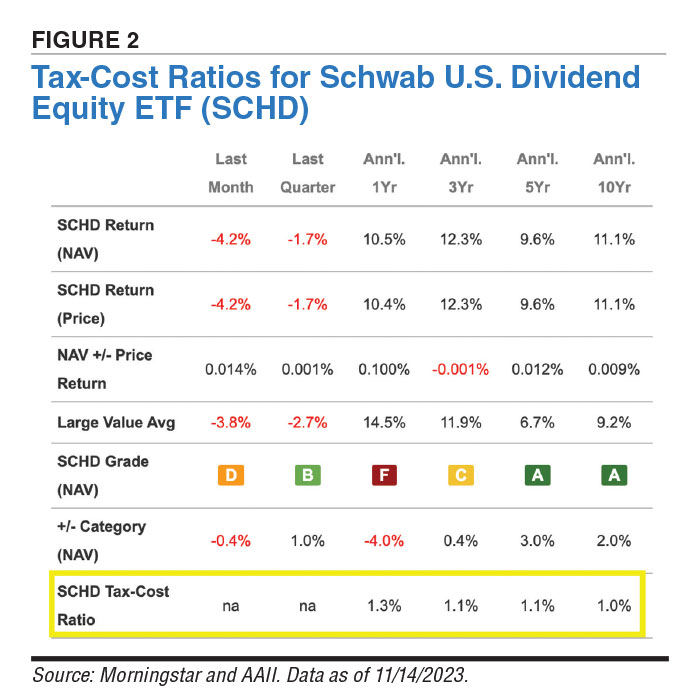
The tax-cost ratio indicates how tax-efficient or inefficient a fund has been. This ratio measures how much a fund’s annualized return is reduced by the taxes paid on distributions, assuming the maximum marginal tax rate. If a fund had a 3.0% tax-cost ratio, it means that on average each year over the past three years investors lost 3.0% of their assets to taxes. The lower the ratio, the more tax-efficient the fund.
The tax-cost ratio for a specific fund can be viewed on AAII’s Mutual Fund and ETF Evaluator pages. To access them, just type the fund’s name or ticker symbol into the search box located at the top of most pages on AAII.com. The ratio is also included in both AAII’s Mutual Fund and ETF Guides. A+ Investor and AAII Platinum subscribers can use the mutual fund and ETF screeners to filter for funds with low tax-cost ratios.
The wash-sale rule disallows you from claiming a loss in a stock or security in a taxable account if you purchase a substantially identical stock or securities within a 30-day period. Additionally, you are disallowed from buying options to purchase the sold investment or buying the substantially identical security in an IRA or Roth IRA.
Violating the wash-sale rule prevents you from claiming the loss of the sale for tax purposes. The loss can, however, be used to reduce the cost basis of the security you repurchased within 30 days.
To date, the IRS has not applied the rule to situations where an ETF from one fund family has been sold and a similar one from another fund family has been purchased. We suggest being cautious and choosing a slightly different ETF. An example would be to replace an S&P 500 index ETF sold at a loss with a large-cap ETF following a similar but different index such as the Russell 1000 index.
ETFs and Mutual Funds

AAII How-To

Portfolio Strategies

DAVE G from TX posted over 2 years ago:
DAVE G from TX posted over 2 years ago:
James M from VA posted over 2 years ago:
CHARLES R from IL posted over 2 years ago:
EDWARD J from TX posted over 2 years ago:
You need to log in as a registered AAII user before commenting.
Log InCreate an account