


Charles Rotblut leads a class in AAII's new Essential Investing Video Course. Go to https://www.aaii.com/ves for more information and to subscribe.
The tax code allows you to roll over many different types of retirement accounts without penalty. We show you which types of retirement savings accounts can be rolled over to others, explain the key difference between various types of retirement savings accounts and point out caveats to consider before initiating a rollover.
There are a few key terms to understand first:
- A rollover involves shifting retirement savings from one type of retirement account to another with the same tax treatment. When you leave a job, you may roll your workplace 401(k) assets over to an individual retirement account (IRA). Note that the account type has changed but the tax treatment has not changed significantly.
- A trustee-to-trustee transfer moves assets from an account held at one custodian to the same type of account held at another. Directly transferring your Roth IRA from, say, E-Trade to Fidelity is an example of a trustee-to-trustee transfer.
- A Roth conversion alters the savings from being pretax to aftertax. Converting your traditional IRA to a Roth IRA leaves you with a tax liability for the year of the conversion and aftertax retirement savings instead of pretax savings.
What Types of Retirement Savings Accounts Can Be Rolled Over?
The Internal Revenue Service (IRS) publishes a rollover chart explaining what types of retirement savings accounts can be rolled over into others. We recreated it in Figure 1. As you look at it, you may notice a few key rules regarding rollovers:
- In general, “traditional” retirement savings accounts—meaning those funded with pretax contributions—can be rolled over to another pretax retirement account.
- Designated Roth accounts—401(k), 403(b) and 457(b)—can be rolled over to a Roth IRA on a tax-free basis.
- IRAs can be rolled over to a workplace retirement account, but Roth IRAs cannot.
As of press time, the rollover chart had not been updated to reflect Roth SEP IRAs and Roth SIMPLE IRAs. We are awaiting guidance from the IRS regarding these new types of accounts.
A surviving spouse who is the designated beneficiary has the option to roll over IRAs and Roth IRAs inherited from their deceased spouse to their own respective accounts. See “Update Your Estate Plan for Your IRAs” in the October 2021 AAII Journal for more information.
Figure 1. The Internal Revenue Service’s Rollover Chart
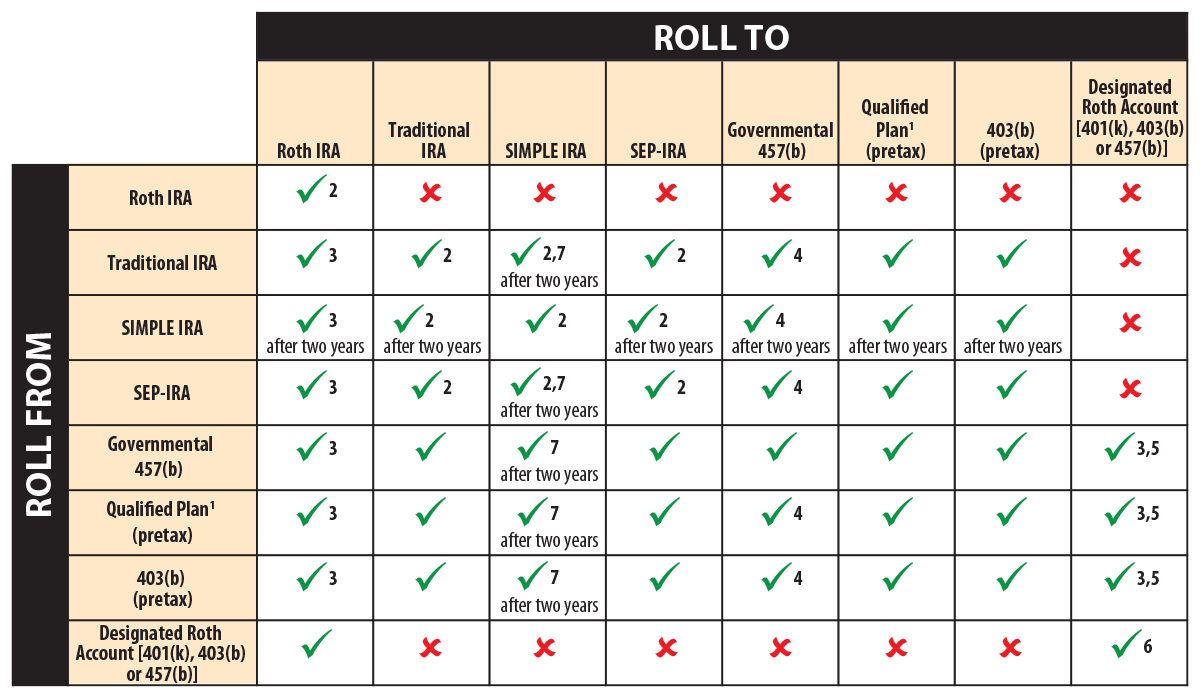
1Qualified plans include, for example, profit-sharing, 401(k), money purchase and defined-benefit plans
2Only one rollover in any 12-month period
3Must include in income
4Must have separate accounts
5Must be an in-plan rollover
6Any amounts distributed must be rolled over by direct trustee-to-trustee transfer
7Applies to rollover contributions after December 18, 2015
For more information regarding retirement plans and rollovers, visit IRS.gov page Tax Information for Retirement Plans.
Source: IRS.gov.
Tax-Deferred Retirement Savings Accounts
Tax-deferred retirement savings accounts are funded with pretax dollars. Withdrawals are taxed. Mandatory withdrawals—required minimum distributions (RMDs)—must be taken each year starting at age 73 for those attaining this age in 2023 or later. (The required beginning date, or RBD, will rise to age 75 in 2033.)
Traditional IRAs
Set up by an individual investor, traditional IRAs are generally placed with a brokerage firm, mutual fund firm or advisory firm (including robo-advisers). IRAs offer investors the most flexibility in terms of investment options.
RMDs from separate IRAs—including SEP IRAs and SIMPLE IRAs—can be aggregated and withdrawn from one individual retirement account. (You must take a withdrawal that is at least equal to the cumulative sum of each individual account’s RMD.) Qualified charitable distributions (QCDs) of up to $100,000 can be made from traditional IRAs and reduce the RMD dollar for dollar. (It’s best to make the QCD prior to taking the RMD. The $100,000 limit will be indexed to inflation starting in 2024.)
According to Experian, IRAs receive federal protection of up to $1,512,350 per person in 2023 under the Bankruptcy Abuse Prevention and Consumer Protection Act (BAPCPA) of 2005. (This exemption is subject to inflation adjustments.) Outside of bankruptcy, state laws determine whether savings held in an IRA are protected from creditors.
SIMPLE IRAs
Savings Incentive Match Plans for Employees, or SIMPLE IRAs, are most typically offered by small employers who are not sponsoring a retirement plan.
RMD amounts from these accounts can be aggregated with other traditional IRAs and SEP IRAs. (You must take a withdrawal that is at least equal to the cumulative sum of each individual account’s RMD.)
SIMPLE IRAs receive bankruptcy protection by the Employee Retirement Income Security Act of 1974 (ERISA). ERISA protection does not, however, extend to non-bankruptcy situations according to Baird. State laws may provide some protection from creditors.
Rollovers from a SIMPLE IRA to other types of IRAs are not permitted for a two-year period beginning when you first participated in your employer’s SIMPLE IRA plan. A penalty applies if you violate this rule.
SEP IRAs
SEP IRAs, or Simplified Employee Pension plans, are used by employers to contribute to employees’ retirement savings. Pretax contributions of up to 25% of each employee’s pay can be made.
RMD amounts from these accounts can be aggregated. (You must take a withdrawal that is at least equal to the cumulative sum of each individual account’s RMD.)
These plans also lack full ERISA protection, meaning protection from creditors outside of bankruptcy. State laws may provide some protection from creditors.
401(k) Plans
401(k) plans are the employer-sponsored retirement savings accounts with the highest overall name recognition. Investment choices are generally limited, and plan costs need to be monitored.
RMDs must be taken separately from each individual 401(k) account and cannot be aggregated.
These accounts qualify for full ERISA protection from creditors.
403(b) Plans
Certain tax-exempt organizations offer retirement plans that are called 403(b) plans. These include schools, religious organizations and nonprofit organizations. Investment choices are generally limited, and plan costs need to be monitored.
RMDs generally must be taken separately from each individual 403(b) account and cannot be aggregated. An exception exists if you have more than one 403(b) tax-sheltered annuity account. In such cases, you can total the RMDs and then take them from one (or more) of the tax-sheltered annuities.
Full ERISA protection from creditors applies to 403(b) plans, except for cases when an exemption from ERISA applies. [Check with your human resources department if you are not sure whether your 403(b) falls under Title I of ERISA. BAPCPA provides protection under bankruptcy, and state laws may provide some protection from creditors for such accounts.]
457(b) Plans
Retirement plans offered by state and local governments, and some tax-exempt organizations, are called 457(b) plans. Investment options are generally limited, and plan costs need to be monitored.
RMDs must be taken separately from each individual 457(b) account and cannot be aggregated.
Governmental 457(b) plans subject to Title I ERISA receive full ERISA protection, including from creditors outside of bankruptcy. Non-qualified 457(b) plans lack this protection but are protected in bankruptcy under BAPCPA. State laws may provide some protection from creditors.
Note that ERISA protections may not apply in all situations. These can include situations where a former spouse is a creditor, or the account owner has been convicted of a crime.
Roth Retirement Savings Accounts
Roth retirement savings accounts hold aftertax dollars. These accounts are exempt from the RMD rules. Withdrawals are not taxed if the account owner is at least age 59 and it has been five years since the first tax year for which a contribution was made or the first day of the tax year of a Roth conversion from a traditional IRA or a rollover from a non-Roth retirement account. The earnings portion of the distribution will be taxed if these rules are not met. See “Retirement Plans FAQs on Designated Roth Accounts” at IRS.gov for more information.
Investment offerings and protections from creditors are generally the same for Roth accounts as previously stated for their traditional counterparts. Conversions from a tax-deferred account to a Roth IRA are taxable.
Roth IRAs
Roth IRAs are set up by an individual investor. Like traditional IRAs, Roth IRAs offer investors the most flexibility in terms of investment options. Unlike traditional IRAs, QCDs cannot be made from a Roth IRA.
Workplace Roth Accounts
Roth 401(k), Roth 403(b) and Roth 457(b) accounts are subject to the RMD rules in 2023, even though those distributions are not taxable. SECURE Act 2.0 ends these mandatory withdrawals effective in 2024. This change eliminates the need to roll over a Roth account held in an employer’s plan to a Roth IRA by those seeking to avoid the mandatory distributions.
SIMPLE and SEP Roth IRAs
SIMPLE Roth IRAs and SEP Roth IRAs were established by SECURE Act 2.0, signed into law at the end of 2022. As of the time of publication, not much detail was available about these new account options.
It seems logical, but is not guaranteed, that these retirement savings accounts will have similar contribution and creditor protections as their traditional counterparts.
The two-year rule on rollovers may also apply to SIMPLE Roth IRAs.
Potential Pitfalls of Rollovers
There are a few pitfalls of rolling over a retirement account to be aware of:
- The 60-day rollover rule: If the distribution from your retirement savings account is paid directly to you, you must deposit the amount within 60 days. Any amounts not deposited will be treated as a withdrawal. Furthermore, you can only make one indirect 60-day rollover every 12 months.
- Changes in protection from creditors: You will lose certain protections if you roll savings over from an account with ERISA protections to one without them.
- The Rule of 55: Withdrawals from qualified plans such as 401(k) and many 403(b) plans can be taken without penalty at age 55 if you are separated from the employer sponsoring the plan (e.g., you quit, you are laid off, etc.). A lower age of 50 applies to public safety employees. Rolling over a qualified plan account to a non-qualified plan account (e.g., an IRA) raises the minimum starting age to 59½.
- Loans may be taxable: Unpaid loan amounts taken from a retirement savings account such as a 401(k) will be treated as a withdrawal if the account is rolled over. Furthermore, a penalty on top of the taxes can be applied to the outstanding loan balance.
- Fees: Depending on the assets held in the account being rolled over, fees can be incurred. These may include transaction fees or back-end loads for selling certain funds or surrender fees on annuities. The costs associated with the account intended to receive the rolled over savings should also be considered as they may not necessarily be lower. Be sure to ask about any transfer fees associated with the rollover.
- The Same Property Rule: When rolling over an IRA, Roth IRA or SIMPLE IRA to the same type of account, you must roll over the same property. If you have cash in IRA #1, you must roll over the same amount of cash to IRA #2. You cannot use the cash to buy shares of a stock and then roll those shares over in lieu of the cash.
Should You Do a Rollover?
A big advantage of a rollover is simplicity. Owning fewer accounts makes managing your portfolio easier. It also reduces the odds of forgetting about an old account you don’t interact with much.
Costs and investment options are another reason. If you are in a retirement savings plan with high fees or poor investment choices, a rollover makes sense.
Your employer may make the decision for you. You may be forced into a rollover upon leaving a job. If given the option to stay with the plan, consider its costs and investment options versus your alternatives.
Finally, ERISA considerations may be of importance. We encourage you to weigh the benefits of keeping these protections against the costs and investment limitations incurred by not effecting a rollover.

Related

Related

Investor Professor
Online Exclusive: Roth IRA vs. Traditional IRA—Differences You Should Know
Discussion
FREE REPORT

Get your free copy of our special
report analyzing the tech stocks
most likely to outperform the
market.
DONALD M from AZ posted over 3 years ago:
Andrew O from MD posted over 3 years ago:
Hugh P from WA posted over 3 years ago:
SONNY V from CA posted over 3 years ago:
You need to log in as a registered AAII user before commenting.
Log InCreate an account