



Individual retirement accounts (IRAs) are supposed to be simple and flexible investment vehicles, but their investment rules are more complicated and restrictive than many investors realize.
When you invest only in publicly traded stocks, bonds and mutual funds, there are no special issues. However, the tax law prohibits or penalizes some other investments by IRAs. Though part of the law for a long time, these pitfalls are becoming more important as the investment options available to mainstream investors increase and as investors are attracted more to “hard assets” and other non-traditional investments.
The restrictions on IRA investments are not well-known and, as a result, investors often stumble into penalties or other problems. The most common mistake is using a retirement account to hold an investment that falls under one of three categories: prohibited investments, taxable investments and transactions and prohibited transactions.
Restrictions and Rules for IRA Accounts: Prohibited Investments
Before you decide what to invest your IRA money in, it’s important to understand the restrictions, rules and exceptions the U.S. government has set in place. Failure to understand rules and restrictions can result in hefty penalties, fines or additional taxes.
Although almost any type of investment is permissible inside an IRA account; for example, stocks, bonds, mutual funds and exchange-traded funds (ETFs) , there are a few prohibited investments and additional rules you’ll want to be aware of.
The prohibited investment rules apply to IRAs and also to other self-directed accounts, such as 401(k)s. The main category of prohibited investments is “collectibles” as defined in Section 408(m) of the Internal Revenue Code. In the next few sections, we go over a few different sectors of investments that are prohibited by the U.S. government to be bought or sold within IRA accounts. A few of these prohibited IRA investments include:
- Collectibles
- Certain precious metals
- Life insurance
- Some real estate investments (only in some situations; however, there are exceptions)
- Derivative trades that have unlimited or undefined risks (naked call writing, ratio spreads, etc.)
Prohibited IRA Investments: Collectibles
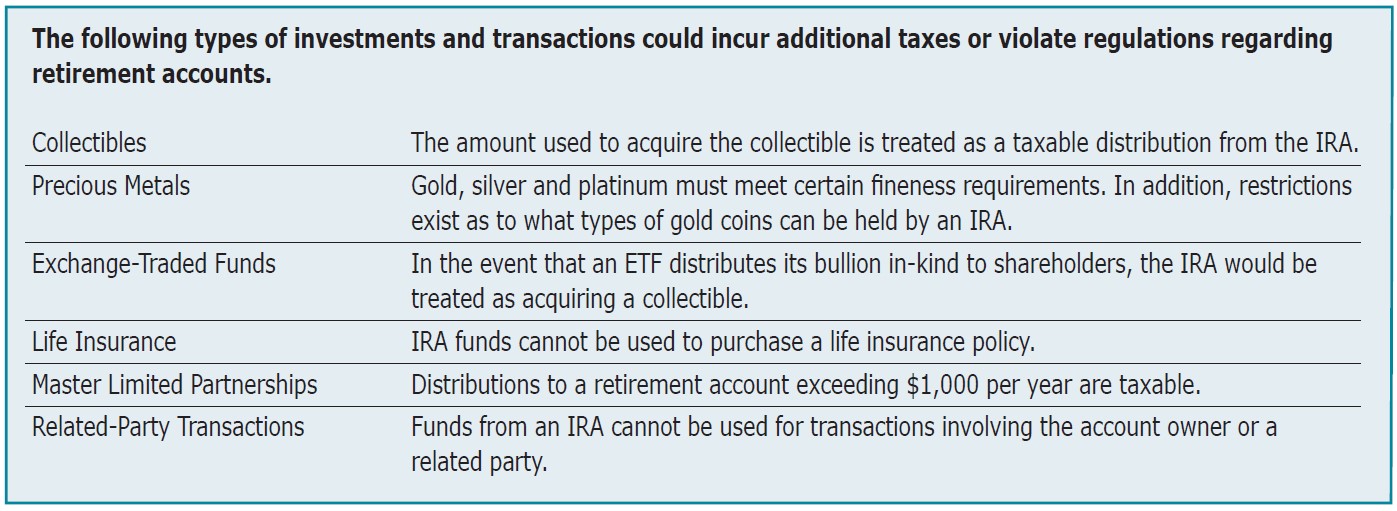
When an IRA acquires a collectible, the amount used for the acquisition is treated as a distribution to the IRA owner. It does not matter whether the collectible is held or eventually sold.
For example, if $10,000 of IRA funds is used to pay for a collectible in 2022, the transaction will be viewed by the IRS as a $10,000 distribution. This means the owner of the IRA will be required to report the $10,000 as gross income in 2022. In addition, if the account holder is younger than 59½ and does not qualify for any of the exceptions to the early distribution penalty, a penalty tax of 10% of the value of the distribution will also be assessed.
The prohibited transaction penalty apparently can result in double taxation. The price paid for the collectible is included in gross income in the year the IRA acquired it. Eventually, either the collectible itself or the proceeds from selling the collectible will be distributed to the IRA’s account owner or their beneficiaries. The amount of this distribution also will be included as part of gross income. There is no credit or deduction for the penalty tax paid on the purchase of the collectible, and there is no provision that allows the IRA’s basis to be increased by the amount that was previously taxed because of the collectible’s penalty.
To make sure you’re aware of prohibited items, collectibles include:
- Works of art
- Rugs
- Antiques
- Metals and gems
- Stamps and coins
- Alcoholic beverages
- Any other tangible personal property specified by the IRS
To date, the IRS has not issued any regulations expanding the list of collectibles.
Only physical collectibles are prohibited investments. Securities of firms that produce or deal in collectibles may be purchased with IRA funds. Among the many possible collectible-related investments that can be added to an IRA are securities of precious metals mining companies, art dealers and producers and distributors of alcoholic beverages.
Rules for Precious Metals
Certain bullion coins issued by the U.S. (generally the American Eagle gold, silver and platinum coins) and any coins issued by any of the states are not considered collectibles.
In addition, restrictions exist as to what types of gold coins can be held by an IRA. Gold, silver, platinum or palladium bullion is not considered a collectible when the metal equals or exceeds the minimum fineness required under a regulated futures contract and is in the physical possession of a qualified trustee.
Prohibited IRA Investments: Life Insurance
Another category of prohibited investments for IRAs is life insurance. IRA funds cannot be used to purchase a life insurance policy. However, an investor can set up an IRA through a life insurance company and hold an annuity that has incidental life insurance benefits.
The difference may sound subtle, but the IRS has clear rules on the matter. The annuity must be issued in the name of the IRA owner and the benefits can only be paid to the owner or the surviving beneficiaries. Furthermore, the entire interest in the contract must be nonforfeitable, the contract can only be transferred back to the issuer, premiums must be flexible to adjust to changing compensation and contributions cannot exceed the annual maximum for IRA contributions.
Exceptions for Prohibited Investments
Of course, as with all rules there are exceptions that allow investors to buy certain prohibited investments within IRA accounts under certain circumstances.
Rules for ETFs in IRAs
An outright purchase of bullion that fails to meet the minimum fineness requirements is prohibited with IRA funds, but ETFs that hold gold or silver bullion are treated differently. These ETFs purchase physical bullion and have it stored under their names. The IRS has not issued public regulations or rulings on the issue, but the agency has made taxpayers aware of its views through private letter rulings sought by issuers of bullion ETFs. The ETFs publish the substance of these rulings in their prospectuses.
Under the private letter rulings, when shares in a bullion ETF that is organized as a trust, such as SPDR Gold Shares  (GLD), are added to an IRA, the transaction is not considered to be a purchase of bullion or a share of bullion. Rather, the transaction is considered to simply be the purchase of securities—just as though shares in any other ETF, mutual fund or company were added to the retirement account. The IRS has reasoned that shareholders are not able to force the ETF to distribute bullion or take other actions, so the IRA is not the owner of the bullion. Therefore, shares of the bullion ETF are not a collectible subject to the prohibited investment rule.
There is an exception: Should the ETF distribute its bullion in-kind to shareholders, an IRA owning the ETF shares would be treated as acquiring a collectible when the distribution is made.
An IRS private letter ruling technically applies only to the taxpayer to whom it was issued and may not be cited by others. But letter rulings do reveal the thinking of the IRS and generally are followed by its auditors. Tax advisers generally agree that you can rely on the conclusions made in these private letter rulings.
The private letter rulings apply to ETFs that are organized as trusts and buy physical precious metals, such as iShares Gold Trust (IAU), iShares Silver Trust (SLV) and SPDR Gold Shares.
The prohibited investment rules also do not apply to ETFs that use futures or derivative contracts to track the performance of metals or metal-based indexes, such as Invesco DB Gold (DGL), Invesco DB Silver (DBS) and Invesco DB Precious Metals (DBP). Mutual funds and ETFs that buy the securities of companies in the bullion business, such as gold mining companies, also avoid the prohibited investment rules.
Rules for ETNs in IRAs
An exchange-traded note is a promise to pay the investor an amount equal to the return of a specific index or other price benchmark, minus the ETN’s fees and expenses. For example, the iPath Series B Bloomberg Precious Metals SubindexTotal Return ETN (JJP) is intended to reflect the unleveraged returns from futures contracts comprising the Bloomberg Precious Metals Subindex Total Return index.
This is another example of a collectible-based investment that does not involve ownership of the physical collectible. The ETN is not even a fund that holds investments, but rather a debt of the issuer. Since ETNs do not hold physical assets, the IRS does not consider them to be a direct investment in collectibles when purchased with IRA funds.
Prohibited Transactions for IRAs
The prohibited transactions rules generally outlaw transactions between the IRA and its owner or any person closely related to the owner (including businesses). The rules apply to all qualified retirement plans as well as tax-exempt organizations.
As the name implies, the prohibited transactions rules target deals or transactions involving the IRA, not necessarily investments. The basic rule is this: No deals are allowed involving the IRA and the owner or a person related to the IRA or its owner. An investor cannot borrow money from their IRA, nor can the account loan money to the account owner’s business or one of their close relatives. The IRA cannot buy property from or sell property to the account owner, their business or a close relative. It does not matter if the transaction is done at arm’s length or at fair market value; the transactions are prohibited under any terms.
The prohibited transactions rules are a vast and complicated body of law. Thus, investors wanting to engage in a transaction that might be prohibited should consult a tax adviser who knows the specific rules.
The penalty for engaging in a prohibited transaction is severe. The entire IRA will be considered fully distributed when the prohibited transaction was made, even the portion of the IRA not involved in the prohibited transaction. The IRA owner must include the account’s full value in gross income, regardless of the amount of the prohibited transaction. If the owner has multiple IRAs, only the IRA that engaged in the prohibited transaction is penalized.
Exceptions for Prohibited Transactions for IRAs
Despite the broad and seemingly final list of prohibited transactions, exceptions are allowed under some circumstances under the regulations and rulings. In addition, an IRA owner can apply for a waiver from the Department of Labor for specific transactions. Many waivers have been issued over the years for various reasons and can be reviewed on the Department of Labor’s website.
For example, it is possible for you to sell real estate to your IRA under either a waiver from the Department of Labor or an exception in the regulations. But the penalty for violating the transaction prohibition is severe, so you need to be sure the transaction is allowed. Before engaging in a transaction with your IRA, consult with an experienced tax adviser who is familiar with the prohibited transactions rules. Determine if the transaction is clearly allowed under the regulations or if you need to apply for and receive a waiver before undertaking the transaction.
IRA Taxable Income Rules and Restrictions
IRAs and other qualified retirement plans generally are tax-deferred vehicles. Their capital gains and income are not taxed to the plans or their owners as long as the profits remain in the accounts. Owners pay ordinary income taxes on the investment returns when they are distributed.
However, a retirement plan might pay income taxes on income that is considered unrelated business income. The unrelated business taxable income (UBTI) rules were added to the tax code to prevent tax-exempt entities from unfairly competing against tax-paying businesses. Though originally focused on charitable organizations that own businesses, the UBTI rules also apply to IRAs and other qualified retirement plans. If an IRA earns UBTI exceeding $1,000 per year, it must pay income taxes on that income. The IRA has to file Form 990-T when gross unrelated business income is more than $1,000. It also must pay estimated income taxes during the year if the adjusted UBTI exceeds $500.
Though Roth IRAs and distributions from them generally are tax free, all tax rules apply to Roths unless they are exempted specifically. Roth IRAs are not exempt from the UBTI rules, so a Roth IRA can be taxed when it earns UBTI.
The IRA owner essentially will be taxed twice on UBTI. The IRA is a separate taxpayer and will be taxed on the income as it is earned. Subsequently, the owner or beneficiary will be taxed on distributions of that income. The IRA owner receives no deduction or credit for UBTI paid by the IRA, and the tax paid by the IRA does not increase the tax basis of the IRA. For example, an IRA could receive a large amount of distributions from a master limited partnership (MLP) and pay taxes on part of them. Eventually, this money will be distributed to the account owner. The account owner will include the full amount in gross income and pay income taxes on it at their rate.
In most cases, the UBTI is targeted at tax-exempt entities that control businesses, but the rules can apply even when the IRA owner is not in control of a business or active in business decisions.
Rules for Master Limited Partnerships
Investors are most likely to be trapped by UBTI when an interest in a pass-through business entity (partnership, S corporation or limited liability company) is held in an IRA. The IRA’s share of a pass-through entity’s income is considered UBTI regardless of the account holder’s ownership percentage of the entity. Pass-through entities generally do not pay federal income taxes. Instead, their income and expenses are passed through to their owners’ income tax returns.
This rule most often trips up individuals who invest their IRAs in master limited partnerships—such as pipeline partnerships—or real estate partnerships. Master limited partnerships are traded on major stock exchanges, and many people think of them as being the same as corporate stock. In fact, these are limited partnership units, and the income and expenses of the partnerships pass through to the owners at tax time. When distributions from master limited partnerships to an IRA exceed $1,000, taxes are due on that income.
Individuals generally are urged not to purchase master limited partnerships through IRAs. Unlike collectibles, investments in MLPs and other pass-through entities can be held in an IRA. However, the ownership triggers the UBTI tax and the requirement to possibly file a version of Form 990 and pay estimated taxes.
When an IRA does own master limited partnerships and earns income of more than $1,000 for the year, some tax advisers recommend taking the easier and cheaper route of reporting any IRA-owned pass-through income on the IRA owner’s individual tax return instead of preparing a separate return for the IRA.
Rules for Financing IRA Investments With Debt
An IRA also has UBTI when debt is used to finance its investments. Any type of income can become UBTI when debt is used to finance the property that generates the income. For example, if an IRA receives a margin loan from its custodian or broker, income generated by the securities purchased with the loan proceeds would be UBTI. Real estate mortgages also are debts that convert exempt income into UBTI. The tax law allows an IRA to own real estate and earn rental income, and that rental income will be tax-deferred. However, if the real estate is financed with a mortgage, the rental income becomes UBTI and is taxed as earned.
The UBTI rules are broad and extensive. It is not possible to fully explain them here. This article highlights the investments that are most likely to trigger UBTI for IRAs. IRA owners should be aware that any ownership of an operating business (other than through a regular C corporation) or use of debt to finance investments can produce UBTI.
The Bottom Line: Avoiding the Don’ts of IRA Investing
Thankfully, the list of investments that cannot be held inside IRAs or would incur additional taxes is small in comparison to the investments you can hold within these accounts. Make sure to research in-depth the additional exceptions that are often tied to collectibles, real estate and precious metals investments. For example, some gold coins are not deemed “collector’s coins”; therefore, they may be allowed in an IRA account. Investors should do their own due diligence and research before deciding what types of investments to add to their portfolio.
Additional Resources About Investing in IRAs
If you’re looking for potential investment opportunities for your retirement portfolio, look no further than AAII’s A+ Investor service. This robust suite of screening tools can help you find the right investments for your IRA account or retirement portfolio without the headache of searching through thousands of securities on your own. Learn more about A+ Investor, or subscribe to the entire AAII Platinum bundle to get complete access to the best screening tools and resources.
Looking for additional resources about investing in IRAs or other retirement accounts? Check out some of our educational materials and articles that will help you find the right investments for your portfolio.
This article was originally published in the March 2010 AAII Journal. Click here for a PDF of the original article.
Discussion
FREE REPORT

Frank from FL posted over 15 years ago:
Dick from TX posted over 15 years ago:
David from TX posted over 15 years ago:
Ed from MD posted over 14 years ago:
Dennis from VA posted over 14 years ago:
Charles from IL posted over 14 years ago:
Timothy from OR posted over 14 years ago:
Edward from TN posted over 14 years ago:
John from NE posted over 14 years ago:
Robert from IL posted over 14 years ago:
Charles from IL posted over 14 years ago:
Robert from CA posted over 14 years ago:
Charles from IL posted over 14 years ago:
John from MO posted over 14 years ago:
Charles from IL posted over 14 years ago:
Dennis Hallett from CA posted over 13 years ago:
Jean Heza from NY posted over 13 years ago:
Bruce Weber from PA posted over 13 years ago:
Petaluma Al from California posted over 10 years ago:
Charles Rotblut from IL posted over 10 years ago:
cactus from WA posted over 7 years ago:
BARRY E from CA posted over 6 years ago:
You need to log in as a registered AAII user before commenting.
Log InCreate an account