

Considerations for Roth IRA Contributions and Conversions
by Charles Rotblut | November 07, 2019
A few AAII members asked me questions about Roth IRA conversions following the portfolio strategy boot camp I gave a day before our recent Investor Conference. Since some of you may have similar questions, I’m going to discuss some of the things you should take into consideration when deciding to use and/or convert to a Roth IRA.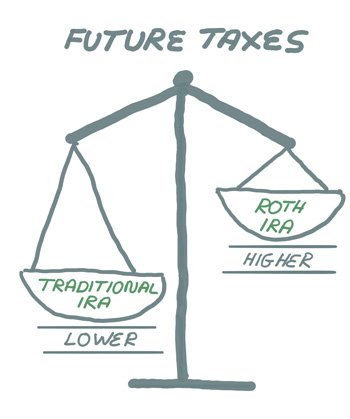
Roth IRAs have two big advantages: Withdrawals are tax free and there are no required withdrawals. The disadvantage is the requirement for contributions to be made with aftertax dollars. For someone adding new dollars to a Roth account, the full cost of the contribution is borne upfront. (Qualified contributions to a traditional IRA are deductible in the tax year they are made for.) In the case of a Roth IRA conversion, taxes are owed for the calendar year in which assets are withdrawn from a traditional IRA for a Roth IRA. The same rule applies for similar conversions such as a 401(k) to a Roth IRA or a Roth 401(k).
Taxes are a big issue to consider when making a Roth IRA conversion. Roth IRA conversions make the most sense when you anticipate your marginal tax rate being higher in the future than it is now. They make less sense if you anticipate your marginal tax rate being lower in the future. This is the simple rule of thumb for deciding whether to contribute to/convert to a Roth IRA: Pay taxes on withdrawals/conversions at the lower tax rate. The actual decision is more complicated since there are other factors to consider.
One argument for using a Roth IRA is tax diversification. The individual tax cuts incorporated into the Tax Cuts and Jobs Act (TCJA) are expected to gradually become less significant between now and 2025. They will fully expire at the end of 2025 if no new legislation is passed. While the outcome of the 2020 elections is uncertain and we have no idea what the political leanings in Washington will be following the 2024 elections, we do know that the federal deficit has grown since the passage of the TCJA. Whether politicians decide to get serious about addressing the deficit and the debt could impact what future tax rates will be a little over five years from now.
Another argument for using a Roth involves Social Security and Medicare. Withdrawals from traditional IRAs are considered ordinary income for tax purposes and can increase how much of one’s Social Security benefits are taxed. Withdrawals from traditional IRAs also have the potential to increase the amount of Medicare premiums charged. The latter occurs if taxable withdrawals are large enough to bump a Medicare participant into a higher Medicare income bracket. Since Roth IRA withdrawals are not taxable, they do not impact the taxation of Social Security benefits or Medicare premiums.
While this may seem like a positive, the conversion from a traditional IRA to a Roth IRA is a taxable event. In other words, even if your goal is to reduce what you might pay in Medicare premiums, you could inadvertently end up paying more because of the conversion. Similarly, you could end up paying more in federal and state taxes because your income was boosted by the conversion. A commonly suggested strategy is to limit the size of the conversion to an amount that would put you near but not above the thresholds at which you would pay more in taxes and/or Medicare premiums.
When possible, it is generally suggested to pay for the taxes associated with a conversion from an existing taxable account. A Roth IRA conversion spreadsheet we created in 2010 provides some of the calculations you will want to run. Our annual tax guide has much of the 2019 tax data you will need. We’ll update it next month with the 2020 numbers. If you don’t want to wait, the IRS announced the 2020 tax brackets and other inflation adjustments yesterday.
There are even more considerations, including the performance of the markets. The IRS cares only about the dollar amount converted, not the number of shares. So, if a conversion is planned for a certain calendar year, take advantage of a period when the market is down. (Last year, I did a Roth IRA conversion in late December, very close to what ended up being the correction’s bottom.) Roth IRA conversions can no longer be undone (aka recharacterized). Once completed, Roth IRA conversions are final.
Be aware of the five-year rule on withdrawals. You must wait five tax years, starting January 1 of the year you make the conversion, and generally be over the age of 59½ to avoid penalties on withdrawals. Money you anticipate needing sooner should not be converted. A separate five-year rule exists for Roth IRA contributions. It starts when the first contribution to an account is made.
Finally, consider setting up a separate account for Roth IRA conversions during different calendar years. While doing so creates some complexity, it will avoid comingling and potentially help you avoid unintended tax headaches.

-
Converting to a Roth IRA Can Minimize RMDs – Judith Ward of T. Rowe Price shared insights and data on starting Roth IRA conversions as retirement approaches.
-
IRA Rollover Chart: Rules Regarding Rollovers and Conversions – This chart, which we republished from the IRS, shows what type of retirement account can be rolled over or converted to another type of retirement account.
Individual investor optimism about the short-term direction of the stock market is above average for the first time since July according to the latest AAII Sentiment Survey. Additionally, pessimism fell to a six-month low.
Bullish sentiment, expectations that stock prices will rise over the next six months, jumped 6.3 percentage points to 40.3%. Optimism was last higher on May 8, 2019 (43.1%). Bullish sentiment is above its historical average of 38.0% for just the ninth time this year.
Neutral sentiment, expectations that stock prices will stay essentially unchanged over the next six months, pulled back by 1.8 percentage points to 35.8%. Even with the decline, neutral sentiment is above its historical average of 31.5% for the 24th time in 25 weeks.
Bearish sentiment, expectations that stock prices will fall over the next six months, fell 4.5 percentage points to 23.9%. Pessimism was last lower on May 8, 2019 (23.2%). This is the third consecutive week bearish sentiment is below its historical average of 30.5%.
This week’s rise in optimism ends a 13-consecutive-week streak of below-average readings. At current levels, all three indicators are within their historical averages.
The shift in sentiment is occurring as the major indexes are setting record highs. Many individual investors continue to monitor trade negotiations, particularly between the U.S. and China. Also having an influence on sentiment are Washington politics, geopolitics, valuations, corporate earnings, economic growth, monetary policy and interest rates.
This week’s special question asked AAII members what they thought about the Federal Open Market Committee’s decision to lower rates for the third time this year. About 45% of respondents view the cut as a bad decision. While the rationale of this group varies, a lack of “ammunition” in a future economic downturn is named most frequently. On the other hand, 26% of respondents say that the latest rate cut was the right decision given the current global economy. Outside of these groups, 15% of respondents say they believe the Fed’s decision was politically motivated and 14% state that they are unsure how the decision will impact the economy going forward.
Here is a sampling of the responses:
- “Disappointed. Our economy is in fairly good shape, so I think the Fed should have waited until the outlook looked weak.”
- “Good for the economy, but not good for us retirees who depend on interest earned income.”
- “I don’t know if it was needed or not. I can see arguments for both sides. The bottom line is, I don’t think the Fed is any better at predicting the future as anyone else.”
- “I’m not impressed as the rates were already very low. It gives them limited room to maneuver when we get into another recession, which is inevitable at some point.”
- “To keep the economy in high gear I think it was a good decision. Jobs are being added to the workplace, unemployment is low and the Dow is up. It should be a good Christmas.”

Bullish: 40.3%, up 6.3 points
Neutral: 35.8%, down 1.8 points
Bearish: 23.9%, down 4.5 points
Bullish: 38.5%
Neutral: 31.0%
Bearish: 30.5%
AAII Asset Allocation Survey
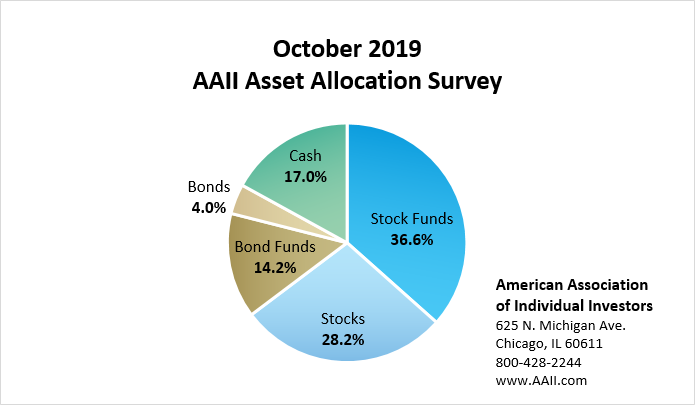
Individual investors’ exposure to cash rebounded last month after having fallen to a 20-month low in September. The October AAII Asset Allocation Survey also shows decreases in exposure to equity and fixed-income investments.
Stock and stock fund allocations pulled back by 1.8 percentage points to 64.7%. Equity allocations are above their historical average of 61.0% for the 79th consecutive month.
Bond and bond fund allocations declined 0.6 percentage points to 18.3%. Fixed-income allocations were last lower in April 2019 (17.1%). Nonetheless, bond and bond fund allocations remained above their historical average of 16.0% for the eighth consecutive month and the ninth time in 10 months.
Cash allocations rose 2.4 percentage points to 17.0%. This is a four-month high. Even with the rebound, cash allocations remain below their historical average of 23.0% for the 95th consecutive month.
The change in cash may be partially due to differences in which AAII members participated in the survey during October relative to September. The rebound in yields may also have played a role. As far as stocks, optimism in our weekly sentiment survey continued to remain below average throughout October.
October AAII Asset Allocation Survey results:
- Stocks and stock funds: 64.7%, down 1.8 percentage points
- Bonds and bond funds: 18.3%, down 0.6 percentage points
- Cash: 17.0%, up 2.4 percentage points
October AAII Asset Allocation Survey details:
- Stocks: 28.2%, down 2.1 percentage points
- Stock funds: 36.6%, up 0.3 percentage points
- Bonds: 4.0%, down 0.1 percentage points
- Bond funds: 14.2%, down 0.6 percentage points
Historical Averages:
- Stocks/Stock Funds: 61.0%
- Bonds/Bond Funds: 16.0%
- Cash: 23.0%
The numbers are rounded and may not add up to 100%.
The AAII Asset Allocation Survey has been conducted monthly since November 1987 and asks AAII members what percentage of their portfolios are allocated to stocks, stock funds, bonds, bond funds and cash. The survey and its results are available online at: www.aaii.com/investor-surveys.
Want to weigh in? Take the survey yourself and see results online at www.aaii.com/assetallocationsurvey.
- Stocks and Stock Funds: 64.7%, down 1.8 percentage points
- Bonds and Bond Funds: 18.3%, down 0.7 percentage points
- Cash: 17.0%, up 2.5 percentage points
- Stocks: 28.2%, down 2.1 percentage points
- Stocks Funds: 36.6%, up 0.3 percentage points
- Bonds: 4.0%, down 0.1 percentage points
- Bond Funds: 14.2%, down 0.6 percentage points
- Stocks/Stock Funds: 62.0%
- Bonds/Bond Funds: 16.0%
- Cash: 22.0%
Take the Asset Allocation Survey.
October 31, 2019 Relying on Process During a Good Year for My Portfolio
October 24, 2019 Choosing Between Return and Risk
October 17, 2019 The 60/40 Strategy Has Worked Even When Bond Returns Have Disappointed
October 10, 2019 Not Selling Can Have a Cost

Discussion
Barry Estell from CA posted over 6 years ago:
Under the current tax code, traditional IRA's make no sense. You get a small tax savings on $2,000 now and forego all the tax advantages of dividends and capital gains at reduced rates on way more money in the future. It's reverse income averaging ; save a little today and pay a lot in the future. You are converting dividend and capital gains to ordinary income. Makes no sense.
Dan G from SC posted over 6 years ago:
Please clarify advice of "setting up a separate account for Roth IRA conversions during different calendar years" to "avoid comingling". Do you mean one Roth IRA for contributions and one Roth IRA for conversions, or a conversion Roth IRA for each calendar year conversion? If the latter, that seems unnecessarily complex since the IRS follows first-in first-out (FIFO) for distribution for multiple conversions over multiple years, regardless of the number of Roth accounts. The first conversion dollars to be distributed are those that were part of the first year’s conversion. My custodian tracks contributions, conversions and distributions by year, so multiple conversion accounts seem unnecessary; referring to the history provided by custodian, I should be able to adhere to the five year conversion rule and avoid taxable events.
Dave G from WA posted over 6 years ago:
Barry, You have to remember when thinking about the Traditional IRA and the Roth IRA, it is ALL about how much after-tax spendable income you have in retirement and not how much tax you paid. If your marginal tax rate on the front-end is the same as the marginal tax rate in retirement your spendable income is exactly the same. It seems like from your mention of dividends and capital gains you are talking about a taxable account, which is just a worse version of a Roth account because some extra taxes will be paid along the way that isn't due if you use a Roth. All that being said then you have to realize that the taxable account doesn't really have a chance over the two tax-advantaged accounts (tIRA & Roth) given equal tax treatment. Here is where I explain it in more detail: https://seekingalpha.com/instablog/3752451-financialdave/4845086-roth-vs-non-roth-401k-403b-457-etc-and-time-value-money . And this one covers the tax drag of a taxable account over the Roth: https://seekingalpha.com/article/4265876-taxable-account-roth-substitute
Charles Rotblut from IL posted over 6 years ago:
Dan, Roth IRA conversions are subject to the five-year rule, which restarts with each year's conversion. So to avoid any headaches, it can be helpful to keep the conversions made in, say, 2017, 2018 and 2019 separate until the five-calendar-year period for each account has passed. -Charles
You need to log in as a registered AAII user before commenting.
Create an account