

Relying on Process During a Good Year for My Portfolio
by Charles Rotblut | October 31, 2019
A good portfolio management problem to have is for most of one’s targeted asset classes to have double-digit year-to-date returns. I’m noticing this in my 403(b) account [which is similar to a 401(k) account]. With a year-to-date gain of 9.94%, the Vanguard Intermediate-Term Investment-Grade Fund (VFIDX) is the only fund in my 403(b) account not to be up by double digits.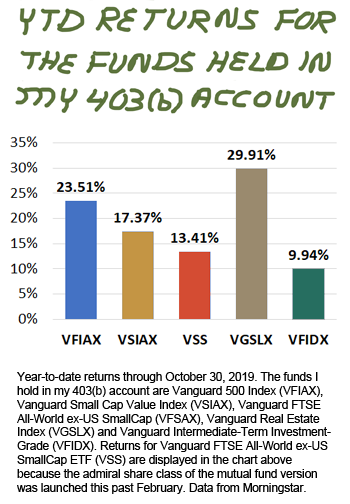
I use the word “problem” because managing sizeable gains is a challenge if one’s goal is not simply allocating to one asset class. Allocations can stray from their targeted range. Valuations can get too high. An investor can become overly confident in their abilities by confusing process with outcome.
All of these are good problems to have in the context of wealth management. The opposite situation of a portfolio with falling asset prices is worse. Yet, in either case, an investor may well find themselves second-guessing their decisions and confusing process with outcome.
Yet it is process that matters. I can’t take any credit for having a retirement account with double-digit year-to-date gains, including two funds currently up by more than 20%: Vanguard 500 Index Fund (VFIAX) and Vanguard Real Estate Index Fund (VGSLX). I also can’t take the blame for last year when all five of my holdings lost money (though far less than they’ve gained this year). What Mr. Market does is out of my—and your—control.
What I can take credit for is the fund selection process and my approach to managing the portfolio. I chose the five funds based on the asset classes they target, the long-term average returns for each asset class, how each works together from a diversification standpoint, my financial and psychological tolerance for risk (which may be different than yours) and a desire to keep the portfolio relatively simple. I can also take credit for two other things: a commitment to saving and a systematic approach for managing the portfolio’s allocation weightings.
I use a five-percentage-point band for determining whether the portfolio’s allocation continues to be close to target. If any of the five funds account for less than 15% or more than 25% of the total portfolio’s balance, I will rebalance the entire portfolio back to an equal-weight allocation of 20% per fund. Having this system in place alleviates concerns about having too much exposure to one fund or too little to another.
Systematic approaches such as this require trusting the model. Though systematic approaches reflect the biases of their creators, they are not emotional and reactive like the human mind is. Rather, when followed, they keep a person disciplined and focused on the process. A big part of investing is putting your portfolio in position to realize the best possible outcome relative to your tolerance for risk and the many factors beyond your control.
As far as my own portfolio, no action was warranted when I looked at it this week for the first time since last April. In fact, I haven’t needed to rebalance it for several years. I suspect part of the reason is my regular contributions to the account. An equal dollar amount is added to each fund each month with money pulled from my paycheck. The other part, of course, is the lack of a big enough difference in returns to create enough separation between the largest holding and the smallest holding.

-
The Role of Luck and Skill in Investing – Strategist Michael Mauboussin provided suggestions on improving the investment process given the role luck plays in realized returns in this 2013 AAII Journal article.
-
Best Practices for Portfolio Rebalancing – My process of periodic rebalancing is based on this study by Vanguard.
It may be Halloween, but there is nothing ghoulish about our survey this week as the largest number of individual investors described their outlook for stocks as “neutral” in the latest AAII Sentiment Survey. Additionally, optimism declined while pessimism slightly increased.
Bullish sentiment, expectations that stock prices will rise over the next six months, pulled back by 1.6 percentage points to 34.0%. Optimism is below its historical average of 38.0% for the 36th time this year and the 24th time in 25 weeks.
Neutral sentiment, expectations that stock prices will stay essentially unchanged over the next six months, rose 1.5 percentage points to 37.6%. Neutral sentiment is above its historical average of 31.5% for the 23rd time in 24 weeks.
Bearish sentiment, expectations that stock prices will fall over the next six months, edged up 0.2 percentage points to 28.4%. Pessimism is below its historical average of 30.5% on consecutive weeks for the first time since July 10, 2019, and July 17, 2019.
At current levels, all three indicators are within their historical averages.
Many individual investors have been monitoring trade negotiations, particularly between the U.S. and China. Also having an influence on sentiment are Washington politics, geopolitics, valuations, corporate earnings, economic growth, monetary policy and interest rates.
Most AAII members voted in this week’s survey before yesterday’s announcement of a third rate cut by the Federal Open Market Committee (FOMC). Our survey period runs from Thursday through Wednesday each week. Reminders to take the survey are emailed to a rotating group of AAII members every Monday.
This week’s special question asked AAII members how they perceive the current state of the housing market. The results were mixed and demonstrate how drastically different the housing market is in different parts of the country. About 27% of respondents state that the housing market is currently overvalued, particularly in areas like the San Francisco Bay area, Seattle and Denver. On the other hand, a similar proportion of respondents (25%) say that the market is stable from both a buyer and seller point of view. Current low interest rates were named as a driving factor for expected growth by 19% of respondents, while 12% say that they believe the housing market is beginning to slow down. Finally, 16% believe that there is an inadequate supply of affordable housing for the middle class in their area.
Here is a sampling of the responses:
- “American businesses are strong, and unemployment is low. We have more upside potential. Prices will move up in the housing market, as long as mortgage interest rates are still low.”
- “Out of sync with demand. Lots of high end, but not much middle-to-low end. This may change after the fire season in California.”
- “Neutral in Florida. No change in the past 10 years.”
- “Housing sector is getting weaker. I see more promotions and homes sitting on the market longer. It may even be a bit over-built in the Pacific Northwest region.”
- “In my area, the market is overpriced because of a lack of homes for sale.”

Bullish: 34.0%, down 1.6 points
Neutral: 37.6%, up 1.5 points
Bearish: 28.4%, up 0.2 points
Bullish: 38.5%
Neutral: 31.0%
Bearish: 30.5%
October 24, 2019 Choosing Between Return and Risk
October 17, 2019 The 60/40 Strategy Has Worked Even When Bond Returns Have Disappointed
October 10, 2019 Not Selling Can Have a Cost
October 3, 2019 Thoughts and Caveats About Brokers Ending Commissions

Discussion
No comments have been added yet. Add your thoughts to the discussion!
You need to log in as a registered AAII user before commenting.
Create an account