

Choosing Between Return and Risk
by Charles Rotblut | October 24, 2019
My discussion last week about the 60/40 strategy drew some comments and questions. They centered around the higher returns that could be realized by allocating a larger percentage of a portfolio to stocks. It’s a fair point to raise. It’s also apropos since today I conducted a three-hour portfolio strategy boot camp ahead of our Investor Conference, which starts tomorrow in Orlando.
A bit of rewinding may be useful to some of you. The 60/40 strategy splits a portfolio between 60% stocks and 40% bonds. I referred to it last week as the Subaru station wagon of allocation strategies. It’s not flashy, but it has a record of reliability, it’s suitable for a large number of people (though certainly not the only option) and while it can’t fully protect you from a crash, it will hold up a lot better than many other strategies.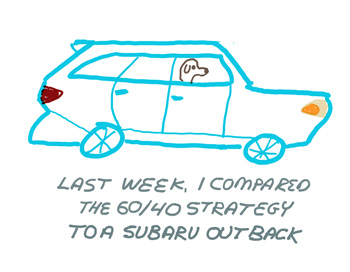
One AAII member responded by pointing out that greater wealth would be realized if an investor solely allocated to stocks. He is right. Over the long term, stocks have outperformed bonds. If your financial goal is to build long-term wealth, stocks give you the best chance of achieving those odds. Our founder, James Cloonan, has long advocated for such an approach. He’s further called the volatility associated with short-term stock price movements “phantom risk.”
I do not disagree. I’m not being contradictory in saying so either.
The biggest financial risk most individual investors face is longevity. In the world of finance, living longer than expected is a risk because more money is needed to cover expenses such as food, shelter and medical care. A closely related risk is what Cloonan calls “real risk.” Real risk is the likelihood of not having the assets saved when you need them. The best way to offset both is to have more wealth than you anticipate you’ll need, which in turn means both saving more and maintaining a higher allocation to stocks over the long run.
Our brains don’t commonly think this way. Rather, our minds are reactive to the risks we perceive as currently happening and/or could happen. Our minds are also programmed to be averse to losses. Combined, these psychological biases are not a good mixture for engaging with Mr. Market. They lead us to focus on the short-term volatility of the stock market and react accordingly. Those reactions to phantom risk lead to decisions that, in turn, increase one’s risk of not having enough wealth when it’s needed.
Because of all this, an investor has to consider their psychological and emotional ability to cope with phantom risk when making asset allocation decisions (as well as the timing of their need to withdraw cash from their portfolio). If all one did was focus on long-term returns and have the ability to never panic, the data makes a strong argument for allocating all investment dollars—except those needed for expected cash flows over the next few years (e.g., four years if retired)—to stocks. Those without such a high tolerance for market volatility should consider strategies providing a buffer against the volatility of stocks. These include, but are not limited to, the 60/40 strategy. The forfeiture of wealth caused by panicking can be far greater than what one gives up by going with a strategy that has a somewhat lower expected return.
Most importantly, keep in mind that allocation is a very personal decision. Beyond the numbers and your tolerance risk, you need to take into account your own financial situation, your cash flow needs, the risk of cognitive impairment occurring (or having started), estate plans, etc.

-
A Lifetime Investment Strategy – In this guide, which is provided to all AAII members, Cloonan explains how the volatility of the stock market decreases substantially the longer you stay invested.
-
Choosing the Right Portfolio Allocation Approach for You – There are more ways to allocate a portfolio than what is discussed above, as this overview of six common strategies shows.
Optimism about the short-term direction of the stock market rose to a 12-week high in the latest AAII Sentiment Survey. Neutral sentiment is slightly higher and bearish sentiment is modestly lower.
Bullish sentiment, expectations that stock prices will rise over the next six months, rose 2.0 percentage points to 35.6%. Optimism was last higher on July 31, 2019 (38.4%). Nonetheless, bullish sentiment is below its historical average of 38.0% for the 35th time this year and the 23rd time in 24 weeks.
Neutral sentiment, expectations that stock prices will stay essentially unchanged over the next six months, increased 0.8 percentage points to 36.1%. Neutral sentiment is above its historical average of 31.5% for the 22nd time in 23 weeks.
Bearish sentiment, expectations that stock prices will fall over the next six months, declined 2.8 percentage points to 28.3%. Pessimism is below its historical average of 30.5% for just the third time in 14 weeks.
At current levels, all three indicators are within their historical averages.
Many individual investors have been monitoring trade negotiations, particularly between the U.S. and China. Also having an influence on sentiment are Washington politics, geopolitics, valuations, corporate earnings, economic growth, monetary policy and interest rates.
In the theme of our 2019 AAII Investor Conference taking place in Orlando, Florida, this week’s special question asked AAII members what their favorite Disney movie is. When it comes to which Disney movie reigns supreme, there was hardly a consensus. Approximately 27% of respondents name “Fantasia” as their favorite Disney film. Trailing close behind is the movie “Bambi” with 20% of respondents naming it as their favorite movie. Additionally, “Cinderella” (16%), “The Lion King” (18%) and “Snow White and the Seven Dwarfs” (19%) have respective followings of their own. Other honorable mentions include: “Beauty and the Beast,” “Lady and the Tramp,” “Mary Poppins” and “Dumbo.”
Here is a sampling of the responses:
- “My first movie ever: ‘Snow White and the Seven Dwarfs.’”
- “‘Pinocchio,’ the first movie I ever saw in a theater. However, you now could pick almost any of the Pixar movies as well. Probably top of that list is the original ‘Toy Story.’”
- “I haven’t paid attention to them in many years. Disney has radically changed since its original genre.”
- “‘Twenty Thousand Leagues Under the Sea.’”

Bullish: 35.6%, up 2.0 points
Neutral: 36.1%, up 0.8 points
Bearish: 28.3%, down 2.8 points
Bullish: 38.5%
Neutral: 31.0%
Bearish: 30.5%
October 17, 2019 The 60/40 Strategy Has Worked Even When Bond Returns Have Disappointed
October 10, 2019 Not Selling Can Have a Cost
October 3, 2019 Thoughts and Caveats About Brokers Ending Commissions
September 26, 2019 ETFs May Be Better Than Mutual Funds, But …

Discussion
Paul from AZ posted over 6 years ago:
As a retiree, I have never understood this guideline "keep enough cash for 3 (or 4) years" there is no way to do this without selling securities every year - after one year of having enough cash for 3 years, I will only have enough cash for 2 years and will have to sell. Whether I am 100% stock, 100% bonds or 60/40, I will have to sell. Whatever securities mix is chosen, we need more advice on how to manage this "3-4 years in cash goal". Otherwise we are just selling sufficient securities every year to raise 1 year of cash - if we just do this, there is really no point to keeping any cash other than for immediate need. For retirees, I believe a cash management strategy advice (for spending money, not investment money) is needed, and likely varies depending on asset mix of investment portfolio - the 3 to 4 year guideline is a thoughtless waste of print for any retirement spending money strategy.
Steve from IL posted over 6 years ago:
As another retiree, what appears to be working for my wife and I under the "keep enough cash for 3 (or 4) years" is a 5 year CD ladder. We've got CDs maturing about every 3 months for the next 5 years which should be about enough to cover expenses in case something bad happens. If something really, really bad happens, we'll just be in the company of a lot of other folks. We're able to hopefully have a growth portion of our portfolio and a dividend portion where the dividends can fund either social security shortfalls or replenish the CD ladder. Just one idea to help one sleep at night better for a few years anyway. We just thank God that this seems to be working for us. Peace, Steve
Shawn from TX posted over 6 years ago:
The individual who noted that a large stock next outperforms is missing the point. One does not take out an life insurance policy and then request a refund because they know lived.
Pete from MI posted over 6 years ago:
Level 3 investing was a revelation. It was not so much the specifics, but the philosophy: Bonds are insurance and we pay too much to insure against equity volatility. I currently have about 50% in equities, both individual, ETF's and mutual funds (for niche markets better left for experts, rather than indices). I have 3 years of US bonds for our RMD's. I sell equities when the market is within 5% of its all time high and the Schiller Cape Index is above its median, as I did this year. When markets are down, I use the bonds. I will not replenish them immediately, but will wait until the market recovers and then sell equities (using the same approach as I do with RMD's). When a Bear market comes and I believe I will not be able to outlive my investments, I will invest for my children's life span. That allocation will be 100% stock minus 5 years of RMD in US bonds or insured CD's, or about 85% equities. That should insure me against having to sell depreciated equities or it will be the Zombie Apocalypse. A separate thought; Expecting a return to favor of small cap value is like waiting for Godot.
Andrew from TX posted over 6 years ago:
Paul from AZ, what you need is a withdrawal strategy. I think AAII recently posted a Level 3 withdrawal method. Do a search in AAII. Another source of info would be in Morningstar. Type in "Withdrawal Strategy" into the search box and they will bring up some articles on it. That said, the 3 to 5 years of cash is for tiding over in down years. For normal years, one still has to depend on income (dividends/interests) and capital appreciation (sell stocks/funds) to fund as expenses. The cash portion comes into play when the market is down and you do not want to sell stocks/funds at depressed prices to fund your expenses. When the market recovers, then you sell enough to fund your expenses and to replenish your cash coffers. Hope this helps.
Pete from MI posted over 6 years ago:
My withdrawal strategy is to just take our RMD. We can live on that, my wife's pension and SS. I have tried to keep track of the various other ways of making withdrawals and it seems they all focus on either the 4% rule or just taking the RMD. The only modification that makes sense is to cut back when the market turns South. I have been retired for 5 years, my wife a little longer and I am now 72, This is the 2nd year we had to take the RMD.
You need to log in as a registered AAII user before commenting.
Create an account