

Related

Portfolio Strategies
Nearly half of our survey respondents changed their investment strategy or portfolio allocation due to the 2007–2009 financial crisis, and 12% said they still have not fully gotten back into stocks.

Charles Rotblut leads a class in AAII's new Essential Investing Video Course. Go to https://www.aaii.com/ves for more information and to subscribe.
Ahead of the 10th anniversary of the bear market bottom of the 2007–2009 financial crisis in early March, we pondered what lasting impact it has had on individual investors. Rather than grasp at assumptions, we sent out a survey directly asking AAII members. The results are shared in this article.
The survey was the first of several we intend to send out periodically. Each one will ask what we’re describing as a “big question” about a subject affecting many investors. AAII members will be asked a specific question, as well as follow-up questions intended to provide more clarity and background. It will give you, the individual investor, a voice in this magazine.
This first survey was emailed to AAII members in late February 2019. The results were tabulated based on responses sent to us as of early March 2019. We received 227 responses at that time from a survey invitation emailed to a random group of AAII members.
Q: What lasting effect, if any, has the 2007–2009 bear market had on how you invest?
Nearly half of respondents (46%) indicated that they changed their investment strategy or portfolio allocation. Many of these respondents (more than one out of five of all respondents, 22%) described themselves as becoming more cautious or patient or adopting a more conservative approach. Others said they switched to a long-term approach.
Slightly more than 8% of respondents indicated that they started paying more attention to the market. Some became more aggressive about rotating their exposure to stocks while others have focused more on diversifying.
Almost 12% said the bear market has had no lasting impact on how they’ve invested since the financial crisis ended.
AAII member Steven Hager has become more willing to tolerate downside volatility to achieve bigger long-term gains. “I have weathered a few of the ups and downs and am willing to endure volatility, knowing that long term it is in my best interest. Plus, I have learned the hard way in the past about timing the market,” he explained.
AAII member Thor Rostock shared his takeaway from the experience. “I felt the financial crisis took everyone by surprise. I learned that there is a difference between ‘economic-type’ bear markets and ‘financial crisis’ bear markets. Economic bear markets seem to be more predictable as they are the result of high stock market valuations, Fed-induced actions (hiking rates too fast) or other measurable economic metrics. Financial crisis bear markets (at least in the case of 2007–2009) seem to sneak up on everyone. The 2007–2009 crash felt more like a house of cards or dominoes that, once in motion, illustrated how fragile the entire credit/financial system was. I remember pundits at the time saying the easy-credit/toxic loans were not a big enough problem to cause the crisis.
“Lesson: You can listen to the pundits but have your plan in place that does not depend on human interpretation just in case.”
AAII member Martin Bauer described himself as “always having been slow to buy, and slow to sell.” Now, he researches even more than he did previously. He added, “I have always had a high tolerance for volatility, but I am getting used to a much higher level in the last several years.”
Q: Ten years after the end of the 2007–2009 bear market, how has your attitude toward investing risk changed?
This question provided more insight. Two out of five respondents said they have become more conservative because of their age as opposed to lingering effects from the financial crisis. This may have to do with the age of our respondents, which was a median of 70 years old.
There was a sizable group of respondents who acknowledged becoming less tolerant of downside risk because of the financial crisis (13%). At the other end of a spectrum, about 18% said they have become more tolerant of downside risk.
See Figure 1 for the results of this survey question.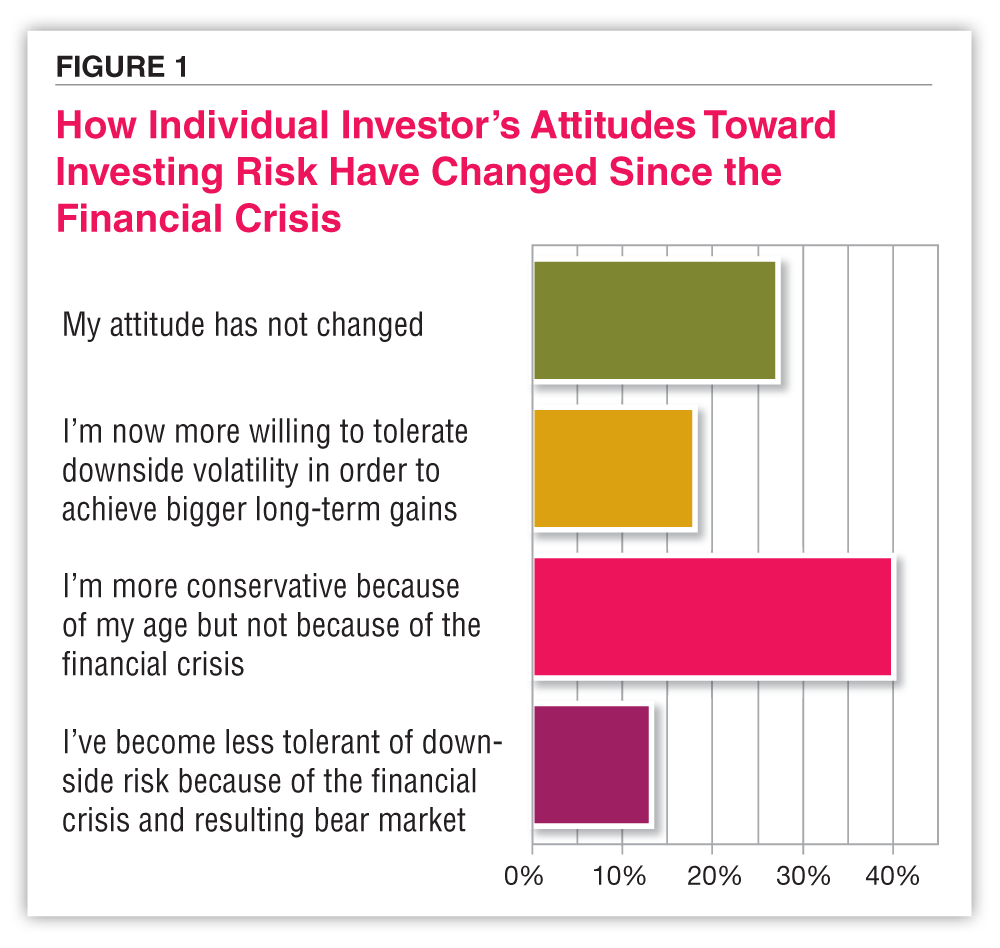
Q: Thinking back to the beginning of March 2009 when, as we now know, the market hit its lowest point, how did you feel about the market?
When asking members to recall their mood at the time, we wanted to know what they remembered thinking or feeling about the market as it hit its bottom. Many expressed an emotional reaction. Seventeen percent recalled either being frightened, angry or worried about how long it would take to recover. A small group of respondents said they were uncertain about when the market would hit bottom, while others regretted not pulling out of the market earlier. About 7% took a contrarian stance by thinking it was a good time to buy. A few respondents said they wished that they had cash available at the time to bargain hunt for stocks.
Bill Gilbert was one of the AAII members whose nerves were frayed by the steep downturn. He recalled, “The 2007–2009 bear, and especially the October 2008 crash, was a Dickens moment: The best of times, the worst of times. Our former adviser had instilled the idea of just staying put during downturns, which had been excruciating during 2001–2002. It was excruciating in 2008 only more so. My dad had passed away in March, and the inheritance hit my account a day or two before the October crash. I had a fear of losing this money that my grandfather had accumulated by doing without for decades. It was nearly paralyzing.
“Finally, I decided to try to put the investments that were getting crushed out of their misery and throw the proceeds at the biggest, strongest, safest investments I could find, mostly dividend-paying staple stocks, utilities and some (energy) midstream securities. I didn’t know how to determine the truly safe issues from the value traps, so I wound up getting into some stinkers like General Electric and Campbell Soup Co., but I picked up some better investments and a lot of utilities. (I figured I couldn’t go too far wrong with those.) Meanwhile, my retirement accounts [in mutual funds and exchange-traded funds (ETFs)] were getting wasted, so I started selling out of those, too. My M.O. became sell the junk, sit on cash, get over it and buy better junk next time. I spent the whole winter like that—miserable, depressed, cranky and longing for better times.
“When the March 2009 bottom came around, I wasn’t believing the bear was done. The last of the cash from what I sold wasn’t redeployed until August. That was really when the panic and depression finally went away.
“In retrospect, I find more good than bad in all the selling I did. The cash was redeployed into things that were a lot more resilient, which is why the remainder of the inheritance was able to thrive in the following years. My main regret from that time was that I was afraid to own bonds. It would have gone so much further to stop the bleeding. Our then-adviser didn’t believe in owning bonds … Bottom line to the experience was that I found a headspace I could live in (if uncomfortably) and eventually recovered and prospered enough to retire about five years ago. It helped to be able to grit my teeth!”
Q: Did you pull any or all of your money out of the market during the bear market period of November 2007 through early March 2009? If so, how long was it before you were back to being fully invested in stocks?
Despite nerves, many AAII members largely stuck with their equity allocations. About 53% of all respondents said they didn’t pull out any or all of their money during the bear market period of November 2007 through March 2009.
When we asked those who did pull out of the market how long it was before they were back to being fully invested in stocks, the majority (60%) said later in 2009. An additional 18% said they put money back into stocks in 2010. Notably, 12% of these respondents said they have never gotten fully back into stocks. Figure 2 illustrates the range of responses for this question.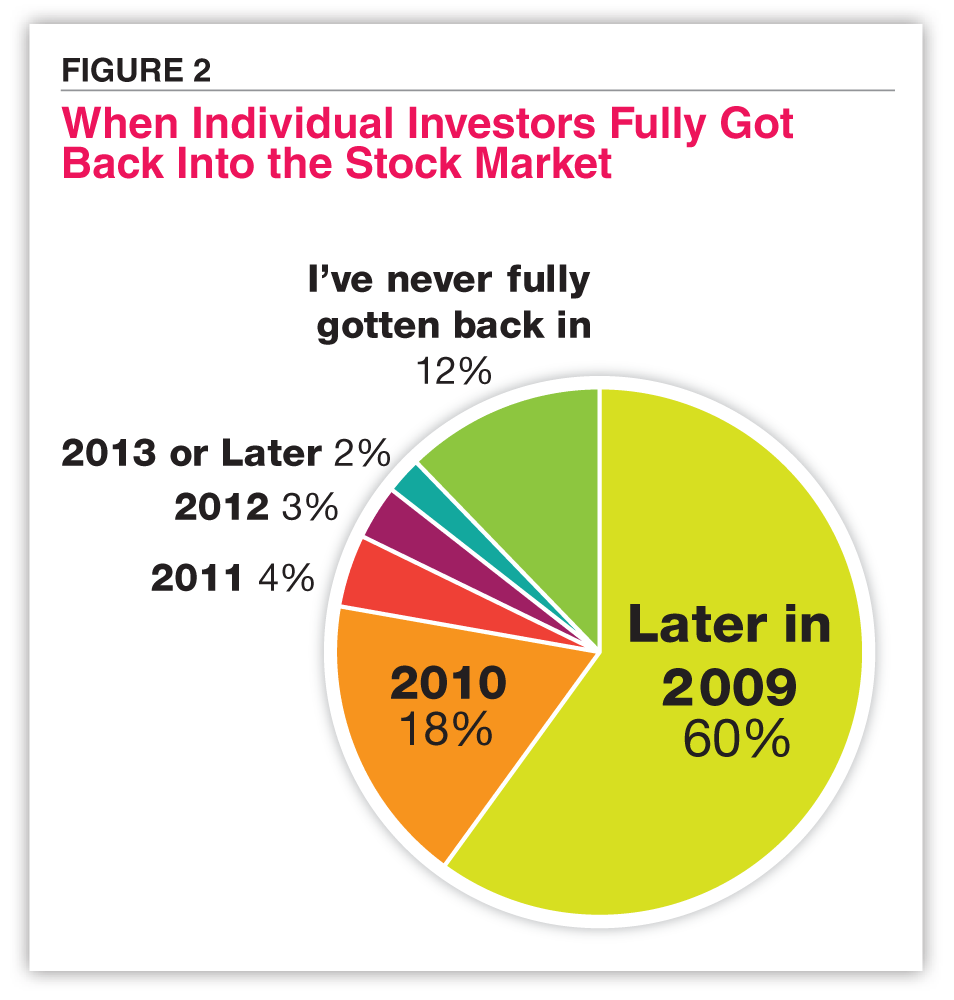
One AAII member, who asked us to withhold his name, was among those individual investors who increased their allocation to cash during the crisis out of fear about how far stock prices could fall. “I think I got to the point where I truly feared losing all of my invested money, which was by far my largest asset,” he told us in a follow-up email to the survey.
He added, “Even during the darkest of those days, I believed in the stock/bond markets ability to rebound. It was hard to do so. I watched every financial show I could find on TV, read too much stuff, learned about ‘tulip mania’ centuries ago and thought this too shall end. I just felt that it really could all crash to the ground, like 1987 on steroids, and it would be a really long time ... a decade or two before things would revert back to ‘normal.’
“So, I thought to myself that I should raise enough cash to get me through many years. I bought some physical gold; wish I would have bought more. I left the majority of my invested assets where they were, thinking that these money managers are way smarter than me, wanted to make money too and would figure out what it would take to rebuild the assets I held, mostly mutual funds at that time. I had faith in capitalism and believed that at some point I would be rewarded for staying the course.
“I have no evidence to prove it, but I do think the way the investments I owned rebounded when the bear market ended and the bull market took over that the cash I had put into low/no interest accounts would have added to the growth of the money that I did leave in the market. That cash did give me some peace of mind, however.”
Q: Looking back, were there any investment decisions you made during the final months of the bear market that you wish you could change?
Finally, we addressed the topic of regret. Approximately 47% said there were no investment decisions they made during the final months of the bear market they wish that they could change, while 44% said, yes, there were decisions they wish that they could change. The biggest regret was not investing more as the 2007–2009 bear market neared its bottom (21% of all respondents). About 8% of all respondents wished they had gotten out of stocks earlier in the bear market. Other regrets include not having enough cash to buy stocks with, not being patient enough or being too conservative.
Stan Tomkiel’s experience may sound familiar to many of you. “The 2007–2009 bear market showed me that I still had a lot to learn. I was approaching retirement as I watched about a decade of heavy investing nearly halved. The financial press, friends and advisers said I could not go into retirement without fixed income. That seemed reasonable to me, so I moved about a third of my portfolio to fixed income and directed all new allocations to 50% fixed income so that I could shift to the traditional 60% stocks/40% bonds split.
“It turned out that those were serious mistakes. I bought fixed income at inflated prices and I avoided fire-sale stocks. As time passed the errors became ever more obvious. By 2011, my fixed-income purchases showed minimal gain and the stocks had soared. I switched back to 100% equity allocation for new money and promised myself to never panic like that again.
“The 2007–2009 bear market had been my second major setback in less than 10 years. Still, I had survived and was losing the fear of corrections. I learned the hard way that recoveries happen reliably and sooner than people expect. I’m now a hardened buy-on-the-dip advocate.”
Ryan Reeh and Robert Baran contributed to this article.
Portfolio Strategies

AAII InvestoGraphic


Bruce Shields from VT posted over 7 years ago:
Dilbert from CA posted over 7 years ago:
DonB from OR posted over 7 years ago:
Charles Rotblut from IL posted over 7 years ago:
Ron from OH posted over 7 years ago:
You need to log in as a registered AAII user before commenting.
Log InCreate an account