


Related

AAII InvestoGraphic
Getting out of the market due to fear over falling prices has a lasting, negative impact on your wealth.
by AAII Staff | March 2018

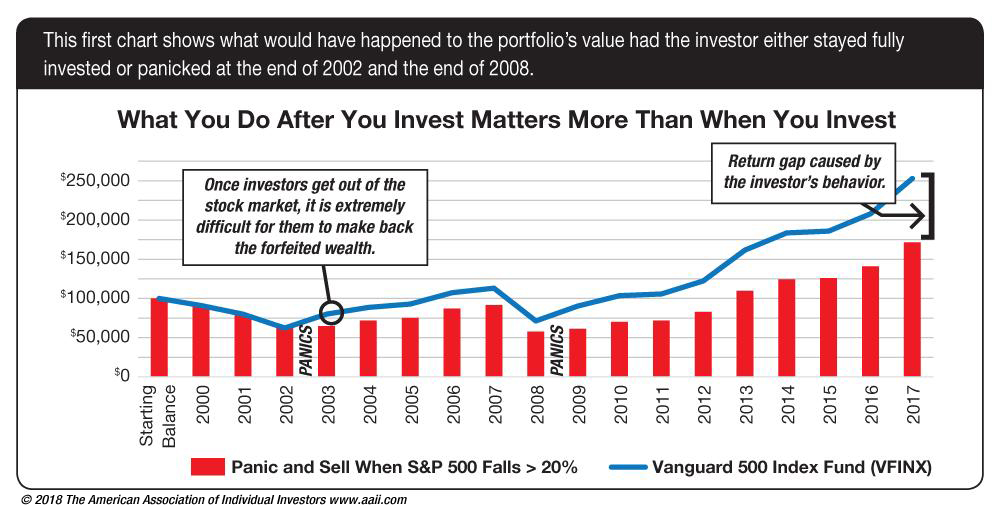
The return gap, also referred to as the behavior gap, is the underperformance investors incur through their own actions. By getting in and out of the market rather than sticking with a well-thought-out allocation strategy, investors cost themselves wealth.
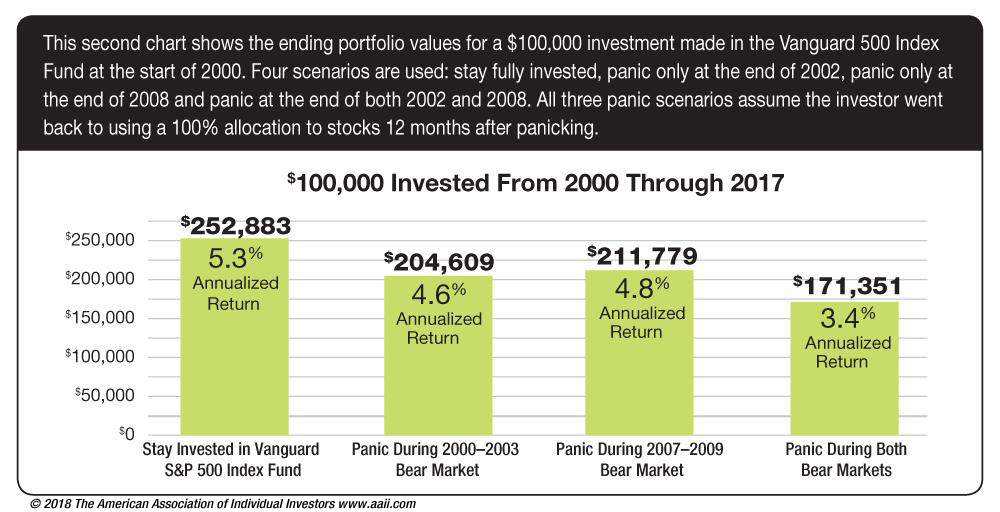
Both charts assume an investor invested $100,000 at the start of 2000. The investor’s target allocation was 100% to the Vanguard 500 Index fund  (VFINX), which tracks the S&P 500 index. The panic scenarios assume this investor switched to all bonds via the Vanguard Total Bond Market Index fund (VBMFX) for 12 months after the S&P 500 fell by more than 20% during a calendar year. After being out of stocks for a year, the investor is assumed to have gone back to the 100% equity allocation.
This first chart shows what would have happened to the portfolio’s value had the investor either stayed fully invested or panicked at the end of 2002 and the end of 2008.
This second chart shows the ending portfolio values for a $100,000 investment made in the Vanguard 500 Index Fund at the start of 2000. Four scenarios are used: stay fully invested, panic only at the end of 2002, panic only at the end of 2008 and panic at the end of both 2002 and 2008. All three panic scenarios assume the investor went back to using a 100% allocation to stocks 12 months after panicking.
AAII InvestoGraphic

Portfolio Strategies


Dave Gilmer from WA posted over 8 years ago:
Neil Micke from WI posted over 8 years ago:
William Baker from NM posted over 8 years ago:
Charles Rotblut from IL posted over 8 years ago:
James Heal from CA posted over 8 years ago:
You need to log in as a registered AAII user before commenting.
Log InCreate an account