A survey of research on the anomaly called post-earnings announcement drift (PEAD) shows that strategies based on earnings surprises have provided abnormally high returns.
PEAD was discovered in the late 1960s and is defined as “a measure of markets inability to price correctly information contained in [an] earnings report.”
The study reviewed research compiled since the late 1960s until about 2011. Earnings reports announce net income numbers, and the research back in 1968 showed that net income was composed of two parts: expected and unexpected. The intuitive finance response would be to “react to the unexpected income part and adjust the stock price accordingly but should not react to the part of income that was expected.” The research showed that 85% to 90% of the net income value was conveyed by media and quarterly earnings reports. An unexplained phenomenon was the drift of stock prices after the earnings report release.
PEAD was a contradiction to the efficient market theory, which says that stock prices reflect all available and relevant information. Separate researches in 1977–1978 measured the extent to which abnormal returns present themselves over various time frames. The survey of these studies concludes that “On average academics found that the postponed response to earnings information produces about 6% abnormal 60 days return.”
The chart below indicates that over the period of 1971 to 2011, the anomaly of PEAD abnormal returns was 350%. The book-to-market strategy, capturing companies with high book-to-market ratios (undervalued), was the only strategy to beat the PEAD strategy post-2001 (due to the dotcom crash).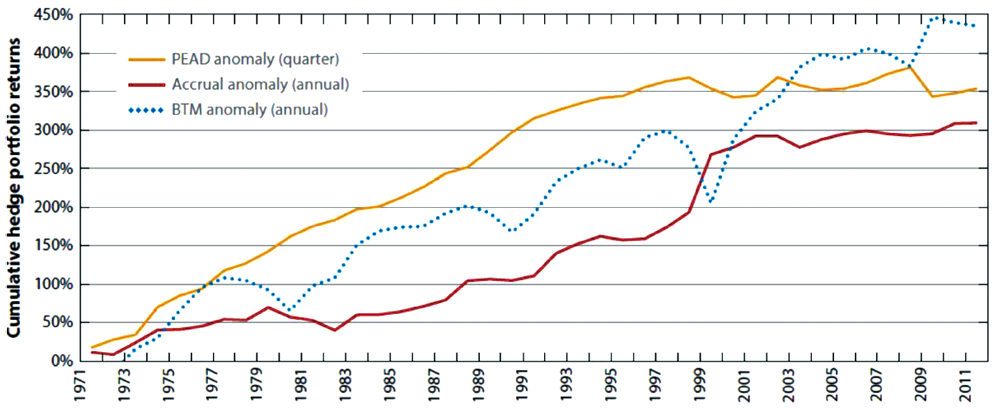
The study concludes that a PEAD strategy requires “large scale data collection and data processing” to implement. The study also states that not all markets can exhibit the PEAD phenomenon and that the data in the article was primarily U.S. market data. A PEAD strategy is abnormal by nature, only available four times a year (earnings reports) but has produced abnormally high returns in the past.
Source: “50 Years in PEAD Research,” by Marek Sojka; Bonum Quant Research, November 2018.
Related

Investor Professor
Earnings Estimates






BARRY J from TX posted over 4 years ago:
You need to log in as a registered AAII user before commenting.
Log InCreate an account