

Related

Stock Strategies
There are two key traits that every contrarian needs: skepticism and patience. Here’s what to consider before you rush to invest in companies that have fallen from grace.
by John Stepek | July 2019

In my experience, few things excite would-be contrarian investors more than a profit warning from a blue-chip company.
You know the sort of thing. A big-name brand suddenly reveals wrongdoing, disaster or over-optimistic accounting. The story hits the headlines, the share price tanks, opinion columnists call for heads to roll and the company’s very existence looks under threat.
Analysts compete to outdo each other by dreaming up worst-case scenarios, each more dreadful than the last, and the crowd can’t sell fast enough. All a gutsy, independent thinker need do is to seize the opportunity. After all, isn’t that what contrarians do—bet against the market?
It’s true that investors can make a lot of money by betting on companies that have fallen from grace. Yet this is also an area where the aspiring contrarian can really get themselves into trouble. These stocks are known as “falling knives” in the financial world—so-named because you can really hurt yourself trying to catch one.
There are two key traits that every contrarian needs: skepticism and patience. And you should be particularly skeptical and patient when it comes to these situations. Here’s what to consider before you rush to pile in.
Do you see a falling knife you’d like to grab? Before letting your contrarian leanings take over, consider these reasons as to why it might make sense to wait.
As soon as a well-known company runs into trouble, your bargain-hunting instinct will kick in, especially if you’ve had your eye on the stock. Your brain will be screaming: “Buy! Any minute now, the market is going to bounce. What are you waiting for?!”
 Stop. Take a deep breath. This is the behavioral bias known as “anchoring.” Your brain can’t let go of the top left-hand side of the share price chart. It’s struggling to cope with the idea that a share that was worth $100 yesterday is now selling for $60. This old information—that the share is ‘worth’ $100—is now irrelevant, but your brain can’t accept that. You need time to incorporate the new information into your mental image of the company.
The good news is that, on average, you have plenty of time in which to do so. Several studies suggest that markets initially underreact to profit warnings. For example, a study by Bulkley, Harris and Herrerias of the department of economics at Exeter University (“Stock Returns Following Profit Warnings: A Test of Models of Behavioural Finance,” 2003), looked at 455 companies that issued profit warnings between 1997 and 1999. They found that prices tended to take around six months, if not longer, to hit rock bottom.
That’s because, even as your brain is screaming ‘buy,’ the owners of the stock are wincing and looking at their trading screens from behind their fingers. They don’t want to crystallize their losses—taking a loss makes us feel stupid and like we’ve wasted our time. (From a behavioral point of view, we also grow attached to assets that we already own—known as the “endowment effect.”)
When a profit warning hits, the endowment effect dictates that sellers won’t sell aggressively enough, while anchoring ensures that buyers are all too eager to jump in. It’s highly unlikely that the immediate fall will be the end, unless the warning itself has been overexaggerated or badly communicated.
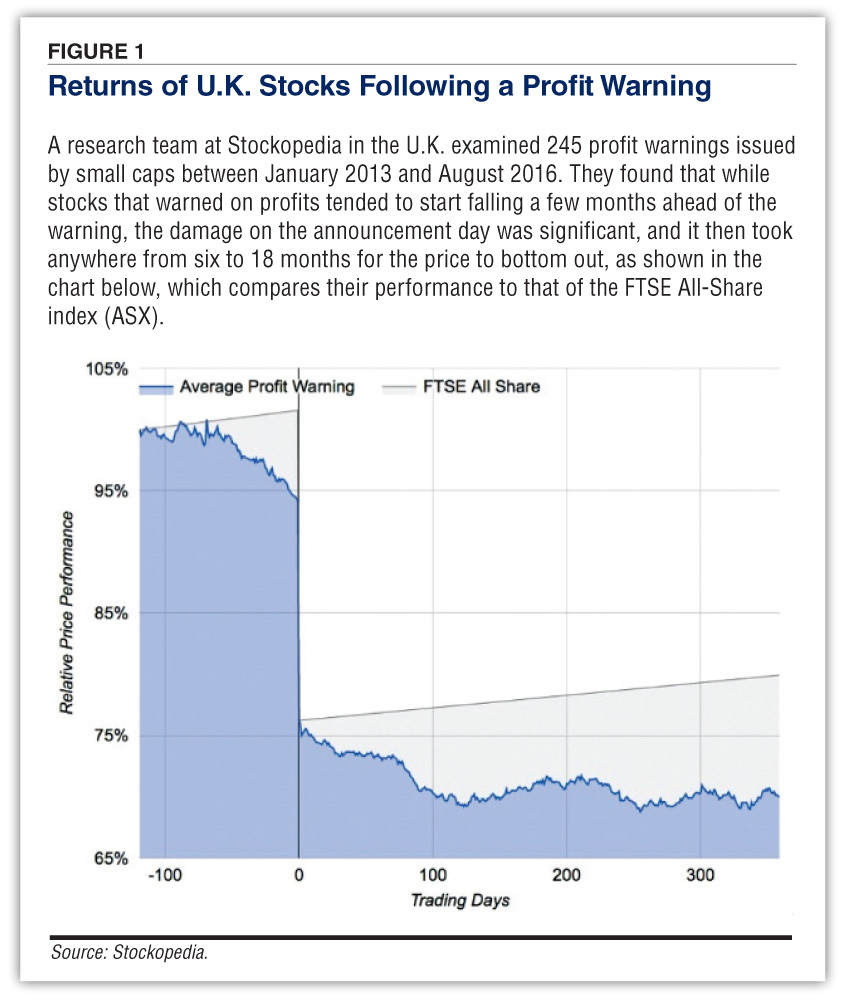
Figure 1 illustrates this point.
There is nothing wrong with viewing a profit warning as the beginning of a potential buying opportunity. However, if the company isn’t already on your watchlist, be extra wary. It indicates that the stock has never previously cropped up on your radar as a decent prospect, which suggests that it’s outside your circle of competence. Instead, you’ve been drawn to it for the wrong reason—you’re focusing on the price rather than on finding a good business. That’s the wrong starting point for any investment decision.
An old saying in financial markets has it that profit warnings come in threes. Like many such sayings, it’s a massive generalization but it’s broadly true—the first profit warning is rarely the end of the story.
A profit warning, by its very nature, is unexpected. As a result, it’s always difficult to quantify the damage or to rely on the company’s new forecasts—after all, if their previous forecasts were wrong, how can we be sure that the new ones are any more accurate?
 Remember that as skeptical, contrarian investors, we’re looking to buy a decent company for the long run. The profit warning might give us the opportunity to do that. But we also need to be very aware of the downside. There are always other opportunities, and it’s far better to let a 50/50 decision that ends up turning out well go by you rather than taking a punt on a fallen angel that ends up eviscerating your portfolio.
As the fund managers at fund group AKO note in their book “Quality Investing: Owning the Best Companies for the Long Term” (Harriman House, 2016), profit warnings need to be taken very seriously. “A material profit warning … can indicate that serious internal problems are brewing … deterioration generally begins with small things not going according to plan … Each disappointment is small in isolation; management provides a good explanation for each and dismisses them as nonrecurring. But a string of setbacks often signals a larger set of problems.”
The point of all these caveats is this: If you’re considering investing in a troubled company, approach it with even more caution than usual. Yes, you might pick a stock that’s ripe for recovery. You might equally end up with a long-term value trap (a stock that’s stuck in long-term decline) or, worse still, a stock that’s on its way to zero.
Remember: A stock that has fallen by 90% started out as a stock that had fallen by 80%—and then lost another 50% of its value. So, what should you look out for to distinguish between a company facing temporary setbacks and one facing oblivion?
Any number of disasters can hit a company. Some are easier to categorize than others. For example, horrendous as they are, environmental disasters are an occupational hazard in the resource extraction industries.
You could argue that it signals that the company has neglected to invest in safety (which is something you would want to look at) but it’s not necessarily a sign of a deeper, existential malaise. It doesn’t mean that the company’s business model is broken or that it is in long-term decline.
 Similarly, if a highly hyped pharmaceutical product fails at the last clinical trial hurdle, it doesn’t necessarily signal anything systemic about a large drug company. It’s a piece of bad news that should be quantifiable using scenario planning and comparing with similar incidents.
The key here is to gauge the worst-case scenario and then work out whether the market is underpricing the stock badly enough to give you a sufficient margin of safety. That requires research and a bit of educated guesswork.
Figure 2 illustrates one example. Oldfield Partners, a U.K.-based group of value investors, bought Volkswagen in 2015 after a profit warning. The German carmaker had scandalized the world when it turned out that its emissions-testing regime was designed to make its cars look “greener” than they really were.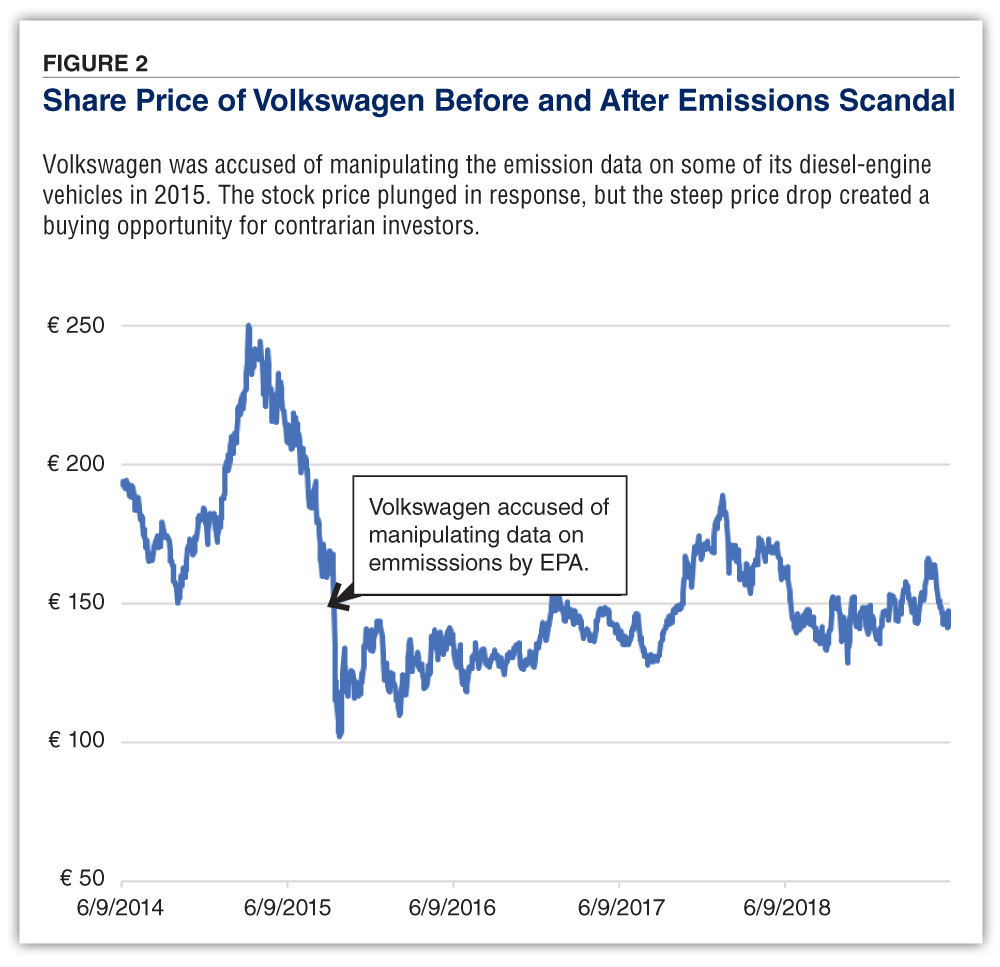
As Richard Garstang of Oldfield points out: “There was fear, there was panic, and a significant fall in the share price—we started looking at the company and the issues it faced in great detail straight away.”
Garstang and his team worked out what they believed the underlying business—home to brands from Audi to Porsche to Skoda—was worth. They assumed that the company would lose market share and be subject to more competitive pressure (and thus lower profit margins) as a result of the scandal.
There were then various other parts of the company, such as its truck business, financial services arm and joint ventures in China, that hadn’t been touched by the scandal and had significant value in themselves. Using conservative assumptions, they reckoned that the company—before potential liabilities from the emissions scandal—was worth roughly twice what it was trading for.
They then looked at potential recall costs (given the number of cars affected) and spoke to lawyers about the historical legal penalties other car manufacturers had seen in similar situations. Even with these thrown in, they estimated that the company was worth about 40% more than the market value at the time—an ample margin of safety.
As you can see, this process of quantifying the damage takes a lot of work, and hinges on a number of assumptions. That’s why, as Oldfield notes, “we don’t want too much of the portfolio in similar situations … We class these types of investments as being in ‘toxic corner,’ where there is a significant downside risk, but if the downside doesn’t materialise the upside is huge.”
One-off warnings caused by specific, quantifiable incidents are often shocking and headline-grabbing—but they are also often relatively quick to resolve. Events unfold rapidly, the scale of the damage becomes clear and the market can make a judgment one way or another.
However, in other cases, the problem is more subtle and typically more pernicious. Indeed, if we were to put together an archetypal profit warning ‘journey,’ the milestones would probably look something like this:
1. Denial: “It’s just a flesh wound.”
At this stage, the company warns that profits aren’t quite going to meet expectations. They’ll state the case in cagey terms. They might even try to avoid calling it a profit warning.
This is because the management team knows that investors will be surprised and disappointed and that they’re going to wonder why the highly skilled management team in charge of the company wasn’t already on top of the issue. So, they feel defensive and inclined to downplay any problems.
2. Reality bites: “Oops, we did it again.”
The trouble is, by the time investors get to hear about the problem, things are already bad and almost certainly worse than anyone is letting on—otherwise management wouldn’t announce it at all. So, unless it’s clear that a solution is already in place and that management has taken things in hand, the situation is only likely to deteriorate further.
AKO studied profit warnings at nearly 650 European companies from the start of 2004 to the second quarter of 2013 (excluding the crisis years of 2007 and 2008 to avoid skewing the sample). They found that if a warning resulted in an initial share price drop of 10% or more, then subsequent performance was likely to be poor. About a third of such warnings were followed by another, even bigger, warning within the year. In other words, the bigger the quake, the more damaging the aftershock.
3. Time for a change: “It’s not you, it’s—well, actually it is you.”
There may or may not be further specific profit warnings. But typically, after the second profit warning, if not before, the market starts to get edgy and loses faith in top management. So, you’ll often see changes at the top and frequently the CEO or the CFO (or both) end up leaving.
4. Resetting expectations: “Tossing in the kitchen sink.”
A change at the top is often a good sign. Once the original management team is shaken up, the new bosses have a clean slate. Also, if the new boss is willing to take the job at all, it suggests that there is still hope (few CEOs are willing to take the helm at a complete basket case).
A dividend cut is often a good sign too. Managements dislike cutting dividends because they know that shareholders hate it. If they grasp that nettle, it shows that they know how serious things are.
So, what tends to happen is that the new CEO kicks the tires, disapproves loudly and exaggerates just how bad everything is (this is known as ‘kitchen sinking’). The share price often falls hard to reflect this, but it’s also at this point that you know the company is finally coming to grips with the problems.
‘Kitchen sinking’ may be somewhat cynical, but it does seem to work. AKO found that companies with recent CEO changes tended to profit warn “a bit more frequently” than those with no change—but having warned, they also tended to go on to beat the index.

One-off warnings can lead to decent buying opportunities. Even ‘cockroach’ warnings (where there’s one, there’s usually more) can culminate in a good buying opportunity, eventually. But what red flags might make you avoid a stock altogether?
If short sellers (investors who profit when share prices fall) target a company that you are thinking of investing in, pay attention. Revisit your thesis for investing with some urgency and make sure that you really understand what’s going on.
Short sellers don’t always get it right, but the high levels of risk involved mean they have a strong incentive to do their research. If you bet on a share price falling, your losses are technically unlimited—a share price can only go to zero but there is no ceiling on its price. It also costs money to hold a short position for an extended period of time.
Short sellers need to have higher conviction than the average “buy and hold” investor—they not only have to get the direction right, but they also have to consider the timing much more carefully.
A study by Akbas, Boehmer, Erturk and Sorescu from 2008 (“Why Do Short Interest Levels Predict Stock Returns?”) concluded that short sellers are “highly informed traders.” They further found that “high levels of short interest predict negative abnormal returns.” In other words, there’s rarely smoke without a fire—short sellers don’t always get it right, but they often do.
If you own a stock that’s widely shorted, make sure that you understand the short sellers’ rationale and why you believe that it’s wrong. In fact, write it down in your investment journal: “Why the short sellers are wrong on this company.” If you can’t come up with a watertight counterargument, then consider selling.
Also, be wary if company management blames short sellers for their woes. That’s a very good sign that they’re covering up for something else.
 If you can’t understand where a company’s money is coming from, be cautious. If the company makes changes to its accounting methodology for reasons it can’t explain or that don’t sound reasonable, then give it a wide berth. The key with profit warnings is that you need to see the company tackling the underlying problem, not covering it up.
Most companies require debt at some point in their existence. Debt can help a company to grow or manage its day-to-day operations efficiently. However, few things can destroy a company more rapidly than a debt burden that it can no longer service.
Shareholders need to be particularly wary of debt, because every single debtor a company owes money to stands in front of shareholders, in terms of having a claim on the company’s carcass, should it go bust.
There are many ways to analyze a company’s balance sheet—too many to go into here—but if a company warns on profits, and you have any concerns that it is at risk of breaching its banking covenants or being unable to raise money from the market, then steer well clear.
So far, we’ve talked about what to consider before buying companies that have been hit by profit warnings. But what if you already own one? The good news is that the correct way to deal with this is simple. The bad news is that it’s not easy.
In his short but punchy book, “The Art of Execution: How the World’s Best Investors Get It Wrong and Still Make Millions” (Harriman House, 2015), fund of funds manager Lee Freeman-Shor looked at nearly 2,000 individual investments made by managers at his fund between 2006 and 2013. He uncovered some interesting and sobering statistics.
Of 131 investments where the share price fell by more than 40% from a manager’s buying point, not a single one recovered sufficiently to make back the initial loss (the companies didn’t necessarily go bust—they just didn’t make it back to their previous highs).
So, when you’re faced with a disaster scenario, you have a stark choice: Sell and cut your losses right away, or buy more in the hope of profiting from a recovery in the longer run (known as “averaging down”).
Freeman-Shor notes that either strategy can be successful. The key point is, don’t dither—act. Ask yourself one simple question, he says: “If I … were looking to invest today, would I buy into that stock given what I now know? If your answer to the question … is ‘no,’ or ‘maybe, but …’ then you should sell.”
The real beauty of this strategy is that it forces you to take action. In most cases, except where you have extraordinary levels of conviction, the answer is almost certainly going to be ‘sell’ and move on. Indeed, Freeman-Shor recommends setting automated stop-losses—set at somewhere between 20% and 33% from the most recent high—as a good way to keep you honest.
This is something you have to decide for yourself—I’ve heard arguments from many fund managers that it makes no sense to set stop-losses, but those are usually from confident, high-conviction managers who know their stocks inside out and plan to buy and hold forever unless something drastic changes. I would strive for that level of clarity and conviction—but it’s worth being realistic about your own limitations.
The main thing to remember is this—it’s a big market out there. You don’t have to take a view on every falling knife or special situation. So, don’t panic. There are always other opportunities.
Indeed, often the asset class or sector you invest in matters far more for your returns than individual holdings. If you can find a market or a sector that is cheap and neglected, that can be a very lucrative way for a contrarian to make money, without taking any individual stock risk.
Patience and skepticism are the contrarian’s ultimate superpowers. Use them.
Stock Strategies
Stock Strategies

Ryan Fuhrmann from Indiana posted over 7 years ago:
Fred from FL posted over 7 years ago:
Fred from FL posted over 7 years ago:
Lee Wenzel from MN posted over 7 years ago:
Nicholas Pratt from CA posted over 7 years ago:
You need to log in as a registered AAII user before commenting.
Log InCreate an account