

Related

Financial Planning
The creative imaginations of con artists permit almost limitless ways to swindle investors. Your best line of defense is education and awareness.

Have you ever been subjected to an investment fraudster’s sales pitch or received unsolicited calls or emails? If you haven’t, you probably know someone who has. There are countless investment frauds, scams, cons, schemes and swindles. The investment world is filled with people who want to take advantage of you.
Our intent is to help you navigate the investment minefield. You will learn why people fall for investment schemes as well as how to avoid them and recognize warning signs.
Don’t assume that you’re immune to investment schemes because of your education, background or business savvy. You can easily be duped by skilled con artists. For example, Bernie Madoff’s notorious Ponzi scheme fooled thousands of individuals, including celebrities as well as financial institutions and universities. Swindlers are students of human nature and use persuasive techniques tailored to the victim’s psychological profile.
Individuals fall for investment schemes for various reasons.
• People are gullible and curious. Those who have a tendency to trust easily are especially vulnerable because they believe what others tell them. They think that everything really is what it appears to be. When they get a fact that doesn’t exactly fit in the puzzle, they tend to force it to fit. Fraudsters and scammers prey on this trusting nature. Curiosity can also pull people into a scam.
• People are sometimes irrational. Everyone occasionally makes quick, irrational decisions. Those who are impulsive, driven by emotion or non-reflective are particularly susceptible to becoming prey to con artists. Fraudsters and scammers often stress the need for fast action to avoid missing out on a “once-in-a-lifetime investment opportunity.” This tactic is highly effective on those who act impulsively. But don’t be foolish—these once-in-a-lifetime offers are likely to turn your pockets inside out.
 • People are attracted to financial gain. The lure of “get rich quick” schemes flames the innate desire to become financially better off. Most schemes promise a high rate of return with little risk, skill, effort or time. In practice, true opportunities are rare. Realistic gains are one thing, but when an investment looks too good to be true, it usually is.
• People are uncertain about the financial environment. When people feel uncertain about financial decisions, they often turn to others who appear or proclaim to be experts and to groups with which they share a connection, such as religious or ethnic communities and professional groups. People often have difficulty saying no to experts or members of affinity groups of which they are a part because these individuals trust that they are being steered in the right direction.
• People are overly optimistic. Those who suffer from “optimism bias” are more likely to be hoodwinked than others. Optimism bias is the tendency to overestimate the likelihood of good things happening and to underestimate the potential of unpleasant events. Swindlers play to this tendency by making good things happen initially to reinforce an investor’s decision. For example, they ask investors to make a small initial investment that pays off to lure them into making larger investments later. Fraudsters also accentuate the positive by either downplaying or avoiding the possibility of bad things occurring from an investment.
• People want to feel special. People have a psychological need to feel special. Fraudsters play upon this need by convincing investors that they are part of an “exclusive club” and are being given special access to an investment opportunity. This ploy is called the illusion of inclusion. The perceived scarcity of the number of people involved in the investment makes the target feel special and more likely to invest.
• People are more vulnerable when they believe they are knowledgeable. Although seemingly counterintuitive, those who have some experience in investing or believe they are experts are often more susceptible to investment frauds and scams than others. Such individuals think they know more than they actually do or that they’re too smart to fall for a fraud or a scam. This psychological bias is called the illusion of knowledge.
• People tend to trust authority and credentials. People often place their trust in authority, whether this is a respected institution or an individual holding a status position. Thus, scam artists send fraudulent emails that appear to be from trusted organizations such as banks and brokerage firms. They also create fake diplomas and credentials, pretending to have a certain level of knowledge or competence that they lack.
How can you avoid becoming prey to investment fraud? You need to remain in charge of your investment decisions and do so in an educated manner. Too many investors trust unscrupulous individuals and outright con artists to make financial decisions for them. Taking the following actions can help lessen the chances of falling prey to frauds and scams:
• Ask questions. Perhaps the best advice when making any investment is to ask questions not only about the investment, but also about the salesperson and company for which the person works.
• Research before investing. Fraudsters expect you to do little, if any, investigation before investing. They want you to fall for their pitch and believe that they’ve already done all of the research for you. Before investing your hard-earned money, you should check out the background of anyone with whom you might be doing business. You also need to be wary of anyone who suggests putting your money into something you don’t understand.
Tools for Checking Out a Financial Adviser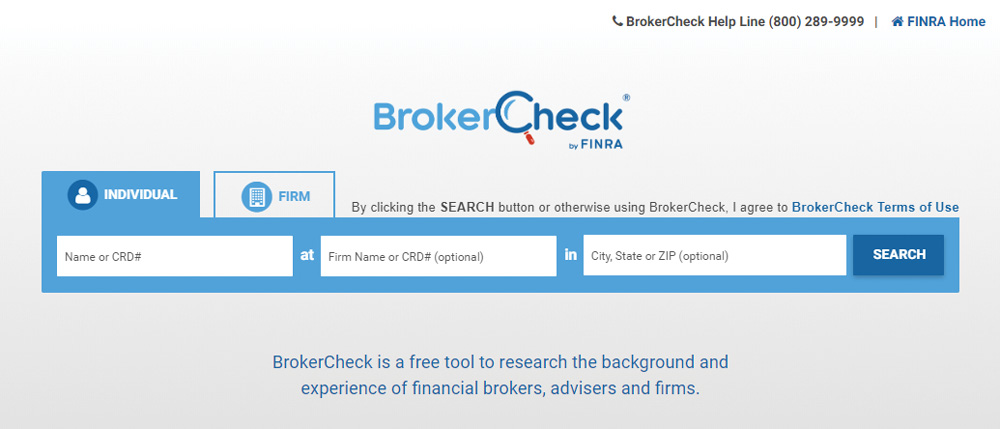
BrokerCheck is a free database anyone can access to conduct a background check on a registered person or firm (https://brokercheck.finra.org). It will give you a summary of a broker’s (aka registered investment adviser, or simply RIA) employment history as well as any regulatory actions taken and/or complaints filed against them and/or their firm.
Besides using BrokerCheck, it can be prudent to also do a search on the U.S. Securities and Exchange Commission’s (SEC) Investment Adviser Public Disclosure website (https://adviserinfo.sec.gov) and to conduct a background check with your state’s security regulators (www.nasaa.org/about-us/contact-us/contact-your-regulator). Simply typing the person’s name into a search engine such as Google may result in additional information being found. (Be aware that scamsters may try to offset complaints by trying to maintain a good online profile.)
—Charles Rotblut, CFA
• Know the salesperson or financial adviser. You should check out the person touting the investment before you invest, even if you know the person socially. For example, you should verify licenses and check out a person’s disciplinary history. You also should avoid judging an investment by how a person looks or sounds because these qualities have no bearing on the soundness of an investment opportunity. Swindlers want to appear polished and professional to create the impression that you can trust them.
• Be watchful of unsolicited offers. You should regard unsolicited sales offers with the utmost caution and skepticism, especially when they promise unusually high rates of return, quick profits and “once-in-a-lifetime” opportunities. Also, you should avoid being rushed, and you should say no to anyone pressuring you to make an immediate decision.
• Be constantly vigilant. You should avoid making an investment and then sitting by the sidelines for the results. Instead, you need to monitor your investments by keeping track of their progress. You should insist on regular written reports and be skeptical of excessive trading. If you have trouble retrieving your principal or cash from profits, you need to find out why.
• Know what to look for. If you understand little about the world of investments, you should take the time to educate yourself or talk to a qualified but uninvolved party about the investment. By making yourself knowledgeable about different types of fraud and scams and signs of any impending problems, you can reduce the chances of being deceived.
• Avoid making decisions when emotions are high. The worst time to make an important financial decision is when your emotions are elevated. Fraudsters and scammers are aware of this behavior and know how to use your emotions against you. To avoid falling for a hoax, you need to manage your emotions around financial decisions.
Fraudsters and scam artists use an arsenal of tricks to separate you from your cash. Here are some red flags that may signal potential problems with a product or security:
 • Investments with high guaranteed returns with little or no risk. Claims of huge gains with almost no risk are illusions or “phantom riches” for unsuspecting investors, despite the efforts of fraudsters to convince you otherwise. All investments carry some degree of risk. Fraudsters dangle the prospects of easy money in front of you to entice you to invest. You should be suspect of an investment that is purportedly both low-risk and high-return because it falls into the category of “too good to be true.”
• Once-in-a-lifetime deals. Scam artists use the tactic of “Don’t miss this opportunity—get in now!” to pressure you into making a quick decision. Scammers love to make this claim. A “limited time only” deal also makes the investment seem more desirable. You should resist the temptation to invest quickly. Instead, take the time needed to investigate any investment opportunity and get independent third-party advice.
• Everyone is buying. Be wary of pitches stressing how “other savvy investors have invested, so you should too.” Just because others, such as successful investors and wealthy celebrities bought a product or security doesn’t mean that it’s right for your portfolio. A variation on this theme is the claim that your friends are investing, so why shouldn’t you? This approach relies on the trust you place in your friends, which might be misplaced because they could be wrong, or the salesperson could be lying.

• Pressure to buy quickly. Fraudsters and scam artists often create a false sense of urgency by claiming limited supply. They want you to buy quickly so that you won’t have time to figure out their game. No reputable investment professional should use high pressure tactics to push you to make a quick decision. Thus, steer clear of a pushy salesperson.
• Overly consistent returns. Although not applicable to all investments, you should be suspicious of investments, such as common stocks or equity mutual funds, providing consistently stable returns regardless of market conditions. Returns generally vary over time due to market volatility.
• Free investment seminar and meal. Another tactic that fraudsters use to attract investors is offering a free seminar with the promise to educate those attending about investing strategies or managing money in retirement. The real purpose of such seminars is often to lure new clients and to sell investment products or services. Fraudsters rely on the concept of reciprocity. That is, if they do a small favor for you, such as providing an expensive lunch or dinner, you’re more likely to do them a big favor in return and buy what they are selling. Although you might not get a hard sales pitch during the seminar, you can expect high-pressure tactics during follow-up contacts from the person selling the investment.

• Unregistered products and salespeople. Anyone offering to sell you an investment should be registered and licensed. If they aren’t certified, they could have little, if any, investment knowledge or experience. You should research the background of the individuals and firms wanting to sell you investment products.
• Avoiding questions. If the salesperson doesn’t answer your questions directly, this individual is probably trying to keep you from seeing the truth. Those who have nothing to hide should willingly respond to your queries.
• Overly complex investments and strategies. Legitimate professionals can explain what they’re doing and strive to ensure you fully understand the investment, any associated fees and its suitability for you. If you don’t understand the investment, it probably isn’t right for you.
Investment schemes come in all types and varieties. We’ll begin by discussing pyramid and Ponzi schemes, followed by a few other types of investment fraud and scams. Pyramid and Ponzi schemes are closely related because they both involve paying longer-standing members with money from new participants, instead of actual profits from investing or selling products to the public. These schemes are self-sustaining, assuming that cash outflows can be matched by monetary inflows. The basic difference arises in the type of products that schemers offer their clients. Additionally, Ponzi schemes are always illegal.
A pyramid scheme is a type of fraud in which participants profit almost exclusively through recruiting others to participate in the program, rather than by supplying any real investment. It simply circulates money among its participants and doesn’t create any wealth.
The hallmarks of illegal pyramid schemes include: 1) no genuine product or service, 2) promises of high returns in a short period, 3) easy money or passive income, 4) no demonstrated revenue from retail sales, 5) buy-in required, 6) complex commission structure and 7) emphasis on recruiting. The scheme can’t continue forever because only a finite number of people can join the program.
 A Ponzi scheme is a form of investment fraud that involves the payment of purported returns to existing investors from funds contributed by new investors. Organizers solicit new investors by promising to invest funds in opportunities claimed to generate high returns with little or no risk. The scheme revolves around the process of paying old investors with the money received from new investors.
Red flags of Ponzi schemes are: 1) high returns with low risk, 2) highly consistent returns, 3) unregistered investments, 4) unlicensed sellers, 5) secretive and/or complex strategies, 6) insufficient documentation and 7) problems receiving payments.
In an advance-fee scheme, victims advance relatively small amounts of money, hoping to realize much larger gains from an investment opportunity—hence its name “advance fee.” To participate in an investment opportunity, victims must first send funds to cover processing fees, taxes, commissions or incidental expenses that will supposedly be repaid later. After they advance the funds, the perpetrators take the money and never deliver on the investment. Gains don’t materialize because no legitimate underlying investment really exists.
To avoid being a victim of an advance-fee scheme, heed this advice: Only send money to people you know and trust.
 Affinity fraud refers to a financial scheme that targets members of identifiable groups such as religious, ethnic, cultural and professional groups for financial gain. Fraudsters may be or pretend to be members of the targeted group to gain your trust. They may also try to enlist respected leaders or members from the group to spread the word about the scheme. Often those individuals are unwitting victims in the fraudulent schemes they help to promote. Resisting an investment tip from someone in your social circle is often difficult but can be necessary to avoid becoming a victim. Thus, affinity fraud may be the unholiest fraud of all because it builds from connections and steals from those closest to you.
Fraudsters use the internet to target specific groups through email. Affinity fraud is especially problematic because it may remain unknown by outsiders and authorities for a long time because of the tight-knit structure of many targeted groups. Additionally, it often involves pyramid or Ponzi schemes where fraudsters use new investor money to pay earlier investors. To avoid affinity fraud, you need to investigate the investment thoroughly regardless of how trustworthy the person who brings the investment opportunity to your attention seems.
 A stock pump-and-dump scheme is an illegal practice that attempts to artificially boost a stock’s price with false, misleading or exaggerated statements about the underlying company. If unscrupulous operators succeed in pumping up the stock price, they seek to profit from the inflated stock price by dumping their holdings of the stock. These schemes often occur on the internet and involve micro-cap or penny stocks, which are low-priced stocks issued by the smallest companies, whose price is more likely to move based on false or misleading information. Such schemes are carried out from “boiler rooms” that frequently target the elderly and use hardcore selling tactics.
A study circulated by the National Bureau of Economic Research reports that some retirees turn out to be thrill seekers or gamblers who are attracted to penny-stock pump-and-dump schemes not out of ignorance but because of their huge risk. Thus, the modern retiree can be the perfect mark for a pump-and-dump scam.
The creative imaginations of con artists permit almost limitless ways to swindle investors. Frauds and scams are more prevalent than you may realize. In fact, many investors simply abide by the notion that “it won’t happen to me.” As Warren Buffett notes, “Only when the tide goes out do you discover who’s been swimming naked.”
However, all isn’t lost. Your best line of defense against investment fraud and scams is education and awareness. By understanding how unscrupulous individuals operate, why people fall for fraud and scams, and how to avoid them, you can reduce the risk of becoming a victim. Remember, you’re ultimately responsible for your actions.
This article is based on material from chapter 5 of Baker and Puttonen’s book “Navigating the Investment Minefield: A Practical Guide to Avoiding Mistakes, Biases, and Traps” (Emerald Publishing Limited, 2019).
Financial Planning

Portfolio Strategies
Portfolio Strategies

Mike Deamer from Utah posted over 7 years ago:
You need to log in as a registered AAII user before commenting.
Log InCreate an account