

We have for many years advanced the Scarsdale Income and Asset Preservation Strategy (Scarsdale Strategy) that deals head-on with the concerns regarding rising interest rates for those individual investors planning for and in retirement.
A note of caution is in order here. While the Scarsdale Strategy is simple in concept, it is outside the investment paradigm followed by most investment professionals. However, it should not be rejected for that reason.
The strategy is outside the mainstream because it focuses on cash flow rather than asset prices. If you are accumulating assets, rising interest rates are your upside case because interest income and the return of principal can be reinvested at higher rates. We focus on cash flow because at some point each individual investor will cease to have earned income and will have to rely on a portfolio of income-producing assets.
 All brokerage statements present monthly listings of the investments that you own and price of each investment at a point in time, generally the end of the month. This is called “mark-to-mark” accounting. It encourages trading of your securities. If you buy into a trading mentality, you will incur more friction in the form of more fees, more transaction costs, more taxes and even more losses. You may also have feelings of more agitation and less peace in your life.
Individual bonds provide a very special asset class. In the Scarsdale Strategy, cash flow rather than the price of the bonds is the focus because individual bonds generally provide fixed regular cash payments. Individual bonds are the only asset class that is self-liquidating. This means that each individual bond at some point will either be called (i.e., bought back by the issuer, generally at face value) or liquidated (come due at their face value) at their due date. This enables you to live off the interest and then receive the face value of the bonds at predictable times.
The Scarsdale Strategy is based on a buy-and-hold approach, creating a custom bond ladder to adapt to the needs of each individual investor. When we picture a ladder it looks static, but in time a laddered bond portfolio operates more like a down escalator (Figure 1). The bonds that come due or are called disappear and new bonds are often purchased at the end of the ladder with a longer maturity date.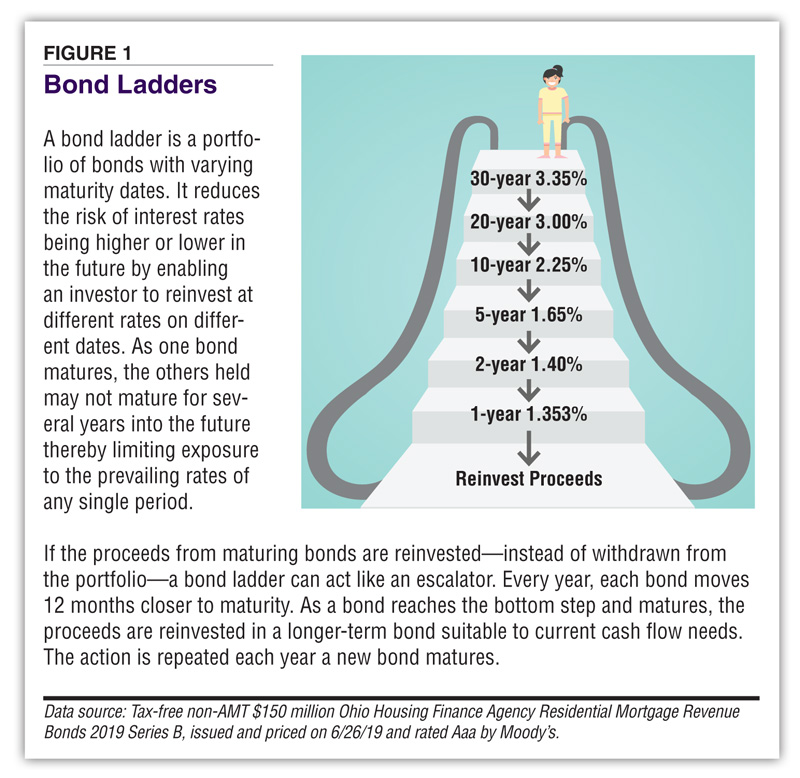
Keep in mind throughout this discussion that we believe the most important factor in all investing for individuals considering retirement planning is to protect their capital in all events. Thus, since individual bonds will in the future self-liquidate at their face value, an investor need not focus or worry about the current value (i.e., the price) of their bonds or whether the value of the bonds are going up or down.
What are the drivers of how to invest your cash in bonds? There are different considerations if you are planning for retirement or are already in retirement.
Planning for Retirement
If you are planning for retirement, and thus have time before you will start to draw down your funds, we recommend that you determine how you can safely maximize your returns and protect your principal. We view this as long-term money that will not be accessed for immediate needs. This is how we personally prepared for retirement.
Bond prices decline when interest rates rise. This is an essential but difficult concept to master. When we hear on the news that Treasury bonds have risen that means that prices are up but bond yields are down, moving like a seesaw. If prices are up, that is good for traders who want to sell. It is not good if you are a buyer, looking for a lower price. The seesaw movement of bond prices is irrelevant to the buy-and-hold investor who wants a steady cash flow and is not looking to trade for gain.
 By consulting the yield curve, which is a plotted graph of average bond yields, you can see for what years you might get the best return on your investment at the moment. The Treasury bond yield curve is the one against which all other bond yield curves are measured. For example, we speak of municipal bonds coming due in 2039 being much above or below the 20-year Treasury bond yield curve.
Since the yield curve is constantly changing, you will continue to consult and refer to it. At times, it is clearly advantageous to invest as long-term as possible. At other times it seems that extending the maturities in your portfolio will not increase your return enough to take the risk of having to sell a bond before its due date.
Long Versus Short Maturities
You may ask, “If I am purchasing high-quality bonds, what are the risks in very long-term bonds?” They are:
-
Possible credit quality deterioration,
-
Possible inflation eating away the value of your investment, and
-
Possible need to sell at a less desirable price.
However, reinvestment risk is inherent in a very short-term portfolio and usually you are paid much less for holding short-term bonds. In the current circumstance (as we write this in May 2019) where the yield curve is very flat—meaning that you are not paid substantially more to extend maturities since the short-term bonds pay almost as much as the longer-term bonds—many advisers tell their clients to have a short average maturity ladder. Why invest longer-term when you are not paid to do it, they argue.
When interest rates rise, bond prices decline. Watchers of the Federal Reserve note whether the Fed is raising short-term interest rates in order to tamp down inflation. However, when the Fed is moderating interest rates—neither raising nor lowering—then the expectation is that interest rates will stay the same or even decline. When the aggregate of investors believe that inflation is not a significant factor and that we may have a recession, they stop demanding higher rates. This is the situation right now. While everyone is concerned about future inflation and rising rates, it is just as likely that rates will fall. Therefore, it may be wise to maintain a laddered bond portfolio going out at least 10 years.
Since brokered certificates of deposit (CDs), federal agency bonds and municipal bonds may be redeemed before maturity (i.e., called), you may wish to ladder the calls as well. A call is the right of an issuer to redeem or buy back its bonds on a specified date, or any time thereafter. You do not want all of your bonds to have the possibility of being called in the same year. Bonds are priced to the shortest possible call date, which is described as the yield-to-call.
Bond Coupons
Bonds are issued with a fixed rate of interest called the “coupon” because investors used to clip coupons on interest payment dates and deposit them in their bank accounts like a check. Tax-free municipal bonds currently issued with 5% coupons pay out interest at that rate but may cost you $1,200 per $1,000 bond. You pay a premium over the face value to have an above-market cash flow. Higher-coupon bonds, sometimes called “cushion bonds,” soften the impact of inflation and rising interest rates because there is more cash flow. The cash flow from premium bonds may be viewed as the receipt of interest and a return of a piece of the premium you paid when you purchased the bonds.
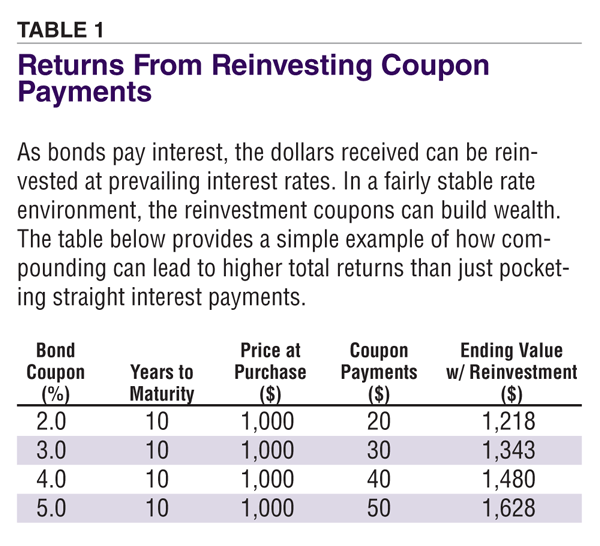
Many bonds are currently issued with 3% coupons and sell at a price close to their face value or at a discount—e.g., 99.7 ($997 per bond). Many experienced buyers eschew these bonds because they “know” that in a rising interest rate scenario they will decline in value. However, in a fairly stable low interest rate scenario, the compounded rate of return on the 3% coupon over an eight- to 10-year period may be higher than the return on either a 4% or 5% coupon. Since we don’t know the future, it appears to be pragmatic to purchase a mix of coupon types unless there is a specific need to increase cash flow. Table 1 shows the compounding of returns from reinvesting coupon payments in a stable interest rate environment.
Our overall strategy is buy and hold. We do not trade based on market conditions. This does not mean that the portfolio is static. Because of redemptions and bond calls as well as semiannual payments of interest, there is a frequent replenishment of cash for new investments. This can be beneficial if interest rates are rising and detrimental if interest rates have fallen. We believe that the direction of interest rates is not predictable. All we know is that they will continually change and if we do not reinvest, we will lose the ability to earn interest on the cash.
Owning Bonds in Retirement
Living in retirement without an earned income is based upon the generation of cash flow from a variety of sources. Lucky people have pensions, in addition to Social Security and investment income. Some streams of income will remain for your lifetime. Other cash flow streams may not. There are financial shocks for which we may not be prepared: market corrections and unexpected expenditures for ourselves and our family. We don’t know how long we will live, so we don’t know how much we can spend while we are younger and energetic. We may not be prepared for market corrections and the necessity of living on less and changing our lifestyle. How do we manage if we go into cognitive decline?
Types of Bonds
Though bonds are often discussed as a single asset class, there are differences among them. Here is a brief comparison of the major types and, to provide contrast, a brief overview of certificates of deposit (CDs).
U.S. Treasuries
These bonds have the best credit quality. You can purchase Treasury bonds at auction directly from the Treasury department (www.treasurydirect.gov) so that you know you are getting an average price. There is little friction. Treasury bonds are subject to federal tax but are exempt from state and local income tax.
Treasury Inflation-Protected Securities (TIPS)
These are an inflation hedge because their principal is tied to the consumer price index (CPI). They currently come with a low yield because they are potentially very valuable if there is a great deal of inflation. The imputed and current income from these bonds is subject to annual taxation. It’s best to purchase them for a retirement account.
Municipal Bonds
Purchasing very high-quality bonds and diversifying by state, issuer and type of issuance means that less surveillance would be required of the overall portfolio. Tax-exempt muni bonds can be triple tax-exempt, meaning free of federal, state and local taxes. However, you must be aware of the exemptions and potential impacts on Social Security benefits, Medicare premiums and the alternative minimum tax. (Income from taxable bonds and many other types of investments can also impact how much of your Social Security benefits are taxed and what you pay in Medicare premiums.)
Corporate Bonds
When purchasing mutual funds, exchange-traded funds (ETFs), closed-end funds or unit investment trusts holding taxable corporate bonds, individual investors often overlook the contents of the vehicle and only focus on the reported yield. Fifty percent of the Bloomberg Barclays broad corporate bonds index is now triple-B rated, which has increased its correlation to equity according Wasmer Schroeder portfolio manager Christopher Sheehan. Safe bonds are supposed to balance equity exposure, but credit quality deterioration in the corporate sector has left many unwittingly exposed.
FDIC-Insured Certificates of Deposit (CDs)
These can be purchased either directly from a bank or through a brokerage house. As long as you do not exceed the maximum amount to qualify for FDIC insurance ($250,000 per depositor, per insured bank, for each account ownership category), then your principal will be protected. Brokered certificates of deposit with a defined maturity have a maximum maturity of 10 years. The income is subject to taxation on all levels. Some CDs are not insured by the FDIC and may be risky investments.
A caring and well-educated financial planner can address many of the life and financial issues you will have to deal with in retirement. We focus only on one aspect of your plan—creating cash flow from your principal to help support your lifestyle needs.
Perhaps as you read this you are wondering: “Why be satisfied with the lower returns provided by high-quality bonds when there are alternative investments promising so much more?” The answer is that you could just as soon lose what you have instead of gaining more. Large losses at the beginning of your retirement will have a much greater impact on your ability to retire than losses incurred later. This is called sequence of return risk. If you are no longer working or expecting an inheritance, then you will have no way to replenish your asset pool. Winning the lottery is not a retirement plan.
Focus on Taxes
 When buying bonds, the first decision is whether the bonds should be taxable or tax-exempt. If the bonds are being purchased for a retirement account, the bonds should be taxable—subject to state, federal and local taxes—to maximize the return. You may opt for tax-exempt if the bonds will be held in a taxable account.
Individual bonds can be purchased in many types of retirement accounts. Taxable investments that may be held in these accounts include brokered certificates of deposit, federal agency bonds, Treasury bonds, Treasury inflation-protected securities (TIPs), corporate bonds and taxable municipal bonds. Most 401(k)s mandate only the purchase of funds; however, these accounts can, at some point, be rolled over into an IRA.
If you are purchasing bonds for a taxable account, consider purchasing tax-exempt municipal bonds. The interest income will be exempt from federal income tax and might be tax-exempt from state and local taxes with careful planning.
Conclusion
Our Scarsdale Strategy is designed to reduce risk, taxes, fees and bad timing.
We reduce risk by investing in only the highest-quality bonds. We only buy municipal bonds with a minimum rating of Aa1 and Aaa by Moody’s. Bonds may be long-term investments and you don’t want to have to monitor them often.
We believe in creating a custom bond ladder as guided by the needs of your family. Interest rates can be maximized by using the yield curve as guidance.
Taxes should be reduced by holding tax-exempt municipal bonds in taxable accounts. Investors should also use tax-deferral techniques by investing in IRAs, 401(k) and 403(b) accounts. Roth IRAs are also a good vehicle to hold individual bonds.
Finally, don’t trade. Reduce fees as much as possible by using a buy-and-hold strategy. There is no fee when a bond comes due.
Related
Related
Bonds
Bond Pricing Made Simple
Discussion
FREE REPORT

andrew jacknain from DC posted over 7 years ago:
shelly frank from CT posted over 7 years ago:
Stan Richelson from PA posted over 7 years ago:
Barry from NY posted over 7 years ago:
Charles Rotblut from IL posted over 7 years ago:
Barry from NY posted over 7 years ago:
Barb from OH posted over 7 years ago:
Eloy from TX posted over 7 years ago:
Stan Richelson, author from PA posted over 7 years ago:
Stan Richelson, author from PA posted over 7 years ago:
D S from CA posted over 7 years ago:
barb from OH posted over 7 years ago:
Stan Richelson, author from PA posted over 7 years ago:
Marilyn from IL posted over 7 years ago:
Stan Richelson, author from Pennsylvania posted over 7 years ago:
Anonymous from DE posted over 6 years ago:
You need to log in as a registered AAII user before commenting.
Log InCreate an account