


Related

Small Cap Value Investing
After conducting the quarterly review of the Model Shadow Stock Portfolio in early June, two stocks were removed from the portfolio and one new stock was purchased.
by John Bajkowski | July 2019
Expectations that the U.S. and China were close to reaching a trade deal were shattered in May, resulting in strong stock market sell-off and renewed concerns that the trade tariffs will result in reduced global economic growth. Expectations had been growing that the threat of a tariff increase was just a negotiation tactic that would not be implemented. As we know now, these expectations were proven wrong.
The market sell-off extended to commodities such as oil and pushed down the yield of bonds, as investors see a greater likelihood that the Federal Reserve will need to lower interest rates to offset some of the negative economic impact of the escalation of tariffs.
The S&P 500 index, as measured by the Vanguard 500 Index fund (VFINX), lost 6.4% during May, but the damage was even worse for the Model Shadow Stock Portfolio, which declined 13.7% during the month, pushing its performance into the red for the year. The Model Shadow Stock Portfolio is now down 0.2% year to date, while the Vanguard 500 Index fund is up 10.7%. The Vanguard Small-Cap Index fund (NAESX) was down 7.3% during May and has a year-to-date performance of 11.6%, while the DFA U.S. Micro Cap fund (DFSCX) was down 9.1% during the month and is up 4.9% for this year through the end of May. Figure 1 shows performance over longer periods.
Value-oriented stock indexes are lagging growth stocks on a year-to-date basis. Large-cap value stocks were down 7.6% during May, reducing their year-to-date performance to 8.0%, while large-cap growth stocks lost 5.3% during the month and are now up 13.2% through the first five months of the year.

In the mid-cap segment, value stocks are up 7.9% for the year after losing 9.7% during May. Mid-cap growth stocks are up 11.2% for the year after losing 9.7% during May.
Small-cap value stocks are up 6.7% year to date, while small-cap growth stocks are up 11.7%. Small-cap value stocks lost 8.2% during May, while small-cap growth stocks were down 7.4%.
Stocks in the information technology (+16.5%), telecom services (+14.2%) and consumer discretionary (+13.0%) sectors are leading the market this year. Sectors that are lagging this year include pharmaceuticals (+0.2%), health care (+1.3%) and energy (+3.5%).
Since its inception in 1993, the AAII Model Shadow Stock Portfolio has a compound annual average return of 13.8%, versus the Vanguard 500 Index fund’s gain of 9.2% per year on average. Over the same period, the Vanguard Small-Cap Index fund posted an average annual gain of 9.7%.
Table 1 shows the current holdings in the Model Shadow Stock Portfolio. After conducting the quarterly review of the Model Shadow Stock Portfolio in early June, two stocks were removed from the portfolio—Amira Nature Foods Ltd. (ANFI) and CSS Industries Inc. (CSS).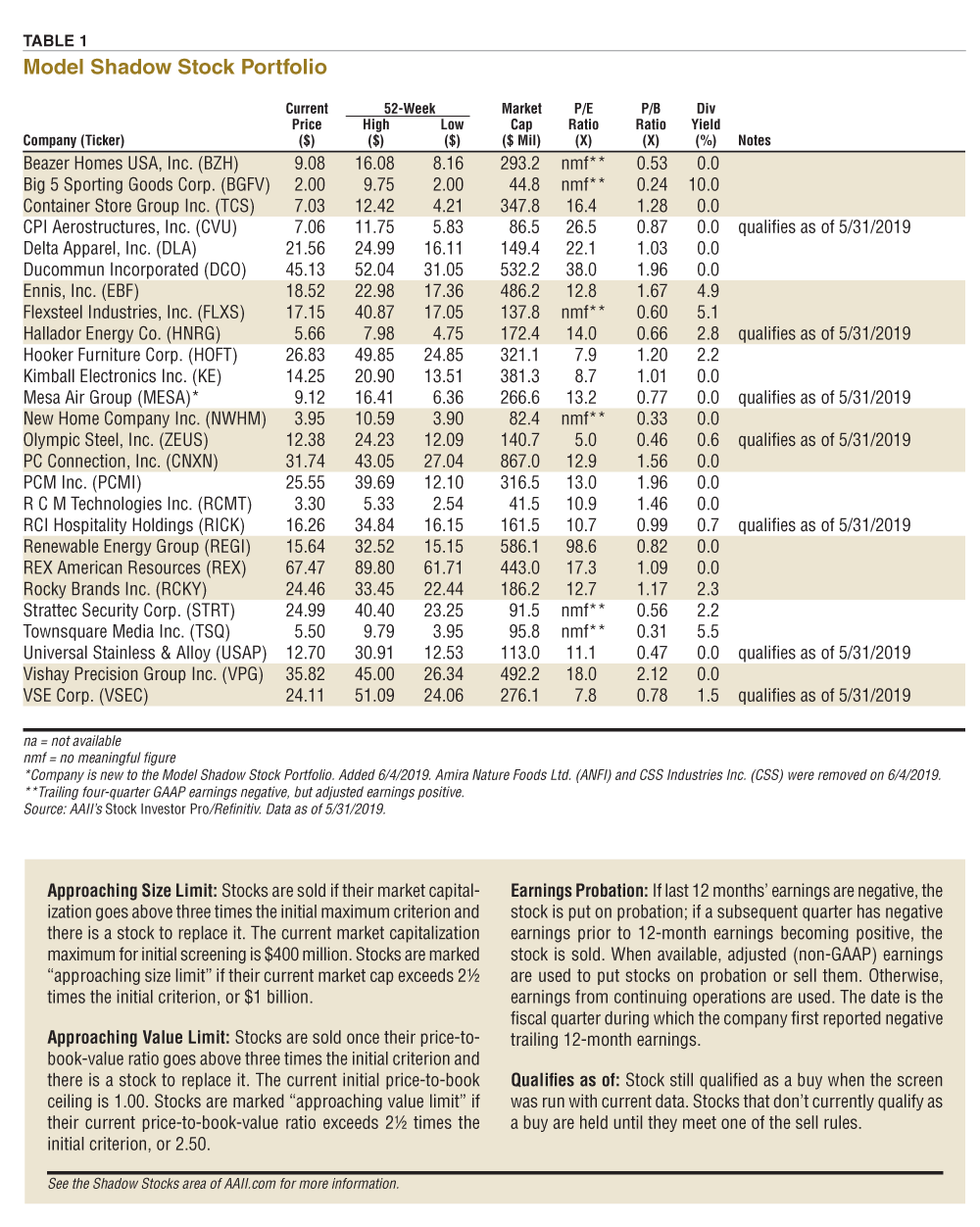
With the cash on hand and the proceeds from the two sells, there was enough to purchase one new stock with a position size roughly equal to the average position size for the portfolio holdings: Mesa Air Group (MESA).
Table 2 summarizes the changes. The detailed Model Shadow Stock Portfolio Rules below note the purchase and sell rules, provide some of the portfolio management rules and illustrate tips to consider when buying and selling micro-cap stocks.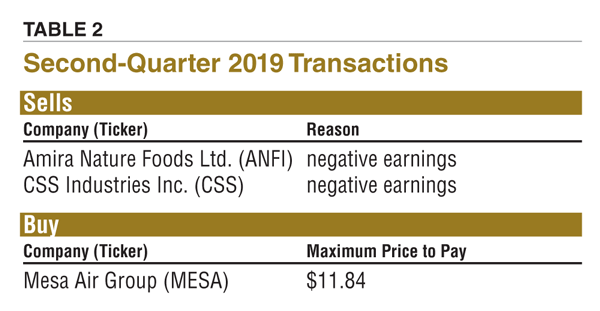
Amira Nature Foods has been on earnings probation since it announced its second-quarter 2018 earnings. At that time, the company’s trailing 12-month earnings per share turned negative. In August of last year, the company announced it would be late in filing its Form 20-F for the year ended March 31, 2018. The company filed its Form 20-F in mid-March, at which time it was shown that its six-month results for the period ended September 30, 2018, were negative. If a Shadow Stock that is on earnings probation reports a subsequent quarterly loss (or in this case a subsequent six-month loss), it is removed from the portfolio.
CSS Industries has been on earnings probation since it announced its second-quarter 2019 earnings on November 1, 2018. At that time, the company’s trailing 12-month earnings per share turned negative. On May 30, the company reported a quarterly loss. If a Shadow Stock that is on earnings probation reports a subsequent quarterly loss, it is removed from the portfolio.
With the proceeds from the Amira Nature Foods and CSS Industries sales and the existing cash position of the Model Shadow Stock Portfolio, there were enough funds to take a position in one company at roughly the average position size for the existing holdings in the tracking portfolio.
The market downturn in May opened the door to a larger number of stocks falling below the maximum market-cap size filter of $400 million and the price-to-book-value ceiling of 1.00. As of the end of May, 25 stocks met the initial selection criteria. Applying the liquidity requirements to the remaining stocks reduced the number to 16 candidates. Looking at the price-to-book-value ratio and the four-week relative price strength led to Mesa Air Group.
Mesa Air Group is the holding company for Mesa Airlines, a regional carrier. Mesa Airlines provides regional air service for American Airlines under the American Eagle banner and for United Airlines under the United Express brand. Mesa Air Group operates 145 aircraft with approximately 610 daily departures. The company’s agreements with its partners extend to 2025 with American Airlines and 2028 with United Airlines.
Based on Mesa Air Group’s closing price of $9.00 on June 3, we suggest paying no more than $11.84. To calculate the maximum buy price based on the price-to-book-value ratio, multiply the current share price by the ratio of the maximum price-to-book ratio to be considered for the Model Shadow Stock Portfolio (currently 1.00) to the current price-to-book ratio of the stock. The price-to-book ratio for Mesa Air Group as of June 3 was 0.76, so the calculation is: $11.84 = [$9.00  (DFSCX) (1.0 ÷ 0.76)]
The next quarterly review of the Model Shadow Stock Portfolio will take place at the end of August. In the meantime, you can follow the portfolio in the AAII Shadow Stocks area on AAII.com (www.aaii.com/model-portfolios). To receive monthly email updates along with alerts to any changes made to the portfolio, please sign up at www.aaii.com/email.
Shadow Stock Portfolio Rules
Purchase & Sales Rules
Stock purchases must meet these criteria:
Stocks are sold if any of the following occur:
Stock Order Guidance
Management Rules
Small Cap Value Investing
Small Cap Value Investing

Growth Investing

Doug from CO posted over 7 years ago:
Randy from CA posted over 7 years ago:
David from MA posted over 7 years ago:
You need to log in as a registered AAII user before commenting.
Log InCreate an account