

Related

Financial Planning
Upon reaching full retirement age, a retiree can look back at the performance of their nest egg portfolio to determine whether to claim immediately or wait until credits for delayed claiming stop.

This article uses figures current in 2019.
At what age should you claim Social Security benefits? For a new retiree, this question involves a trade-off that is easy to recognize but difficult to analyze. The annual Social Security benefit increases by up to 8% per year as the claiming age is delayed from age 62 to 70, which suggests waiting as long as possible to claim. But the retiree will have to spend down their nest egg portfolio while waiting to claim that higher benefit, which increases the risk that the nest egg will be depleted, and the retiree will have to live on only what is provided by Social Security.
In a pair of recently published papers (one of which was written with my colleague Mike Alderson), I analyzed this trade-off using Monte Carlo simulation. Since the future is inherently unknowable, the best we can do is to make probabilistic statements about what might occur. The goal of the simulation exercise is to answer the question: Given the size of my nest egg portfolio and my annual consumption expenditures, if I claim Social Security benefits at a certain age, what is the probability that my nest egg portfolio will be exhausted before I die? [Editor’s note: Monte Carlo simulation calculates outcomes by randomizing data over a large number of scenarios.]
For illustrative purposes, I considered a newly retired 62-year-old male (or married couple) with the goal of achieving constant real (inflation-adjusted) consumption over his (their) remaining life-span(s). The new retiree elects to claim Social Security benefits at either age 62 (the earliest possible age to claim), 66 (full retirement age for someone retiring in 2018) or 70 (the age at which credits for delayed claiming stop). The best age to choose is the one that minimizes the probability of running out of money during a retiree’s lifetime. Of course, nothing forces a retiree to claim only at one of these three ages. However, more than 75% of all persons filing for Social Security benefits in 2013 did in fact claim at one of these three ages, and over one-third of retirees claimed at age 62.
 It should be clear that the 62-year-old retiree doesn’t need to make an irrevocable choice to claim immediately, at age 66 or at age 70. In fact, the retiree has a valuable option that they can use upon turning 66: They can look back at the performance of their nest egg portfolio over the prior four years, and then either claim immediately or wait four more years. If portfolio returns have been high over the prior four years, waiting till age 70 to claim the higher benefit may be optimal. But, if the nest egg has underperformed, it may not be able to withstand four more years of withdrawals while the retiree waits to claim at age 70. In this case, the retiree should claim at age 66 rather than wait. The best decision depends not only on the prior investment performance of the retirement assets, but on the size of the original nest egg portfolio as well.
I investigate the benefits of using this “look-back” option, relative to the “static” strategy of pre-committing to claiming Social Security at a fixed future age.
The retirement benefit available from Social Security depends on both career earnings and the age at which benefits are claimed. The current full retirement age (for someone turning 62 in 2018) is 66 years and four months. Benefits may be claimed as early as age 62, however. Benefits are reduced if a retiree claims prior to age 66 and increased if claiming is deferred beyond age 66 up to age 70. Married individuals are eligible for up to the greater of half of the spouse’s benefit or the benefit attributable to their own career earnings. When a spouse dies, the surviving spouse can receive the entire benefit of the deceased spouse, if it is larger than their own.
I briefly introduce the assumptions built into the simulation model here. More technically minded readers who want more details about the simulation model are encouraged to consult the two papers referenced at the end of this article.
The model assumes that a retiree is eligible for the maximum Social Security benefit at any claiming age and has accumulated savings in amounts ranging from $100,000 to $1 million, which includes most U.S. households ages 55–64 who have any retirement savings.
A retiree’s life was simulated 10,000 times in every scenario. In each “life,” a year of death was assigned based on the current life tables used by the Social Security Administration. These tables estimate median life expectancies of about 85 years for males and 88 years for females.
 The retiree’s portfolio was assumed to be invested in a 60%/40% mix of large-capitalization U.S. stocks and long-term U.S. Treasury bonds. (This mix consistently resulted in lower failure probabilities than other potential asset allocations.) For each year in a simulated life, returns to stocks and bonds, as well as inflation, were chosen by randomly drawing a year from the period 1926 through 2017. An objection to these assumptions might be that future annual returns to stocks and bonds may be lower than their historical averages. Thus, I re-ran every simulation on the assumption that stock and bond returns were 3% lower compared to their historical numbers. While lower portfolio returns affected the probability of exhausting the nest egg, conclusions about the best age to claim Social Security were largely unaffected.
The retiree is assumed to have the goal of constant real (inflation-adjusted) consumption. Age 62 consumption is set equal to 4% of the nest egg plus the age 62 Social Security benefit, and this amount is increased by the inflation rate for each subsequent year. Thus, if the retiree does not claim until age 70, the nest egg portfolio must withstand extra drawdowns (beyond the inflation-adjusted 4% withdrawals) for eight years while waiting to claim.
The simulations thus consider a newly retired 62-year-old individual and examine four different strategies for claiming Social Security. In the first three, the retiree pre-commits to claiming benefits at either age 62, 66 or 70. The fourth strategy allows four years to elapse, at which point the (now 66-year-old) retiree can assess the performance of the nest egg over the prior four years and use this information to help decide whether to claim benefits at age 66 or wait four more years to claim at age 70. Of course, in this scenario the retiree needs a definition of what constitutes “poor performance” of the nest egg portfolio. Poor performance was defined simply as an average portfolio return over the prior four years that was lower than the historical average from 1926 through 2017 for the 60% stock/40% bond portfolio, which is a return of 9.59%. (Variations on this definition, including simulations that reduced the real returns on stocks and bonds, didn’t generate results that are meaningfully different from the ones presented here.)
The simulations produced “failure probabilities” (the probability that the nest egg will be exhausted prior to death) for a 62-year-old retiree for each of four Social Security claiming strategies: claim at 62, pre-commit to claiming at 66 or 70 and the “look-back” strategy whereby the decision to claim at 66 is conditioned on the nest egg portfolio’s performance over the previous four years. Table 1 presents the results for single male retirees followed by the results for married couples in Table 2. (Results for single females do not meaningfully differ from those for single males.)
Single Retirees
First, consider the scenario in which a person retires at age 62, invests retirement savings in a 60/40 stock/bond portfolio and either pre-commits to claiming benefits at age 62, 66 or 70, or decides to utilize their look-back option upon turning 66. Table 1 contains the results of this exercise, using historical returns to simulate future returns. The table presents failure probabilities for the optimal strategy (i.e., the one with the lowest failure probability). Recall that the retiree wishes to maintain constant real consumption over his remaining life-span; the table provides the probability that they will fail to achieve this goal.
Table 1 indicates that a 62-year-old retiree with $150,000 or less in savings should claim Social Security immediately, as failure is a near certainty if claiming is delayed until 66 or 70. The nest egg is simply too small to support four or eight years of withdrawals while waiting to collect a higher benefit. For wealth levels between $150,000 and $400,000, claiming at age 66 is optimal.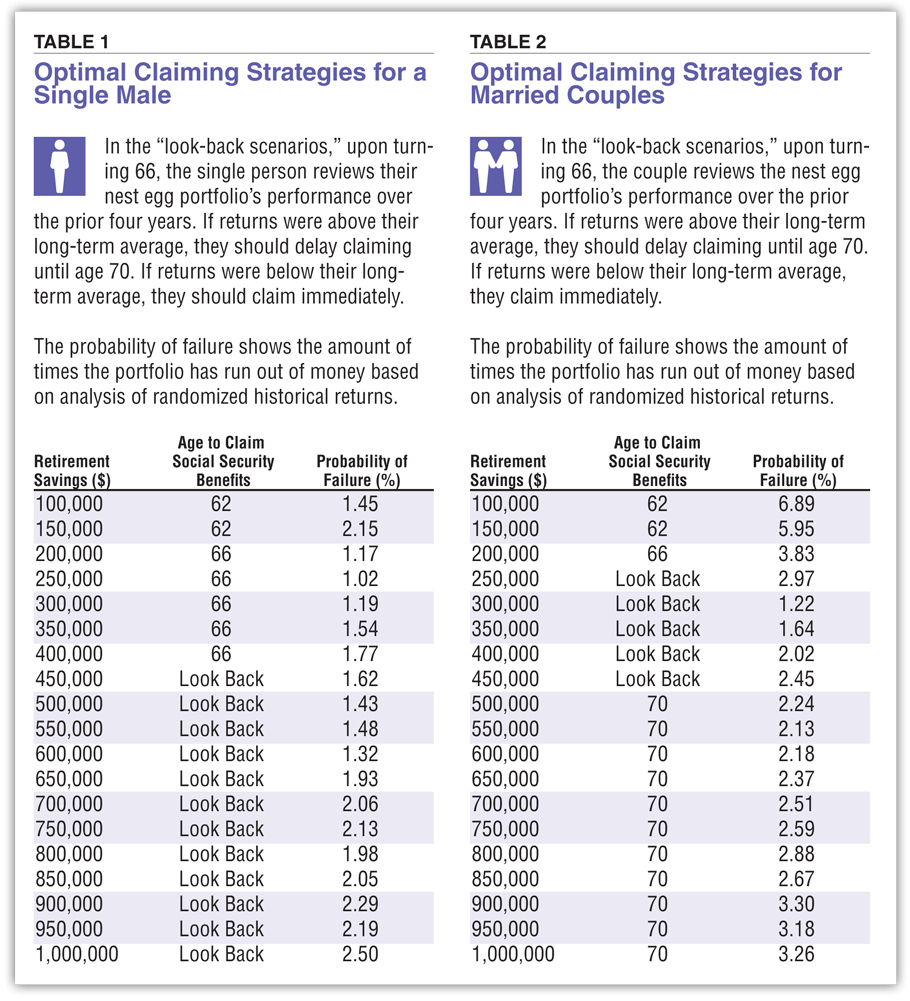
 For wealth levels above $450,000, the look-back option provides significant value for the single retiree. At these wealth levels, the failure probability for the look-back strategy is lower than that of the strategy of pre-committing to claim at 66 or 70. Essentially, the look-back strategy allows the retiree to reduce the chances of making one of two mistakes. First, if the portfolio has performed well over the past four years, it may be a mistake to claim at 66, since the portfolio can now withstand four more years of larger withdrawals. Second, if the portfolio has performed poorly over the past four years, waiting until age 70 to claim will put too great of a burden on the now-depleted nest egg. Conditioning the decision to claim on recent portfolio performance helps avoid these mistakes and maximizes the odds that the retiree will achieve their goal of constant real consumption over their remaining life-span.
Married Couples
Recall that the Social Security survivorship benefit awards the surviving spouse with the benefit of the deceased, if higher than their own. The simulation examined whether using the look-back option in conjunction with the couple’s claiming decision can reduce the probability of exhausting the nest egg portfolio.
To accommodate married couples, this set of simulations assumed that both spouses retired at 62 and the lower-earning spouse claimed Social Security immediately. The higher-earning spouse then had to decide when to claim: age 62, 66 or 70.
Table 2 reports the results using historical returns to simulate future returns. Here, the range of wealth levels where the look-back strategy was optimal was narrower, due to the value of the survivor benefit. The look-back option was most valuable at wealth levels where “claim at 66” tended to be the best strategy for a single person. Rather than automatically claiming at 66 (thereby locking in a lower survivor benefit), the couple benefits by looking back at past portfolio returns. In scenarios where portfolio returns between ages 62 and 66 were above average, the higher earner should delay claiming until age 70, thus locking in the maximum survivor benefit. The higher expected survivor benefit for the lower-earning spouse outweighs the negative effect of four more years of spending exclusively from the nest egg portfolio. The nest egg is better positioned to withstand the additional spending due to its above-average performance in the prior four years.
At wealth levels above $500,000, the strategy of pre-committing to claim at age 70 is optimal. This strategy pre-commits to locking in the maximum survivor benefit for the lower-earning spouse. It dominates the look-back strategy in these cases, because here it would be a mistake to claim at age 66 just because the portfolio underperformed in the prior four years. At these wealth levels, the portfolio is large enough to withstand this underperformance, and the paramount concern becomes ensuring the highest possible survivor benefit.
The simulations thus highlight the importance of looking back at recent investment performance before deciding whether to claim Social Security benefits. If the nest egg portfolio has performed well, a retiree can be more confident in the decision to delay claiming and earn the guaranteed 8% increase in benefits for waiting an additional year up to age 70, and, for married couples, locking in a higher expected survivor benefit.
Using past average returns for a 60%/40% stock/bond portfolio to simulate future returns for a person retiring at age 62, optimal Social Security claiming strategies can be projected. A single person with $150,000 or less in savings should claim Social Security immediately. For singles with portfolios between $150,000 and $400,000 claiming at age 66 is optimal. At wealth levels above $450,000, the single person should not pre-commit to claiming Social Security at a certain age, but rather at age 66 look back at their portfolio performance: If performance was poor over the prior four years, they should start taking benefits; if performance was good they should delay starting benefits until age 70. For married couples retiring at age 62, whether to use the look-back strategy to decide when to start benefits hinges on maximizing Social Security survivor benefits.
This article summarizes results contained in two recent publications. The interested reader is referred to these articles for more background and details about the mechanics of the simulation model.
“Does the Benefit of Deferring Social Security Offset the Opportunity Cost to Do So?,” by Michael J. Alderson and Brian L. Betker; Journal of Financial Planning, September 2017.
“What Is the Value of a ‘Lookback’ Strategy for Claiming Social Security?,” by Brian L. Betker; Journal of Financial Planning, May 2019.
Financial Planning
Financial Planning

Portfolio Strategies

TWheeler from Vermont posted over 7 years ago:
Ronald McNay from CA posted over 7 years ago:
Rick from VA posted over 7 years ago:
Joe from WA posted over 7 years ago:
adam from MA posted over 7 years ago:
Carl from NY posted over 7 years ago:
Bruce Bodner from Massachusetts posted over 7 years ago:
Scott Neal from KY posted over 7 years ago:
Paul W from CA posted over 7 years ago:
Dan M from OR posted over 7 years ago:
John Lambert from NJ posted over 7 years ago:
Jean from AAII posted over 7 years ago:
Robert Muksian from Rhode Island posted over 7 years ago:
Jean from AAII posted over 7 years ago:
Ed from NC posted over 7 years ago:
Jim from NJ posted over 7 years ago:
Tom from OH posted over 7 years ago:
Michael Lassi from Oregon posted over 6 years ago:
Robert B from USA posted almost 2 years ago:
You need to log in as a registered AAII user before commenting.
Log InCreate an account