



Related
AAII InvestoGraphic
Making a wrong trade due to confusion about the name and/or ticker of a company is more common than one may think.
by AAII Staff | September 2019

Making a wrong trade due to confusion about the name and/or ticker of a company is more common than one may think.
Investors have spent around $70 million in mistaken trades annually because part of the stock’s name or ticker symbol is the same as another company.
A study searched for companies with similar names and ticker symbols [such as Ford Motor Co. (F) and Forward Industries Inc. (FORD)], finding that approximately 55% of publicly traded firms shared some part of their names and/or ticker symbols, leading to investor confusion.
The researchers also observed co-movement, where 12% and 25% of these paired companies experience surges or decreases in their stock prices thanks to trading turnover and investors thinking one company represents the other.
Overall, the study’s authors identified 254 candidate pairs with the highest similarities. Within this group, 31 pairs exhibited a statistically significant co-movement in share turnover (a measure of how many shares were traded relative to the number of shares outstanding) that could be attributable to investor mistakes.
Total transaction costs for these 31 pairs over the sample period of 1999 through 2013 were $1.37 billion. Estimated transactions costs attributable to investor confusion regarding these stocks were $66 million, around 4.8% of the total costs. On average, costs attributable to the confusion were roughly $1.1 million in transaction costs per pair per year. The study’s authors described this figure as representing “the lower bounds of the true costs associated with confusion trading.”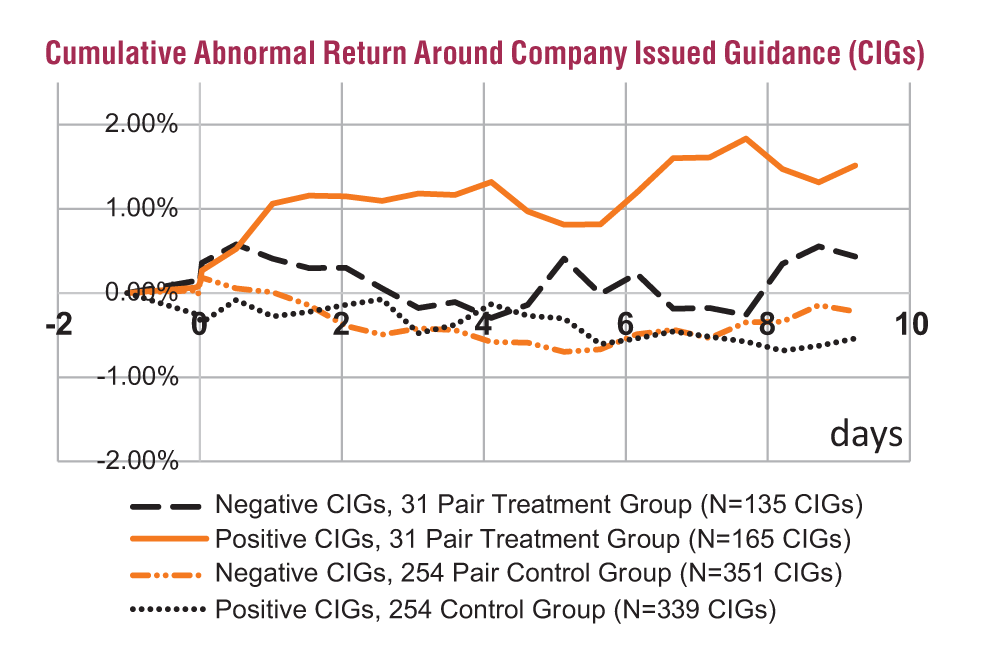
The mistakes are not just attributable to confusion among individual investors; institutional investors make the same mistakes about which stock they are trading. Trades made out of confusion are more likely to occur following an irregular event (e.g., new guidance from a company) than regular, scheduled events (e.g., earnings announcements).
Examples of such mistakes include Tweeter Home Entertainment Group (TWTRQ) and Twitter Inc. (TWTR). On October 4, 2013, shares of Tweeter soared 1,400% following news of Twitter filing papers for an initial public offering. Other pairs of stocks found to have experienced bouts of investor confusion included Newell Brands Inc. (NWL), which owns Graco Children’s Products and Graco Inc. (GGG), as well as HP Inc. (HPQ) and Helmerich & Payne Inc. (HP).
The researchers recommend that financial regulators further study this phenomenon and “publicize the list of the tickers which are often most confused.”
Source: “How Much Do Investors Trade Because of Name/Ticker Confusion?” by Vadim S. Balashov and Andrei Nikiforov; Rutgers School of Business-Camden, May 2019.
AAII InvestoGraphic

Stock Strategies

Beginning Investor

No comments have been added yet. Add your thoughts to the discussion!
You need to log in as a registered AAII user before commenting.
Log InCreate an account