


Charles Rotblut leads a class in AAII's new Essential Investing Video Course. Go to https://www.aaii.com/ves for more information and to subscribe.

Note: An update to this article was published in the April 2024 AAII Journal; click here to access.
Defined-maturity funds were first launched in 2010 and continue to be an option for income-seeking investors. These hybrid investment vehicles share advantages attributable to owning actual bonds and to investing in bond funds.

As the name implies, defined-maturity bond funds mature like bonds do. At maturity, investors receive a distribution equivalent to the fund’s net asset value (NAV). These funds are intended to be a solution for investors who desire certainty with the timing of cash flows or wish to stagger their interest rate exposure but do not want to invest in individual bonds. Defined-maturity funds are a solution for investors who prefer not to purchase individual bonds or desire to have a professional manager determine what bonds to own and which to avoid.
As hybrid investment vehicles, defined-maturity bond funds come with both compromises and unique characteristics that should be understood and considered before purchase. The complexities lie not only in the structure of the funds themselves, but also in the differences between bonds and bond funds. Understanding how these two differ helps to better understand the role that defined-maturity funds can play in a portfolio.
We first discussed these funds in 2013 (“Defined-Maturity Funds: A Bond Alternative With Compromises,” October 2013 AAII Journal). Since the article’s publication, several of these funds have matured, giving us insights on what investors have experienced. In this update, we discuss those insights. We also compare and contrast the offerings from Fidelity, Invesco and iShares.
Since many of you may not be familiar with these funds, we start our discussion by providing an overview of what defined-maturity funds are and how they compare/contrast to both bonds and traditional bond funds.
Bonds Versus Bond Funds
The underlying premise for defined-maturity bonds lies in the key differences between bonds and bond funds: maturity versus perpetuity.
Bonds cease to exist at maturity while bond funds are designed to last into perpetuity. The difference affects the return of capital an investor can expect at the time they make an investment.
Bond Maturity
A bond is essentially a loan to a corporation or government entity. A bond promises its owner a set amount of interest payments and full payment of the note’s balance—typically $1,000 in the U.S.—on a specified date (the maturity date). These characteristics enable an investor to determine the amount and timing of cash flows they will receive. For a traditional bond, the issuer will pay a prespecified amount of interest and, at maturity, will pay the par value of $1,000. Unless the issuer defaults, these are set amounts for traditional, noncallable bonds. This is why bonds are described as providing return of capital. Thanks to this characteristic, an investor can calculate their future return based on their purchase price and the prevailing yield, as long as they hold the bond to maturity.
A bond fund—whether it is a mutual fund, an exchange-traded fund (ETF) or a closed-end fund (CEF)—is a managed portfolio of bonds. A fund’s manager invests in a number of bonds meeting the criteria specified by the fund’s objective. Should a bond mature, the fund manager will typically reinvest a fund’s proceeds into a new bond. Quite often, bonds are sold from the portfolio before maturity as the fund’s manager seeks to manage yield, duration (a bond’s or a portfolio’s sensitivity to interest rate changes), diversification and security selection.
An Example of What Happens at Maturity
The iShares iBonds Sep 2018 Term Muni Bond ETF (IBMG) started trading in March 2013. At its inception, the fund had approximately five and a half years until its end date of September 2018.
The fund ceased trading on September 1, 2018. Its ending net asset value (NAV) of $25.45 was 1.2% above its NAV at inception. This increase was a capital gain for those who bought the fund on its inception date. The actual realization of a capital gain or loss depended on the price paid for the fund and the selling price if shares of the fund were sold prior to its liquidation.
Shares of the fund stopped trading on its last day. The distribution of the fund’s assets was a return of capital. BlackRock typically distributes the assets two business days after its defined-maturity bonds stop trading. Shareholders do not pay a brokerage commission on the distributed amount since it is not considered a trade.
A Form 1099 is issued and may have three classifications:
- Liquidation Distribution: A return of capital that is not taxable to the investor. Depending on the price paid for the fund’s shares, each individual shareholder may have a capital gain or loss for tax purposes.
- Exempt-Interest Dividend: This interest is not subject to income tax as long as the ETF had more than 50% of its assets invested in municipal securities. This is the type of distribution iShares’ municipal iBonds funds have paid since inception.
- Taxable Interest Income: This is taxable income at ordinary income rates. This is the type of distribution iShares’ corporate iBonds funds have paid since inception.
Source: “iBonds ETFs: Fund Maturities Case Study,” iShares.
More importantly, the typical bond fund is designed to last into perpetuity. In order to realize the return of their invested capital, shareholders must sell their shares at prevailing prices. Since the price of a fund’s shares fluctuates, there is no approximate dollar amount investors can plan on receiving in the future. The distributions paid by a bond fund also fluctuate depending on the composition of the portfolio and how the manager changes the holdings in response to shifting market conditions and interest rate expectations.
It is very possible to realize a loss of capital with a bond fund. If interest rates rise between the time an investor purchases and sells the bond fund, the fund’s share price may drop in value, causing a loss for the investor. Potentially offsetting this decrease are the distributions paid by the fund, the change in the fund’s yield, the portfolio decisions made by the fund manager and the length of time the investor holds the bond fund.
(It is also possible to realize a capital loss on an individual bond. This would occur if the bond was purchased at too high of a premium, its issuer defaults or the bond falls in value. The latter can be caused by an increase in interest rates and/or a changed perception of the bond’s credit quality.)
Bond Liquidity
Bond funds hold a key advantage in terms of bond purchasing power. Though U.S. bonds have a par value of $1,000, they typically trade in far larger quantities. A round lot of municipal bonds is $100,000. An individual investor can find bonds trading in smaller lots, such as $5,000, but as the size of the transaction decreases in dollar amount, so do the choices of bonds available for purchase. It can also be more difficult to sell smaller lots of bonds than it is to sell larger lots. Anytime the pool of would-be buyers or sellers shrinks, the opportunity for mispricing increases. This mispricing can work for and against smaller buyers of bonds, depending on prevailing prices.
Fund managers, conversely, have the ability to buy and sell large blocks of bonds. This gives them a greater selection of bonds and the ability to interact with a bigger range of buyers and sellers. Plus, since fund managers work with professional traders, they can get better pricing and lower transaction costs.
The Defined-Maturity Fund Solution
Defined-maturity funds seek to strike a middle ground between bonds and bond funds. Like bonds, these funds mature on a specified date and return the capital to shareholders. Like bond funds, they are professionally managed and benefit from economies of scale that a large portfolio offers.
Defined-maturity funds mature during the year listed in their names. For example, the Invesco BulletShares 2020 Corporate Bond ETF (BSCK) will mature on or about December 15, 2020. Shortly after this date, the fund will return its proceeds to shareholders. This is an important distinction from most target date funds, which continue their existence after the year in their names are reached. (For more information about target date funds, see “A Second Look at How Target Date Funds Change Their Allocations” in the June 2016 AAII Journal.)
 A big advantage of the termination dates is the ability to manage interest rate risk. An investor can build the equivalent of a bond ladder by investing in defined-maturity funds with different maturity dates. This allows them to stagger their exposure to changing interest rates instead of relying on forecasts that may or may not prove to be correct. The known termination date also provides a comparatively higher level of certainty in the timing and amount of cash flows relative to traditional bond funds.
Defined-maturity funds are actual funds. Investors buy shares in a fund that holds a portfolio of bonds maturing around a specified date. Within the limitations specified in the fund’s objective, the fund manager has the ability to adjust the portfolio, including replacing bonds. Bonds may also be added to or removed from the portfolio in reaction to purchases or redemptions from shareholders. This means investors are not buying into a static portfolio of bonds that are held until maturity but rather are purchasing a managed portfolio that evolves up until its maturity date.
Turnover rates—a measure of how often securities are held within a portfolio—are generally pretty low but do vary by fund and what is invested in. The highest levels of turnover occurred in the high-yield offerings from Invesco. These funds also had the highest tax-cost ratios. Neither fact is surprising, given the type of investments targeted. (High-yield bonds and high-yield bond funds are best held in tax-preferred accounts such as a traditional or Roth IRA by investors seeking to minimize their potential tax liabilities.)
Since these are actual funds, investors get the advantages of active management and effective buying power. The fund managers have access to the expertise of bond analysts and bond traders to assist with decisions regarding credit quality, valuation and bond selection. They also have access to a larger amount of data than the typical individual investor has and are better equipped to assess the attributes of bonds from municipalities or businesses that an individual investor may not be familiar with. The traders a fund uses have a better understanding of the market and can get more favorable pricing. Plus, due to the sheer amount of dollars available to invest, a fund’s portfolio is often more diversified than what most individual investors could create for themselves by buying bonds of similar maturities.
The disadvantage, of course, is that these are actively managed funds. Shareholders are reliant on the decisions of the fund manager and their team. If a fund manager makes poor bond choices or trades in a manner that creates taxable events, shareholders will be adversely affected. There is also no ability to customize, such as only owning bonds qualifying for exemptions from a specific state’s taxes. Furthermore, the cumulative expenses paid by a shareholder may be more than the commissions paid for individual bonds.
How Defined-Maturity Bond Funds Work
Defined-maturity bond funds hold a portfolio of bonds set to mature near the fund’s expiration date. The bonds held by the fund can be replaced in the years leading up to the maturity date at the manager’s discretion. Such trades could occur if a bond is called, the credit outlook changes, inflows or outflows from the fund alter the cash balance or other similar reasons. As such, it is possible for these types of funds to generate capital gains or losses for shareholders holding them in a taxable account.
Most taxes incurred over an investor’s holding period are likely to be attributable to distributions of income. BlackRock’s iBonds, Fidelity’s defined-maturity funds and Invesco’s BulletShares all make monthly distributions.
The termination date of the fund will be listed in the prospectus. The Fidelity Municipal Income 2021 fund (FOCFX) “will be liquidated shortly after June 30 of the funds target year.” Notice the terminology used. The maturity dates listed for these funds are not exact. And the maturity dates of the bonds held by these funds are not identical. Rather, the bonds held in these funds mature within a certain window of time leading up to the termination date of the fund. Data provided by Fidelity, Invesco and iShares showed some variance in the actual liquidation dates. Investors have the option of selling their shares before liquidation occurs.
As bonds mature in the final year of the fund, the proceeds may be invested in cash-equivalent securities. Fidelity’s funds may hold municipal money market securities. Invesco’s funds have the option of holding U.S. Treasury bills and investment-grade commercial paper. The iShares funds may hold money market funds affiliated with BlackRock Fund Advisors. As the transition to these cash equivalent securities is made, the fund’s yield will likely drop. This would particularly occur in the final months of a fund’s intended life-span, with the intent of the fund’s assets entirely consisting of cash by the termination date. Figure 1 in the box below provides an example of how a defined-maturity fund’s allocation evolves as it nears its maturity date.
Allocation Shifts to Cash as Maturity Date Approaches
Unlike traditional bond funds, defined-maturity bond funds liquidate after they reach their stated maturity date. Distributions from the liquidation are paid to the funds’ remaining shareholders.
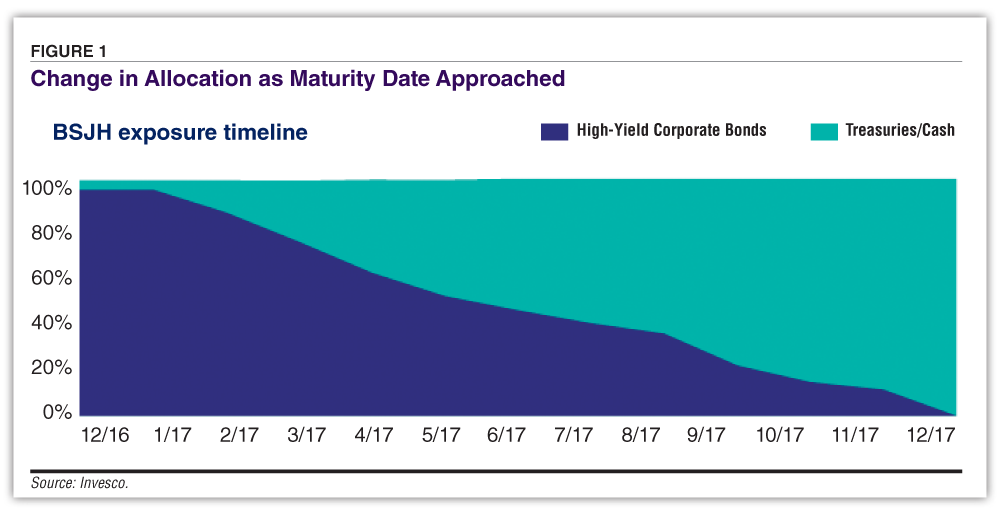
This characteristic leads to a shift in allocations as the maturity date approaches. Proceeds from maturing bonds are allocated to cash and cash equivalents rather than reinvested into new bonds. Figure 1 provides an example of this evolution. It plots the change in allocation during the last year of the Invesco BulletShares 2017 High-Yield Corporate Bond ETF (BSJH).
Investors preferring to maintain exposure to bonds can sell the maturing funds and reinvest the proceeds in a more recently launched defined-maturity fund as opposed to waiting for the fund they own to liquidate.
At termination, the fund’s balance is distributed to shareholders, less any final expenses withheld from the balance. The amount may be more or less than what a particular shareholder paid for the shares. This aspect is akin to individual bonds. Investors who paid a premium relative to the liquidation value of a fund (which would be the same as paying above par value for a bond), would receive less in final proceeds than what they paid for the fund. A capital loss could be claimed in their situation if the fund was held in a taxable account. A capital gain would be realized if the purchase price of the fund turns out to be below the fund’s final value at liquidation (akin to buying a bond below its par value).
Both BlackRock and Invesco list their funds’ yield to maturity on their respective websites. Yield to maturity calculates the present value of future cash flows relative to the prevailing net asset value. Their figure provides a bond-like figure to help you determine the future income return on a given day. BlackRock provides a calculator showing the acquisition yield for its funds. It adjusts the yield to maturity based on the price paid and the expense ratio. The calculator can be found near the bottom of each iBonds ETF’s page. As is the case with any ETF, seek to pay the quoted net asset value or a price below it.
Fidelity’s defined-maturity funds trade only at net asset value because they are mutual funds. The investment firm maintains the right to close these funds to new shareholders. Fidelity includes language in its prospectus to the effect that it also anticipates closing its defined-maturity funds to new purchases, both by prospective and current shareholders, during the 12-month period leading up to a fund’s maturity date. Because iShares and Invesco funds are ETFs, they never close to new investors. Shares in their funds are purchased on the open market instead of directly from the fund sponsor, as is the case with the Fidelity funds.
Characteristics of the Funds
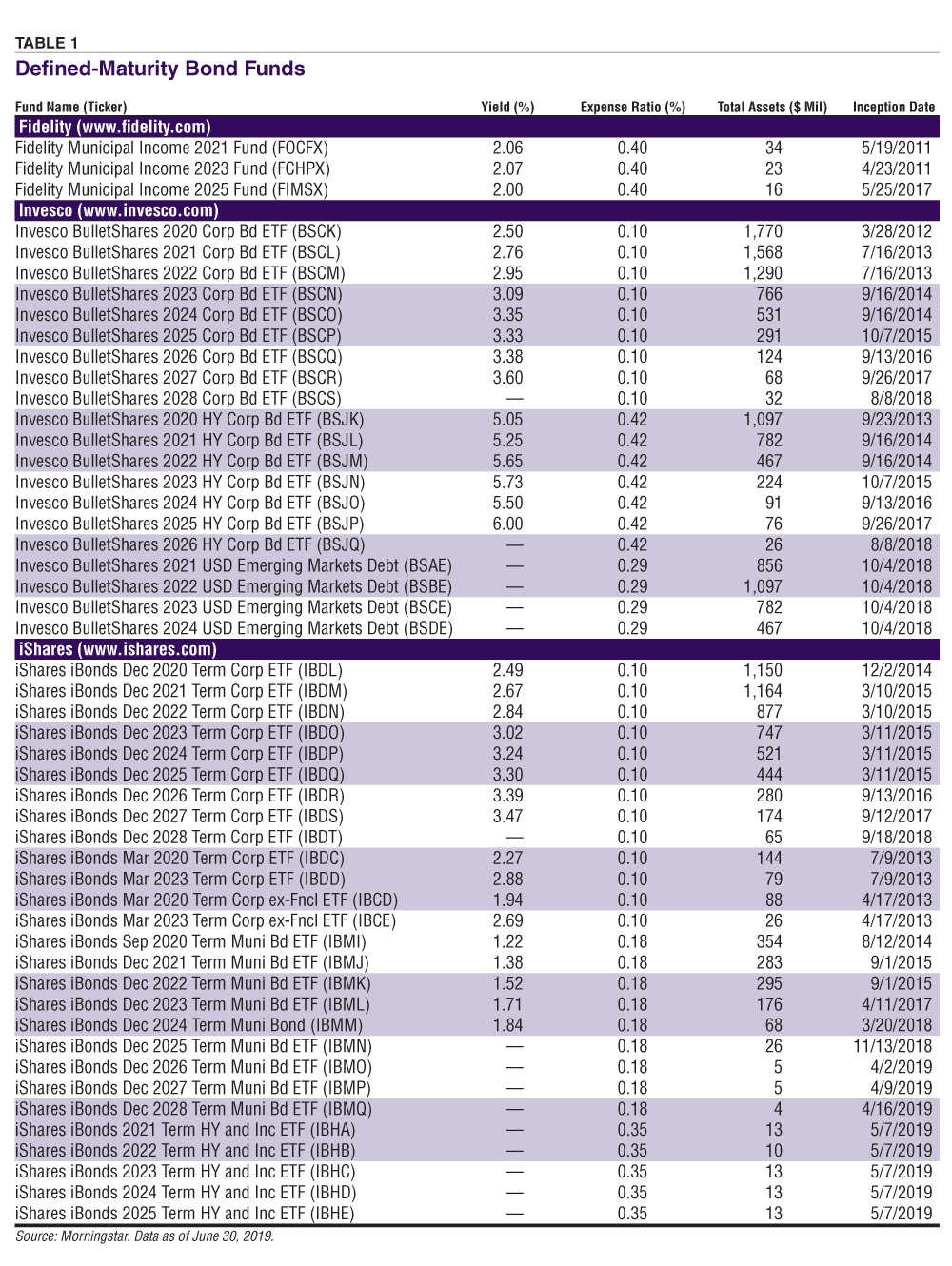
Table 1 shows a listing of the defined-maturity funds available as of July 1, 2019. As the funds with the nearest maturity dates terminate, it is expected that new, longer-dated funds will be introduced. Check each fund family’s website for the most current list.
Fidelity
Fidelity is unique in that its fixed-maturity offerings are mutual funds. The funds can be purchased directly from Fidelity or through other investment firms, including discount brokerage firms like TD Ameritrade and Vanguard. Since these are mutual funds, shares are bought and sold at net asset value at the end of each day. There is no required minimum investment. As mentioned previously, the funds may be closed to purchases during the 12-month period leading up to termination. The expense ratio is 0.40%. Distributions are made monthly.
Three defined-maturity funds are offered, with maturity dates ranging from 2021 through 2025. The funds are spaced at two-year intervals. The targeted termination date for all of the funds is June 30 of the year listed in the fund’s name. In the final year of each fund, the proceeds from maturing bonds may be invested in cash or cash equivalents, including municipal money market securities. New funds have historically been launched in April and May.
All three funds primarily invest in investment-grade municipal bonds. Income from these bonds is expected to be exempt from federal taxes, though the funds’ objectives do give the manager discretion to invest in bonds subject to the alternative minimum tax (AMT).
Will I Get My Investment Back at Liquidation?
Bonds are often viewed as preserving capital because, at maturity, investors receive a payment equal to par value in addition to the final interest payment. Par value is the amount of debt that the bond issuer asks to borrow and agrees to repay at maturity.
Defined-maturity bond funds are not debentures but rather funds that own a portfolio of bonds with similar maturity dates. At maturity, these mutual and exchange-traded funds (ETFs) liquidate their portfolios and distribute their assets to their shareholders.
There is no stated par value as with a bond. Rather, what is distributed is an amount equal to the value of assets owned by each share of the fund. This underlying amount is a fund’s net asset value (NAV).
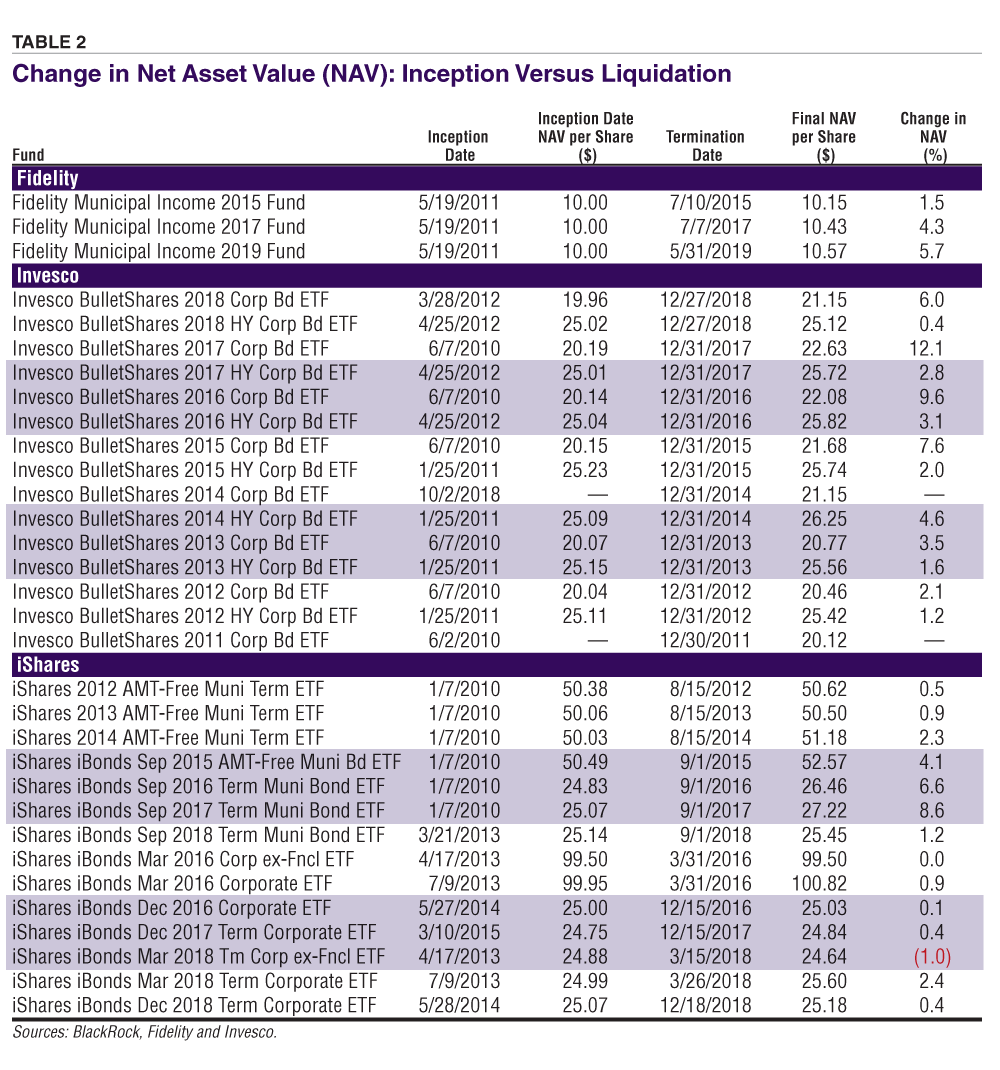
Fidelity, Invesco and iShares provided us with data about what has actually happened with their respective defined-maturity bonds. In most cases, investors who bought the funds at inception and held them until liquidation received a distribution in excess of the fund’s starting NAV. There were two exceptions. The iShares iBonds March 2018 Term Corporate ex-Financials ETF had a starting NAV of $24.88 per share and an ending NAV of $24.64. The iShares iBonds March 2016 Corporate ex-Financials ETF had a final NAV equal to its starting NAV.
Whether or not the final NAV of a defined-maturity fund is above or below your purchase price will depend on the price you paid. Changes in the fund’s NAV from inception due to fluctuations in the underlying value of the portfolio, fluctuations in a fund’s share price and whether you pay a premium or a discount to the fund’s underlying net asset value all will impact whether you realize a capital gain or a loss.
Even with a bond, it is possible to realize a capital gain or loss at maturity. If you pay a premium for a bond, the principal amount you pay will be less than your purchase price. If you pay a discount, you will receive more than your purchase price. The difference with individual bonds is that you have certainty of whether a gain or loss will be realized at maturity on the date of purchase (assuming the bond is not callable prior to maturity). There is less certainty with defined-maturity bond funds over the liquidation value. This is a trade-off for buying a fund holding bonds from many issuers and having an easier ability to sell quickly at quoted prices.
If a fund’s final NAV is above your purchase price at liquidation, the difference will be treated as a capital gain for tax purposes. If the final NAV is below your purchase price, the difference will be a capital loss. Similarly, if you sell your shares in a defined-maturity fund before liquidation, any difference in price from what you paid will be a capital gain or loss for tax purposes. (Neither capital gains nor losses are taxable events in retirement accounts such as IRAs and Roth IRAs.)
Table 2 compares the actual difference between the initial and final NAV for defined-maturity bond funds from all three fund companies.
Invesco
Invesco took over the BulletShares lineup of defined-maturity bond funds when it acquired Guggenheim Investments’ ETF business in 2018. Invesco currently offers in excess of 20 BulletShares categorized into one of three groups: investment-grade corporate bonds, high-yield corporate bonds and emerging markets debt. New funds are typically launched in late summer/early fall and mature on or after mid-December.
Since these are exchange-traded funds, they can be bought and sold just like stocks through any broker throughout the trading day. As such, the shares may trade at a premium or discount to net asset value. [On August 21, 2019, the Invesco BulletShares 2024 High Yield Corporate Bond ETF (BSJO) closed at a 0.52% premium to its underlying net asset value.]
The funds are never closed to new investors prior to termination. The expense ratios are 0.10% for the investment-grade corporate bond funds, 0.42% for the high-yield corporate bond funds and 0.29% for the emerging markets debt funds.
Nine corporate bond ETFs are offered with maturity dates ranging from 2020 through 2028, excluding the soon to be maturing 2019 fund. The funds are spaced in one-year intervals and hold at least 80% of their assets in bonds that make up an investment-grade corporate bond index. Six months prior to maturity, the objective allows the funds’ manager to transition the holdings to cash, U.S. Treasury bills and investment-grade commercial paper.
Seven high-yield corporate bond ETFs are offered with maturity dates ranging from 2020 through 2026, excluding the soon to be maturing 2019 fund. These funds intend to hold at least 80% of their assets in bonds that make up a high-yield (“junk bond”) corporate bond index. The funds track, but do not exactly mimic, the index. During the six months prior to maturity, the objective allows the fund’s manager to transition the holdings to cash, U.S. Treasury bills and investment-grade commercial paper.
Four high-yield emerging markets ETFs are offered with maturity dates ranging from 2021 through 2024, excluding the soon to be maturing 2019 fund. These funds intend to hold at least 80% of their assets in bonds that make up an index of U.S. dollar-denominated, emerging markets bonds. The funds track, but do not exactly mimic, the index. During the year of maturity, the objective allows the fund’s manager to transition the holdings to cash, U.S. Treasury bills and investment-grade commercial paper.
iShares (BlackRock)
The iShares iBonds lineup comprises investment-grade corporate, high-yield and income corporate ETFs and municipal bond ETFs. The expense ratios are 0.10% for the investment-grade funds, 0.35% for the high-yield ETFs and 0.18% for the municipal bond funds.
Like Guggenheim’s BulletShares, iShares’ iBonds are exchange-traded funds and can be bought and sold throughout the trading day from any broker at the prevailing market price. The shares may trade at a premium or discount to net asset value. [On August 21, 2019, iShares iBonds 2025 Term High Yield and Income ETF (IBHE) closed at a 0.76% premium to its underlying net asset value.] The funds are never closed to new investors prior to termination.
Thirteen corporate bond ETFs are offered with maturity dates ranging from 2020 through 2028, excluding the soon to be maturing 2019 fund. These funds mimic, but do not replicate, investment-grade corporate bond indexes. At least 80% of the funds’ assets are invested in individual bonds (domestic and foreign bonds domiciled in developed countries) and other BlackRock affiliated funds. As the fund’s termination date approaches, proceeds from maturing bonds will be held in cash and cash-equivalent investments, including money market funds. Distributions are paid monthly from these funds and are taxable. Nine of the funds are intended to terminate in December of their respective calendar years, while two are set to mature in March 2020 and two are set to mature in March 2023.
Five high-yield and income corporate bond ETFs are offered, with maturity dates ranging from 2021 through 2025. These funds mimic, but do not replicate, high-yield and other income-generating corporate bond indexes. At least 90% of the funds’ assets are invested in individual corporate bonds, including high-yield corporate and other BlackRock-affiliated funds. (High-yield bonds have credit ratings equal to or below Ba1 or BB+ but above CC. Bonds selected from a corporate index are BBB or equivalently rated.) As the fund’s termination date approaches, proceeds from maturing bonds will be held in cash and cash-equivalent investments, including money market funds. Distributions are paid monthly from these funds and are taxable. The funds are intended to terminate in December of their respective calendar years.
Nine municipal bond funds are offered, with maturity dates ranging from 2020 through 2028, excluding the soon to be maturing 2019 fund. These funds mimic, but do not exactly replicate, investment-grade municipal bond indexes. Generally, at least 90% of the fund’s assets will be in securities of the index. These bonds have at least a BBB- or Baa3 credit rating. Bonds held in the funds mature during the last calendar year of the respective fund (e.g., 2021 for the 2021 fund). During the last six months, proceeds from maturing bonds are allocated to cash and cash equivalents. These funds will begin to wind down and terminate in September of their respective calendar years.

Related


Discussion
FREE REPORT

Ed from MN posted over 7 years ago:
Charles Rotblut from IL posted over 7 years ago:
Newly retired from SC posted over 7 years ago:
Charles Rotblut from IL posted over 7 years ago:
Gary Rector from AR posted over 7 years ago:
Greg C. from MN posted over 7 years ago:
Greg C. from MN posted over 7 years ago:
Charles Rotblut from IL posted over 7 years ago:
Ron F from PA posted over 7 years ago:
Tom S from MN posted over 7 years ago:
Todd from VA posted over 6 years ago:
J A from NJ posted over 6 years ago:
PETER M from MN posted over 6 years ago:
CHARLES R from IL posted over 5 years ago:
You need to log in as a registered AAII user before commenting.
Log InCreate an account