



- Defined-maturity bond funds offer diversification without the hassle of researching and purchasing individual bonds
- Investors buy shares in a fund that holds a portfolio of bonds maturing around a specified date
- Whether or not the final NAV of a defined-maturity bond fund is above or below your purchase price will depend on the price you paid
Having a solution for cash flow certainty and timing is helpful when facing a known expense in the future. Owning individual bonds provides a reliable stream of cash flow and a predictable value at maturity. The headaches start with the research required for initial purchase of a bond. Identifying individual bonds to buy can be time-consuming, and acquiring the right number and types of bonds to achieve diversification is a hurdle. Additionally, coupon payments and proceeds from bonds that are called prior to maturity can be difficult to reinvest without a good understanding of the bond market and a large enough portfolio. Defined-maturity bond funds can offer diversification among different issuers and remove the pain of researching and purchasing multiple individual bonds.
Exchange-traded funds (ETFs) and mutual funds classified as defined-maturity funds seek to strike a middle ground between bonds and bond funds. Like bonds, they mature on a specified date and return the capital to shareholders. Like bond funds, they benefit from economies of scale that a large portfolio offers. As hybrid investment vehicles, defined-maturity bond funds come with unique characteristics and complexities that should be understood and considered before purchase.
We last discussed these funds in 2019 (“A Fresh Look at Defined-Maturity Bond Funds,” September 2019 AAII Journal). Since that article’s publication, some of the funds listed have matured. In this update, we present data on what investors holding defined-maturity bonds funds have experienced. We also discuss the ETF offerings from Invesco and iShares. Fidelity appears to be phasing its defined-maturity bond funds out, going from three funds in our previous listing to only offering one: the Fidelity Municipal Income 2025 fund (FIMSX), shown in Table 1. We conclude with strategies for using defined-maturity bond funds in investment portfolios.
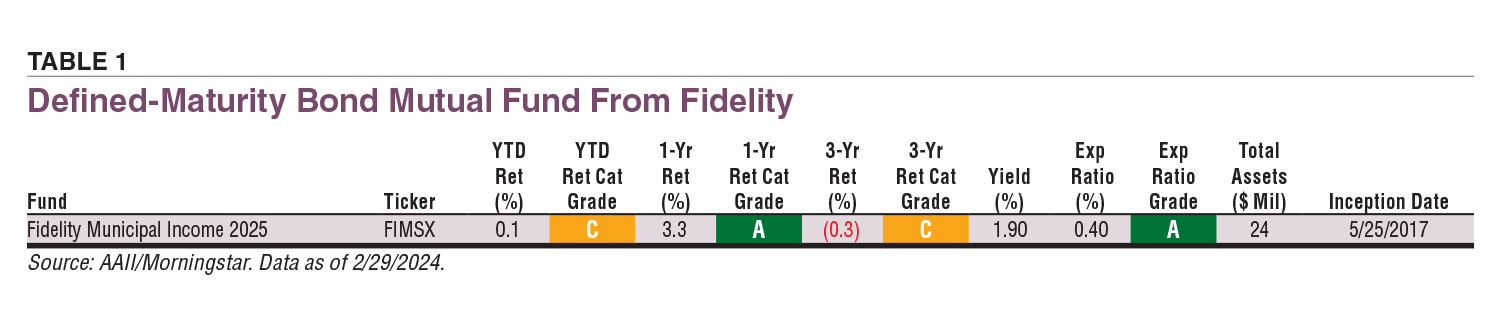
Download the Excel spreadsheet for Table 1.
Bond Fund Risks
There are key differences between bonds and bond funds. Bonds cease to exist at maturity, while bond funds are designed to last into perpetuity. The difference affects the return of capital an investor can expect at the time they make an investment.
A traditional bond fund—whether it is a mutual fund, ETF or closed-end fund (CEF)—is a managed portfolio of bonds. A fund’s manager invests in multiple bonds meeting the criteria specified by the fund’s objective. Should a bond mature, the fund manager will typically reinvest the proceeds into a new bond. Bonds may be sold from the portfolio before maturity as the fund’s manager seeks to control yield and duration (a bond’s or a portfolio’s sensitivity to interest rate changes) and provide diversification.
To realize the return of their invested capital, shareholders must sell their shares at prevailing prices. Since the price of a fund’s shares fluctuates, there is no approximate dollar amount investors can plan on receiving in the future. The distributions paid by a bond fund also fluctuate depending on the composition of the portfolio and how the holdings change in response to shifting market conditions and interest rate expectations.
Investors can realize a loss of capital with a bond fund. If interest rates rise between the time an investor purchases and sells the bond fund, the fund’s share price may drop in value, causing a loss—as occurred in 2022. Potentially offsetting this decrease are the distributions paid by the fund, the change in the fund’s yield and the length of time the investor holds the bond fund.
Mechanics of Defined-Maturity Bond Funds
Defined-maturity bond funds mature during the year included in the fund name. For example, the Invesco Bullet-Shares 2025 Corporate Bond ETF (BSCP) will mature on or about December 15, 2025. Investors gain exposure to defined-maturity bonds by buying shares in a fund that holds a portfolio of bonds maturing around a specified date. Shortly after the designated date, the fund ceases to exist and returns its proceeds to shareholders.
Investors experience a mix of returns that come from monthly or periodic distributions and the final net asset value (NAV) distribution. These returns can change over time. For example, if new bonds are added at higher yields versus the bonds previously held by the fund, the portfolio will pay out higher monthly income. The final NAV distribution could potentially be lower too. Importantly, investors should focus on total return, where they achieve the yield to maturity through both the regular payments and the final NAV payment.
The termination date of the fund will be listed in the prospectus. The maturity dates listed for defined-maturity bond funds are not exact; neither are the maturity dates of the bonds held by these funds. Rather, the bonds held in defined-maturity bond funds mature within a certain window of time leading up to the fund’s termination date. Data provided by Invesco and iShares show some variance in the actual liquidation dates. If desired, investors can sell their shares in the fund prior to the specified termination date.
As bonds mature in the final six months to a year of the fund, the proceeds may be invested in cash-equivalent securities. Invesco’s defined-maturity bond ETFs have the option of holding U.S. Treasury bills and investment-grade commercial paper. The iShares defined-maturity bond ETFs may hold money market funds affiliated with BlackRock. Figure 1 provides an example of this progressive change in allocation during the final six months of the iShares iBonds December 2023 Term Corporate ETF, which listed a termination date of December 15, 2023.
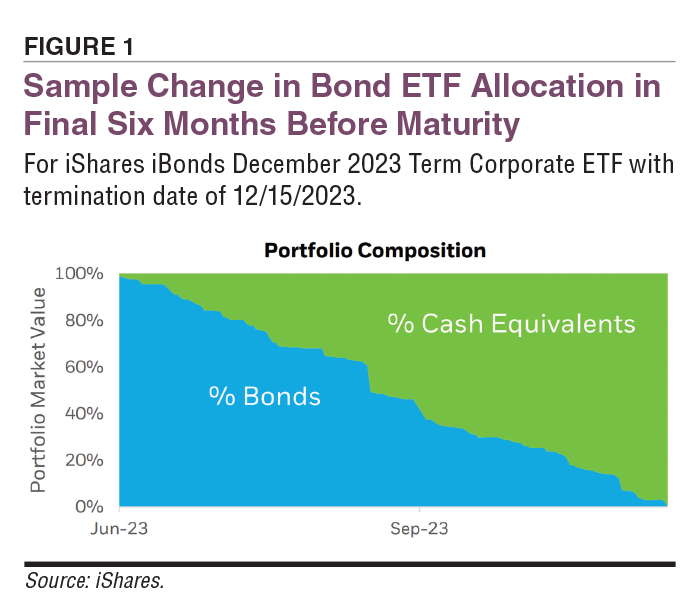
As the transition to cash-equivalent securities is made, the fund’s yield will likely drop. This would particularly occur in the final months of a fund’s life-span, with the intent that the fund’s assets consist entirely of cash by the termination date. Investors wishing to maintain exposure to bonds can sell funds that are maturing and reinvest the proceeds into a more recently launched defined-maturity bond fund.
At termination, the defined-maturity bond fund’s balance is distributed to shareholders, less any expenses. The amount may be more or less than what was paid for the shares. Investors who paid a premium relative to the liquidation value of a fund (which would be the same as paying above par value for a bond), would receive less in final proceeds than what they paid for the fund. A capital loss could be claimed if the fund was held in a taxable account. A capital gain would be realized if the purchase price of the fund turns out to be below the fund’s final value at liquidation.
Defined-Maturity Bond ETF Offerings
Tables 2 and 3 show the defined-maturity bond ETFs available from Invesco and iShares, respectively, as of February 29, 2024. Year-to-date, one-year and three-year returns are shown along with the corresponding A+ Investor Grades. As the funds with the nearest maturity dates terminate, it is expected that longer-dated funds will be introduced.

Download the Excel spreadsheet for Table 2.
Invesco currently offers 28 BulletShares ETFs categorized into one of three types: investment-grade corporate bonds, high-yield corporate bonds and municipal bonds. New funds are typically launched in late summer/early fall and mature around or after mid-December.
The expense ratios are 0.10% for the investment-grade corporate defined-maturity bond funds, 0.42% for the high-yield corporate defined-maturity bond funds and 0.18% for the municipal defined-maturity bond funds. The expense ratios for the corporate and high-yield ETFs are below (less expensive than) the average ETFs for their respective categories. The defined-maturity municipal bond ETFs are more expensive than their category peers—as indicated by the A+ Investor Grades of D.
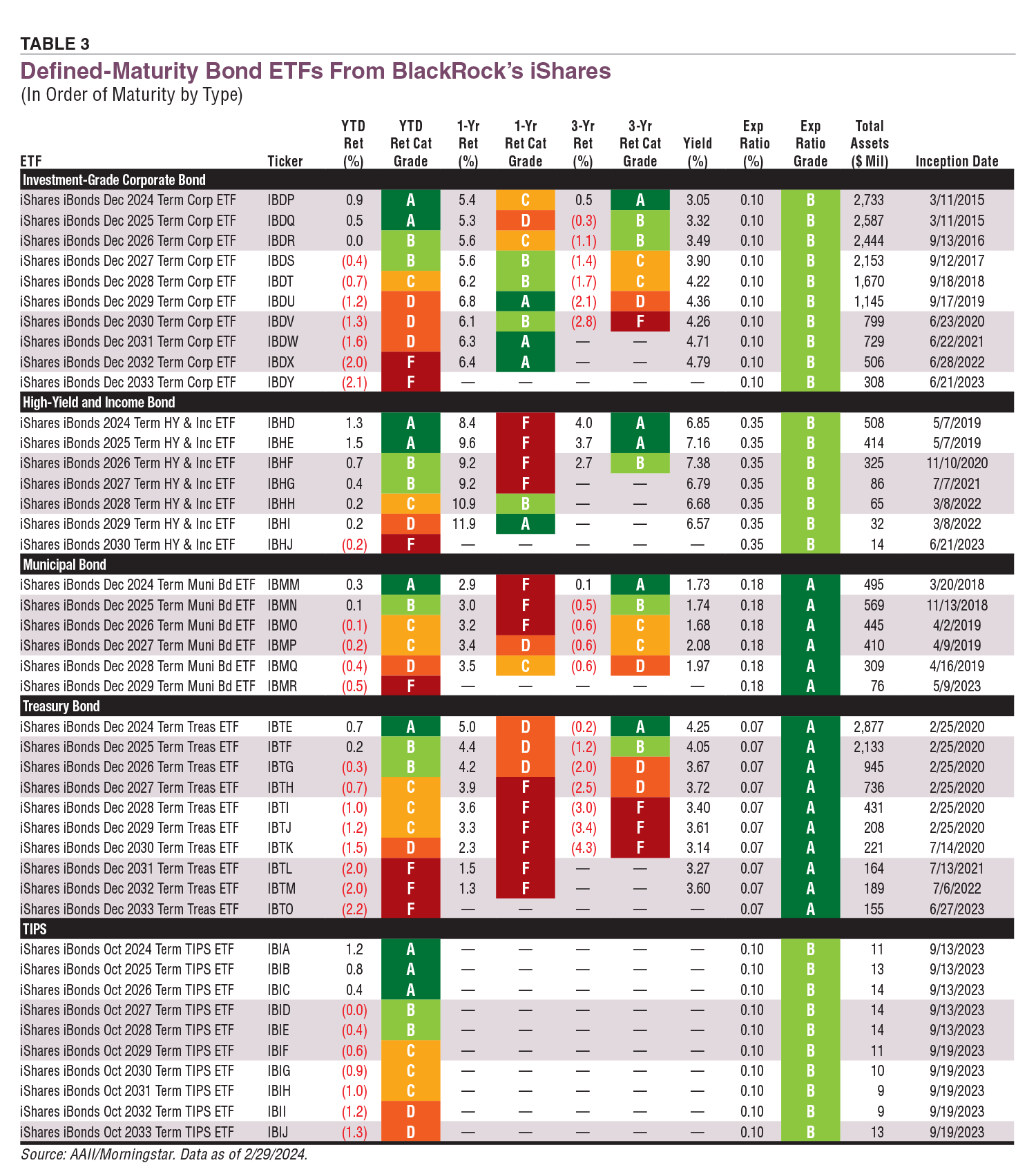
Download the Excel spreadsheet for Table 3.
The 43 defined-maturity ETFs in the iShares iBonds lineup comprise investment-grade corporate bond, high-yield and income corporate bond, municipal bond, Treasury and Treasury inflation-protected securities (TIPS) ETFs. The expense ratios are 0.10% for the investment-grade ETFs, 0.35% for the high-yield ETFs, 0.18% for the municipal bond ETFs, 0.07% for the Treasury ETFs and 0.10% for the TIPS ETFs. These are all below the average (inexpensive) for their respective category peers.
Both BlackRock and Invesco list their defined-maturity bond ETFs’ yields to maturity on their respective websites. Yield to maturity calculates the present value of future cash flow relative to the prevailing NAV. These bond-like figures indicate the future income return on a given day. BlackRock provides a calculator showing the acquisition yield for its funds. It adjusts the yield to maturity based on the price paid and the expense ratio. The calculator can be found near the bottom of each iBonds ETF’s page.
Portfolio turnover rates—a measure of how often a portfolio’s holdings are replaced—are generally low but vary by fund. The ratio is also affected by the types of bonds a fund holds. The highest levels of turnover occurred in the high-yield offerings from both Invesco’s BulletShares and BlackRock’s iBonds. These funds also had the highest tax-cost ratios. Neither fact is surprising, given the type of investments targeted.
Most taxes incurred over a holding period are likely to be attributable to distributions of income. IShare’s iBonds and Invesco’s BulletShares ETFs make monthly distributions. The exception is the iShares iBonds TIPS bond ETFs, which make quarterly distributions.
What Happens at Liquidation?
At maturity when these ETFs liquidate, an amount equal to the value of assets owned by each share of the ETF is distributed. This underlying amount is an ETF’s final NAV.
Invesco and iShares provided us with data about what has actually happened with their respective defined-maturity bond funds. In most cases, investors who bought the funds at inception and held them until liquidation received a distribution in excess of the fund’s starting NAV. The Invesco BulletShares high-yield corporate bond ETF series had final NAV values that were less than the starting values for 2019 through 2023, as did the iShares iBonds high-yield income ETFs.
Whether or not the final NAV of a defined-maturity bond fund is above or below your purchase price will depend on the price you paid. Changes in the fund’s NAV from inception due to fluctuations in the underlying value of the portfolio, fluctuations in a fund’s share price and whether you pay a premium or a discount to the fund’s underlying NAV all affect whether you realize a capital gain or a loss.
With an individual bond, you know on the date of purchase if you will receive a capital gain or loss at maturity. There is less certainty with a defined-maturity bond fund’s liquidation value. This is a trade-off for having the flexibility to sell at quoted prices and the diversification of a fund that holds bonds from many issuers.
If a fund’s final NAV is above your purchase price at liquidation, the difference will be treated as a capital gain for tax purposes. If below your purchase price, the difference will be a capital loss. Similarly, if you sell your shares in a defined-maturity bond fund before liquidation, any difference in price from what you paid at purchase will be a capital gain or loss for tax purposes.
Table 4 compares the difference between the initial and final NAV for defined-maturity bond ETFs from Invesco and iShares that have liquidated in the last five years. Data on older defined-maturity bond ETFs and mutual funds is included as an addendum at the end of this article.
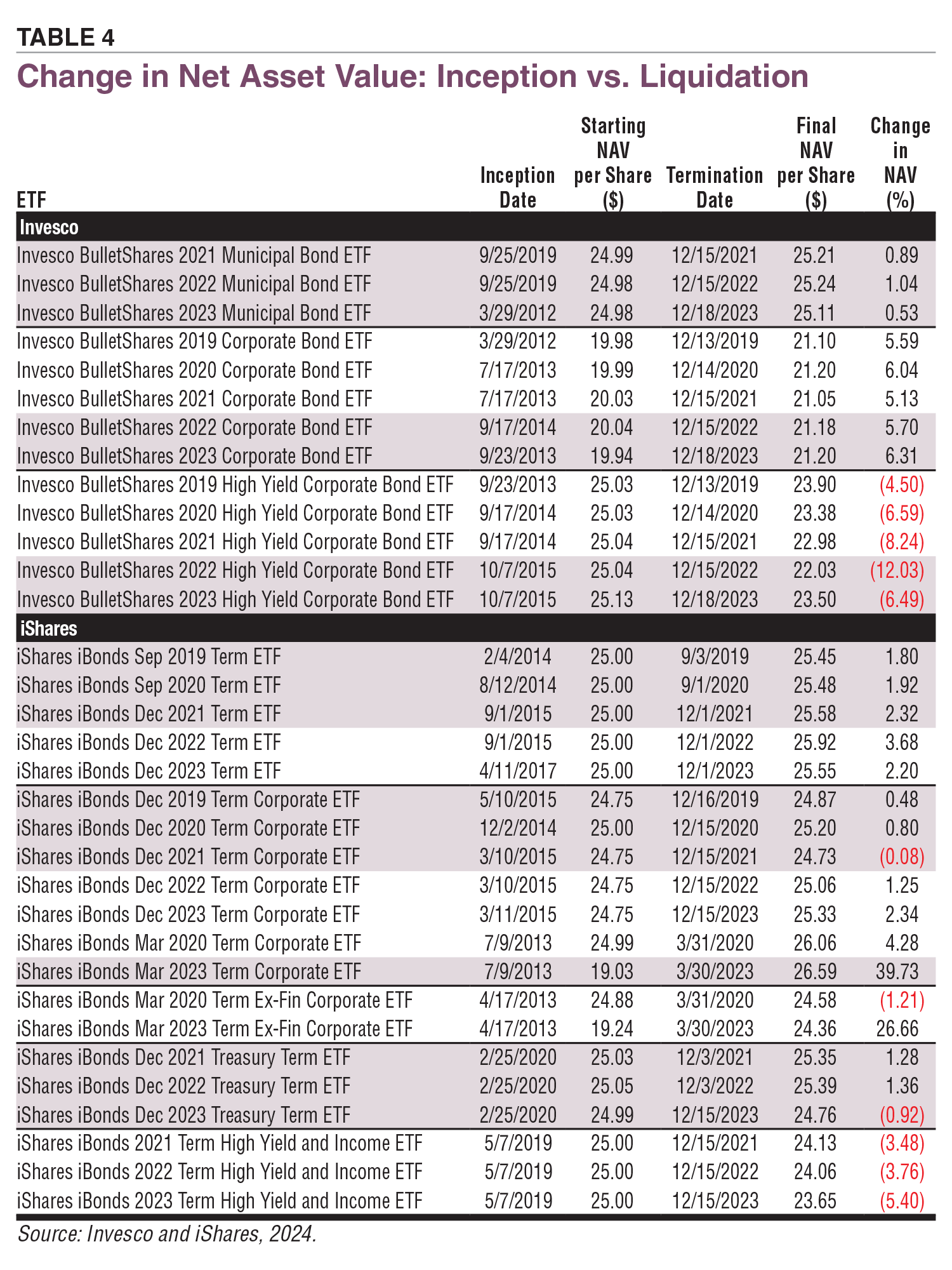
Download the Excel spreadsheet for Table 4.
Portfolio Applications
Generally, defined-maturity bond funds are intended to be a solution for investors who desire to avoid variability with yields or wish to stagger their interest rate exposure but do not want to invest in individual bonds. Investors wanting to add duration (interest rate sensitivity) to their portfolios can put their money to work by targeting longer-dated defined-maturity bond ETFs. Those who prefer to reduce durations can seek out shorter-dated defined-maturity bond ETFs.
Defined-maturity bond ETFs can be used to create a bond-like ladder, meaning a portfolio of ETFs with staggered maturity dates. The varying liquidation dates allow investors to manage interest rate risk. The equivalent of a bond ladder can be built by investing in defined-maturity ETFs with different maturity dates.
Rolling down the yield curve is a strategy that targets investing in the steepest part of the curve, meaning the bonds with the highest yield. Ahead of the maturity date, the bonds are sold (since there is less future income left to earn) and reinvested into higher-yielding and longer-maturity bonds. The price increase from the drop in yield is captured as the bond moves closer to maturity. Defined-maturity bond ETFs can be utilized to implement a strategy similar to this by selling the ETFs ahead of their liquidation dates and reinvesting the proceeds into newer funds.
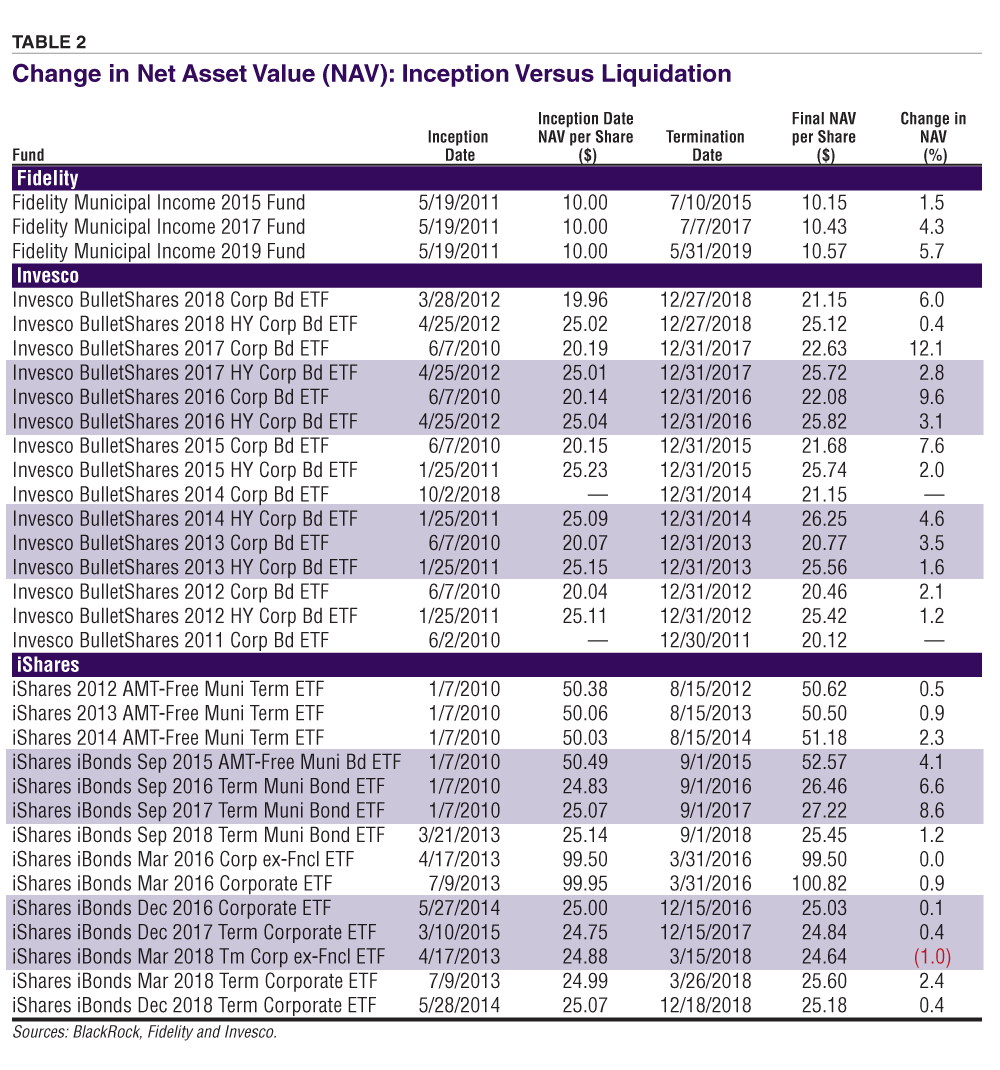
Liquidation Data on Older Funds
This table from the May 2019 AAII Journal article “A Fresh Look at Defined-Maturity Bond Funds” shows liquidation data for mutual funds and ETFs that matured between December 2011 and May 2019.
Discussion
FREE REPORT

PETER G from NY posted over 2 years ago:
JOSEPH B from CA posted over 2 years ago:
KEN R from CA posted over 2 years ago:
You need to log in as a registered AAII user before commenting.
Log InCreate an account