

Related

Financial Planning
Avoid Becoming a Victim of Investment Schemes

Editor's Note
by AAII Staff | November 2019

Accredited households age 80 and older are more than 80% less likely than unaccredited investors age 60–64 to have better financial literacy scores and 82% less likely than younger non-accredited investors to show understanding of basic survey questions.
An individual investor meets the definition of “accredited investor” if they have an annual income over $200,000 ($300,000 for a married couple) or a net worth over $1 million excluding primary residence, according to the U.S. Securities and Exchange Commission (SEC). Using this definition, regulators and experts have assumed that wealthier investors have a greater ability to evaluate securities or to hire experts who can help them understand these investments. However, with data suggesting that older investors perform 3% to 5% worse than younger investors, researchers wanted to uncover whether older households have greater financial sophistication than younger ones.
Using 2016 data from the Survey of Consumer Finances conducted by the Federal Reserve Board, the Consumer Finance Monthly survey from The Ohio State University and the Health and Retirement Survey from the University of Michigan, the researchers found that financial literacy scores rose during adulthood for accredited investors and began declining after age 60, while for non-accredited investors’ financial literacy scores were constant from young adulthood through middle and declined after age 60.
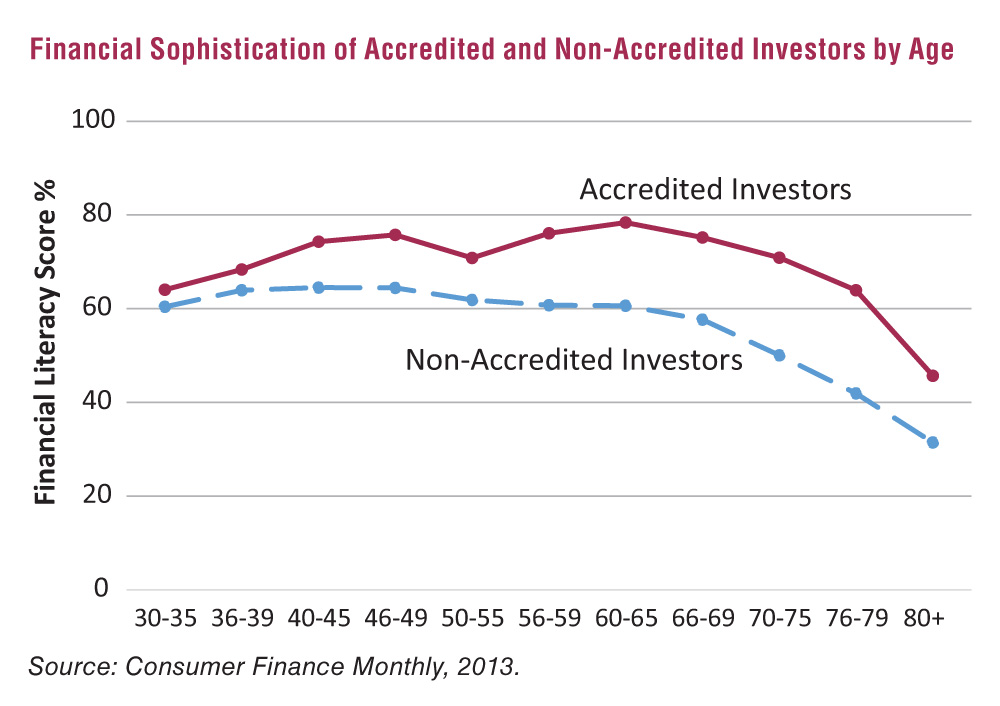
Looking at the declines in financial sophistication in old age, both accredited and non-accredited investor groups saw lower percentages of correctly answered financial literacy questions on a test.
The Dodd-Frank Act requires the SEC to review the accredited investor definition every four years starting in 2014. Based on the data in this study, the researchers recommend that regulators revise the definition, as more investors have met the income qualification than the SEC intended. The rationale is that many of the investors now meeting the financial requirements may lack the financial sophistication to effectively invest in complex securities.
Source: “The Unsophisticated ‘Sophisticated’: Old Age and the Accredited Investors Definition,” by Michael Finke and Tao Guo; SSRN, September 2019.
Financial Planning
Editor's Note

No comments have been added yet. Add your thoughts to the discussion!
You need to log in as a registered AAII user before commenting.
Log InCreate an account