

Related

Investor Professor
A survey of AAII members brought out a range of opinions on where rates are headed and insights into what they are specifically doing about it.

Charles Rotblut leads a class in AAII's new Essential Investing Video Course. Go to https://www.aaii.com/ves for more information and to subscribe.
The low interest rate environment is having an impact on how individual investors are allocating their portfolios. Three out of five AAII members we surveyed said they have either increased their stock allocation or sought out higher-yielding assets because of ongoing low interest rates.
As we conducted the survey, the benchmark 10-year Treasury note was yielding a little under 1.6%. The yield curve in the U.S. was also inverted, with yields on three-month Treasury bills exceeding yields on the longer-term benchmark note. The futures market was pricing in the likelihood of the Federal Open Market Committee lowering rates further. Overseas, the two-, five- and 10-year German bunds were trading with negative yields. Given this backdrop, we wanted to know what actions individual investors had taken or were taking in response.
The “big question” we asked focused on how, if at all, individual investors have adjusted their portfolios in response to low interest rates. The survey was part of a new, periodic initiative to give AAII members such as yourself a chance to talk about their investment decisions and challenges. Each survey will ask what we’re describing as a “big question” about a subject affecting many investors. A randomly selected group of AAII members will be asked a specific question, as well as follow-up questions intended to provide more clarity and background.
This second survey in the series was emailed to AAII members in early-to-mid October. The results were tabulated based on responses sent to us. We received 264 responses from the survey invitation. Respondents were overwhelmingly male. The average and median ages were 70, with retirees accounting for slightly more than two-thirds of all respondents (69%).
Q: How have low interest rates influenced how you invest?
One-third of respondents (33%) said they have sought higher yields in dividend-paying stocks and/or other higher-yielding assets. An additional 26% said they increased their stock allocations.
There were some who reduced their exposure to interest-paying investments. Nine percent said they’ve cut their bond allocations and/or exposure to fixed-rate investments.
A small group of respondents (6%) boosted how much of their portfolios they hold in cash.
There were also those who haven’t let the low interest rates alter their investing plans. Slightly more than a quarter of all respondents (26%) said they haven’t changed their portfolio allocations.
AAII member Lance Morikawa is among those who have boosted their equity allocations. His portfolio now has a “higher stock percentage and a lower bond percentage to maintain a reasonable return.” He also has boosted his cash allocation. “My increase in allocation to stocks is the dividend returns from companies that are financially sound to minimize risk. The increase in cash is to fund potential personal needs if the market does take a downturn into a correction or bear market. The bond market returns are not covering risks of capital, so a reduction is warranted.”
Q: What specific allocation decisions have you made because of the prevailing level of interest rates?
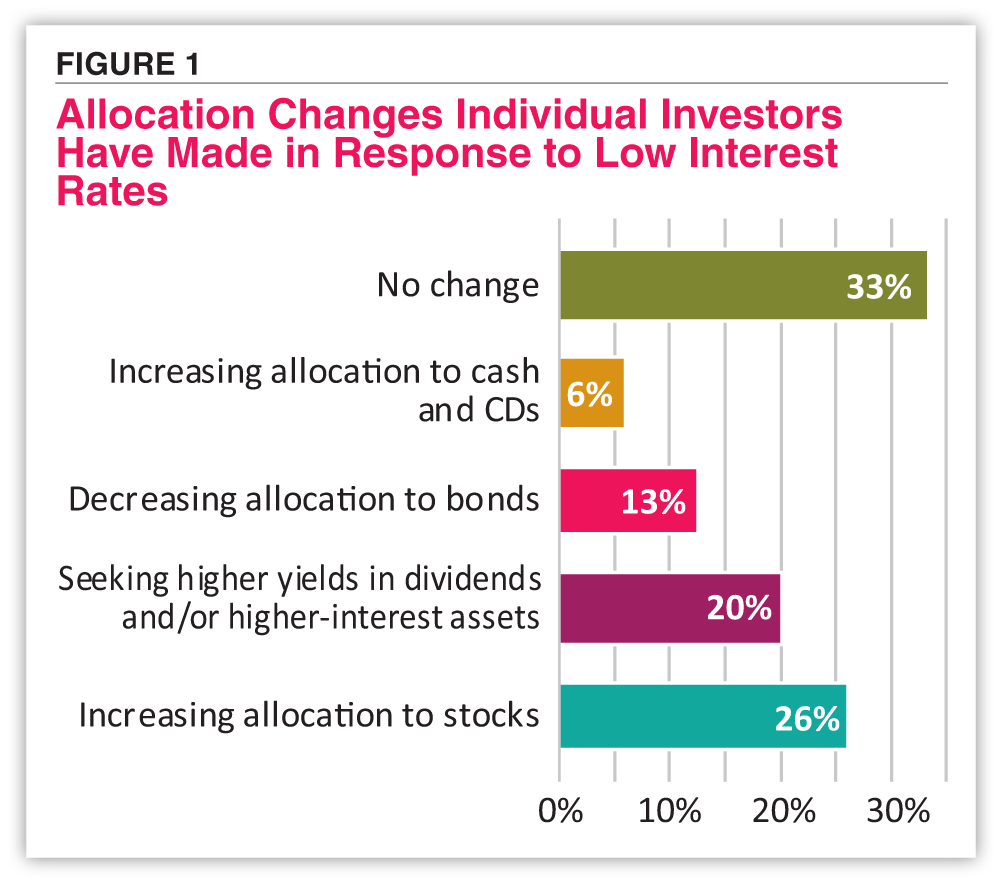
When we asked respondents to be more specific about the actions they have taken, the responses were similar to what they told us in response to the first question. Many said they are allocating more to equities and higher-yielding investments. Figure 1 shows the breakdown of responses.
AAII member Richard Leo Andres was among those who expressed frustration about finding investments to buy. “I spend way too much time and resources finding acceptable investment opportunities,” he told us. Though he has refrained from “chasing yield,” he has also found that “finding SWAN (‘sleep well at night’) investment instruments” has become “a full-time job.” Andres thinks it has been “a tough nut trying to deploy when money market rates have gone to a ‘zero’ yield.” He believes that “sometimes the best move is not to play the game.”
Q: In terms of your cash savings, have you made any changes?
Many banks are now paying depositors low interest rates on their savings. Given this reality, we wanted to know what AAII members are doing with their cash. A third of respondents have moved their cash to a higher-yield savings account, certificate of deposit (CD) or money market fund. Thirteen percent have reduced how much they keep in cash. Just under half of all respondents (47%) say they haven’t made any changes.
“I started buying one-year CDs with the expectation (really, hope) that rates would rise at least slightly in the near future. When there was widespread talk of interest rates going even lower, I bought a two-year CD with almost 20% of my cash. Now that the rates have declined, as my one-year CDs mature, I’ll continue reinvesting in one-year increments until we see an improvement in rates,” AAII member Richard Pichowsky told us.
Fellow AAII member Alan Odgers has been following a similar strategy, buying CDs whose longest maturity is 12 to 18 months. He puts the cash he intends to reinvest in CDs “laddered out for one to four months and reinvested each month they renew.” Alan added, “I would never go beyond two to five years out at these low CD rates.”
Q: Are you taking on more risk to get a higher yield because of the low interest rate environment?
To get a better sense of the impact low interest rates are having on individual investors’ portfolios, we asked about perceptions of risk. Thirty-seven percent of respondents said they are taking on more portfolio risk in response to low interest rates. Fifty-five percent said they aren’t.
We followed up by asking those who view themselves as taking on more risk to explain how they are taking on more risk. Nearly three-quarters of those who responded to the follow-up question pointed to their higher exposure to stocks and dividend income.
We then asked all survey respondents to describe their tolerance for risk. The choices presented were “conservative,” “moderate” and “aggressive.” Moderate was the most widely chosen option, picked by 61% of respondents.
Those who described themselves as having a moderate tolerance risk were fairly evenly split between saying they have taken on more risk and saying they haven’t. Among investors with a self-described aggressive tolerance for risk, more said that they have not taken on more risk than those who said they have taken on more risk. This is unsurprising given that such investors are likely accepting higher levels of risk anyway to get higher levels of return.
Fewer conservative investors said they haven’t taken on more risk than those who have taken on more risk. The overall differences were not large enough to be significant. The lack of a significant difference could imply that for some investors the decision to maintain a conservative allocation is independent of what interest rates are doing.
AAII member Cal Cobb is among those with a conservative tolerance for risk. In an email to us, he wrote, “I have resisted the temptation to reach for yield in the current environment out of concern over a number of macroeconomic issues and the thought that the cycle is closer to the end than the beginning. Therefore, I’m willing to sit on the sidelines and preserve capital until the global economic and investment environment is more stable.”
Q: Thinking back to the beginning of the decade, where did you think interest rates would be by now?
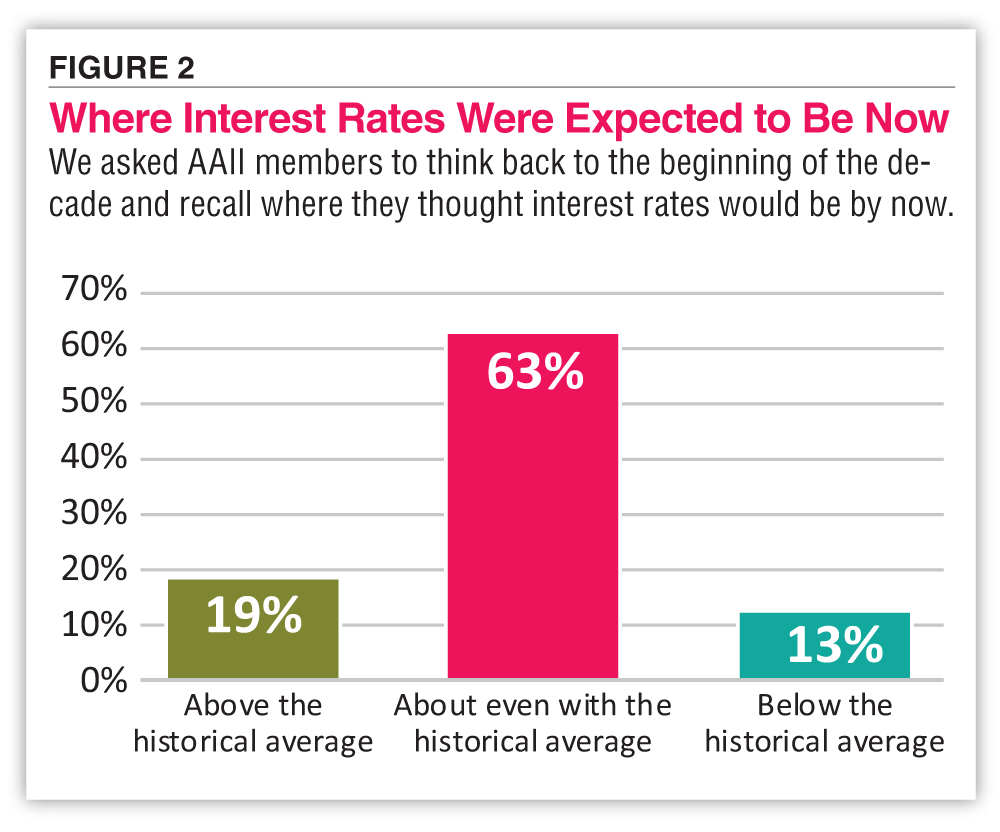
To get a sense of where interest rates are now relative to where individual investors thought they would be, we asked respondents to think back to the beginning of the decade and recall what their expectations were at the time. As shown in Figure 2, almost two-thirds of respondents (63%) said they were expecting interest rates to be about even with the historical average by now. An additional 19% indicated that they had expected interest rates to be above the historical average.
Just 13% anticipated that interest rates would be below the historical average at this point.
Q: What do you currently place greater odds on happening in the next one to three years?
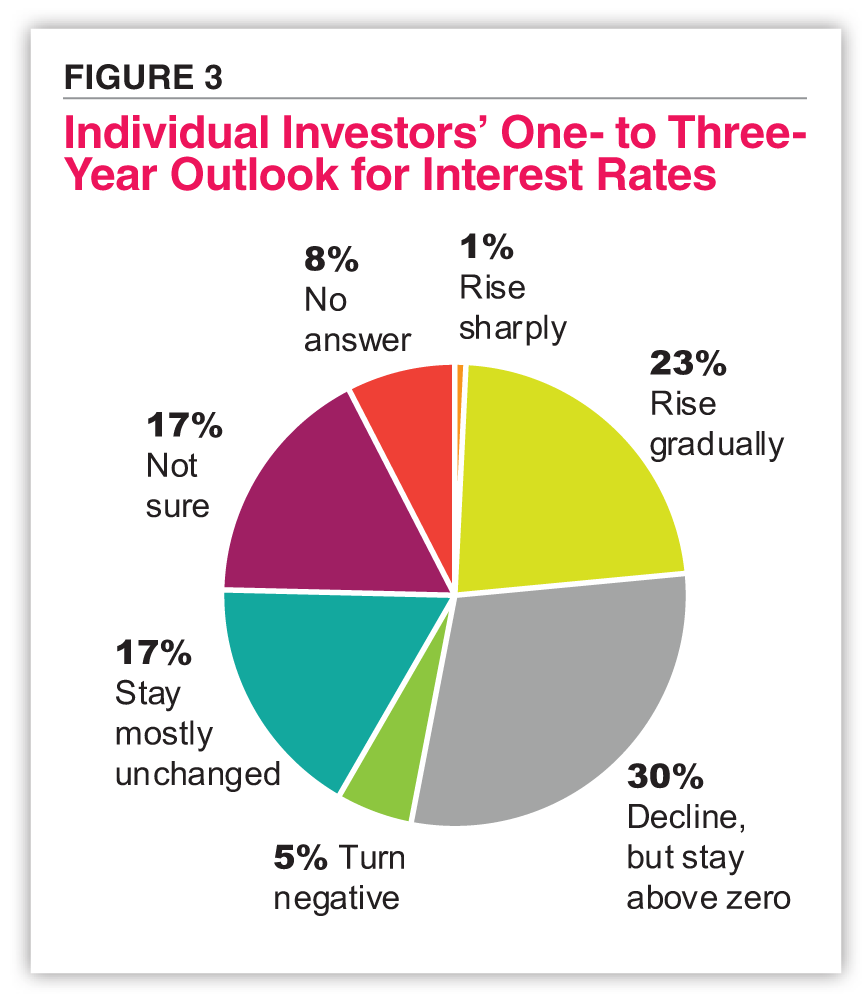
Respondents’ expectations about what will happen to interest rates over the next few years are decidedly mixed as Figure 3 shows.
More than one-third of all respondents (35%) expect that interest rates will fall further. Most of this group think rates will decline but not turn negative. Five percent think negative rates will happen.
At the other end of the spectrum, nearly a quarter of all respondents (24%) expects interest rates to rise. Few anticipate a significant increase in rates, however. Just two respondents (1%) selected the predefined response option “interest rates will rise sharply.”
Q: What advice would you give other investors about investing in the current interest rate environment?
When asked what advice they would give other investors, respondents gave mixed opinions.
The most common suggestion was to stick with one’s strategy in terms of diversification, allocation choices, etc. Twenty-eight percent of respondents gave an answer along these lines.
AAII member Rob Fates’ response was representative of some of the answers we received: “Stay the course and follow your long-range plan.” Elaborating, he explained, “Over the past three years, I have moved toward a dividend-growth investment strategy: Buying high-quality companies that have a record of growing sales, earnings and dividends, and reinvesting the dividends in the same stocks that pay them. I view it as a way of compounding dividend returns.
AAII member Hugh Miller shared a similar sentiment, writing “Maintain your approach. No knee-jerk responses because of changes.” He added, “For me, the steady focus on long-term goals and allocations has been far more productive (even in the short run, in most cases) than watching the particular rate offered by a particular investment.”
Eighteen percent of respondents suggested being more careful or cautious with investment decisions due to the risks of a recession, a drop in security prices and/or a change in rates. AAII member Ed Lustenader suggested that other investors “be cautious about how much risk you take in chasing higher yields.” He added, “What I’ve found with higher yields is usually more risk. Many of the higher-yielding stocks have higher price-earnings ratios, and sometimes the yields increase because the stock price declines. Regardless, choosing stocks with steadily increasing dividends has been the better investment.”
Sixteen percent suggested increasing exposure to stocks, particularly dividend-paying stocks.
Investor Professor

Editor's Note

Investor Professor

Doug Propp from Illinois posted over 6 years ago:
Bud from WA posted over 6 years ago:
Mike Heller from California posted over 6 years ago:
Ken Tubman from California posted over 6 years ago:
You need to log in as a registered AAII user before commenting.
Log InCreate an account