This Decade’s 10 Biggest S&P 500 Winners

With the decade ending soon, we thought it would be interesting to see which companies have experienced the biggest price increase. 

Charles Rotblut leads a class in AAII's new Essential Investing Video Course. Go to https://www.aaii.com/ves for more information and to subscribe.


With the decade ending soon, we thought it would be interesting to see which companies have experienced the biggest price increase. We looked at S&P 500 companies, comparing their current prices with their prices as of December 31, 2009.

What we found was a broad mix of companies. Some of the names likely won’t be a surprise. Several others will be. These less-familiar companies don’t receive a great deal of attention in the financial press even though their 10-year gains are extremely high.

Of the 10 stocks shown below, just one was a member of the S&P 500 at the start of the decade. Several of the stocks making this month’s First Cut were small-cap companies 10 years ago. It’s a good lesson in why it makes sense to widen the universe of potential investment candidates beyond the large-cap index and certainly beyond the stocks receiving the most attention.
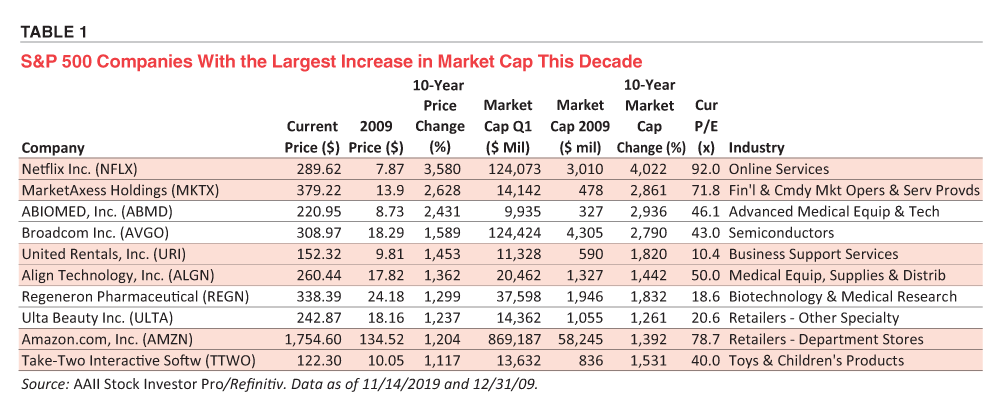
 

Our starting point for this month’s First Cut was the S&P 500’s current composition. Using AAII’s Stock Investor Pro, we gathered current market capitalization as well as current and historical share price information. We then ran the same list of stocks through the January 1, 2010, version of Stock Investor Pro to get decade-old market cap data. Market cap shows how the company’s value has changed over time. Differences between price and market cap change reflect the impact of stock buybacks, dividend distributions and share issuances on investor return.

Discussion

Steve from IN posted over 6 years ago:

Very interesting list for sure. In the current environment, it seems like everyone is assuming you have to own Apple, Amazon, Google, etc. to beat the market. Clearly not true. Of course, the hard part now is deciding what the 10 stocks for the next 10 years are. As you say though, it helps to broaden your list of options.


Nathan Busch from Minnesota posted over 6 years ago:

Very nice article given that it constitutes 20/20 hind sight. The problem is that hind sight is of no value in making a decision as to how to go forward. Sure, companies come and companies go: the S&P 500 is always in flux. However, it is nearly impossibly to consistently build a portfolio of small S&P 500 companies that will match the yield of the S&P 500 let alone actually exceed that yield. Rothblut down played the use of ETFs as investment vehicles in favor of searching for small, unknown S&P 500 companies. That is a fool's errand. Consider RSP, an ETF that uses only the S&P 500 companies to track the S&P 500 but has bested the gains of the S&P 500 since its inception in 2003. Sure, over the past year, RSP has stagnated but so has the S&P 500. Now that the S&P 500 is on the move again, we can expect that RSP will continue to have a much higher long-term yield than the index. So, why should an individual investor guess at which companies in the S&P 500 might succeed only to be invariably proven wrong in the longer term. Just use RSP.


Dan from NE posted over 6 years ago:

"So, why should an individual investor guess at which companies in the S&P 500 might succeed only to be invariably proven wrong in the longer term. Just use RSP." Sorry, Nathan, I'm afraid you missed the whole point. Choosing - not GUESSING, which I suggest is exactly how some investors don't beat the S&P 500 - small companies before they are in the index can be very profitable. But it requires considerable study and lots of reading to be successful. If one doesn't have the time or the inclination for such, then I would agree there's nothing wrong with using ETFs or index funds instead of choosing individual stocks. Peter Lynch ("One Up on Wall Street") is the all-time master of mutual fund management and even he says that an investor who wants to self-build his portfolio should make at least 10-12% more than the return of the S&P. If it were not possible (note that no one says EASY) I don't think the man who managed the highest-returning mutual fund in history would recommend that individual investors build their own portfolios if he didn't thank that most investors could do so, if they truly wanted to make better returns than some stodgy, cap-weighted index which is guaranteed by definition to be average. Many individual investors who consistently beat the indices by a considerable margin look for smaller firms that are not covered by many analysts (none is best) which have a great business plan and a sizable personal stake in that business, all of which is pretty much the opposite of an index like the S&P 500. But there are many ways to win. All methods that win consistently take some level of dedication and effort. But they can also pay well. :) Don't count on luck, but good luck all.


Gordon Robinson from NC posted over 6 years ago:

Forget about individual stocks in the S&P 500 Index, buy the index itself The SPDR E&P 500 Index (SPY) which is the largest S&P 500 Index fund (289 billion in assets) is up 27.6% this year, average 13.3% per year for the past 10 years It has tripled since 2009 (up 322%) You can buy it (an ETF) for an ER of 0.09 and forget about doing anything else to your portfolio I own it.....It has tripled since 2009


Sunny from TX posted over 6 years ago:

These first cut securities are, indeed, "shooting stars". Sometimes Shooting Stars reach their zenith and become Falling Knives. This First Cut is made to order for a momentum investor. Only three of the securities to make the first cut have a PE below 25. Far too much risk for a plodding value investor who likes small caps with good value. I own a couple of ETFs with low fees (income and growth)and they have been good this year.


You need to log in as a registered AAII user before commenting.
Create an account

Log In

Get your free copy of our special report analyzing the tech stocks most likely to outperform the market.

Download the FREE Report Here: