



Related

Portfolio Strategies
A look at how my thinking has evolved over the last decade and lessons I’ve learned from AAII members, colleagues and contributors.

Charles Rotblut leads a class in AAII's new Essential Investing Video Course. Go to https://www.aaii.com/ves for more information and to subscribe.
Ten years ago, I took over as editor of the AAII Journal. Since then, I’ve had the privilege of speaking with many bright people, including practitioners and academics. The list includes four Nobel laureates. This doesn’t even touch on the long list of books I’ve read and the numerous studies to cross my desk.
My career in finance started long before I joined AAII. Every job I’ve had has influenced my investing philosophy and approach. AAII has been no different. My colleagues have been good sounding boards and sources of useful information and feedback. AAII members have also had an influence, prompting me to do further research and learn things I didn’t previously know.
Given my 10th anniversary, I thought there might be interest in hearing how my thinking about investing has evolved as well as some of the key concepts I’ve learned along the way.
Long before I heard the term “behavioral finance,” I knew it played a role in how people invest. Anyone who has spent time reading about the history of the financial markets knows how much cognitive biases have led to bad decisions.
For me, what brought it to the forefront was the dot-com bubble. After it burst, I sat down and read “Security Analysis” by Benjamin Graham and David Dodd. (Yes, all 700 pages.) Though originally published in 1934, it could have come out in 2000 or 2001 and still have been relevant. The book brought the idea that excessive exuberance can be a repeatable event to the forefront of my mind.
Somewhere along the line, I also came across DALBAR’s Quantitative Analysis of Investor Behavior study. This report has long documented the gap between the returns mutual funds report and the lower gains actually realized by individual investors. Though there has been criticism about how DALBAR calculates the gap, the report’s conclusion remains valid: Investors are often their own worst enemy.
 Coming into AAII, I believed that having a predefined approach with preset buy and sell rules was extremely useful in combating behavioral errors. Working at AAII has only further solidified my belief.
I’ve seen numerous examples and studies showing how important a defined and repeatable process is. The long-term success of AAII’s portfolios—including the Model Shadow Stock Portfolio and the Stock Superstars Report—is in large part attributable to following the buy and sell rules. Even when a little leeway has been allowed (investing is messy, after all), the rules have never been strayed from.
The other reason I’m a big believer in process is simply because we’re wired to make mistakes. The list of cognitive biases is very long; it includes overconfidence and giving too much importance to present conditions. We’re also too focused on short-term results. Making matters far worse is our collective tendency to confuse outcomes with process and to discount the importance of achieving long-term portfolio growth.
When I started at AAII, index investing was still being derided for not working during the financial crisis. Ten years later, there is an open discussion about whether index investing is becoming too popular. Quite a change.
I bring this up because a traditional, market-capitalization-weighted index fund or its equal-weighted version is a simple, low-cost way to get the returns of the market. For many people, these funds work very well. They should also continue to realize better returns than the majority of actively managed funds and money managers.
Low fees are one reason. Another is the efficiency of the market. The efficient market hypothesis (EMH) holds that all known information is priced into the market. The theory has its detractors. Yet, regardless of how much one believes or disagrees with EMH, it doesn’t alter what has happened with technology. Data is now more widely available and can be analyzed quicker than ever. Bots are even being used to analyze social media chatter about stocks.
This is why I’ve become a big believer in being a truly active investor. If a person is going to actively select the stocks or funds they invest in, their portfolios should be different than the S&P 500 index.
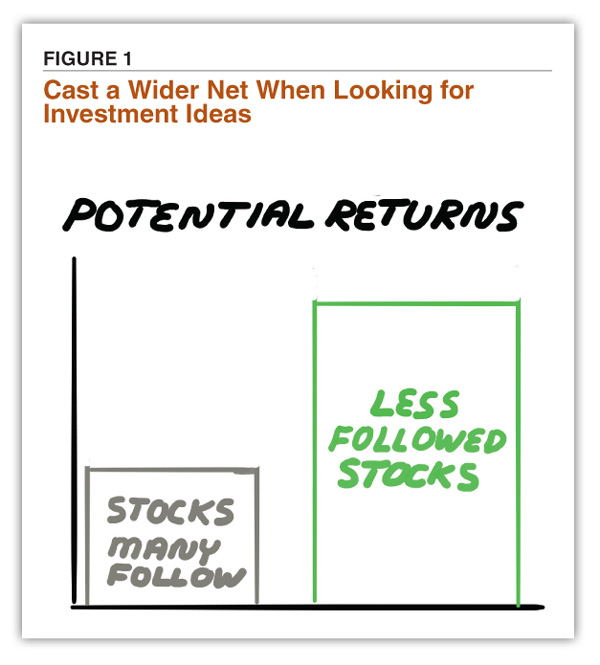
None of the stock portfolios at AAII resembles the S&P 500. If you look at the stock screens that AAII tracks, the stocks identified often aren’t the ones being talked about on CNBC or in the pages of Barron’s. There’s no advantage to playing in the same sandbox as everyone else, especially when there are potential treasures to be found in less populated sandboxes (Figure 1).
For decades, AAII founder James Cloonan talked about looking in the shadows of Wall Street for stock ideas. While throughout my investing life I’ve been willing to invest in a broad range of stocks—including many that most people don’t talk about or aren’t familiar with—working here has reinforced my belief in doing so.
None of this is to say that large-cap stocks should be ignored—I own shares in both Berkshire Hathaway Inc. (BRK.B) and Constellation Brands Inc. (STZ)—but rather to say that you shouldn’t limit yourself to S&P 500 companies either. It’s how you beat the market.
 I’ve used stock screeners since the late 1990s and have long been a big proponent of them. Working at AAII has only reinforced my views on the subject.
The securities held in all four AAII stock portfolios were originally identified by stock screens. Because stock screens scan the broad universe of stocks, they find companies with traits an investor desires but may never have looked at otherwise. Screens have led to big winners at AAII—including stocks that were not anticipated to do as well as they have.
I also like stock screens because they make the investment process more focused. They give you a preset list of stocks to research. Contrast this with the process of trying to jot down ticker symbols mentioned on TV or touted online. Attempting to do the latter leads to a haphazard method without a clear process for identifying stocks most likely to possess the traits you are seeking.
You don’t just have to take my word for it, you can also look at the performance of AAII’s 60 stock screens. While the returns are based on backtesting (as opposed to AAII’s model portfolios, which are run through actual brokerage accounts), the results show how effective stock screens can be.
If pressed to name one aspect of investing where my views have been influenced the most by working at AAII, I would say portfolio management. Not only has the management of my own portfolios evolved, so have my views of what others should do. The changes aren’t so much attributable to who I work with as what I have learned from being the AAII Journal’s editor for 10 years.
One of those changes is rebalancing. As many of you know, I’m a proponent of periodic but rules-based rebalancing. Rebalancing is the process of adjusting your portfolio back to your target allocation. My belief is directly related to a Vanguard study we ran eight years ago, (“Best Practices for Portfolio Rebalancing,” May 2011 AAII Journal).
There are a few reasons why I like rebalancing. For one, it provides an outlet to channel your emotions when the market turns volatile. Though investors are encouraged not to react to Mr. Market’s tantrums, many people find that to be easier said than done. Rebalancing restores a sense of control in a healthy manner. Second, it reduces portfolio volatility by keeping the equity portion from getting too big. Third, it prompts an investor to buy low and sell high—a key to long-term investment success. Finally, it can also be applied to a variety of portfolio allocations.
There are certainly other allocation approaches. Working at AAII has also made me appreciative of bucket strategies. Bucket strategies allocate investments based on the time you need the cash flow. A common form is splitting the portfolio into short-term (one to four years), intermediate-term (three to seven years) and long-term (five to seven years or longer) portions. The withdrawal strategy that Cloonan introduced in his book “Investing at Level3” uses just two buckets, a short-term cash bucket and a long-term growth bucket.
The reason I like bucket strategies is their simplicity. They can be easier to understand than other allocation approaches. The use of a cash bucket can also help many investors psychologically weather downside volatility.
I’ve also become a bigger fan of the classic 60/40 allocation. This strategy simply splits a portfolio between 60% stocks and 40% bonds. While there are ways to achieve higher returns, this allocation strategy has historically proven to be a tough long-term benchmark to beat. The data shows this strategy to be a good default option—especially for those desiring simplicity or having limited knowledge about allocation strategies. It’s easy to do worse than a low-cost 60/40 portfolio.
All of this said, I don’t think there is one single allocation approach that applies to every person. Allocation is a personal decision. A person’s financial situation, goals, investment knowledge, psychology and interest in managing a portfolio all play influencing roles in how they should allocate. The optimal strategy is the one you can stick with no matter what the market is doing.
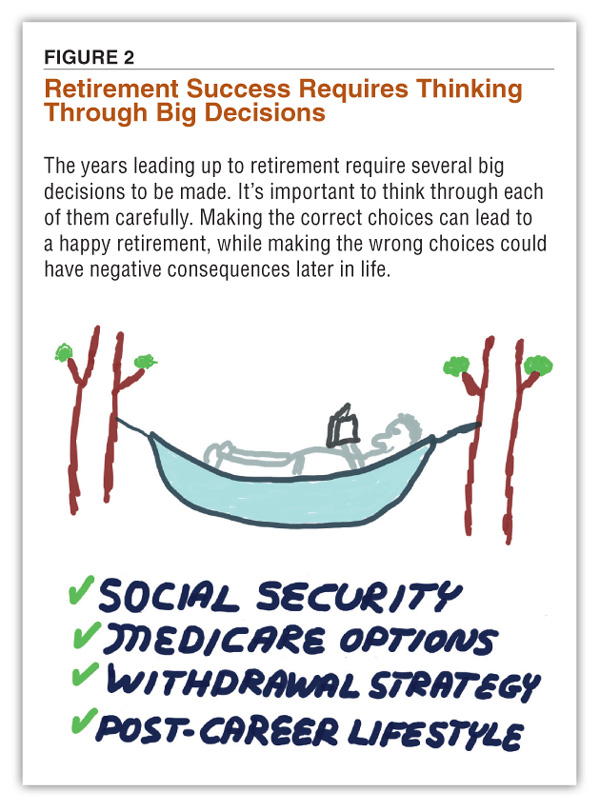
Probably the second-biggest aspect of investing where my views have evolved is retirement planning. Working at AAII has led me to be more cognizant of the big decisions that those approaching and entering retirement must make. There are several choices to be made, with some having potentially large ramifications later in life (Figure 2).
Compounding matters is a lack of knowledge among many individuals and a lack of agreement among experts about the correct decisions to make. It’s very easy for a layperson who hasn’t spent time thinking through their choices and/or seeking professional guidance to make a mistake.
Let’s start with the decision about when to retire. The initial studies I read on early retirement after joining AAII found that it adversely impacted health. Later studies came to different conclusions. What is agreed upon is the need to have a plan for staying socially and cognitively engaged as well as physically active. While we, at AAII, focus on the financial side of life, it’s critical for those transitioning into retirement to also have a strategy for how they’re going to fill up their free time. (Men, be aware of the adage I’ve heard some wives jokingly repeat when discussing retirement, “for better or worse, but not for lunch.”)
Closely related is Social Security. I’m in the delay claiming camp because doing so will result in more cumulative lifetime benefits for the primary spouse and the surviving spouse, should the latter have a smaller (or no) earnings record. Not all of you agree. I do acknowledge the importance of considering lifestyle and health. Still, the risk of living longer than expected is a big one, financially speaking.
Then there is Medicare. At age 65, a person has to sign up for Medicare and choose whether to go with Part B (which I refer to as “traditional Medicare”) or Part C (Medicare Advantage). While it is possible to change Medicare plans, depending on how your health evolves, it may be difficult/costly to do so.
When it comes to using a portfolio to fund retirement and allocating investments within that portfolio, the choices become even more complex. Furthermore, a consensus on the best approach doesn’t exist. I’ve talked to people from the various camps and they openly disagree on what the typical retiree should do. Even target-date funds—which are designed to be a single investment product an investor can use throughout their working years and into their post-career years—differ on what should happen to a portfolio’s allocation when the retirement date has been reached and after.
This said, there are a few areas of common ground I think are worth taking note of:
I didn’t purposely plan on becoming the person in the office with the most knowledge about tax laws as they apply to individual investors, but working on 10 tax guides has made me intimately familiar with the tax code. The IRS is pretty hands-off about which types of accounts specific investments must be held in. So, carefully choosing the type of account you hold different investments in can lower your tax bill (e.g., shorter-term holdings in IRAs, municipal bonds in taxable accounts, etc.).
 History is a good guide for investing. It bodes well for investing in stocks and favors those who are less reactive to the day-to-day headlines. While the shorter-term performance of the market may veer in one direction or another, over the long term the historical trends do play out. Corrections are common and bear markets are typically not as bad as we experienced during the 2007–2009 financial crisis. If you’re nervous, look at your portfolio less often.
Talk to your family. I started my career in finance, in part, by providing expert analysis to estate attorneys. As AAII Journal editor, I’ve gone back to thinking about estate planning because it’s part of lifetime investing. Tell your family what firms you work with. Introduce them to your attorney, accountant and planner. Share the logic behind your estate plans. Discuss your investing strategy and what you’ve learned. Communicate any final wishes you have.
Finally, think in terms of percentage changes, not point changes. When I started at AAII, the Dow Jones industrial average was at 11,124. A 200-point move represented a 1.8% change. A little over 10 years later, the Dow is at 28,235.89 and a 200-point move is just a 0.7% change—a big difference.
Portfolio Strategies
Portfolio Strategies

Stock Strategies

Tommie G from Virginia posted over 6 years ago:
Frank Thibault from AR posted over 6 years ago:
Jim L from Michigan posted over 6 years ago:
DUEY F from IL posted over 5 years ago:
You need to log in as a registered AAII user before commenting.
Log InCreate an account