


Related

Computerized Investing
Insights from the discount broker pioneer about what he invests in and where he sees his industry going.
Editor’s Note: Charles “Chuck” Schwab founded discount broker Charles Schwab Corp.  (SCHW) and continues to serve as its chairman. He has also authored several books, most recently “Invested: Changing the Way Americans Invest” (Currency, 2019). We spoke about the investing and brokerage industry insights he’s gained over the course of his lengthy career.
—Charles Rotblut, CFA
In your new book, you write about how your first job out of college involved analyzing companies for a growth newsletter. I got the impression that, decades later, you still consider yourself a growth investor. Is that fair?
That’s very fair. I’ve always been a growth junkie, and for a good reason. It’s not without its logic.
In my view, if you want to change your wealth position, you’ve got to be a participant in something that grows. There’s nothing that grows better, generally speaking, than American companies. We are built to grow. Some don’t make it. Some lose out to competition, innovation, all that stuff, but on balance, America is built to grow.
I’ve been on five S&P 500 index company boards in my career, and I’ve never had a management team come in and say, “we’re not going to grow next year.” If they did, they would have gotten fired. We all have ambitions to grow next year.
But you also have advocated for index funds. The Schwab 1000 Index fund (SNXFX) launched in 1991. Going back to your book, you described index funds as passing your “would I buy it for myself” test.
Right. I think our index fund, as it turns out, is a fantastic example of the power of indexing. It’s 1,000 companies. But every year about 50 companies fall out of it and 50 new ones come in. So, there’s always that push of the market doing the evaluation of these companies. It’s the market capitalization that drives their success, either coming into the top 1,000 or falling out of the top 1,000. And every year we’re changing the fund’s holdings by at least 5%.
Indexing has grown quite a bit since you launched that fund and since index fund pioneer John Bogle started Vanguard. Any concerns now about indexing being or possibly becoming too large in the future?
I just don’t think so. People will identify values very quickly and wanting to do so is a huge part of all of us, even for me who loves index funds. But if I see values that are way out of balance, I’ll certainly be buying those individual companies because there is a massive number of astute investors out there, institutional investors, that still do the same thing. I don’t think it’ll be 100% indexing ever because I think people will always be looking for good deals.
You’ve been through many bubbles and, unfortunately, busts as well. You wrote openly about your experiences and how they impacted Schwab.
Could you talk about the bowling industry, and the bubble that occurred several decades ago? I’d like you to explain why you thought at the time that those bowling alleys were too expensive.
Well, I probably wasn’t that smart to say they were way too expensive, but what I was able to do was observe. I was just getting out of business school. This was in 1961.
During that year, there was a fantastic explosion in the interest in bowling and analysts on Wall Street were doing their usual thing. They were taking that interest and extrapolating it out four or five years. If their forecasts were correct, before you’d ever know it, everybody in America would spend some time each week bowling.
Of course, it never happened, but that was extrapolated by analysts and, of course, these stocks went to 30, 40, 50 times earnings. So if you were making bowling balls, if you were making bowling alleys, if you owned a bowling alley, bowling shoes, chalk, you name it, you were on a fast track there for about 10 months. The market got completely overdone in that small segment.
That was really an introduction to bubbles for me. It is an example I’ve used many times in the past few years.
Then several decades later we had the housing bubble. You observed a common question from clients, “Should I get out of the market?”
Could you share your observations? Not only what you experienced during that bear market, but also during other busts. Are there any suggestions about what investors can do to keep from acting on their fear?
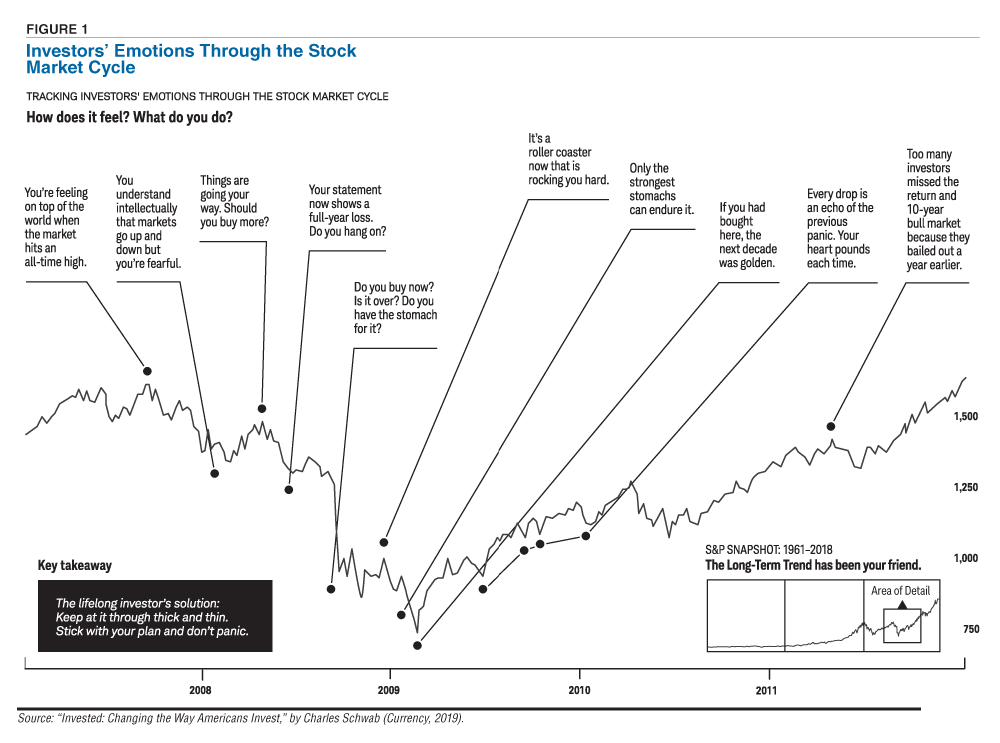
There are three things that I think are really important. I think you’ve got to be in the market all the time. You can probably moderate that to say you’re 75% invested or 60% invested or 85% invested, but I think you have to be in the market—I’m talking about every market all the time (Figure 1). You also have to have adequate diversification. Using index funds helps, but if you don’t use them, have at least 20 or 30 stocks in your portfolio, evenly distributed.
The other thing is you’ve got to manage or exclude leverage margin. You cannot live a long time in a margined position. If you have credit and things go the wrong way, it is easy to get wiped out. I’ve seen that too many times. So, you have to be very thoughtful about using it. It’s okay to use margin on occasion, but make sure it’s very temporary.
You obviously have had experience with investors being overextended. I believe you wrote about Teddy Wang regarding the dangers of margin. [Editor’s note: His debt with Schwab peaked at $126 million following the 1987 crash.]
He used margin, but he wasn’t really borrowing money as such. He sold short puts, and people do it to this day. They sell puts short and they make a nice income, maybe 1% to 2% per annum. In the case of a huge downfall in the marketplace, those puts go up in value and so you quickly wipe out the 1% or 2% gain. Over a long period of time people can use short puts to make a nice additional income, but a lot of people don’t realize that when the really horrible time comes along—when the black night comes along—and the market is down for a year or so, you can really lose a lot of money.
Did Wang just get too overconfident in his abilities?
No, it was a pretty popular approach at that time. A lot of people did it. A lot of pretty wealthy people with large portfolios wanted to scrape out another 1% to 2% of income. It’s probably more like greed, you know. And the strategy was sold by many different firms. So, he wasn’t just unique to us. Wang used a lot of firms on Wall Street to do that strategy of selling puts. He also had a large portfolio with a lot of blue-chip stocks. He put that up as collateral and then sold the puts. The goal is to let the puts expire and collect the premiums on the contracts on an ongoing basis. It is a strategy that works—except when the black swan arrives.
Moving on to the brokerage industry, what were the commissions being charged when you started Schwab?
It was fixed rates. It was something in the neighborhood of $110 for 100 shares—in that zone. If you were buying a $50 stock, the commission was only about 2%. If you were buying a $10 stock, it was a whole lot more than that.
Do you recall when you first started the company what you were charging for commissions?
Well, if we look back to May of 1975, so-called May Day, we had a rate card that we published, and it was approximately 50% to 75% below the old fixed rate. That was the beginning of discount brokerage, made possible when the SEC eliminated fixed commissions, and the first in a series of price drops bringing us to today.
Now, commissions are down to zero for stocks and exchange-traded funds (ETFs). One question I’ve already heard from our members is, “How are the discount brokers going to make money now that they’re not charging commissions?”
Well, what has happened here is a really interesting thing and a bigger issue. At the very beginning of our company, I put in place that our employees would not receive a commission for the work that they did. Everyone gets paid a salary and a bonus based upon the success of the company. So, I took commissions out of the relationship between us and our clients at the very beginning, and I retained that all through these years. I’ve always thought commissions were a totally unprofessional way of fulfilling one’s fiduciary responsibility. As a broker, you’re providing people supposedly unconflicted advice, but a commission does just the opposite.
By paying your broker’s commissions, you’re putting them into a terribly conflicted position vis-à-vis a client. So, taking commissions now to zero is the ultimate of taking them out of play and there’s no more commission-related conflicts.
Now, we do charge people for different services. There’s a charge for advisory services. For some of our ETFs, there’s a small advisory fee for us putting it together—management fees, as such. If you’re in our Schwab Private Client account, we do charge a fee for that. We give you a lot of time and expertise. We make money on some spreads, like a bank. You put your deposits there and we make a little bit of spin in there. We give you a little bit and we make a little bit on the spread of a large portfolio of assets that we hold for people.
So, there are different ways, but we took commissions out of the picture, which I’ve always wanted to do because I always thought it led to the terrible conflicted relationship with a client. You don’t pay commission to your lawyer. You don’t pay commission to your doctor. You pay fees for services rendered.
The Simple Truths I’ve Learned About Investing
Nobody can predict the movement of the stock market in the short term, but you can live with the short-term uncertainty if you believe the following, as I do.
—Chuck Schwab
Excerpted with permission from “Invested: Changing Forever the Way Americans Invest,” Currency, 2019.
Correct me if I’m wrong, but I thought at some point a few years ago you brought up the idea of eliminating commissions.
I talked about a lot, so there’s probably some comments in the press along the way.
Has your company noticed any difference in terms of investor behavior so far since commissions were eliminated last year? Have you noticed any evidence that people are trading more frequently than they did previously?
We really haven’t at all. It’s been just an imperceptible change in their activity per customer. I noticed there was an article in The Wall Street Journal recently about TD Ameritrade and E-Trade seeing an increase in activity, but they tend to appeal to a more active trading clientele than we do. We have our active traders, but we haven’t seen a huge increase in activity because of the elimination of the fees.
How do you think the industry will evolve in the future? If you could look ahead, maybe five or 10 years, any ideas?
Well, I think it’ll continue to grow, for sure, and there’ll be continuous pressure to do the right thing for clients. I mean, helping them get in and get started doing the right things, having a no-conflict relationship with clients. Providing them information, education to do balanced investments. All of the things that you guys do at the American Association of Individual Investors.
Looking back over the past several decades, what do you think the brokerage industry has done right, and what do you think it has done wrong?
Well, there’s a massive trend over the last 20 years of brokers moving away from their brokerage and setting up their own independent advisory firms where they charge no commissions—they just charge a fee. So, you can see the movement of money away completely from the commission world and into the advisory world.
People still want help and advice. They want it un-conflicted. That’s profoundly true, and I think this move to zero commissions has put the nail in that coffin in terms of conflicted relationships. So, you’ll see all the traditional firms, the Merrill’s and Morgan’s, really going to an emphasis on advisory kinds of positions, although they can’t help themselves at times because they still have commissions based upon different products that they might come up with.
Is there anything I didn’t ask you that I should have? Perhaps any lessons or additional insights you’ve learned that you’d like to share.
Well, you guys are pretty much on the right track. You know, it’s certainly getting people to get invested. Just start. The first thing you should do is to put your $100 in and get going. It’s amazing what happens once you get the habit of it. Start the habit as early as you possibly can in life.
Coming up, one of the things that I’m really anxious to do—and have been wanting to do for a number of years—is to offer the opportunity for people with little amounts of money to buy a fraction of, let’s say, Amazon.com Inc. (AMZN) or a fraction of Netflix Inc. (NFLX). They can buy, say, one-tenth of 1% of a share. So, we’re doing fractionalization or decimalization of shares.
One of the sad things I see is these companies letting their stock prices go higher and higher. There’s no division of their pricing, no stock splits, none of that kind of thing anymore to make it more affordable to buy a share, so we’re going to provide that service. If you’re a new investor with $1,000 you’ll be able to buy 20 different stocks, all big names, and have them in your portfolio. It’ll be good for your kids, your grandkids and yourself.
We want more and more people to join AAII—we are with your vision.
We’d like that. Thank you.
In the audio clip below, hear Schwab talk about getting children and grandchildren interested in investing as well as share the biggest lesson he’s learned over the course of his career.
Computerized Investing

Stock Strategies


Barry C Johnson from Texas posted over 6 years ago:
Bill Rogacheski from Wisconsin posted over 6 years ago:
Ray from Ma posted over 6 years ago:
You need to log in as a registered AAII user before commenting.
Log InCreate an account