

Related

AAII InvestoGraphic
Changes to retirement plan rules may impact your retirement and estate planning. Learn what you need to know.

The SECURE Act, whose name stands for Setting Every Community Up for a Retirement Enhancement, is the largest overhaul to retirement laws since 2006. Instead of fixing numerous retirement issues in the U.S. like Social Security, Medicare and long-term care, the SECURE Act is more of a tax revenue generator for the government and is unlikely to live up to its lofty name.
The bill isn’t all bad news for investors, however. Like most pieces of legislation, there’s a bit of give and take with the government. Sure, the government removes tax benefits in the SECURE Act, but it does so to fund other tax credits and policies.
 I’ve dubbed the SECURE Act “the messing at the fringes of retirement” act. Most of its 29 provisions won’t have a major impact on the everyday American investor. However, there are several provisions that will have some effect in the short and long run.
We can organize these changes into three categories. First are changes that impact distributions and savings opportunities from tax-advantaged retirement accounts. Second are changes to lifetime income options (annuities) in employer-sponsored retirement plans. Third are changes to employer-sponsored retirement plans and the Employee Retirement Income Security Act (ERISA) of 1974.
It’ll be hard to judge, let alone understand, the full impact of the SECURE Act and all its changes for years. In the meantime, we can look at the major changes likely to affect many of you to learn when they’re effective, what impact they might have and possible planning strategies to maximize the changes.
The CARES Act Retirement Plan Changes
Due to the global coronavirus pandemic and national health emergency in the U.S., a new bill was passed in March 2020 to provide relief to Americans impacted by the virus. The Coronavirus Aid, Relief and Economic Security (CARES) Act supports Americans and the economy by opening up $2.2 trillion dollars in tax benefits, grants, loans and other sources of funding.
The bill includes three major retirement planning changes for 2020 intended to provide temporary relief and not make permanent changes.
First, the CARES Act suspended all required minimum distributions (RMDs) for 2020. If you owed an RMD from your retirement account or an inherited account, you can skip 2020 and won’t have to double up what you owe in 2021.
Second, the CARES Act created a coronavirus-related distribution. This allows you to take $100,000 in distributions from an IRA or retirement account in 2020 that will not be subject to the 10% early withdrawal penalty tax and can be repaid over the next three years. In order to qualify, you need to take a distribution in 2020 and you or your spouse has to be diagnosed with COVID-19 or suffer financial implications due to a decrease in employment or work due to the virus’ impact on the economy.
And third, the CARES Act extends the time you have to repay 401(k) loans and increases the amount you could withdraw as a loan during 2020. From March 27, 2020, to September 23, 2020, you can borrow up to 100% (instead of 50%) of the vested retirement plan account balance and up to $100,000 (instead of $50,000). Typically, plan loans are to be repaid over a five-year time period. If part of the loan’s due date was during March 27, 2020, to December 31, 2020, a plan may choose to allow the participant to delay the due date for one year, turning the five-year period into a six-year period.
The CARES Act doesn’t change retirement planning for the long term, but it does make significant changes for 2020 that have a direct impact on retirement planning for millions of Americans. Rather, the SECURE Act will continue to be law and impact planning in 2021 and beyond.
Effective Date: Applies to accounts if the owner dies after December 31, 2019 (government plans December 31, 2021).
This provision has likely the largest impact on individual retirees and investors. It’s the tax driver behind the revenue increase in the bill. In short, this rule modifies the required minimum distribution (RMD) rules that apply to defined-contribution plans [such as 401(k) plans] and individual retirement accounts (IRAs) upon death.
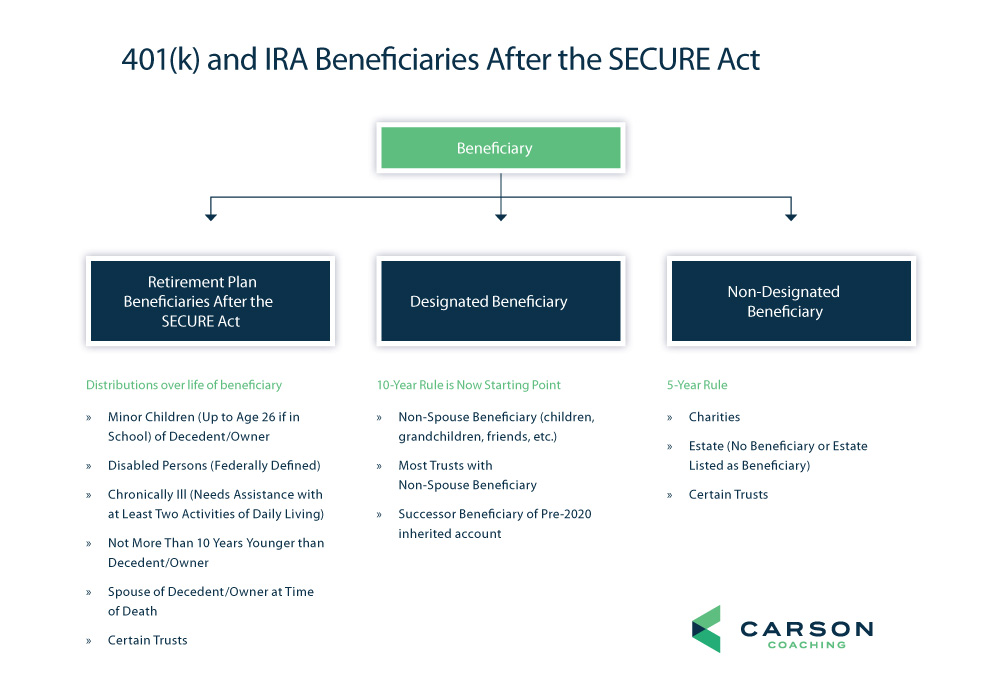
Instead of allowing beneficiaries to stretch out RMDs over their own life expectancy, the beneficiary must distribute the entire balance of the inherited account by the end of the 10th year following the year of the account owner’s death.
Exceptions to this new rule include: the surviving spouse of the deceased account owner, individuals who aren’t more than 10 years younger than the deceased owner, a minor child of the deceased, a disabled individual or a chronically ill individual. These individuals will still be able to stretch out distributions.
Minor children can stretch out distributions until the age of majority in their state (typically age 18, but not always) and in some cases until age 26 if they’re still in school. They have to finish distributions by the end of the 10th year following the age of majority. Additionally, certain beneficiaries for trusts and estates will still be subject to a five-year distribution period.
Lastly, if the owner died before the end of 2019 (or the end of 2021 as it relates to government retirement plans), the old stretch rules will continue to apply. However, if a beneficiary of an inherited IRA or retirement account dies after 2019, the grandfathering rules will no longer apply and the beneficiary of the beneficiary (often called a successor beneficiary) will now have only 10 years to distribute the account.
Impact: This change significantly lessens the tax-deferred benefits of inherited retirement accounts for beneficiaries. Individuals used to have years to enjoy tax-deferred investment growth and have time for tax planning.
 Shortened distribution periods will result in larger taxable distributions, pushing up the beneficiary’s marginal and effective tax rates, maybe even phasing out of tax breaks. Furthermore, the individual might pay higher Medicare premiums or Social Security taxes.
Planning Points: You can try to minimize the impact of the new 10-year stretch rule or attempt to mimic the previous lifetime stretch rules. Start with your planning goals. Are you trying to maximize your legacy for your heirs? Are you trying to maximize your own retirement income? Are you trying to leave money to charity? Are you trying to pay as few taxes as possible? Are you trying to limit fund access to your heirs?
Once you have your goal in mind, you can start the planning by reviewing your beneficiary designations. This will make sure the right person is inheriting your retirement accounts.
Perhaps the most powerful and easiest planning strategy is to take advantage of Roth IRA conversions. This involves taking money from a 401(k) or traditional IRA and putting it into a Roth IRA and paying taxes on it now. Roth IRA investments and distributions are typically tax free. If you think tax rates will increase in the future, take advantage of the lower tax rates today.
Additional planning strategies include removing money from your IRA or 401(k) during or close to retirement to buy a life insurance policy or an annuity. Both of these insurance products can provide valuable estate planning and income options for beneficiaries.
You can enhance your estate and retirement income plan by giving to charities. One option is to leave your IRA to a charitable remainder trust, which could provide lifetime income in a tax-advantaged manner to your beneficiary while the remainder amount would generate a tax deduction and gift to a charity of your choice. This can be a great way to mimic the tax benefits and lifetime income payment strategy most beneficiaries lost with the SECURE Act.
Don’t forget to coordinate your planning with other estate planning documents like your will or trust. If you were using a trust as an IRA beneficiary to meet the stretch provisions prior to the SECURE Act, you need to have your financial adviser and estate planning lawyer review that language. Many of those trusts no longer have language that allows the beneficiaries to access any funds prior to the end of the 10th year after the death of the owner.
For example, if your trust says something like “the beneficiary has access to the required minimum distributions each year from the IRA in order to qualify as a conduit stretch trust” this might mean the beneficiary can’t touch the money for a decade after death. Because the SECURE Act says the account must be distributed by the end of the 10th year, there is no technical RMD for years one through nine after the death of the owner. This means the trust language that only gives access to RMDs each year would provide no access until year 10, at which time the entire balance would be distributed in one taxable year. This could be a disaster from an access point and from a tax perspective. Review your trust language in light of the SECURE Act changes.
Effective Date: After December 31, 2019.
For those who did not reach age 70½ by the end of 2019, the new required beginning date for RMDs from retirement plans will now be age 72.
However, the “still working” exception will apply to those who aren’t more than 5% owners in the company. This allows employees still working to defer their retirement plan at that employer until they retire. However, accounts like IRAs or other retirement accounts not held at their current employer are still subject to RMDs.
Impact: This pushback affects those who own tax-advantaged retirement accounts and have not already reached age 70½ by the end of 2019. The change is positive in that it gives retirees a few more years to defer their RMDs. The new RMD distribution age of 72 is also more clean-cut than age 70½.
Planning Points: You can’t avoid your RMDs in 2020 if you’ve already reached age 70½ at the end of 2019. Missed RMDs come with a 50% penalty tax on top of your ordinary income rate. For some individuals, gaining back a couple of years before RMDs start could provide additional time to defer investment growth and do Roth IRA conversions. While you can still do Roth IRA conversions after you start RMDs, it becomes a lot harder. Now you might have an additional two years’ time to convert money to a Roth IRA, which isn’t subject to RMDs at age 72.
Effective Date: Applies to years after December 31, 2019.
Prior to 2020, individuals over age 70½ couldn’t contribute deductible or aftertax contributions to a traditional IRA. Starting for tax-year 2020, individuals over age 70½ with earned income can contribute to an IRA.
 Impact: This allows individuals who are working in retirement to continue to save for retirement in a tax-advantaged manner. In 2020, a couple working past age 70½ can now save and deduct from income taxes $14,000 a year as a couple by maxing out contributions to a traditional IRA. That is a substantial amount of savings and a valuable tax deduction contribution.
Planning Points: If you’re working past age 70½, you need to determine if you want to keep contributing money to a tax-advantaged IRA. Another option would be to use a Roth IRA. This should be an annual decision based on tax laws, income levels and tax diversification needs.
The SECURE Act created an anti-abuse provision around deductible post-age 70½ IRA contributions and a charitable giving technique called qualified charitable contributions (QCDs). Any deductible IRA contributions made after age 70½ will offset QCDs in the future up to the total amount of the deductible contributions. If you’re planning to use QCDs during retirement as a tax-effective way to reduce RMDs and give to a charity, consider using a Roth IRA or non-deductible contributions to an IRA instead of a deductible.
Effective Date: After December 31, 2019.
This new rule allows an exception from the early withdrawal penalty tax of 10% for distributions from defined-contribution plans and IRAs prior to age 59½. Now, from one year of the date of childbirth or day of legal adoption of a minor child, each spouse can withdraw $5,000 from an IRA or defined-contribution plan and not be subjected to the penalty tax. Spouses can withdraw $10,000 total and there’s no lifetime limit, just a per childbirth or adoption limit. Money can be repaid under the provision and the tax benefit recaptured.
Impact: This provision provides much-needed cash flow and access to funds for many young parents who are experiencing high expenses related to childbirth or adoption. While the provision has a public policy feel to it, its impact will be somewhat minimal. The distributions will still be subject to ordinary income taxes and this could create more leakage from retirement accounts to pay other short-term expenses.
Planning Points: For those who need an influx in cash, this rule provides a new way to get around the penalty tax and tap into retirement savings. However, individuals should look for other assets to meet their current needs. If retirement assets are always tapped into for short-term needs, this will leave many people ill-prepared for retirement. Retirement accounts can’t be the fix-all for every expenditure and spending need at the individual level or the tax revenue solution for all government budget needs.
Effective Date: Applies to distributions after December 31, 2018.
The SECURE Act made a few modifications to 529 plans, but most importantly it now allows federal tax-free 529 distributions for student loan principal and interest repayment. However, you can’t double dip by both using the tax-free distribution to pay student loan interest and also deduct the interest paid. The new provision allows for a lifetime aggregate amount of $10,000 in student loan repayments per 529 plan beneficiary and $10,000 per each of the beneficiary’s siblings.
Impact: Individuals can use 529 plans to help offset student loan interest and principal after graduation. One problem with 529s after graduation is that most qualified education expenses need to be paid directly to the institution—if you’re done with school, you can’t benefit as easily from the 529.
Planning Points: Grandparents might want to consider waiting until after their grandchild’s sophomore year to fund their 529 in some situations to make sure it doesn’t impact federal student aid (FASFA) and other student aid benefits.
The 529 can now be funded to help with student loans they might incur earlier. And depending on how your state treats 529 contributions, you might be able to deduct the contribution to the 529 as a way to generate a state income tax deduction, as opposed to paying the student loan principal outright and receiving no deduction. Overall, 529s should be funded for education expenses, but this new provision adds flexibility when it comes to paying down student loans.
Effective Date: In effect (no date provided).
The SECURE Act created a fiduciary safe harbor for employers who run retirement plans to select an annuity as an investment option in the plan. The exemption allows for the employer to vet the insurance company and not have to examine each individual insurance contract as part of the process.
If the employer follows the guidelines and process laid out in the safe harbor, then the employer will not be liable if the insurance company fails to meet its promised benefits under the contract in the future.
Impact: This provision’s goal is to increase the number of annuities available inside of retirement plans like 401(k)s. By reducing the financial liability of the employer and laying out a clearer process to vet an insurance company, the expectation is that more plans will be willing to add these types of investments. It’s not likely that there’ll be a flood of annuities into retirement plans immediately, but expect to see a steady increase in insurance companies lobbying plans to add their annuities over the next few years.
Planning Points: If you’re an investor in a 401(k), this rule change highlights the shift of burden away from employers and onto the individual as it relates to retirement planning and saving. You now need to vet the individual product to make sure it’s suitable for your goals. The plan might no longer vet the costs or the suitability of such an annuity for your individual investment and retirement needs. To some degree, this has always been the case—every investment a plan offers is not always a good investment for every investor. Before investing in your 401(k), make sure you know what investments and which allocation make sense for your goals, risk tolerance and long-term needs.
Effective Date: 12 months after the Department of Labor finalizes rules.
The SECURE Act created a requirement for defined-contribution plans to annually disclose to participants a lifetime income statement that would show how much income their account balance could generate. The U.S. Department of Labor was charged with finalizing and developing a model for such a disclosure.
Impact: This provision’s goal is to draw investors away from thinking about saving toward a magic number and instead focus on how retirement is about income generation. Pension plans have always shown income at retirement and now defined-contribution plans will be required to do the same.
Planning Points: From an investor standpoint, there’s not a lot to do with regard to this provision at this time. However, it can spark the conversation around retirement income planning and not just savings. Retirement is about cash flow—the income you can generate from your savings in order to meet your spending goals.
Effective Date: Plan years beginning after December 31, 2019.
This provision allows for the portability of annuities (the ability to move the annuity) via a direct trustee-to-trustee transfer from a defined contribution, 403(b) or 457(b) plan to another employer-sponsored retirement plan or an IRA without having to cash out or surrender the annuity within the plan, if the annuity is no longer authorized to be held as an investment option under the original plan. An individual now has 90 days to take advantage of the rule and move the annuity after it’s no longer able to be held in the plan.
Impact: Increasing portability is a good rule change. It allows individuals in retirement plans who are leaving the plan completely (or if the plan changes its investment options) to roll out their annuity to another tax-deferred vehicle. Many annuities, even those inside retirement plans can come with charges and fees associated with surrendering or cashing out of the policy. This provision helps people avoid those penalties in some situations when it might not even be their fault.
Planning Points: If you have an annuity, understand your options for rolling over the annuity and all the surrender charges and fees associated with them. Annuities can serve a valuable function in a retirement income plan, but you do need to understand the product you’re purchasing—just as you would with any other investment or insurance product.
Effective Date: Tax years after December 31, 2019.
This section covers two different tax credits in relation to setting up retirement plans. First, the SECURE Act increased the small business tax credit for starting a retirement plan. Second, a new tax credit of up to $500 per year for up to three years would be allowed if an employer included automatic enrollment in the plan. This credit would also kick in if the employer modified an existing plan to add automatic enrollment.
Impact: Automatic enrollment is an incredibly powerful and important retirement plan design since so many employers have moved away from offering pension plans and over to offering defined-contribution plans like 401(k)s. This puts more of the responsibility of saving on the individual. While many new 401(k)s that are set up today have automatic enrollment plan design features, this provision is an additional encouragement for employers to set up plans accordingly.
Planning Points: This provision’s goal is to get more people to save automatically when they join a plan. If you’re an employer, take advantage of these new tax credits by setting up a retirement plan and add automatic enrollment to your plan design.
Effective Date: Plan years after December 31, 2020.
In the past, multiple employers could come together into a pooled employer-sponsored retirement plan like a 401(k). Usually, they needed a common nexus (i.e., same general work). However, this new rule allows unconnected companies to come together into one plan known as a multiple employer plan.
The SECURE Act removed another hurdle to joining an MEP, the often-called “one bad apple rule.” If one employer failed certain requirements of the MEP, the plan could become disqualified and impact the other employers. However, the new MEPs won’t have this issue.
Impact: The goal of the new MEPs is to add a lower-cost savings option to the market. MEPs, because they can share costs across many employers, might be able to help bring down both the cost and administrative complexity of running a retirement plan, especially for the middle-sized and small-employer market.
However, the new MEPs aren’t the first attempt at getting small employers to save more and set up retirement plans—so proceed with a healthy dose of skepticism. If the SECURE Act ends up being a success in 10 years, it will likely be because the MEPs are successful in increasing the number of small business owners offering plans to their employees.
Planning Points: There’s not a lot for the individual investor to do today with regard to MEPs. Large financial institutions will start outlining and developing their offerings as 2020 progresses and we should expect to hear some company announcements later in the year. Large financial institutions will likely still be waiting on additional IRS and Department of Labor guidance with regard to MEPs before announcing their full offerings and plans.
In the fall, small business owners could start looking to add or join an MEP in 2021 once the plans hit the market. This could be a replacement for an existing 401(k), SEP, SIMPLE, or another plan, or just a new plan for the business altogether. As the year progresses and next year kicks off, MEPs could start to become a viable retirement planning option for businesses to consider and review.
Effective Date: Starts to consider years of service in 12-month periods on January 1, 2021.
The Employee Retirement Income Security Act of 1974 (ERISA) sets out a number of rules designed to keep employers from overly discriminating against rank and file employees in favor of themselves and other highly compensated employees. Minimum coverage and counting rules apply to plans under ERISA, like 401(k)s and other defined-contribution plans. I refer to one as the “21-1-1” rule. This rule means you can be excluded from an employer retirement plan if you are not at least age 21, have one year of work with the company and 1,000 hours of work in that year.
The new rules, which will start counting in plan years after 2021, will state that if an employee completes 500 or more hours of service in the prior three years, they need to be considered for the plan. However, it’s important to note that these employees just need to be counted as eligible employees, but they could still ultimately be excluded from the plan in some cases.
Impact: This provision acknowledges the changing workforce in the U.S. that’s seeing more part-time workers—often called the gig economy—and recognizes that these employees need access to savings opportunities for retirement, too.
From an administrative perspective, employers might decide to ignore the three-year rule and just add people to the plan once they reach 500 hours in a year. If an employer is trying to keep costs down, they will need and want to track for the full time period to keep as many people out of the plan as possible.
Planning Points: In the future, if you become eligible for savings in an employer retirement plan, make sure you take full advantage of things like the employer salary deferral match—you just need to save enough and your company will match it. If you’re an employer or business owner running a plan, make sure you understand how this new provision will impact your plan and its costs. The impact of this rule is years away but it’s never too early to start planning and thinking if you’re a small business owner with a lot of part-time employees.
The SECURE Act is a massive retirement overhaul bill. It’ll take years for certain provisions to fully kick in, as the Department of Labor and IRS will need to pass additional guidance and regulations to help us understand some of the finer points.
It won’t have an equal impact across everyone. Some people might benefit more than others. However, look at the bill from an investor standpoint and make sure you know how it’ll impact your retirement and estate planning.
The removal and modification of the stretch IRA provisions will affect most people. This is the big tax revenue piece of the bill. If you have a retirement account, make sure you do the proper planning with regard to your RMDs and beneficiary planning. Don’t end up paying more taxes or leaving less wealth to your heirs than you’re legally required. In the end, those who are proactive with their planning and continue to monitor tax and legal changes will position themselves for a secure retirement. ▪
AAII InvestoGraphic
Financial Planning
Financial Planning

Richard Shaw from AZ posted over 6 years ago:
Charles Rotblut from IL posted over 6 years ago:
Robert Yankowitz from MD posted over 6 years ago:
Rodney Day from Texas posted over 6 years ago:
Charles Rotblut from Illinois posted over 6 years ago:
Charles Rotblut from IL posted over 6 years ago:
Craig from CA posted over 6 years ago:
Martin from Iowa posted over 6 years ago:
Kaye from Nebraska posted over 6 years ago:
Bill from Florida posted over 6 years ago:
Rey from Michigan posted over 6 years ago:
Charles Rotblut from IL posted over 6 years ago:
Doug from WA posted over 6 years ago:
Bob from MI posted over 6 years ago:
timothy from New Jersey posted over 6 years ago:
dick brennen from Arizona posted over 6 years ago:
Charles Rotblut from IL posted over 6 years ago:
Karl from MD posted over 6 years ago:
Charles Rotblut from IL posted over 6 years ago:
Karl from MD posted over 6 years ago:
Randy from Utah posted over 6 years ago:
David L from UT posted over 6 years ago:
Randy from UT posted over 6 years ago:
Shawn from CA posted over 6 years ago:
CHARLES M from NY posted over 6 years ago:
You need to log in as a registered AAII user before commenting.
Log InCreate an account