

Related

Portfolio Strategies
Though many AAII members bought or sold securities and funds in reaction to the coronavirus-related volatility, 70% say they are continuing to stick to their portfolio strategy.

Charles Rotblut leads a class in AAII's new Essential Investing Video Course. Go to https://www.aaii.com/ves for more information and to subscribe.
Many AAII members took a contrarian stance as the coronavirus pandemic caused big swings in the financial markets. More than two out five surveyed AAII members bought more stocks and/or stock funds as stocks fell in March and continued to trade well below their highs in April.
Given the high level of volatility, we wanted to know how individual investors were reacting. So, we used our “big question” survey to find out what AAII members were doing. Some opened their wallets, some turned conservative and others chose to stand pat.
The question was asked as part of a survey about the subject. The survey itself is part of a periodic initiative to give AAII members such as yourself a chance to talk about their investment decisions and challenges. Each survey asks what we’re describing as a “big question” about a subject affecting many investors. A randomly selected group of AAII members is asked a specific question, as well as follow-up questions intended to provide more clarity and background.
This fourth survey in the series was emailed to AAII members during the first half of April. The results were tabulated based on responses sent to us. We received 661 responses from the survey invitation. The average and median age of respondents was 69 with a range of age 38 to ages in the mid-90s.
Q: In reaction to the coronavirus volatility in the financial markets, what actions have you taken?
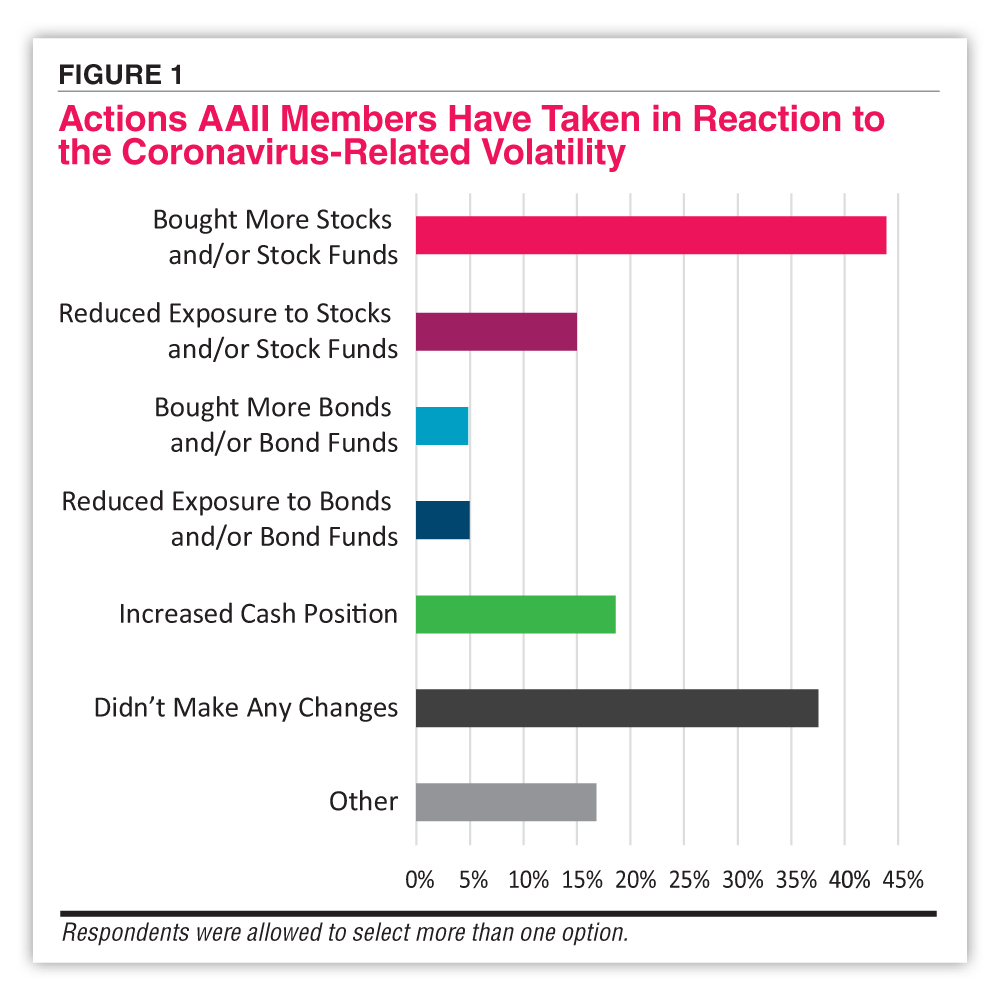
Nearly 44% of all respondents said they bought more stocks and/or stock funds (mutual funds and/or exchange-traded funds). Several described the drop in the financial markets as a good buying opportunity or described the prices of stocks they had been watching as becoming attractive.
AAII member Edwin Morris saw the pullback as an opportunity, telling us, “When a market puts everything on sale, that’s when it is time to buy.”
Stephen Carney shared a similar statement, exclaiming “Woo-hoo, I’ve been waiting for this sale for two years!” He later added in a follow-up to our survey, “I probably deployed 66% of my cash. I’m waiting for an even bigger drop due to COVID-19 surprises, and a couple of terrible quarters for earnings this year. If that doesn’t happen, I’ll put it back into the market anyway.”
AAII member Len Mozeko bought while being cognizant of the possibility of further downside occurring.
“I usually have dry powder and I couldn’t envision a better time to put it to use. I’m on ‘high alert’ and can quickly pull back to cash in a second,” he explained.
The willingness to go bargain-hunting was not universal. Approximately 15% of respondents told us they reduced their exposures to stocks and/or stock funds. The response of “I increased my cash allocation” was chosen by 19% of respondents. We allowed respondents to select more than one answer, so it was possible for an AAII member to say they both reduced their exposure to equities and increased the amount they held in cash. Many respondents expressed concern about the health of the economy and/or a further decline in stock prices.
Steve Surowitzq was among those who shifted to more cash. “I wanted to stop the bleed and retain some cash holdings with which to reenter the market at a more opportune time,” said Surowitzq.
In terms of bonds, respondents were split. Bonds and bond funds were purchased by 5% of respondents. Bond and bond fund exposure was reduced by 5% of respondents. Again, because of the option to choose multiple responses, some of these actions were taken along with others such as buying or selling stocks.
An additional 38% of respondents said they did not make any changes. Their reasons for not acting were simple. Nearly half describe themselves as long-term investors, while an additional third simply stuck to their long-term plan.
Bruce Lucki was among them. His rationale was simple: “My stock investment portfolio is long-term investments and I have learned that you never mess with Mr. Market.”
As a whole, AAII members do not actively trade. In fact, slightly more than one out of three respondents (34%) said that under normal market conditions they make changes to their portfolio “as infrequently as possible.” An additional 29% only make changes once or twice a year. Just 23% make portfolio changes once or twice a quarter, while only 10% do so at least monthly if not more frequently.
Q: Have you changed your portfolio strategy recently?
Though many AAII members bought or sold securities and funds in reaction to the coronavirus-related volatility, 70% say they are continuing to stick to their portfolio strategy.
The disconnect of this statistic with the percentage of respondents who bought stocks can be explained by the fact that some AAII members were looking for buying opportunities. Prior to the coronavirus pandemic, we had heard from individual investors who were looking for opportunities to buy stocks on sale.
Of the 26% who did alter their strategy, more than half said they became more conservative. They increased their cash positions, shifted more to bonds or invested in less risky stocks. Some altered their portfolios by favoring larger, dividend-paying stocks. Only about 23% said they adopted a more aggressive strategy.
“I had been gradually moving from one fund that had a high allocation to stocks to others that were more moderate with an increased allocation to bonds,” AAII member Dennis Lewis told us. “I also changed some of the bond funds to other holdings that were less volatile.”
Q: Have you looked at your portfolio’s balance since the downturn started?
Most respondents (85%) told us they had looked at their portfolio’s balance since the market downturn started. About 44% described the losses they incurred as being less than they expected. More than one-third of respondents (38%) said the decline in their portfolio’s value was more than they expected.
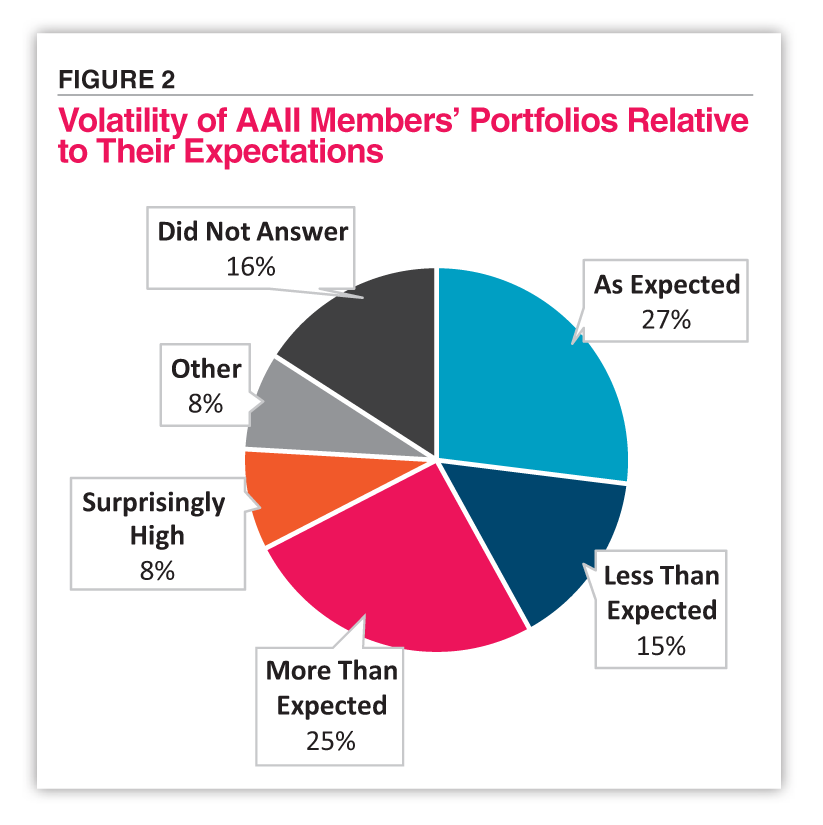
We then asked respondents to describe the volatility of their portfolios relative to what they expected. Responses were mixed. Almost 15% of respondents said their portfolios were less volatile than they expected or held up better than the market. About 25% described their portfolios as being more volatile than expected. An additional 8% described the level of volatility as having been much greater than they expected. (We categorized these responses as “surprisingly high” in Figure 2.)
Several respondents commented about the speed at which the market moved. Mike Showalter was among them. “I did not expect this rapid downturn. I thought a more gradual downturn might evolve over 2020–2021,” he told us.
John Labbe described the market conditions as having been “fairly volatile but expected. The pandemic and the resulting degree of volatility in the markets couldn’t have been reasonably predicted.” He further stated, “I was prepared for a downturn at some point and had somewhat reduced my allocation to stocks over the past few years (from over 90% to closer to 70%).”
Q: How do you think the economy will perform over the remainder of the year?
To get a sense of individual investors’ expectations for the economy, we asked them for their outlook. More than one out of four (27%) anticipate a further contraction. On the other hand, 34% of surveyed AAII members expect the economy to rebound either slowly (22% of all respondents) or quickly (12%). Many of those whom we classified as expecting a fast recovery believe economic conditions will remain tough over the short term before rebounding strongly. About 8% expect an uneven recovery. Respondents in this group either expect the recovery to be bumpy, or for certain industries to recover while others continue to struggle.
We grouped 8% of responses into a category titled “unsure.” The uncertainty reflected by them was focused on the duration and severity of the pandemic. Many of these individual investors said their outlook was dependent on how quickly businesses would be able to reopen and when the rate of infections would drop.
Not surprisingly, 72% of respondents described their current economic forecast as being more pessimistic now than it was at the start of the year.
Q: What signs are you looking for to see that the stock market is on its way to recovering?
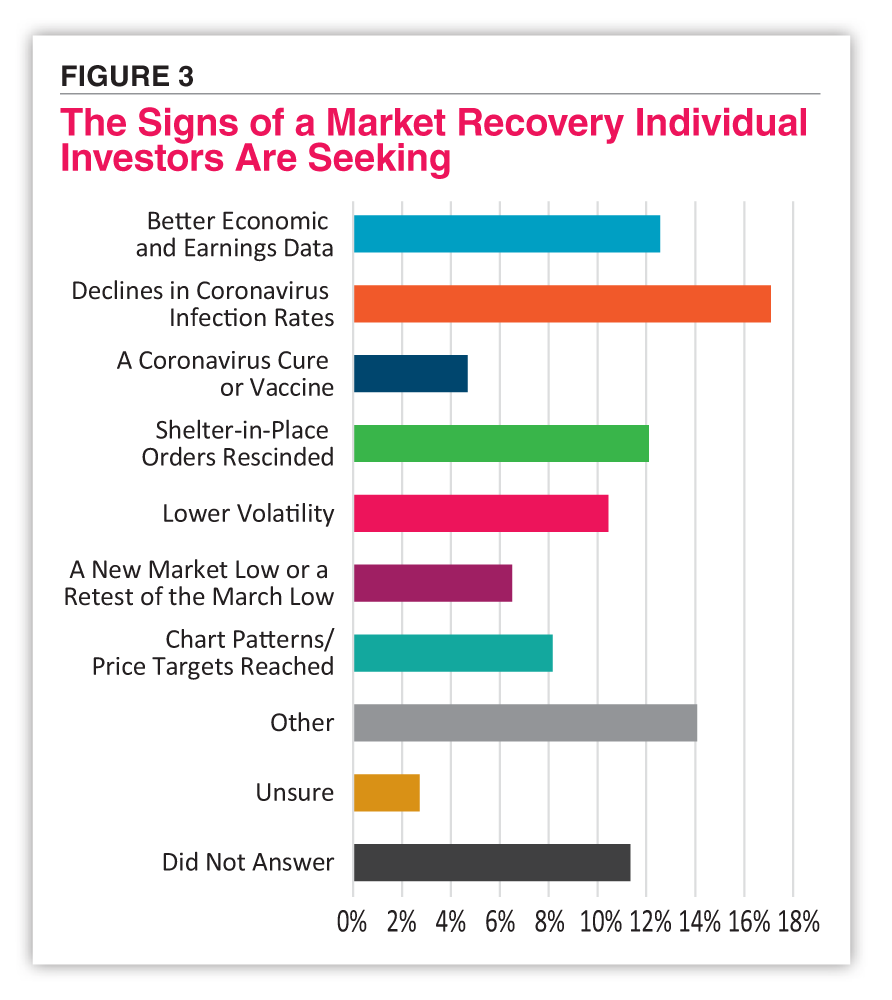
Finally, we asked AAII members to list signs they are looking for that the market is on its way to recovery. Developments with the coronavirus topped the list with 22% of respondents referring to it. A cure or related medical breakthrough, a drop in the number of infections and a reduction in the number of fatalities were all cited.
Mark Hirschfield listed the sign he’s looking for as a “lessening of virus numbers; both the numbers of infections and the numbers of deaths.” He added, “I believe, as usual, the market will recover before the actual economy does. However, as actual numbers come in during this (and probably the next few) earnings seasons, I think the current volatility will likely continue for at least a few more months.”
The economy was commonly cited. About 12% of respondents are looking for businesses and other enterprises to reopen. An additional 13% are paying attention to trends in economic and earnings data. They want to see indications of both or either showing signs of improvement.
David Ferris was among them, saying he wanted to see “small businesses get back on their feet as we get through the pandemic and stay-at-home orders.” Harvey Keynes echoed a similar sentiment by saying he was looking for “a reduction of staying-at-home requirements in large parts of the country.” Keynes also wants to see “reemployment of furloughed workers as companies restore work levels.”
Some respondents are paying attention to the stock market. A decline in volatility and/or a sustained upward trend was named by 10% of those who took the survey. Various technical indicators—including moving averages and support/resistance lines—are being monitored by 8% of respondents. Others (7%) think the market will need to either retest its March lows or set new lows before it can rebound.
John Whiting wants to be sure “there is no double-test of the [March] lows.” In a follow-up email, he observed that “usually we see a retest of the low or at least a pullback approaching the prior low after a large drop like this.”
The fairly large “other category” (14%) contained a wide range of responses, including the federal stimulus package and the outcome of the November elections. ▪
Portfolio Strategies

Portfolio Strategies


No comments have been added yet. Add your thoughts to the discussion!
You need to log in as a registered AAII user before commenting.
Log InCreate an account