


During the equity market sell-off in February 2020, there was a flight to quality as investors sought the perceived safety of bonds. Indeed, conventional wisdom holds that having a significant allocation to fixed-income securities in your investment portfolio is a prudent strategy, because of the diversification benefit that bonds provide. Some advisers recommend allocating 60% of your portfolio to stocks and 40% to bonds, while other strategists opt for decreasing your portfolio’s stock weight as you age, suggesting a percentage equity weight of 120 (or perhaps 100) minus your age, with the remainder in bonds. The motivation behind the latter strategy is that as you grow older and reach or enter retirement you may be less willing to face equity market volatility, and so more and more of your portfolio ought to be in “safer,” fixed-income assets. Such approaches have performed well over the past 40 years or so, with the allocation to bonds tending to dampen a portfolio’s volatility even as the equity market experienced bull and bear markets.
The bond market continued to perform very well in 2019, with Bloomberg’s corporate bond index returning 14.54% for the year. Long-term Treasury bonds (as measured by the Bloomberg Barclays U.S. Long Treasury index) did marginally better, returning 14.83%. While this is less than the 31.48% returned by the S&P 500 index in 2019, Treasuries beat stocks through August 31, 2019, returning 22.83% for the first eight months of the year versus the S&P 500’s 18.34%. If bonds can offer double-digit returns, isn’t that a good thing, and aren’t they a safe haven? The answer is “not necessarily.” To understand why, we can look at three factors: yield, credit quality and liquidity.
The Impact of Changes in Yield
As I discussed in the November 2019 AAII Journal (“How Big of a Concern Is the Inverted Yield Curve and Negative Interest Rates?”), the yield on a corporate, municipal or other non-Treasury bond is a function of the broad supply of and demand for capital—as reflected in Treasury yields—and the incremental credit spread that reflects the perceived risk of the bond due to its unique factors such as risk of default, appeal to other investors, etc. Bond prices typically move inversely with interest rates.
Figure 1 graphs the price of an exchange-traded fund (ETF) that invests in Treasury bonds with 20 or more years to maturity and contrasts it with the yield on a 30-year Treasury over the 12 months through February 2020. As you can see, the ETF price moves inversely with the bond yield.
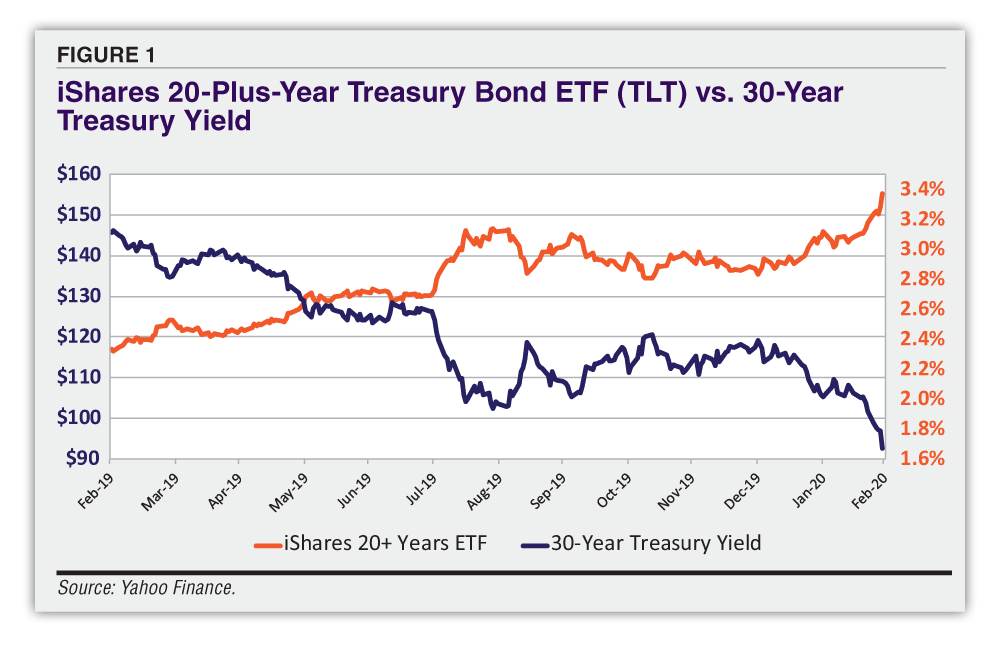
If a bond’s yield decreases, because there is more capital available or because the bond appears less risky, investors who own the bond will benefit in one of two ways: The price of their bond will increase, so they can sell and realize a capital gain; or they can continue to hold the bond, collecting a coupon that is now more attractive relative to interest rates in the market than it previously was.
If yields in the market increase, however, bond investors will suffer. They can recognize the pain immediately by selling their bonds at a loss, or over time as an opportunity cost, by continuing to hold the bonds but earning returns that are now lower than those available to purchasers of new, higher-yielding bonds. They will, however, benefit to some extent by being able to reinvest coupons at a higher rate and will, barring a default, receive their principal at maturity.
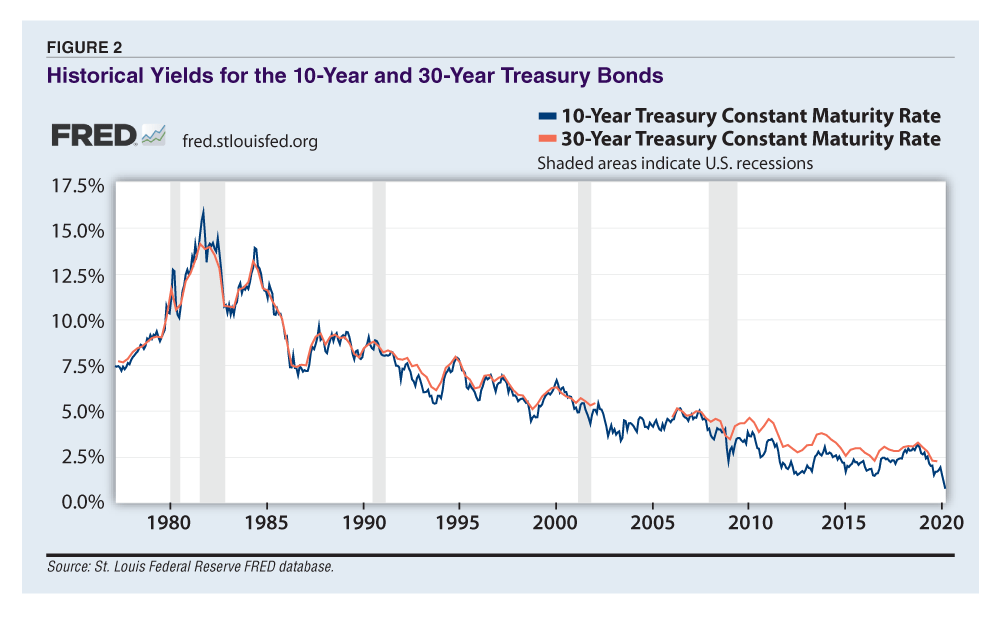
Interest rates have been declining since their peak in the early 1980s, resulting in gains for bond investors.
Figure 2 shows the sustained decrease in 10-year and 30-year yields over this period. [Since the article was prepared, interest rates dropped even further, with yields for all maturities out to 30 years dropping below 1% on March 9, 2020, before recovering slightly.]
What Goes Up Sometimes Comes Down
A key difference between stocks and bonds is the source of their returns. As the economy grows due to increases in spending and productivity, companies become more valuable. The market responds by posting higher stock prices, thereby rewarding equity investors. Most bonds, on the other hand, offer a fixed rate of interest so that price changes can only result from changes in yield, driven by changes in Treasury rates or credit spreads. To some extent, for bonds it’s a zero-sum game. If yields drop, bond prices rise, but when yields increase again, bond prices will drop. If bond investors have a windfall gain in one year from a favorable interest rate move they should expect to give it back in a future year, although the future loss will be offset to some extent by being able to reinvest coupons at higher yields if they continue to hold the bond. Given the strong bond performance in 2019, it’s not unreasonable to expect that when yields inevitably begin to rise, returns could be quite muted, or even negative, particularly for investors who choose to sell their holdings.
 Long-term bond prices are much more sensitive to yield changes than those of short-term notes. The 10-year Treasury bond, for example, has a duration (price sensitivity per 1% interest rate move) of more than nine, indicating that if rates increase 1% the price should drop by about 9%. (In practice, bond prices move somewhat less than duration predicts, because of a phenomenon known as convexity. See the aforementioned November 2019 article for a more detailed discussion about convexity.) The 30-year Treasury bond, though, has a duration of 22.7, and is almost two and a half times riskier. As I write this in early March 2020 using end of February data, yields on long-term bonds are only marginally higher than on their short-term peers, suggesting that investors are not being adequately compensated for the risk of owning long-term bonds.
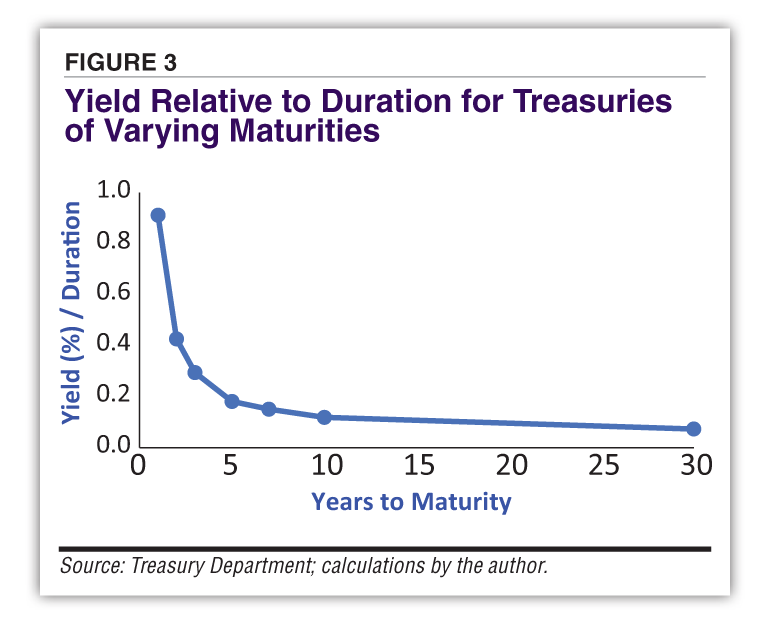
Figure 3 shows yield divided by duration, by maturity, illustrating the unfavorable risk/return profile of long-term Treasuries. Note that interest-rate sensitivity increases as yields decrease; today’s historically low-interest-rate environment has benefited investors as rates fell, but has left them more exposed to interest-rate risk than ever before. The downward pressure on rates has been a global phenomenon, with low U.S. rates in part the result of negative rates overseas; while it doesn’t appear imminent, a global economic recovery could lead to a rapid spike in rates.
Credit Quality Matters
In addition to interest-rate risk, investors in corporate bonds also have credit exposure, that is, the risk that the issuer becomes weaker and, in extremis, defaults on the bond. In part driven by today’s historically low interest rates, many firms have increased the proportion of debt in their capital structures. Debt issued by firms to fund investments that can increase earnings may benefit bondholders, but if the debt is used to repurchase stock it reduces the firm’s creditworthiness.
S&P Global reported in May 2019 that of all investment-grade bonds currently outstanding, an unprecedented 55% now carry a “BBB” rating—the lowest investment-grade rating—compared with 37% in 2007. Furthermore, the average leverage (debt/equity) ratio for these BBB-rated firms increased from about 2.25 in 2007 to 3.08 in 2018, while interest-coverage ratios have not improved.
The implication of this deterioration in credit quality is that, in a future economic downturn, these bonds are more likely to be downgraded to junk status, depressing their prices and possibly saturating the market for high-yield (junk) bonds.
Liquidity Matters for Bond Mutual Funds and ETFs
Liquidity is typically not a primary concern of a buy-and-hold investor who owns individual bonds. On the other hand, an investor who owns bonds indirectly through a mutual fund or an ETF, and who wishes to redeem their shares, will cause the fund manager to sell bonds unless there is sufficient cash to meet the redemption. In normal markets, bond ETF redemptions often don’t result in a sale of the fund holdings since the sponsor can retain the bonds in exchange for cash, but when faced with a wave of selling pressure the sponsor may be unable or unwilling to do so. We can note that some specialty funds have been forced to halt redemptions in the past; in December 2015, for example, the Third Avenue Focused Credit Fund prohibited redemptions as it sought an orderly sale of assets.
While there is more than $4 trillion in equity ETFs, according to Morningstar, there is now more than $1 trillion in bond ETFs. In the event of a significant increase in interest rates, or a dramatic decrease in credit quality, the resulting decrease in bond and ETF prices may cause a rush of fund redemptions. Whether there would be sufficient liquidity to absorb the selling pressure without additional pricing shocks is unknown.
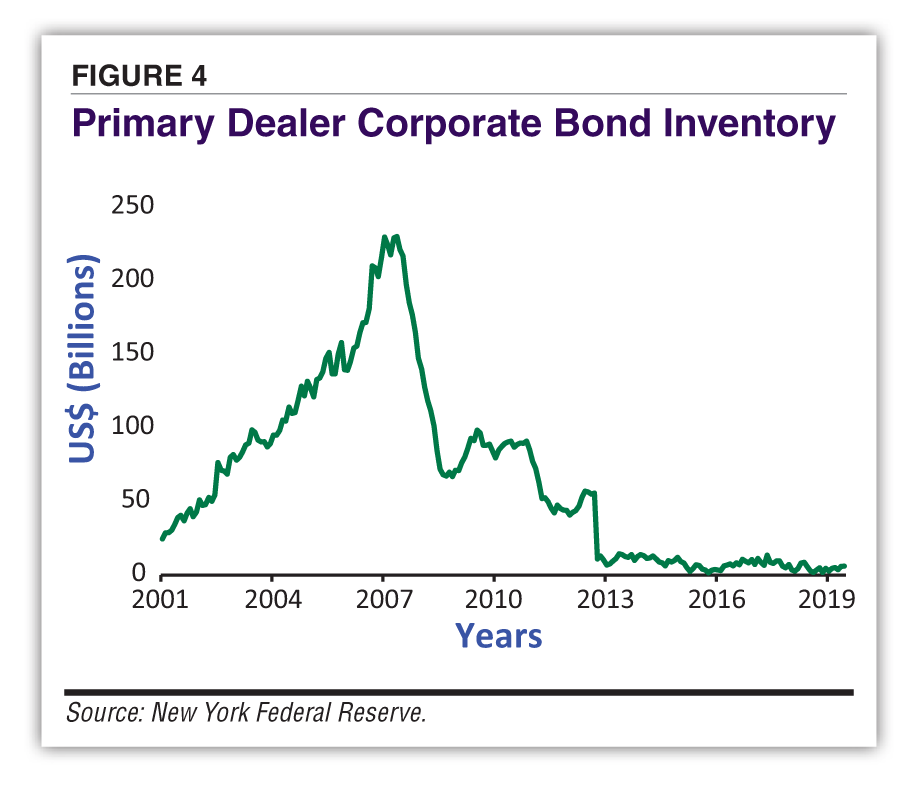
Traditionally, investment banks acted as bond market makers, willing to use their inventory to sell to buyers and to buy from sellers. Since the mortgage crisis and the passage of the Dodd-Frank Act, banks now carry much smaller inventories, as shown in Figure 4. We should note that although these inventories are dramatically smaller than in 2007, they are much more actively traded. Nevertheless, the concern that in a crisis there will be insufficient liquidity to absorb a significant wave of bond selling is certainly legitimate. [Of course, actions taken by the authorities can have a significant impact. In early April 2020, for example, the Federal Reserve announced an unprecedented initiative through which it will purchase corporate bonds and ETFs, including those that are rated below investment grade, thereby adding significant liquidity to the market.]
Potential Steps Individual Investors Can Take
While diversification is a useful risk-management tool, investors should remember that we are living in an unprecedented interest-rate environment, and that what worked in the past may not work in the future. Bond investors probably face more interest-rate, credit and liquidity risks than ever before, so caution is warranted. We can be fairly confident that rates will increase; the only question is when. They may remain low for a prolonged period, but an increase may come sooner than we expect. When it does, it will drive down bond prices. Even if Treasury rates remain low, a future recession could lead to a wave of bond downgrades, increases in credit spreads and price declines. In either of these scenarios, investors in bonds and bond funds may rush to sell.
If you are concerned about the risk of increasing rates, remember that short-term notes have less interest-rate exposure than long-term bonds. While high-yield bonds are also, in general, less exposed to interest-rate risk, their performance is likely to suffer—possibly dramatically—in an economic downturn, so if you expect a recession you should avoid them. [The consequences of the coronavirus pandemic were more precipitous than many anticipated. Since the article was prepared the U.S. has entered a significant economic downturn. How prolonged that will be remains to be seen.]
You can avoid credit risk entirely by focusing on Treasury securities, or reduce credit risk by focusing on high-quality municipal bonds. If you are concerned about future inflation, you can consider investing in Treasury inflation-protected securities (TIPS). Meanwhile, you can reduce your liquidity risk by ensuring that any fund or ETF that you invest in has significant daily volume, or by opting for individual securities that are actively traded. Note that if you plan to hold until maturity, liquidity will not be an issue for individual securities.
You can also consider substituting alternatives such as blue-chip, dividend-paying stocks for some or all of your existing fixed-income allocation depending your ability to tolerate the price volatility of stocks. ?


Related

Discussion
FREE REPORT

Marty Seitz from Maryland posted over 6 years ago:
Brian Haughey from NY posted over 6 years ago:
George Lewinnek from Massachusetts posted over 6 years ago:
Brian Haughey from NY posted over 6 years ago:
Ron Plue from California posted over 6 years ago:
Hildy Richelson from PA posted over 6 years ago:
Hildy Richelson from PA posted over 6 years ago:
Carl Altenburg from NJ posted over 6 years ago:
Steve from Louisville, Kentucky posted over 6 years ago:
KATHLEEN C from NJ posted over 5 years ago:
CHARLES R from IL posted over 5 years ago:
BARRY J from TX posted over 4 years ago:
Richard H from PA posted over 4 years ago:
You need to log in as a registered AAII user before commenting.
Log InCreate an account