

Related

Behavioral Finance
Though biases are ingrained in our emotional psyche, the really great investors follow strict investment disciplines to reduce the impact of their emotions.

“Investing isn’t about beating others at their game. It’s about controlling yourself at your own game.”
—Jason Zweig, investing and personal finance columnist for The Wall Street Journal
Despite their best intentions, investors can’t be Spock-like in their lack of emotion. Emotions affect our decisions. An emotional bias is a bias that arises from impulse, intuition and feelings, and results in irrational decision-making. Emotional biases tend to be difficult to correct because they are ingrained in our emotional psyche. Yet, the really great investors follow strict investment disciplines to reduce the impact of their emotions. As multi-billionaire Warren Buffett notes about investing, “It’s an easy game if you can control your emotions.” Buffett also remarks that “The most important quality for an investor is temperament, not intellect.” Cognitive biases and social influences can also affect investor behavior. Here are eight common emotional biases and suggestions for dealing with them.
Many investors exhibit loss aversion, which refers to the tendency to prefer avoiding losses to acquiring gains. In short, investors have difficulty coming to terms with losses. The expression “losses loom larger than gains” summarizes this bias. For example, if you lose $10,000 versus gain $10,000 on an investment, research shows that the pain experienced from the loss is psychologically greater than the satisfaction or pleasure of an equivalent gain. As Peter H. Diamandis notes, “Loss aversion is often what keeps people stuck in ruts.”

Remedy: One approach to dealing with loss aversion is to consider the merits of each investment. Ask yourself, would you buy this investment today? If the answer is “no,” then why are you holding it? Another approach is to talk with a trusted investment adviser about market expectations and how to manage emotions, especially during market downturns. A third tactic is to set up and follow preestablished guidelines for when to sell a winner or loser and stick to them no matter how you feel in the moment.
Regret aversion is the indecision and failure to take action due to fear of experiencing bad outcomes. Investors suffering from regret-aversion bias don’t take a necessary action because of the regret of a previous failure or the fear their decision will turn out to be wrong in hindsight. This bias stems from the desire to avoid feeling responsible for a poor result. Regret-averse investors sometimes fear buying the wrong assets (error of commission) or not buying the right assets (error of omission) because they want to avoid the emotional pain related to making poor decisions.
Let’s take several examples. Investors who suffered recent losses might become too conservative to avoid the pain associated with additional loses. They may develop a habit of investing in short-term bonds to avoid the greater volatility of investing in the stock market. By staying in low-risk investments, their portfolios have limited upside potential. However, if stocks declined to where bargains are available, regret aversion could prevent them from breaking their bond-buying habit to take advantage of high-potential stocks. If investors suffer from regret-aversion bias, they may also invest in familiar investments or follow the herd.
Another example of regret aversion involves selecting stocks. Instead of considering the likelihood of a stock rising or falling in price and the gain and loss associated with each, investors consider how bad they would feel if a stock performed as poorly as they envisioned. To minimize that feeling, they often engage in less risk-taking because risks increase the maximum potential regret. As a result, a close link exists between regret aversion and risk aversion.
Remedy: To avoid regret aversion, you should realize that not making a decision is a choice to maintain the status quo and your current portfolio holdings. You must develop the discipline to engage in financial planning as a means of reaching your long-term goals and to periodically rebalance your portfolio.
Self-control bias is the failure to pursue long-term goals because of a lack of self-discipline in the short run. Investors may try to make up the shortfall by assuming too much risk. Self-control bias may lead to several ineffective investment behaviors.
First, many people have an immediate gratification mindset leading them to consume more today at the expense of saving for tomorrow.
Second, self-control bias leads to inadequately planning for retirement. Many retirees wish that they had spent less, saved more and started investing sooner. After becoming aware of their retirement shortfall, they may take more risk in their portfolios to make up for lost time.
Third, self-control bias may result in asset allocation imbalance. That is, due to a “spend today” mentality, investors may prefer income-producing assets, which may inhibit achieving a desired level of long-term wealth needed for retirement.
Remedy: To lessen self-control bias, you need to strike a careful balance among short-, medium- and long-term goals that translates into assessing the appropriate level of saving, investing and risk-taking. Achieving this balance requires planning. People don’t plan to fail; they simply fail to plan. Another remedy is to maintain a proper asset allocation in your portfolio to attain your financial goals. You need to engage in spending control. Establishing and following a budget can also help deter the propensity to over-consume. A final suggestion is to pay yourself first by setting aside a certain amount of funds each period for investment purposes.
Although having a positive self-image can be beneficial, it can also lead to poor investment decisions. Overconfidence bias is an excessive belief in one’s own judgments and abilities. It generally arises from the desire for a positive self-image. Overconfident investors believe that they know more than they actually do. Many investors are overconfident even when they are wrong. Thus, they often overestimate their abilities but underestimate a decision’s actual risks. As Daniel Kahneman, the co-recipient of the Nobel Prize for Economics in 2002, notes, “We’re generally overconfident in our opinions and our impressions and judgments.” Overconfident investors are victims of the “ego” or “superiority trap.” Those falling into this trap are easy prey for the true experts who can and do exploit them. Overconfident investors also tend to be slow in combining additional information about any decision-making situation because they are confident in their initial decisions.
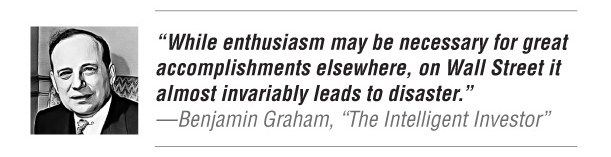
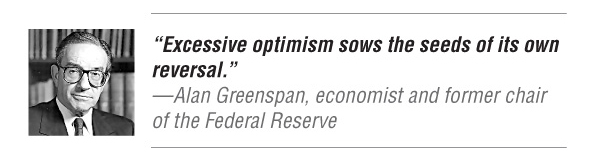
Although excessive optimism and overconfidence are related, they represent two distinct behavioral biases. Excessive optimism involves a belief that future events are more likely to be positive than is realistic. Investors may make bold forecasts due to their optimism. Not surprisingly, this behavior contributes to market bubbles, as excessively optimistic investors believe that the market will continue to rise.
Self-attribution bias is the tendency to attribute successes to one’s own choices (self-enhancing bias) and to blame failures on others and external factors (self-protecting bias). In other words, investors credit themselves for the “good stuff” that happens and blame others for the “bad stuff.” In reality, good performance may result more from luck than skill, which gives rise to the saying “never confuse brains for a bull market.” However, investors want to maintain high self-esteem and feel good about themselves. This behavioral pattern influences them to exaggerate their abilities and ignore their mistakes.
Remedy: To overcome overconfidence, you need to recognize the signs of overconfidence such as attributing a few short-term “wins” to superior knowledge, ability or skill; bragging about short-term investment performance; trading too much; and taking excessive risk. When these signs become visible, you need to apply the brakes. However, an objective observer is more likely to detect these biases than you are. Trading less, especially in taxable accounts, and diversifying your portfolio should help to curb overconfident behavior. Additionally, you should carefully examine your assumptions and conduct adequate research before undertaking any investment. Keeping detailed records of trades and the motivation for each can enable you to identify personal mistakes and successes relative to the strategy used. Developing accountability mechanisms such as seeking constructive feedback from others can help you become aware of overconfidence bias. You also need to keep an open mind about other opinions and seek alternative viewpoints when making investment decisions.
Investors learn by interacting with others such as friends, colleagues and financial advisers. Both the media and the internet also play a role in influencing investment decisions. However, the information provided tends to be in sound bites rather than in-depth analysis. The media is often biased, favoring optimism to sell products from advertisers and attract viewers or readership. The media often focuses on specific stories for long periods of time, which can contribute to exuberance or dismay surrounding the investment.
Perhaps the most common social bias is herding, which refers to the tendency to flock together—especially under conditions of uncertainty. Herding behavior occurs because investors feel powerful social pressure to fit in and conform.
Novice investors are particularly susceptible to herding because they may believe that others know more than they do, so following the crowd makes sense to them. However, having a herd mentality leads to buying when the market is high and selling when it is low. Such behavior is exactly the opposite of the common investment mantra to “buy low/sell high.” Investors don’t want to be left out of a winning stock or surging market, so they go with the flow of the crowd. Their irrational exuberance leads them to buy a stock at an increasingly higher price, which is called the bandwagon effect. Eventually the stock’s price starts to decline when market participants realize it’s overpriced and a sell-off occurs. Those who bought the stock for irrational reasons begin to regret their purchases and fear losing their money, so they start selling. This type of “groupthink” results in an irrational or dysfunctional decision-making outcome.
As Friedrich Hayek, an Austrian-British economist and philosopher, once noted, “By the time any view becomes a majority view, it is no longer the best view: somebody will already have advanced beyond the point which the majority have reached.” Herding behavior also contributes to stock market and other bubbles, when market participants drive prices above their intrinsic value relative to some valuation system.
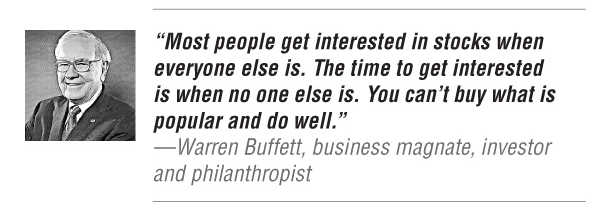
Remedy: Several strategies are available to deal with herding behavior. Although you might not want to be left out of a market trend, you should question the wisdom of the crowd. To avoid the lure of crowd psychology, you can resist following the herd or jumping on the bandwagon by doing your own research before investing. You may also want to consider taking a contrarian approach in which you do the opposite of what everyone else is doing. Using a contrarian approach can enable you to capitalize on what others may overlook. As the Oracle of Omaha Warren Buffett notes, “Be fearful when others are greedy and greedy when others are fearful.” However, you should base your decisions on fundamentals, not optimism.
Illusion-of-control bias is the tendency to overestimate your degree of control or influence over external events. Investors like to think that they have more control over their investments than they actually do. Although you have control over your asset allocations, security selection and market timing, you don’t have control over the outcomes resulting from these decisions. This bias can lead to excessive trading and overconfidence and can also stop investors from learning from their mistakes and being sensitive to feedback.
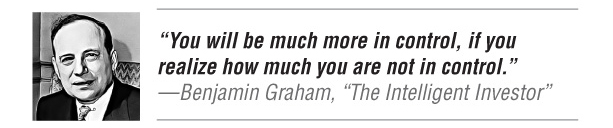
Remedy: To lessen the illusion of control, you should stick to a well-crafted investment plan and avoid unnecessary trading. You can also seek the opinion of others and keep records of trades to see if you are successful at controlling investment outcomes. Once you realize your control in markets and investments is illusory, you can begin practicing flexibility and conserve your energy for those matters over which you can exert influence.
Status-quo bias is the tendency to do nothing or maintain a previous decision unless some compelling incentive exists to change. Status-quo investors prefer to hold the investments they already have based on the unwarranted assumption that another choice is likely to be inferior or make matters worse. By maintaining their current asset allocation, they may forgo making value-enhancing adjustments and experience changing risk characteristics of their portfolios.
Status-quo bias helps to explain why so many people defer saving for retirement or postpone opening and making contributions to a retirement account. After entering a retirement plan, investors may not actively manage or monitor their accounts, but instead maintain the status quo. Remaining comfortable or complacent with an existing portfolio could lead to an inappropriate risk-return profile over time.
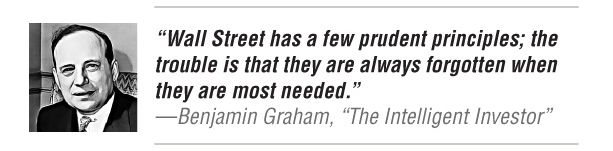
Remedy: To resist status-quo bias, you should implement a disciplined investment strategy, periodically reexamine your investment plan and rebalance your portfolio on a consistent basis. Of course, if your financial circumstances or risk tolerance changes, you should alter your asset allocation. This action helps to ensure that your risk-tolerance profile matches the asset allocation throughout the life of a long-term portfolio.
The endowment effect is the tendency to overvalue assets you already own. Investors often cling to assets because of familiarity, comfort or emotional attachment. That is, they have difficulty separating from things once they become part of them. For example, someone who inherits shares of a stock from a parent or close relative may refuse to sell because of emotional ties. Another example is when an investor holds onto an asset for too long and possibly loses money in the process when more appropriate investments are available.
Remedy: To deal with the endowment effect, you first need to step back and determine why an asset is meaningful to you. That is, you’ve identified the reason for your attachment. Next, you need to determine whether the current asset is appropriate for your portfolio. In other words, you should decide whether keeping an asset negatively affects your overall asset allocation. If so, you should replace it with a more suitable investment. To counter the endowment effect for inherited securities, ask yourself the following question: If you received cash as part of an inheritance, what portion would you allocate to buy the inherited security? If your answer is little or none, this awareness could provide an incentive to sell the inherited asset. ?
Behavioral Finance

Financial Planning

Portfolio Strategies

Joe K. from CA posted over 6 years ago:
BARRY J from TX posted over 5 years ago:
You need to log in as a registered AAII user before commenting.
Log InCreate an account