

Related

Behavioral Finance
The level of happiness in music listened to by individual investors affects their market sentiment. The study’s authors used Thomson Reuters Tick History (TRTH) from Refinitiv for their market data and streaming service Spotify for music data. They looked at the top 200 songs in the U.S. played on Spotify over the period of 2017 to 2019. This research follows other studies that have tried to analyze investors’ mood swings based on the weather, the outcome of major sports events and air disasters. Music was chosen as a correlated factor because “music can give voice to emotions that cannot be expressed in words and would not be captured by a word-based sentiment measure.”

The level of happiness in music listened to by individual investors affects their market sentiment. The study’s authors used Thomson Reuters Tick History (TRTH) from Refinitiv for their market data and streaming service Spotify for music data. They looked at the top 200 songs in the U.S. played on Spotify over the period of 2017 to 2019. This research follows other studies that have tried to analyze investors’ mood swings based on the weather, the outcome of major sports events and air disasters. Music was chosen as a correlated factor because “music can give voice to emotions that cannot be expressed in words and would not be captured by a word-based sentiment measure.”
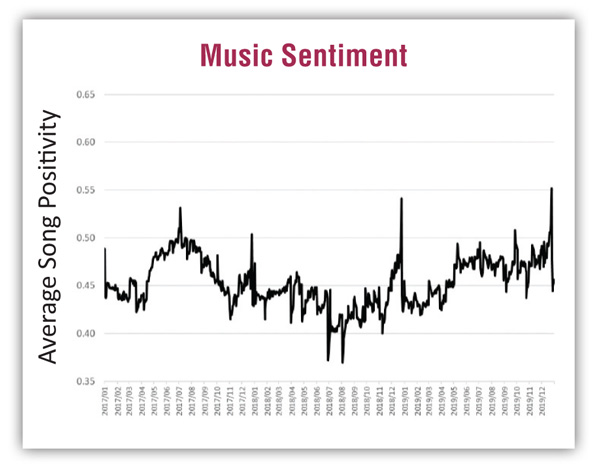
To analyze the songs on the list and how they could affect individual investors, the authors focused on “how individual differences in musical preferences are linked to personality traits, values and cognitive style … (e.g., cheerfulness, depression, anxiety).” More specifically, they used the “average positivity” of songs as a way to discover investors’ moods.
They observed that more positive songs (happy, cheerful, euphoric) were listened to around Christmas and other public holidays, and that during the winter months more negative songs (sad, depressed, angry) were listened to.
The authors also looked at the top 200 songs based on “loudness, danceability, energy, speechiness, acousticness, instrumentalness, liveness and tempo,” but found that these factors didn’t have much of an effect on stock market returns.
It was found that “when investor sentiment is highly positive, prices are temporarily high but later become low, reflecting a pattern of mispricing correction.” Therefore, the correlation between the more positive the song being listened to and the stock market’s prices is temporarily positive. The authors elaborated, “our findings suggest that our music-based mood proxy captures reasonably well mood swings and is associated with a systematic pattern of mispricing correction, where a more positive (negative) mood is associated with a negative (positive) expected stock market return in the following week.”
Source: “Music Sentiment and Stock Returns,” by Adrian Fernandez-Perez, Alexandre Garel and Ivan Indriawan; SSRN, May 6, 2020.
Behavioral Finance

Trading Strategies


W E from MN posted over 6 years ago:
You need to log in as a registered AAII user before commenting.
Log InCreate an account