

Related

Computerized Investing
While performance has varied among providers, most robo portfolios represent a viable, low-cost option for professional management.
by Ken Schapiro | June 2020

Backend Benchmarking publishes The Robo Report, a free comprehensive quarterly newsletter reporting on the digital-advice industry. Our project started in 2015 when we opened and funded accounts at the largest robo-advice providers to track their performance, trading and other activities. Since the project’s inception, we have expanded to report on more than 80 accounts across more than 40 digital advice providers. As we grow, our mission remains the same: to bring transparency to the financial services industry.
The taxable account universe in the report, which contains the portfolios discussed in this article, represents moderate to moderately aggressive portfolios. Specifically, we seek to be invested in a portfolio that contains 60% equities and 40% fixed income. While most portfolios are quite close to this 60% equity allocation, the taxable account universe ranges between 50% and 70% equities.
To allow for better comparison of portfolios with differing equity percentages, the full report contains allocation information, equity-only returns, fixed-income returns and a return above and below a normalized benchmark. The normalized benchmark is a benchmark that is customized to each portfolio based on the portfolio’s percent of equities.
Robo-advice as we know it today first emerged in the mainstream in 2008 when Betterment and Wealthfront were founded and later launched digitally managed portfolios with low fees and minimums. In 2015, Schwab launched its Intelligent Portfolios and Vanguard launched its Personal Advisor Services. Since then, robo-advice products have become ubiquitous among financial institutions. Here, we intend to look back at the industry, how its evolution is impacting individual investors and what investors can expect next from these innovative products.
When robo-advisers entered the mainstream, they grabbed headlines as disruptors to the traditional financial advice industry. Many questioned whether these platforms would replace traditional advice relationships. While the advent of robo-advice is having and will continue to have profound effects on how financial advice is delivered to individuals, it is not disrupting the traditional advice industry in the way that many expected.
Although robo-advice platforms are becoming increasingly complex and better at servicing individual clients, they have yet to convert many clients with existing traditional advice relationships. While independent robos like Wealthfront, Betterment and Personal Capital are still aiming to disrupt traditional advice, incumbent firms are positioning robo-advice products to service client segments that are separate from traditional advice. In fact, major incumbent firms are positioning robo-advisers to serve previously underserved areas of the market. Specifically, they target clients who do not have enough assets to be attractive to traditional advisers and self-directed investors.
For consumers, this means that they will be increasingly presented with a robo-advice option at institutions where they already have an existing relationship. It is important to understand what these products are, as not all robo-advice products are created equally. One of the largest differences between products is the level of live advice and financial planning offered. Some robos offer live advisers to all clients, others offer access to representatives to help with technical or other general questions, while some are digital-only and do not have ready access to anyone. Individuals first need to determine what level of service they are looking for and whether they have financial planning needs. Consumers should ask questions not only about access to advisers, but whether those advisers can provide financial planning or advise on client-specific scenarios.
However, not everyone needs in-depth financial planning, while others may be comfortable working with self-directed digital-planning tools. Wealthfront, for example, does not offer live planning and advice but has strong online planning tools, allowing users to build robust plans on their own. An offering that has tiered service levels can also be attractive for those who do not need significant financial planning now but may want to graduate to a higher service level in the future as their wealth and needs grow.
Robo-advice has dropped the traditional minimum investment amount from hundreds of thousands of dollars to zero at many providers. It has also created a new tier of services available at a fraction of the cost of traditional advice. This is a paradigm shift for consumers. Those with less assets or an aversion to high fees no longer need to feel they must manage their own assets. Robo-advice has allowed individuals to enroll in professionally managed accounts with $10 or less. Those just starting on their wealth accumulation journey should take advantage of these low-cost and low-minimum products.
The net result is positive for individuals. Since the explosion of digital advice products, consumers who did not previously have the wealth to be attractive to traditional advisers now have a plethora of options available to them. In fact, they likely have an option available to them at a financial institution where they already do business. The market for professional management has been greatly expanded to include both the mass affluent investors and those new to investing.
Micro-investing apps have proven successful at attracting large swaths of young clients. Lowering the behavioral and logistical barriers to investing is helping younger generations engage with their finances. Two independent firms stand out with their success in introducing investing to individuals who have not invested before: Acorns and Stash, both considered “micro-investing” companies, have millions of users.
While robo-advice has been adopted by traditional financial services firms, robo-advisers and fintech firms more broadly are pushing back by expanding the services they offer to compete in more areas. Independent firms are first targeting savings and spending accounts to expand. Wealthfront, Betterment, Personal Capital and SoFi, among others, have launched high-interest savings accounts through partner banks. Betterment, SoFi and Acorns have now all launched checking accounts with a debit card. Wealthfront is expected to launch one soon. These savings accounts have compelling interest rates, and checking accounts are also attractive due to having little to no fees.
Not only are these robos now competing with banks, but they are also pressuring traditional firms to lower fees and increase interest rates on their products. Fintech firms are working toward becoming comprehensive personal finance platforms that can provide services to consumers from their day-to-day spending and saving through long-term planning and investing. We expect to see a steady increase in the types of services offered. For example, Wealthfront is working on the ability to connect their clients with mortgage providers.
Increased competition and innovation will result in better products for individuals. Robo-advisers and other personal finance fintechs are providing attractive alternatives to traditional banks. This competition will have the net effect of raising the quality of products across the board.
The independents have had to stay a step ahead of major firms by continuing to innovate and improve how their users interact with their money. We believe that the future rounds of innovations and feature releases will go beyond automated investing and will tackle budgeting by introducing tools to help users save automatically and integrate long-term planning with day-to-day spending and saving.
Wealthfront’s acquisition of Grove was part of developing their “Self-Driving Money” product that has yet to be launched. We are excited to see what innovations around day-to-day spending behavior will follow the introduction of checking and savings accounts.
Retirement income strategies is another area where we are seeing innovation. Product developments are tackling the behavioral components of saving and investing and are addressing tax optimization. The industry is starting to launch products to address the transition from saving and investing to withdrawing and spending during retirement.
Schwab announced “Intelligent Income” earlier this year. This feature of Intelligent Portfolios Premium not only helps retirees determine how much to spend but also identifies how to draw down assets in a tax-efficient way. Personal Capital and United Income both have features that help clients determine how much and from where to draw assets.
Products like these can help clients understand how to transition from earning money to drawing down assets, addressing the behavioral component of spending during retirement, while also helping to optimize for taxes. We expect to see other firms address retirement spending by leveraging technology.
Robo-advice is successfully transforming the industry, although not always in the way the industry expected. Robo-advice products have fit in next to traditional advice offerings more than replaced them. These products opened professional management to large swaths of the population that have historically been underserved. Digital advice solutions represent the newest onslaught of pricing pressure and are pushing the battle for new clients much earlier in the client lifecycle.
While independent robo-advisers are well along their path to becoming comprehensive personal finance platforms and are already competing with banks on savings and checking accounts, we expect to continue to see an expansion of services and products. The financial services landscape has been forever changed by robo-advice in the last five years. Innovation and competition will continue to force firms to adapt, rethink products and improve how they serve all types of clients.
Robo-adviser performance reported here is calculated net of fees, and our commentary is for the period ending March 31, 2020.
Among our moderate portfolios (equity allocations close to 60%), our Wealthsimple portfolio had the best total-portfolio performance above/below the benchmark, the best fixed-income performance and the second-best equity performance for the first quarter of 2020. Our Wealthsimple socially responsible investing (SRI) portfolio placed third, when compared to the normalized benchmark. The standard Wealthsimple portfolio stood out because the entirety of its fixed-income holdings is investment grade, with nearly two-thirds being long-duration U.S. Treasury bonds. When the Federal Reserve lowers interest rates, long-duration bonds will increase in price more than short-duration bonds will. The result was a 9.4% fixed-income return in the first quarter and a 12.4% return over the one-year trailing period.
The next best fixed-income performer (after Wealthsimple SRI) was FutureAdvisor. FutureAdvisor also holds all investment-grade fixed income and relies heavily on a Barclays Aggregate Bond Index-tracking exchange-traded fund (ETF), which has a large allocation to Treasuries, helping it achieve a 2.8% fixed-income return for the quarter.
On the equity side, Wealthsimple benefited from its holdings of two international minimum-volatility funds. In our previous Robo Report, we cited these funds as hurting Wealthsimple’s performance when markets were rising. In this volatile bear market, they have had the opposite effect.
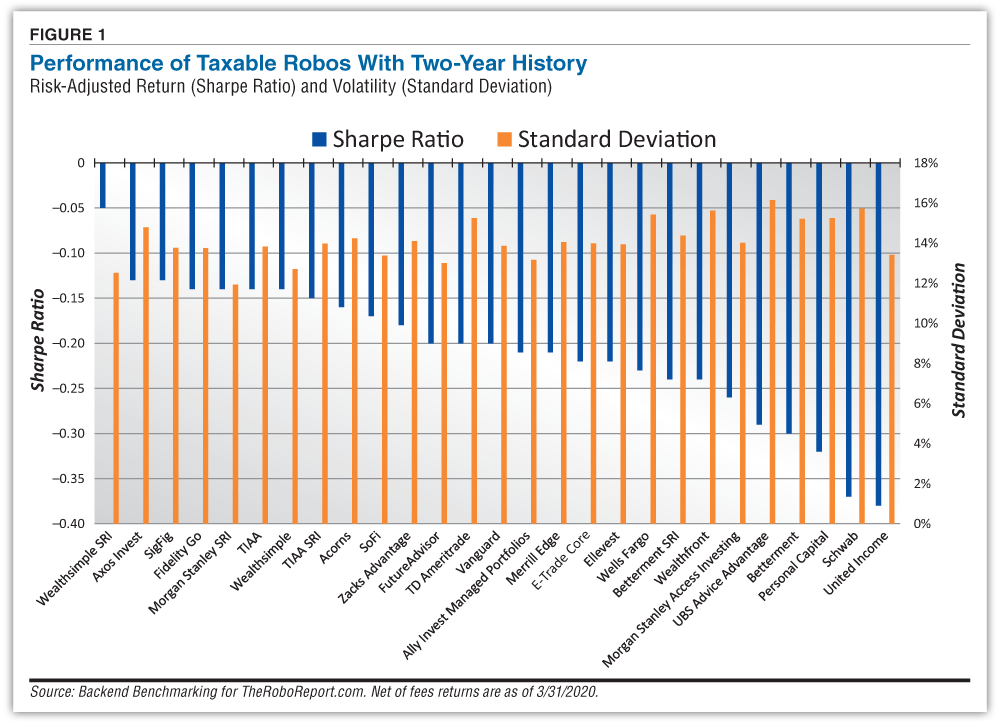
Figure 1 shows the risk-adjusted return, as measured by the Sharpe ratio, and volatility, as measured by the standard deviation, for taxable robo-adviser portfolios with a two-year history.
The worst moderately allocated (60%/40% target) performer when compared to the normalized benchmark was our Morgan Stanley Inflation Conscious portfolio. Its fixed-income holdings were concentrated in higher-quality issues and the underlying funds hold Treasuries, resulting in overall strong fixed-income performance. However, its equity holdings had the worst performance, posting a loss of 28.3%. This portfolio holds a master limited partnership (MLP) energy ETF. The coronavirus pandemic has hit the energy industry particularly hard as demand has dried up and political battles have boosted supply. This fund lost 59% of its value in the first quarter. Its higher-than-average allocation to small- and mid-cap stocks also hurt its performance, as these groups underperformed large caps over the same period.
Wells Fargo had the worst fixed-income returns in the first quarter, with a loss of 3.7%. Although much of its fixed-income allocation is in a Barclays Aggregate Bond Index-tracking ETF, it had close to one-third of its fixed-income exposure in high-yield corporate and emerging market ETFs. These two areas of the bond market were very hard hit, particularly emerging markets.
Schwab fell short again. Our Schwab Domestic Focus and standard portfolios placed in the bottom five of first-quarter returns compared to the normalized benchmark. The standard portfolio’s equity performance was slightly worse since it has more exposure to international equities. The Domestic Focus was only slightly better and was the third-worst equity performer. One of the primary factors driving Schwab’s underperformance is their tilt toward value. Value stocks have consistently underperformed growth over the past three years, including during the recent market volatility. Among all the robo-advisers we track, Schwab holds the most cash as a percentage of the total portfolio. This may have helped since part of the portfolio was not in equities, but it also can hurt if an investor could otherwise be in investment-grade fixed income, specifically Treasuries, which do well during tough times.
One feature that has been popularized by robo-advisers is automated tax-loss harvesting. While tax-loss harvesting can add value, the value is often less than providers present to their customers. Additionally, activity over this quarter has shown us that not all robo products that offer tax-loss harvesting are performing equally.
To measure tax-loss harvesting, we track a set of specific accounts that were all opened and funded at the same time and receive monthly deposits. These are different from the main accounts that we use to measure performance of the robos. As of the end of the quarter, UBS and Wells Fargo were two noticeable providers that offer tax-loss harvesting but had yet to execute significant tax-loss generating trades. While UBS and Wells Fargo still may execute tax-loss trades, others like TD Ameritrade, Schwab, Betterment, Axos Invest and Wealthsimple have already turned over significant portions of their account in tax-loss-generating activity.
The aggressiveness of the trades has also varied. TD Ameritrade, Schwab, Wealthfront, Axos Invest, Wealthsimple and Betterment stood out for the amount traded and the losses realized relative to the size of their accounts. Schwab had a turnover ratio of higher than 66% during March. TD Ameritrade turned over more than 100% of their portfolio. Betterment turned over nearly 21% of their account, Axos turned over 30% of their account and Wealthsimple turned over 37%. Most accounts have executed rebalancing trades at this point. Vanguard noticeably had not rebalanced their accounts as of the end of the quarter.
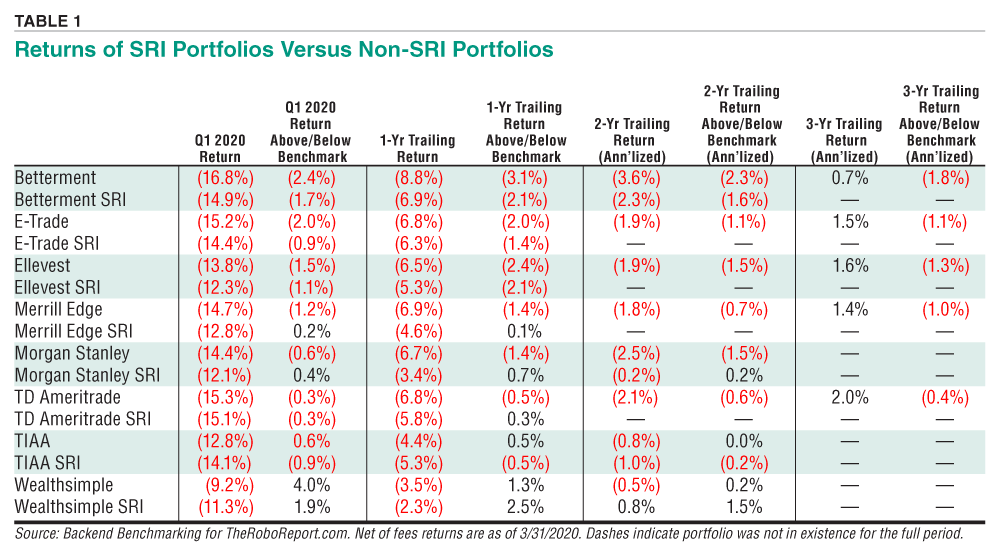
Many robo-advice products have launched portfolios with a socially responsible investing theme, which have proven popular among users. One concern many investors have is whether opting for an SRI portfolio will be detrimental to portfolio performance. While management fees at the providers we cover do not increase when opting for an SRI-themed portfolio, the underlying funds’ expense ratios typically are higher for thematic funds employed by the robo-advisers. After tracking many of these portfolios for over two years now, performance results are promising.
In this quarter, we have seen further evidence that investors are not paying a significant performance premium when opting for SRI portfolios offered by robos. Many of the SRI portfolios that we track actually outperformed their non-SRI counterparts on a net-of-fees basis in the first quarter, as well as the one- and two-year trailing time periods. Those that did underperform their non-SRI portfolios at the same provider did not underperform by a wide margin. This quarter, five of the eight SRI portfolios outperformed the non-SRI portfolio when compared to the normalized benchmark. When looking at the two-year trailing return above or below the normalized benchmark, three of four outperformed. Impressively, not only are SRI portfolios showing that they can outperform the non-SRI portfolio at the same provider, but two SRI portfolios were also top 10 performers for the quarter out of 66 taxable portfolios tracked in the report.
Table 1 shows performance over various time periods for the SRI-themed robo portfolios we track compared to their non-SRI counterparts.
Taking a deeper look at why some SRI portfolios outperformed, we found that the Merrill Lynch, Morgan Stanley and Betterment non-SRI portfolios all tilt toward value. The SRI portfolios do not have the significant value tilt seen in their non-SRI counterparts. Value has underperformed growth going back two years through this recent downturn. For example, the equity portion of Morgan Stanley’s SRI portfolio outperformed its counterpart’s equities by 3.2%, due in part to less value exposure. Additionally, the equity portion of Betterment’s SRI portfolio outperformed its non-SRI version because of a more muted overweight to value equities.
While performance has certainly varied among providers, most robo portfolios represent a viable, low-cost option for professional management. Most portfolios are well diversified and rely on low-cost ETFs in portfolio construction.
Automated rebalancing can provide great discipline during market times of volatility. Self-directed investors often overmanage portfolios, resulting in underperformance. Adding a robo-adviser can be a great addition to a self-directed investor’s strategy to achieve long-term goals and can provide a disciplined and diversified portfolio as an addition to their overall financial picture. ▪
Computerized Investing
Computerized Investing

Portfolio Strategies

JG from PA posted over 6 years ago:
Robert P from IL posted over 6 years ago:
Jonathan C from MN posted over 6 years ago:
F F from OH posted over 6 years ago:
CARL G from NY posted over 6 years ago:
You need to log in as a registered AAII user before commenting.
Log InCreate an account