



Related

Financial Planning
Taxpayers with moderate levels of wealth can often lower the taxable portion of their Social Security benefits by delaying the start of these benefits.

How the size of a financial portfolio affects the additional portfolio longevity from delaying the start of Social Security benefits was shown in a 2012 Journal of Financial Planning article that I co-authored with William Meyer. Here, we illustrate this point again, but this time using the updated tax code.
We present four cases, where retired single individuals each turning 62 in December 2018 have, respectively, $250,000, $500,000, $750,000 and $1 million in their financial portfolios as of the end of 2018. In each case, the retiree lives in an income-tax-free state, and we assume 80% of the financial portfolio is in a tax-deferred account (e.g., a traditional IRA) and 20% is in a taxable account (with cost basis equal to market value). The primary insurance amount (PIA) is set at $2,200 for each retiree. The PIA is the benefit paid at full retirement age (FRA). In each case, we set the monthly spending amount beginning in January 2019 to a level so that the conventional wisdom withdrawal strategy (CW) with Social Security beginning at age 62 and one month allows the financial portfolio to barely last 25 years. We then calculate how much longer the retiree’s financial portfolio will last if they continue to use the conventional wisdom withdrawal strategy, but delay the beginning of Social Security to full retirement age and age 70, respectively. Finally, we present one more strategy that allows us to see the additional longevity if the retiree coordinates the decision to claim Social Security benefits with a tax-efficient withdrawal strategy. Although these cases assume that the retiree is single, the same lessons apply for a retired couple.
Under the conventional withdrawal strategy, retirees are encouraged to take withdrawals from their taxable account until it is exhausted, then from the tax-deferred account until it’s exhausted and then from the tax-exempt Roth account. The spending amount is the largest monthly real spending amount in increments of $25 such that the CW at 62 strategy lasts 25 years.
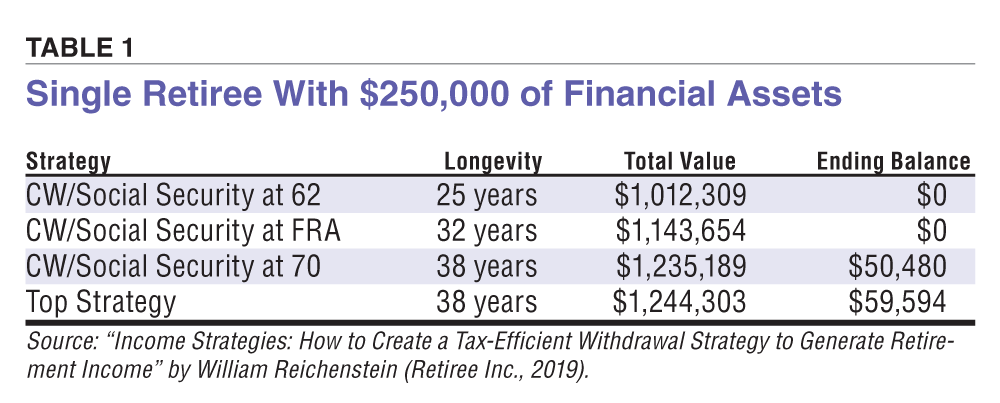
The first case is that of a single individual with $250,000 in their financial portfolio as of the end of December 2018. Going back to 2018, for the purpose of discussion, they, like the other single retirees, will turn 62 between December 3, 2018, and January 1, 2019. Thus, the first month for which they can apply for retirement benefits is the month of January 2019. (A person must have “attained” age 62 for the entire month before they are eligible to file for Social Security retirement benefits. We assume the first month of eligibility is the month a person attains age 62 plus one month, instead of age 62. Only people born on the second of a month are eligible for benefits in the month they first attain age 62, with a benefit amount based on their age 62 for the entire month.) Their full retirement age is 66 years and four months. The inflation rate is 2%, and they select an asset allocation of 40% stocks and 60% fixed-income assets, including cash. We set their life expectancy at 100, so we can see how much longer their financial portfolio would last with a better Social Security claiming strategy and a more tax-efficient withdrawal strategy. Their real spending level beginning in January 2019 is $2,650 per month. Table 1 summarizes the results for this retiree.
In the CW with Social Security at 62 strategy, they begin their Social Security benefits at age 62 plus one month and follow the conventional wisdom withdrawal strategy. Their portfolio lasts 25 years. If they follow the conventional wisdom strategy but delay the start of Social Security benefits until full retirement age—the age they receive full benefits—their financial portfolio lasts 32 years. If they follow the conventional wisdom strategy, but delay the start of Social Security benefits until age 70, their financial portfolio lasts 38 years—that is, until they turn 100—and their heirs inherit the remainder of the portfolio. Finally, in the top strategy, they begin Social Security benefits at age 70. In the top strategy, each year they withdraw from their tax-deferred account the larger of 1) enough funds from their tax-deferred account to fill the top of the 10% tax bracket or 2) required minimum distributions (RMDs) once they begin. They then withdraw additional funds as needed to meet spending needs following the conventional wisdom withdrawal strategy. The top strategy also allows their portfolio to last 38 years and leaves even more funds for heirs than the CW with Social Security at age 70 strategy.
For this retiree with $250,000 in financial assets, the additional longevity from delaying the start of Social Security benefits from age 62 to 70, but still following the conventional wisdom strategy regarding taking withdrawals, is 13+ years; that is, the portfolio lasts 13 more years, and there are additional funds remaining in the portfolio. The additional longevity from delaying Social Security benefits until age 70 and following a more tax-efficient withdrawal strategy is also 13+ years.
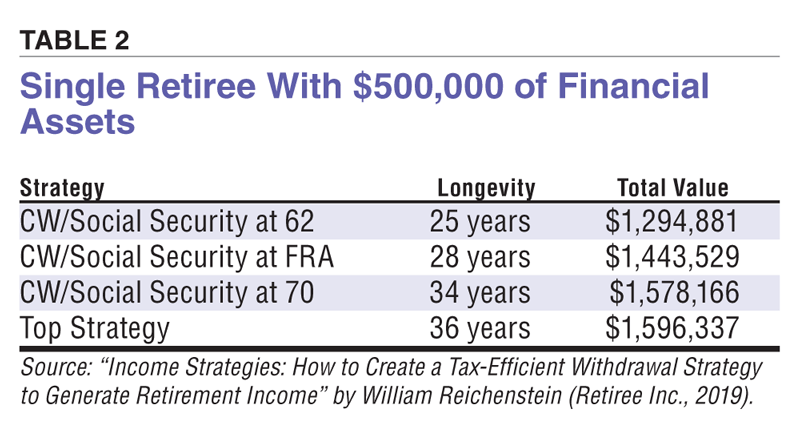
The second case is that of a single individual with $500,000 in their financial portfolio as of the end of December 2018. As before, they will turn 62 between December 3, 2018, and January 1, 2019. Their PIA is $2,200. Their real spending level beginning in January 2019 is $3,625 per month. Table 2 summarizes the results for this retiree.
In the CW with Social Security at 62 strategy, they begin Social Security benefits at age 62 plus one month and their portfolio lasts 25 years. In the CW with Social Security at full retirement age strategy, their financial portfolio lasts 28 years. In the CW with Social Security at age 70 strategy, their financial portfolio lasts 34 years. In the top strategy, they begin Social Security benefits at age 70. Each year they withdraw from their tax-deferred account the larger of 1) enough funds from their tax-deferred account to fill the top of the 10% tax bracket or 2) RMDs once they begin. They then withdraw additional funds as needed to meet spending needs following the conventional wisdom. The top strategy allows the portfolio to last 36 years.
For this retiree, the additional longevity from delaying the start of Social Security from age 62 plus one month to age 70, but still following the conventional wisdom, is nine years. The additional portfolio longevity from coordinating the Social Security claiming decision with a tax-efficient withdrawal strategy is 11 years.
The third case is that of a single individual with $750,000 in their financial portfolio as of the end of December 2018. They will turn 62 between December 3, 2018, and January 1, 2019. Their PIA is $2,200. Their real spending level beginning in January 2019 is $4,600 per month. Table 3 summarizes the results for this retiree.
In the CW with Social Security at 62 strategy, they begin Social Security benefits at age 62 plus one month and their portfolio lasts 25 years. In the CW with Social Security at full retirement age strategy, their financial portfolio lasts 25 years. In the CW with Social Security at age 70 strategy, their financial portfolio lasts 28 years. As before, in the top strategy, they begin Social Security benefits at age 70. The shorthand for the withdrawal strategy of the top strategy is Roth 12%, 2026 multiple account (MA) 10%. From 2019 through 2021, the retiree withdraws funds from their taxable account to meet spending needs. They then convert additional funds from their tax-deferred account to a Roth IRA to take their taxable income to the top of the 12% tax bracket. By the end of 2021, their taxable account has been exhausted. So, from 2022 through 2025, they withdraw funds from their tax-deferred account to meet spending needs, at which point, they are in the 22% tax bracket. Thus, there are no Roth conversions these years. Each year beginning in 2026, they withdraw from their tax-deferred account the larger of 1) sufficient funds to fill the 10% tax bracket or 2) RMDs. They then withdraw additional funds to meet spending needs following the conventional wisdom, which in this case means withdrawing these additional funds from their Roth account, which is their only remaining account.
For this single retiree, delaying Social Security benefits from age 62 plus one month until age 70 extends the longevity of their financial portfolio by three years. The top strategy allows their portfolio to last 31 years. Thus, coordinating the Social Security claiming strategy with a tax-efficient withdrawal strategy adds six years of longevity to their portfolio.
The fourth case is that of a single individual with $1 million in their financial portfolio as of the end of December 2018. They will turn 62 between December 3, 2018, and January 1, 2019. Their real monthly spending level beginning in January 2019 is $5,525 per month. Table 4 summarizes the results for this retiree.
In the CW with Social Security at 62 strategy, they begin Social Security benefits at age 62 plus one month and their financial portfolio barely lasts 25 years. In the CW with Social Security at full retirement age strategy and CW with Social Security at age 70 strategy, their financial portfolio lasts 25 years. The top strategy combines beginning Social Security benefits at age 70 with the Roth 22%, 2026 MA 10% withdrawal strategy. This combination allows the portfolio to last 29 years. In the early years before tax rates rise in 2026, the retiree makes a Roth conversion each year to the top of the 22% tax bracket and otherwise follows the conventional wisdom for making withdrawals (exhaust the taxable account first, the tax-deferred account second and the Roth IRA last). Then, each year beginning in 2026, they withdraw from their tax-deferred account the larger of 1) sufficient funds to fill the 10% tax bracket or 2) RMDs. They then withdraw additional funds to meet spending needs following the conventional wisdom for making withdrawals.
Delaying Social Security benefits from age 62 plus one month until age 70 for this single retiree extends the longevity of their financial portfolio by less than a year. However, this less-than-one-year amount understates the advantage for this retiree of delaying their Social Security benefit until age 70. In the years after their portfolio is exhausted this retiree’s income will be limited to their Social Security benefits. By delaying claiming Social Security benefits from age 62 years plus one month until age 70, their annual benefits will be 75.4% higher. Thus, even though their financial portfolio is exhausted in the 25th year in both the CW at 62 and CW at 70 strategies, the CW at 70 strategy would allow their pretax income to be 75.4% higher in years after their portfolio has been completely exhausted than it would be with the CW at 62 strategy. Coordinating the Social Security claiming strategy with a tax-efficient withdrawal strategy adds four years of longevity to the portfolio.
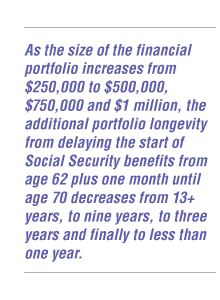
In summary, as the size of the financial portfolio increases from $250,000 to $500,000, $750,000 and $1 million, the additional portfolio longevity from delaying the start of Social Security benefits from age 62 plus one month until age 70 decreases from 13+ years, to nine years, to three years and finally to less than one year. The additional longevity from coordinating the Social Security claiming decision with a tax-efficient withdrawal strategy decreases from 13+ years, to 11 years, to six years and finally to four years.
The inverse relationship between the size of the financial portfolio and the additional portfolio longevity from delaying the start of Social Security benefits is due to two factors. First, each retiree will depend on two resources of funds to finance their retirement spending needs: assets in their financial portfolio and Social Security benefits. The larger the financial portfolio, the smaller the portion is of retirement resources that comes from Social Security benefits. Thus, Social Security benefits represent a much larger portion of retirement resources for the retiree with a $250,000 financial portfolio than for the retiree with a $1 million financial portfolio. Therefore, delaying Social Security benefits from age 62 plus one month until age 70 adds more years of portfolio longevity for a retiree with $250,000 in financial assets than it does for retirees with higher levels of financial assets. However, this does not mean that wealthier retirees should not be concerned with their Social Security claiming decision. For example, the additional total value of the CW with Social Security at age 70 strategy compared to the CW at age 62 strategy for the retiree with a $1 million financial portfolio is about $200,000; this is a present value, aftertax amount. Almost all of this additional $200,000 comes from the 75.4% larger Social Security benefits in years after their financial portfolio has been exhausted.
Another way to illustrate these results is to consider the cumulative real pretax value of lifetime Social Security benefits if begun at age 62 plus one month, full retirement age and age 70 if this retiree lives to age 95. If benefits begin at age 62 plus one month, the real monthly benefit would be $1,622 per month for 32 years and 11 months for a total of $640,690, [$1,622 × 395 months]. The cumulative lifetime real benefits would be $756,800 if begun at full retirement age of 66 years and four months [$2,200 per month × 344 months], or $853,500 if begun at age 70 [$2,845 × 300 months]. By delaying benefits from age 62 plus one month to age 70, the real pretax value of lifetime Social Security benefits would be almost $213,000 higher. Naturally, this additional level of real pretax benefits would have a larger impact on the portfolio longevity of a client with a smaller financial portfolio than on a retiree with a larger financial portfolio. However, retirees of all income ranges could benefit from this additional $213,000 of Social Security real benefits.
The second reason for the inverse relationship between the size of the financial portfolio and the additional portfolio longevity from delaying the start of Social Security benefits is due to the taxation of Social Security benefits. Provisional income (PI) is the measure of income used to calculate the taxable portion of Social Security benefits. By delaying Social Security from age 62 plus one month until age 70, Social Security benefits in 2034 increase by almost $20,000; we use numbers from 2034 to illustrate this reason. If this allowed a $20,000 reduction in withdrawals from the tax-deferred account, then provisional income would decrease by $10,000—because all tax-deferred account withdrawals, but only half of Social Security benefits, go into the calculation of PI. This lower level of PI could lower the taxable portion of Social Security benefits by up to $8,500, and thus it could substantially lower income taxes.
As shown in Table 5, retirees following the CW with Social Security at age 70 strategy may pay taxes on a lower percentage of their Social Security benefits than retirees following the CW with Social Security at age 62 strategy. Retirees following the CW with Social Security at age 62 strategy saw the taxable portion of their Social Security benefits rise from 14.4% for retirees with financial portfolios of $250,000, to 85.0% for retirees with financial portfolios of $750,000 and $1 million. In contrast, retirees following the CW with Social Security at age 70 strategy had none of their Social Security benefits taxable in 2034 if their portfolio was $250,000. Moreover, these retirees did not have to pay taxes on 85.0% of their Social Security benefits until their portfolio reached $1 million.
Therefore, taxpayers with moderate levels of wealth can often lower the taxable portion of their Social Security benefits by delaying the start of these benefits until age 70. In their early retirement years, they may withdraw funds from their tax-deferred accounts to finance part of their spending needs. This will lower their RMDs after age 70½ (age 72 starting in 2020). [Editor’s note: The CARES Act suspended RMDs for 2020.] In later retirement years, the combination of much larger annual Social Security benefits and, therefore, the need for much smaller tax-deferred account withdrawals can sharply lower the taxable portion of their Social Security benefits. This can lower their taxable incomes and, thus, their income taxes.
Financial Planning
Portfolio Strategies

Financial Planning

WILLIAM F from CT posted over 6 years ago:
MARK N from CT posted over 6 years ago:
ELLIOTT B from FL posted over 6 years ago:
CHARLES M from NY posted over 6 years ago:
JOSEPH K from TX posted over 6 years ago:
ALASTAIR B from WI posted over 6 years ago:
DAVE G from WA posted over 6 years ago:
DAVE G from WA posted over 6 years ago:
You need to log in as a registered AAII user before commenting.
Log InCreate an account