

Our Revised Risk Tolerance Worksheet
by Charles Rotblut | June 11, 2020
Charles Rotblut recently spoke at the AAII Investor Conference 360. Video replays of all sessions are available for purchase. Go to www.aaii.com/investorconference for more details.

A few factors determine how much volatility in portfolio returns you can withstand and still meet your goals. They are: 1) the timing of when you will need the money to spend on your goal; 2) the period in which you anticipate spending money on the goal; 3) how much money you need relative to your wealth once the goal is reached (and the first few years afterward, if the goal does not require a lump sum payment); 4) your psychological ability to cope with up and down markets; and 5) your knowledge of investing. We’ve included investing knowledge in this list because familiarity with the characteristics of investments and market cycles helps an investor to be less reactive to shorter-term fluctuations in asset prices.
We attempted to address these in our first risk tolerance worksheet. After members shared their thoughts and observations with us, we revised the worksheet and its grid for assessing risk tolerance. In addition, we’ve added a new questionnaire to help investors better determine their risk profile. More information is available in the June 11, 2020, Investor Update.
The questionnaire is divided into two parts. The first part addresses the timing of the goal. The second part helps you to assess your psychological and financial tolerance. The answer to each question has a score associated with it. Simply enter the appropriate score in the boxes next to each question. The spreadsheet will tabulate both your timing risk and psychological and financial tolerance scores.
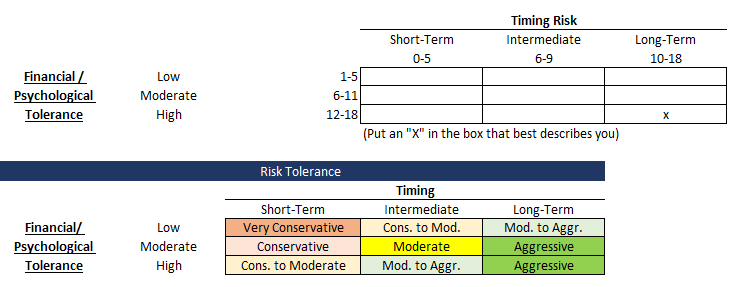
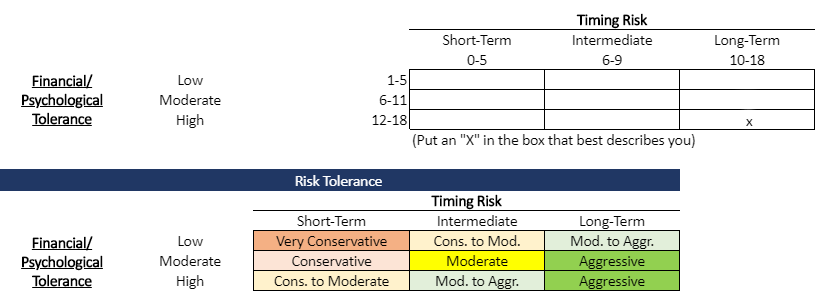
To determine where you land on the grid, simply match up your timing risk score (displayed horizontally across the grid) with your psychological/financial tolerance score (displayed vertically across the grid).

In a forthcoming worksheet, we’ll show you how these scores tie in to asset allocation decisions.
For those of you who like examples, we’ve created two versions of this worksheet using hypothetical people. The first is a recently retired couple, Bob and Jane, whose primary goal is covering expenses. The second is a younger couple, Frank and Sue, who are setting aside money for their young child’s college education.
AAII Way: Assessing Your Risk Tolerance Example 1
Retired Couple: Bob and Jane are recently retired (both age 66) and have $1.5 million in savings. They have non-portfolio income from pensions and Social Security.
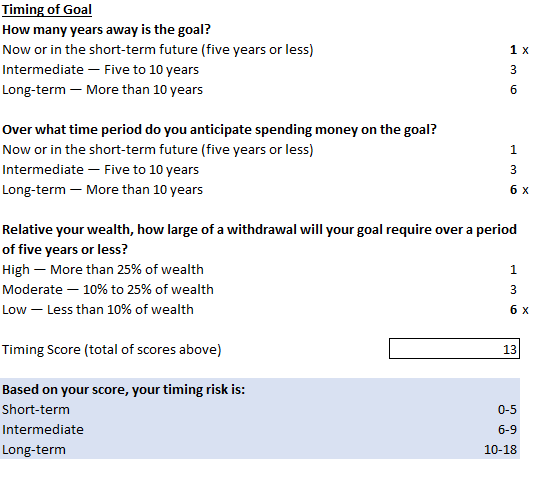
The timing of their goal is now, because they’re retired. Given that they are in their mid-60s and could be looking at retirement potentially lasting three decades or longer, their spending time horizon is long. Bob and Jane’s wealth allows them to take proportionately small withdrawals relative to their savings. Combined, these factors result in a timing risk score of 13, which is long-term.
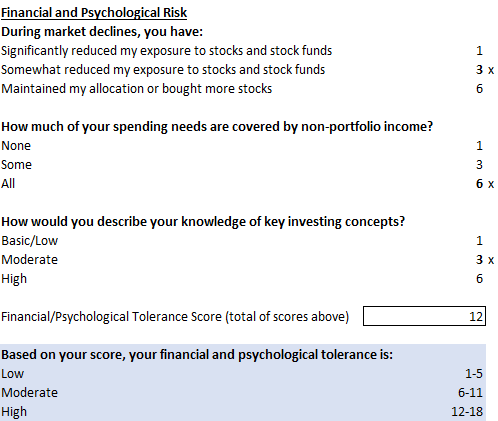
Bob and Jane are fairly disciplined investors but have gotten a bit nervous during past bear markets and pulled back a little bit on their equity allocations. Their pension and Social Security benefits provide a guaranteed stream of non-portfolio income. Bob and Jane have a good understanding of investing concepts, but they do not consider themselves experts. These factors result in a financial/psychological tolerance score of 12, which is at the low end of “high.” If they had less non-portfolio income, their tolerance score would be lower.
The combination of their timing risk and financial/psychological tolerance suggests that they can use an aggressive allocation strategy (one designed to seek long-term growth). Their wealth and the presence of a pension are big reasons why.
AAII Way: Assessing Your Risk Tolerance Example 2
Younger Couple With a Child: Frank and Sue have a young child, whose college education they are seeking to save for.
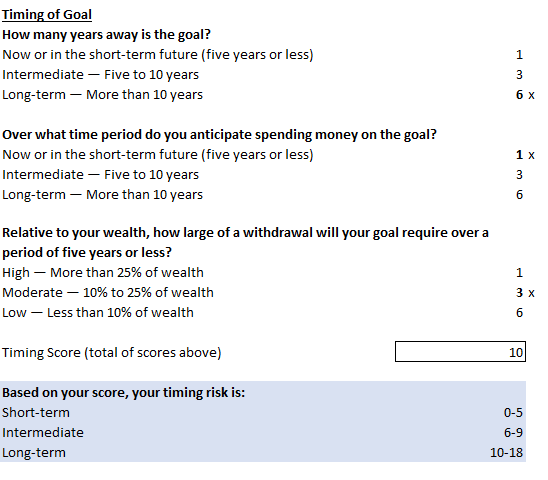
Their toddler just turned three, which means college is 15 years away. Once college starts, they’ll be looking at spending potentially all of the money they’ve set aside for this goal in a span of just four years. The projected total amount spent will also represent a moderate level of their total wealth, as Frank and Sue will just start to approach their peak earnings years at that time. This combination gives them a long-term timing risk due to the length of time because their child is young. As their child ages, their timing risk will gradually shift to intermediate and then eventually short-term.
From a financial and psychological standpoint, they’ve so far maintained their exposure to stocks during down markets. If college costs more than expected, they are prepared to rely on their salaries to help cover the expenses, so they chose “some” as the answer to the spending question. Finally, they consider themselves to have a moderate level of investing knowledge.
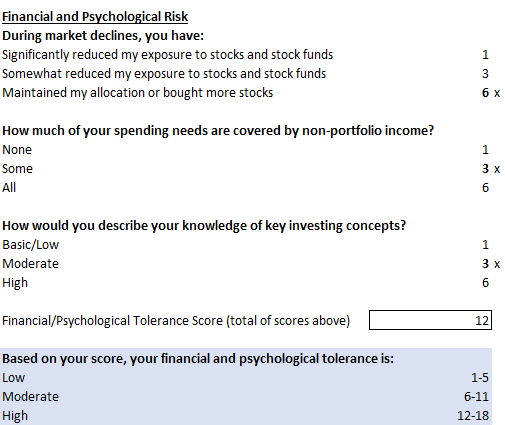
The combination of their timing risk and financial/psychological tolerance suggests that they can use an aggressive allocation strategy (one designed to seek long-term growth). Their child’s young age is a big reason why.
Discussion
ERIC E from GTM posted over 6 years ago:
This version of the Risk Assessment Worksheet is a clear improvement over the earlier version. Much cleaner and easier to understand. Thanks for taking the feedback you received and improving it. I do have a couple of observations: 1) As a (retired) technical writer/editor, I'd suggest you make the format of your questionnaire responses consistent. The first answer to the "How many years away is the goal" question should be either "Short-term (five years or less)" to be consistent with the second question, or better yet the first response to both questions 1 & 2 should be "Short-term -- 0 to 5 years" to be consistent with the other answers (I'd also use numbers for the years throughout, for clarity.) 2) I'm sure you'll hear this a lot, but the second example worksheet is completely inconsistent with everything that's gone before. The ranges for the Financial/Psychological Tolerance levels are completely wrong. It's a minor point, easily fixed, but the incorrect ranges are not only confusing, but alter the example's placement in the grid (though not the overall assessment of risk).
You need to log in as a registered AAII user before commenting.
Create an account