A look at the advantages and disadvantages of virtual shareholder meetings through the eyes of a portfolio manager. Plus, a scoring system you can use to measure whether a firm is promoting shareholder interests.
As many of you know, corporations’ annual general meetings (AGMs) are where shareholders can meet executives and board members, hear about prior results and learn about future prospects. Historically, most AGMs have been in-person affairs; over the years, many states have changed their corporation laws to also allow virtual-only and hybrid (in-person and virtual) meetings. However, in the era of the coronavirus, many in-person AGMs have been replaced with virtual-only meetings for safety reasons. Even the Berkshire Hathaway meeting, historically attended by thousands, was virtual-only this year. According to shareholder advisory firm Institutional Shareholder Services (ISS), the total number of virtual-only meetings globally confirmed as of April 22, 2020, was 2,240 versus 286 in all of 2019. U.S. firms accounted for half of these.
Current State Law Regarding Annual General Meetings
Delaware’s General Corporation Law (DGCL) governs corporations incorporated in the state. These companies represent 55% of all U.S. publicly traded firms and 65% of the Fortune 500. From a legal perspective, the primary purpose of the AGM is to elect directors and to take action on management or shareholder proposals. In 2000, the Delaware legislature, in a nod to technology, amended Section 211 of the DGCL thereby allowing firms to hold virtual-only and hybrid meetings in addition to in-person meetings. Other states followed suit, now:
-
Thirty states allow virtual-only or in-person meetings;
-
Forty-two states allow hybrid or in-person meetings; and
-
Nine states allow in-person meetings only, although many are allowing exceptions this year.
The question is whether the surge in virtual-only meetings becomes permanent. Fans of virtual-only AGMs cite several advantages:
-
Travel and hotel arrangements are eliminated, so less expensive to shareholders.
-
Less driving and/or flying means time saved and less pollution.
-
Companies don’t have to rent large meeting rooms to accommodate the many shareholders who often attend big company AGMs.
-
Current audio-visual technology is reliable and up to the task.
However, as big fans of in-person AGMs, we’ll be disappointed if firms make virtual-only AGMs permanent after current health concerns pass. There are many benefits to attending an in-person meeting, including the following:
-
The ability to ask hard questions of management and board members, which is often lost with virtual-only meetings. While questions are often allowed, they generally must be submitted in advance and are screened before presented. As a result, sometimes only softball questions get asked and shareholders are deprived of the knowledge provided by answers to sharper questions.
-
At every in-person AGM we’ve attended there’s always the chance to mingle with executives and board members pre- or post-meeting. You can learn a lot from someone’s demeanor and response to questions and follow-ups in an informal setting. We often come away with key intelligence that is much more difficult in a virtual-only setting.
-
Meeting like-minded investors. You never know who you’re going to bump into at an AGM. We’ve found that most shareholders who show up at the meetings are well-informed investors who know the company well. Oftentimes the exchange of information leads to a lifelong and profitable friendship. In her book “The Snowball: Warren Buffett and the Business of Life” (Bantam Books, 2008), author Alice Schroeder describes how Warren Buffett met fellow value investor Walter Schloss early on at the annual general meeting of Marshall Wells, a hardware wholesaler in Jersey City, New Jersey. As the meeting began, Schloss started asking pointed questions of management. Buffett was impressed with this approach of holding management accountable, and the two became lifelong friends.
-
The ability to adjourn the meeting and ask questions or make comments afterward. Since we specialize in smaller companies, many of the AGMs we attend attract only a handful of shareholders. After the formal section of the meeting is complete (election of directors, auditor approval, etc.), we’ll often move to adjourn the meeting. This is often granted, at which point we’ll proceed with the Q&A off the record, often allowing managers and board members to respond more freely.
-
If the AGM is held at the firm’s headquarters, there may be a factory, distribution center or customer call center attached. If so, ask for a tour before or after the meeting—a request that is often accommodated. However, do your homework ahead of time so you can ask intelligent questions during the tour and always arrange this ahead of time.
-
Once we attended an AGM held in a company’s conference room and then drove an hour to a nuclear reactor construction site where the firm was doing significant work. Seeing the firm’s workers on site and the tasks performed did much to enhance our knowledge.
-
Sometimes the AGM is held away from headquarters for space or security reasons, often at the meeting room of a local hotel or restaurant. If so, take note of the venue. While shareholders like to be treated well, extravagant (and expensive) meals and other events may indicate misplaced priorities. Of course, if it’s a meeting for a restaurant chain, you may be taken to lunch there, which is always a chance to learn more about the business.
-
In-person meetings allow shareholders to vote in person when shareholder proposals are presented. These are important and boards normally don’t like to see them because they may contradict longstanding policies and procedures. The initiator of a shareholder proposal is normally allowed to make a brief presentation, and meeting the initiator in person may allow an uncommitted shareholder to make a more informed decision.
We believe that investor participation at AGMs should be valued and encouraged. These meetings should provide equal treatment of individual and institutional shareholders. The meetings should provide an opportunity for meaningful engagement between shareholders, management and directors. While all of these may be accomplished via an accessible and efficiently managed virtual-only meeting, there are many reasons we prefer in-person AGMs to virtual-only ones. You can learn a lot about a company by attending an in-person meeting. It’s a once-a-year opportunity to meet executives and board members and have them address your questions and concerns. To accommodate shareholders that can’t attend in person, a hybrid meeting should do the trick.
Voting the Proxy Statement
Regardless of whether you attend the AGM in person or virtually, you should always take the time to read and vote your proxy. Unfortunately, many individual investors don’t know what to do with a proxy statement—they’re not sure how to vote the proposals or feel that their votes won’t count for much. Many shareholders simply file the proxy away, or worse, toss it in the circular file. By doing so, they are throwing away their votes and their right to keep management and director interests in line with their own.
As a portfolio manager, I read proxy statements carefully during my initial due diligence and on a regular basis once a position is taken. Although proxies are written by attorneys and can make for some dry reading, they are generally arranged in sections that can lead to organized analysis. Here are some tips on getting the most from a proxy, organized according to a typical proxy’s format:
-
Election of Directors: This is typically proposal one on most proxies and asks you to vote on who you want to oversee management and represent the interests of outside shareholders. Read the backgrounds of each nominee. Are they “independent” with no ties to management or “non-independent” which includes insiders with ties to management? What skill sets, experience and knowledge do they bring to the table?
-
Ratification of Accountants: This is usually proposal two and requires you to approve the auditor for the coming year. For most public firms I like to see a “Big 4” accounting firm—Deloitte & Touche, KPMG, PricewaterhouseCoopers or Ernst & Young—or a strong regional firm doing the audit. They tend to have more experienced staff with a better knowledge of accounting, systems and regulatory issues.
Beyond director election and auditor choice, governance issues come into play, including “Say on Pay” (Is management compensation reasonable?) and other proposals often unique to a particular firm. These often require a reading of the “fine print” but doing so may uncover information that provides real insight on whether management and the board are working for the shareholders or themselves. Remember, shareholders are a key stakeholder of any public firm and it’s worth taking the time to protect your rights.
Corporate Governance: The Shareholder Score
We’ve all heard of credit scoring: The process by which a lender evaluates the creditworthiness of a potential borrower. In this system, the higher the score, the better the loan terms. A similar system could be used on various corporate governance criteria to provide a rough measure of how well a firm actually follows courses of action to protect and promote shareholder interests. Call it a shareholder score.

Download a printable version of the Shareholder Score.
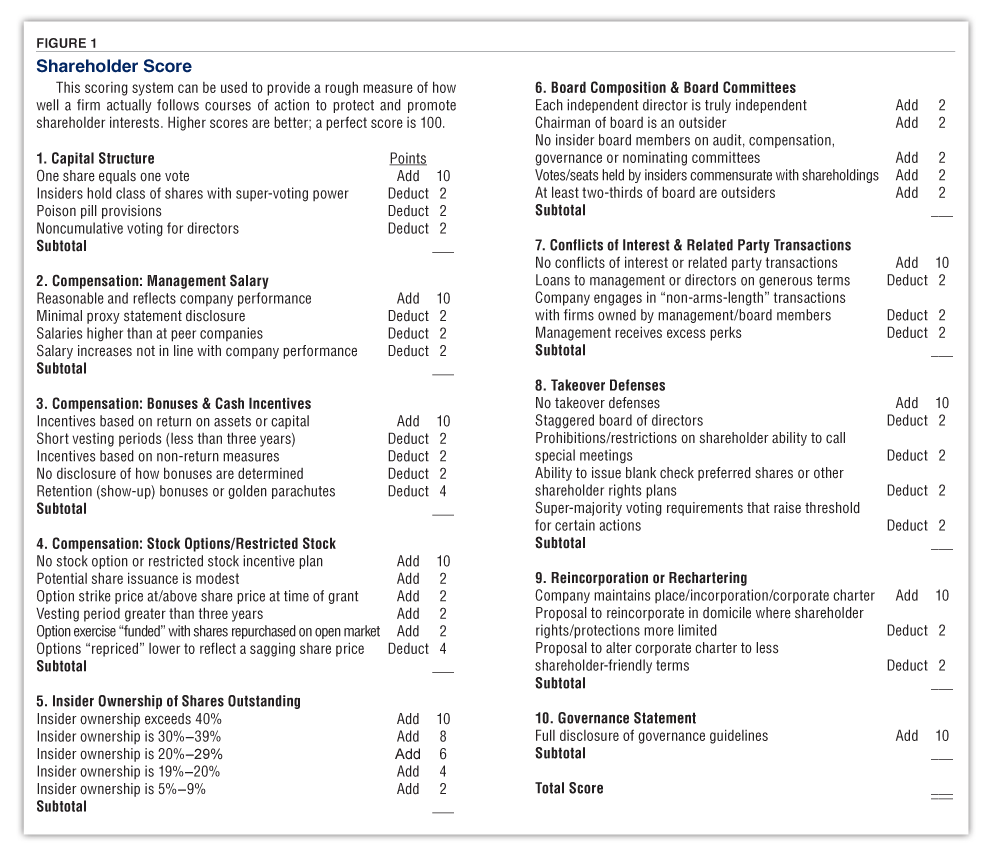
One possible system outlined below contains 10 categories with a maximum of 10 points each for a possible perfect score of 100. Points are deducted or added depending on how well a firm adheres to the ideal. The higher the total score, the better. Most of the data required to derive a shareholder score can be found in the proxy statement or SEC Form 10-K.
1. Capital Structure
Score a full 10 points for a company with one class of stock—one share equals one vote. Deduct two points for each of the following:
-
There are one or more classes of super-voting shares held by insiders, resulting in voting power that dwarfs economic interest.
-
There are unissued common or preferred shares that may be issued to defend against an unwanted takeover attempt. This is also known as a poison pill. It is typically triggered when an outsider buys a significant percentage of stock. Once activated, the plan gives all other shareholders the right to buy additional shares at a set price, thereby diluting the interests of the outsider and making an unsolicited takeover more difficult.
-
There is noncumulative voting for directors.
2. Compensation: Management Salary
Score full 10 points if salaries are reasonable and reflect company performance. Deduct two points for each of the following:
-
There is minimal proxy statement disclosure of how salaries are determined.
-
Salaries are higher than executives running similar size companies in similar industries.
-
Salary increases are not in line with company performance.
3. Compensation: Bonuses & Cash Incentives
Score full 10 points for compensation incentives that are based on return on assets or return on capital. Deduct two points for each of the following:
-
Short vesting periods (less than three years).
-
Incentives based on non-return measures like earnings per share, adjusted earnings before interest, taxes, depreciation and amortization (EBITDA) or stock price.
-
There is no disclosure of how bonuses are determined (i.e., they are discretionary).
Deduct four points if there are retention (show-up) bonuses or golden parachutes.
4. Compensation: Stock Options/Restricted Stock
Score full 10 points if there is no stock option or restricted stock incentive plan. If there is a stock option/restricted stock plan, add two points each if:
-
Potential share issuance is modest—the “overhang” (options plus restricted stock awarded and/or to be rewarded divided by the number of shares outstanding) is less than 10% for non-technology companies and less than 20% for technology companies.
-
Option strike price is at or above the share price at time of grant.
-
Vesting period is greater than three years.
-
Option exercise is “funded” with shares repurchased on open market.
Deduct four points if options are “repriced” lower to reflect a sagging share price.
5. Insider Ownership of Shares Outstanding
Score:
-
10 points if insider (management and board of directors) ownership exceeds 40%.
-
Eight points if insider ownership is 30%–39%.
-
Six points if insider ownership is 20%–29%.
-
Four points if insider ownership is 19%–20%.
-
Two points if insider ownership is 5%–9% .
You need to read this section of the proxy carefully since insider holdings often include shares issuable upon option exercise or restricted stock not yet vested.
6. Board Composition & Board Committees
Score two points each if:
-
Each independent director is truly independent—no relationships with insiders and no business dealings with the company.
-
The chairman of the board is an outsider with no ties to management.
-
No insider board members are on audit, compensation, governance or nominating committees.
-
Votes/seats held by insiders are commensurate with shareholdings—for example, on a seven-person board where insiders hold two seats and hold 28.6% of votes (two out of seven), they should own at least 28.6% of shares. If not, they need to buy more shares or be replaced by an outsider.
-
At least two-thirds of the board are outsiders regardless of insider share ownership.
7. Conflicts of Interest & Related Party Transactions
Score full 10 points if no conflicts of interest or related party transactions. Deduct two points each for any of the following:
-
The company makes loans to management or directors on generous terms.
-
The company engages in “non-arms-length” transactions with firms owned by management or board members—for example, leasing of real estate, supply of raw materials, etc.
-
Management receives excess perks regarding auto or plane use, club memberships, etc.
8. Takeover Defenses
Score full 10 points if no takeover defenses. Deduct two points for each of following:
-
Staggered board of directors—the full board should be elected annually.
-
Prohibitions or restrictions on shareholder ability to call special meetings.
-
Ability to issue blank check preferred shares or other shareholder rights plans.
-
Super-majority voting requirements that raise the threshold for certain actions.
9. Reincorporation or Rechartering
Score full 10 points if company is maintaining place of incorporation or corporate charter. Deduct two points for each of the following:
-
Company proposes to reincorporate in domicile where shareholder rights and protections are more limited—i.e., the Cayman Islands.
-
Company proposes to alter corporate charter to terms less friendly to shareholders.
10. Governance Statement
Score full 10 points if the corporation provides full disclosure in proxy statement of governance guidelines laying out structures, policies and programs on governance, including committee charters and board responsibilities.
Conclusion
Don’t throw those proxies in the circular file. Remember, you as a shareholder own the company and management and the board work for you. Do not vote for any director or proposal you feel is not working for the shareholders. If you don’t understand a proposal, don’t vote for it. And make sure you DO vote for those that align management’s interests with your interests—you won’t regret it. ▪






MARK W from TX posted over 6 years ago:
STEVEN L from WA posted over 6 years ago:
You need to log in as a registered AAII user before commenting.
Log InCreate an account