James O’Shaughnessy’s fourth edition of “What Works on Wall Street” (McGraw-Hill, 2011) examines a diverse range of strategies over 80-plus years of testing to identify which individual factors delivered the best risk-adjusted performance with the greatest consistency. He concluded that investors can achieve better long-term performance by combining several factors into a composite ranking.
AAII’s O’Shaughnessy-inspired value composite consists of the price-to-free-cash-flow ratio, price-earnings ratio, price-to-sales ratio, enterprise-value-to-EBITDA ratio, shareholder yield and price-to-book-value ratio. The individual percentile ranks for each of these variables is averaged together and then re-ranked into percentiles, with the most attractively valued stocks receiving the lowest score.
A financial strength composite ranks stocks on the following four factors: debt-to-equity ratio, free-cash-flow-to-debt ratio, external financing and one-year change in debt. Stocks with the best levels for each factor receive a 100 and stocks with the worst levels for each receive a zero.
 Earnings quality is determined by examining the difference between operating cash flow and net income and scaling the figure to the market capitalization to allow comparison across different-sized companies. This variable is calculated to determine the percentile rank for each company. Companies with a higher level of operating earnings compared to net income are considered to have better-quality earnings.
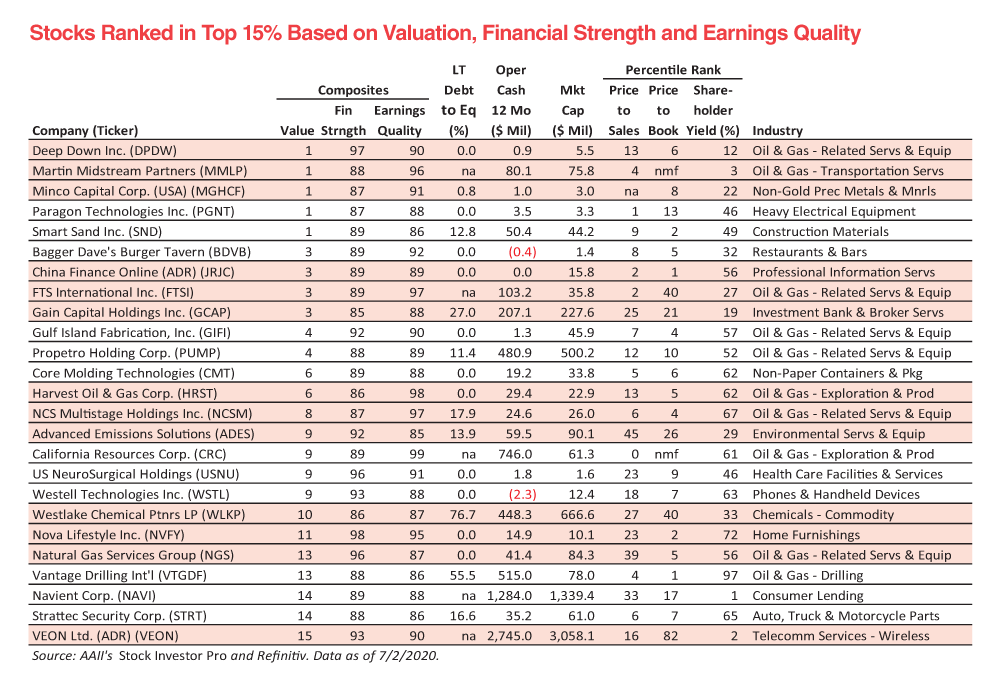
This month’s First Cut shows 25 companies that rank in the best 15% or better based on value (bottom 15%), financial strength and quality scores (both in the top 15%). This screen serves as the starting point for one of the portfolio groups of AAII’s Stock Superstars Report premium portfolio. The table below is ranked in ascending order by value score. ▪







No comments have been added yet. Add your thoughts to the discussion!
You need to log in as a registered AAII user before commenting.
Log InCreate an account